One Ready to Use Board Resolution Template for South African Tenders

A board resolution for a tender submission must explicitly name the person authorised to submit the bid and sign any resulting contract, state the tender number and scope, and rest on proper legal authority under the Companies Act. Once you have that wording and the right signatures, attach it to your bid pack with certified ID copies and any delegation letters, then submit. Everything else is detail.
*TL;DR:>
- All directors should sign the board resolution to ensure maximum legal validity, unless the company's MOI specifies otherwise, and proof of shareholding can support control confirmation.*
- The resolution must explicitly name a specific person, capacity, and tender reference, with attachments like certified ID copies and delegation letters if applicable.
- For delegated signatories or joint ventures, a delegation letter or consortium resolution must clearly define scope, liability, and legal address, following official template structures.
- Valid resolutions include the tender number, full legal details, clear authorisation, and signatures matching the attached ID documents, with dated signatures before the submission deadline.
- Common disqualification triggers include undated resolutions, vague wording, missing signatures, or absent attachments, which should be double-checked in a procedural review before submission.
Table of Contents
- What must a board resolution tender document actually contain?
- Who has to sign a company resolution for a tender to be valid?
- Delegation letters and consortium resolutions: getting the wording right
- Pre-submission checklist: what disqualifies a tender resolution
- How to adapt the resolution template to your company
- What clients get wrong most often
- Find tenders and templates faster with Protenders
- Sources
- FAQ
What must a board resolution tender document actually contain?
Procurement officials reject resolutions for one reason more than any other: vague or missing authority. A resolution that says the company "authorizes its representatives to act" tells an evaluator nothing. It has to name a person, a capacity, and a specific tender.
Get the skeleton right and the rest is filling in blanks. Every board resolution tender document submitted to a South African government buyer should include these elements:
- Full legal entity name and company registration number, exactly as they appear on your CIPC registration.
- The tender title and reference number, plus a short description of the project or scope.
- An express authorisation clause stating the company resolves to submit the tender and, if successful, to sign the resulting contract.
- The full name, ID number, and designation of each authorised signatory, with their capacity clearly stated (director, company secretary, or delegated representative).
- Financial or scope limits, if the board wants to cap what the signatory can commit to.
- A specimen signature block so evaluators can match the signature on the resolution to the signature on the bid documents.
Department tender templates, including the Department of Water and Sanitation's resolution template.pdf), spell out this exact structure, and evaluation panels are trained to check against it line by line. Attachments matter as much as wording. Certified copies of the signatory's ID, proof of shareholding where relevant, and any delegation-of-authority letter should travel with the resolution, not arrive separately. A specimen sample clause reads something like: "Resolved that [Name], in his/her capacity as [Director/Company Secretary], be and is hereby authorised to sign, submit, and execute all documents necessary for the submission of Tender No. [XXXX] and any contract arising therefrom." Adapt the bracketed fields, keep the rest. Pro Tip: Keep a master resolution template on file with blank fields for tender number and signatory, so you're not drafting from scratch every time a deadline lands with three days' notice.
Who has to sign a company resolution for a tender to be valid?
The safest answer is all directors, every time. It is not always the legally required one, and knowing the difference protects you from a resolution that looks fine but collapses under scrutiny.
Under the Companies Act 71 of 2008, directors' resolutions can be adopted at a formal board meeting or in writing through a round-robin process under section 74, provided the required majority signs and proper notice was given. Government etender templates reinforce the same expectation directly: where possible, all directors should sign the resolution to remove any doubt about authority.
That is not always practical. A director might be overseas, unreachable, or in dispute with the board. In those cases:
- A majority of directors can validly pass the resolution, provided quorum rules in the company's Memorandum of Incorporation are met.
- Where directors are also shareholders, proof of shareholding attached to the resolution helps evaluators confirm the signatories genuinely control the company.
- Round-robin resolutions carry the same legal weight as a resolution passed in a meeting, as long as the Act's majority and notice requirements are satisfied.
Before relying on any of these shortcuts, check the MOI. Practitioner guidance is blunt on this point: some MOIs raise the required majority or demand unanimity for specific transactions like tender submissions, overriding the Act's default rules. A resolution that satisfies the Companies Act but violates your own MOI is still invalid.
Once signed, keep the original and issue certified copies for submission. A company secretary or director endorsing the copy as a true certified copy is usually sufficient for procurement purposes without separate notarisation.
Delegation letters and consortium resolutions: getting the wording right
Two situations trip up otherwise solid bid teams: when the signatory isn't a director, and when you're bidding as a joint venture or consortium. Both need language that goes beyond the standard single-entity resolution.
When you need a delegation of authority letterIf the board wants someone other than a director (a general manager or bid specialist, for example) to sign and submit, a resolution alone often isn't enough. Attach a delegation letter that states:
- Who is granting the delegation (the board, by resolution number and date).
- The exact scope of what the delegate may sign (this tender only, or a defined category of tenders).
- The delegate's full name, ID number, and specimen signature for verification.
A letter of authority template built for this exact purpose saves you from drafting one under deadline pressure. When you're bidding as a consortium or joint venture
Consortium resolutions need every party's full legal name, an explicit joint-and-several liability clause, and a domicilium citandi et executandi (the legal address for serving notices) for each party. Government templates for consortium and joint venture submissions build this in as standard, and for good reason: it gives the procuring department direct contractual recourse against any single member if the JV underperforms. Skip that clause and your bid can be flagged as non-compliant even if every other document is perfect. Attach each party's own board resolution behind the consortium agreement, not as a separate bundle. Evaluators read documents in sequence, and a resolution sitting in the wrong place in the pack is often the reason a bid gets queried.
Pre-submission checklist: what disqualifies a tender resolution
Most rejected resolutions fail for procedural reasons that have nothing to do with the underlying bid quality. Run this check before the pack goes in the door.
- Is the resolution dated, and does the date fall before the tender submission deadline?
- Does the tender number on the resolution match the number on the tender document exactly, digit for digit?
- Have the required signatories signed, matching the majority or unanimity rule your MOI demands?
- Are certified ID copies attached for every named signatory?
- If FICA verification applies, does the resolution identify the acting person clearly enough to satisfy proof-of-authority requirements under the FIC Act?
- Is a delegation letter attached where the signatory isn't a director?
The most common disqualifying mistakes are painfully avoidable: an undated resolution, vague wording like "a representative" instead of a named person, or a signature on the bid documents that doesn't match the signatory named in the resolution. A mismatch between who signed the tender form and who the resolution authorises is one evaluator are trained to catch immediately. Pro Tip: If you discover a gap two days before the deadline, a same-day round-robin resolution signed by the required majority, backed by a brief board confirmation email, is usually faster to arrange than people assume, and it's fully valid under section 74.
How to adapt the resolution template to your company
A generic template only works once you know which fields are non-negotiable and which flex depending on your entity type and the tender itself.
Work through the template field by field before you touch the wording:
- Entity details: pull the registered name and number straight from your CIPC documents, not from memory or a letterhead that might be outdated.
- Tender reference: copy it character for character from the tender notice, including any sub-lot or phase numbers.
- Authorised person and capacity: name one person as primary signatory and, where the board wants flexibility, a second as alternate, each with capacity spelled out.
- Signature block: leave space for a specimen signature next to the printed name so it can be matched against the tender submission form.
- Certification line: add a short line for a director or company secretary to certify the copy as true, dated at time of certification, not at time of the original signing.
For a single company bidding alone, the template stays close to the standard clause set out earlier. For a consortium, duplicate the authorisation clause for each party, then add the joint-and-several liability and domicilium sections before the signature blocks. Check your own MOI against the template before finalising it. If your MOI requires a higher threshold than the Act's default majority, the template needs an extra signature line, not a footnote explaining the discrepancy. Once adapted, keep both an editable version and a signed, certified PDF version on file. Refer to a complete tender documents checklist so the resolution isn't the only piece of paper you're double checking the night before submission.
What clients get wrong most often
The resolutions that get rejected almost never fail because of bad legal drafting. They fail because someone treated the resolution as a formality, filled in a template quickly, and didn't check it against the actual tender number or the company's own MOI. That gap between "we have a resolution" and "we have the right resolution for this specific tender" is where most disqualifications happen.
Templates help enormously, but only when paired with a genuine procedural check: right signatories, right dates, right attachments. A resolution that looks professional but names the wrong person, or omits a delegation letter for a non-director signatory, is arguably worse than having none at all because it creates false confidence right up until an evaluator flags it. Build the habit of treating the resolution as part of the compliance review, not a document you sign off separately.
— Dolene April
Find tenders and templates faster with Protenders
You can use platforms that aggregate live listings of government tenders from various national, provincial, and municipal buyers in one place, simplifying the process of finding the tender number your resolution needs to reference.
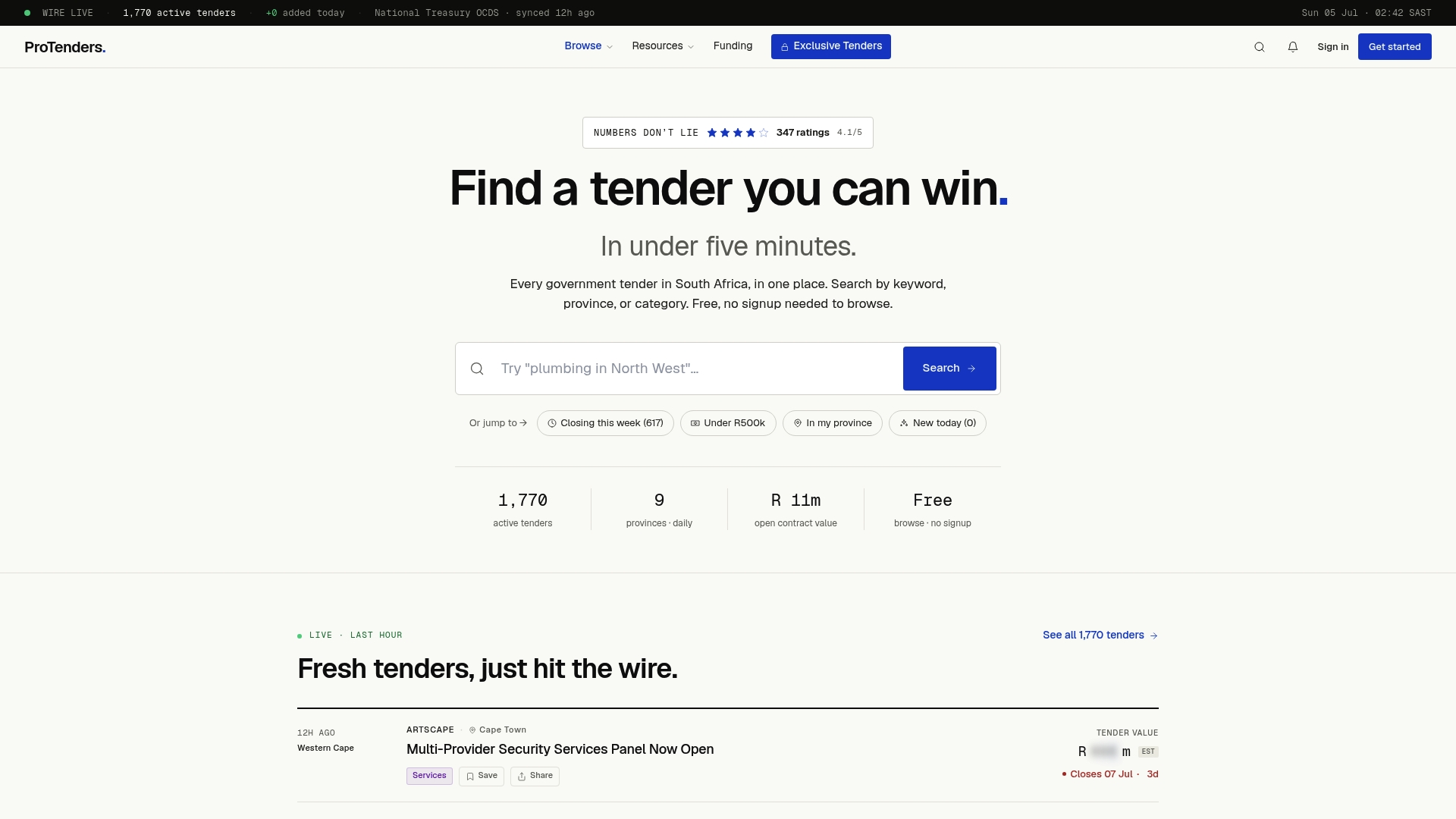
Some tender platforms offer compliance scorecards that flag documents evaluators typically check alongside your resolution, including B-BBEE certification and anti-corruption declarations, before submission. Some also provide document templates and funding-partner introductions for the execution phase once a bid is won. If you're preparing a submission right now, start by browsing live South African government tenders to confirm your tender number and closing date before you finalise the resolution wording.
This article is general information, not a substitute for advice from a qualified lawyer. Consult a qualified legal professional about your own circumstances before acting on anything here.
Sources
- Gov
- Resolution of board of directors template (Department of Water and Sanitation).pdf)
- Resolution of board of directors to enter into consortia or joint ventures (eTenders)
- Directors' & Shareholders' Resolutions (MJ Kotze Inc)
FAQ
How do I write a board resolution for a tender?
Name the company, the tender number, and the authorised signatory in a single clause that grants power to submit the bid and sign any resulting contract, then have the required directors sign and date it.
How do I get a board resolution?
The board passes it either at a formal meeting or through a written round-robin process under section 74 of the Companies Act, provided the required majority of directors signs.
What is a board resolution sample?
A sample is a pre-drafted clause structure showing the entity name, tender reference, authorisation wording, and signature block, adapted with your own company and tender details before signing.
How do I write a tender document?
A tender document bundles your technical and pricing proposal with compliance items like the signed board resolution, B-BBEE certificate, and FICA documents, all matched to the specific requirements listed in the tender notice.
Can one director sign a tender resolution alone?
Only if the company's MOI and the applicable Companies Act quorum rules allow it. Most departments and evaluators still prefer all directors to sign where practically possible.