Compliance Scorecard for Government Tenders: 2026 Guide

A compliance scorecard is a structured evaluation tool that measures an organization's adherence to regulatory, policy, and contractual standards by tracking selected key indicators to inform risk and performance decisions. For businesses and contractors pursuing government contracts in South Africa, a well-built scorecard is not a bureaucratic formality. It is documented proof that your organization manages risk, follows the rules, and can deliver on a contract. Procurement evaluators use compliance data to separate credible bidders from risky ones. Understanding how to build and use a compliance scorecard gives you a measurable edge in competitive tender processes.
What is a compliance scorecard and why does it matter for tenders?
A compliance scorecard translates abstract regulatory requirements into concrete, trackable numbers. The standard industry term for this practice is "compliance program measurement," and the scorecard is its primary output. Frameworks like ISO 37301 (Compliance Management Systems) and the OCC Heightened Standards for large financial institutions both require organizations to demonstrate measurable compliance program effectiveness. A scorecard does exactly that.
For government tender applications, the scorecard serves two functions. First, it shows procurement authorities that your compliance program is active and documented, not theoretical. Second, it gives your own leadership team early warning when something is drifting off track before a tender evaluator notices it first.
 Documented, transparent compliance data builds trust and competitive advantage with procurement authorities. That trust directly influences how evaluators score your bid against equally priced competitors.
What key metrics and indicators go into a compliance scorecard?
The most important design decision in any compliance scorecard is understanding the difference between Key Performance Indicators (KPIs) and Key Risk Indicators (KRIs). KPIs measure compliance execution, while KRIs provide early warning signals about risk exposure before regulatory impact occurs. Confusing the two misleads board-level decisions and creates blind spots in your risk picture.
A KPI example: the percentage of staff who completed mandatory ethics training this quarter. A KRI example: the number of unresolved compliance exceptions older than 30 days. The KPI tells you what has been done. The KRI tells you what could go wrong.
Board-level compliance reports should cover four dimensions: culture and engagement, detection and response, risk mitigation, and program maturity. Each dimension captures a different layer of your compliance program's health.The table below shows how these categories break down into practical scorecard metrics:
| Category | Example KPI | Example KRI |
|---|---|---|
| Culture and engagement | % staff completing annual compliance training | Decline in ethics hotline report rates quarter over quarter |
| Detection and response | Average time to close an investigation | % of reports unresolved beyond 30 days |
| Risk mitigation | % of identified risks with active controls | Number of controls rated "ineffective" in last audit |
| Program maturity | % of policies reviewed on schedule | Number of regulatory changes not yet reflected in policy |
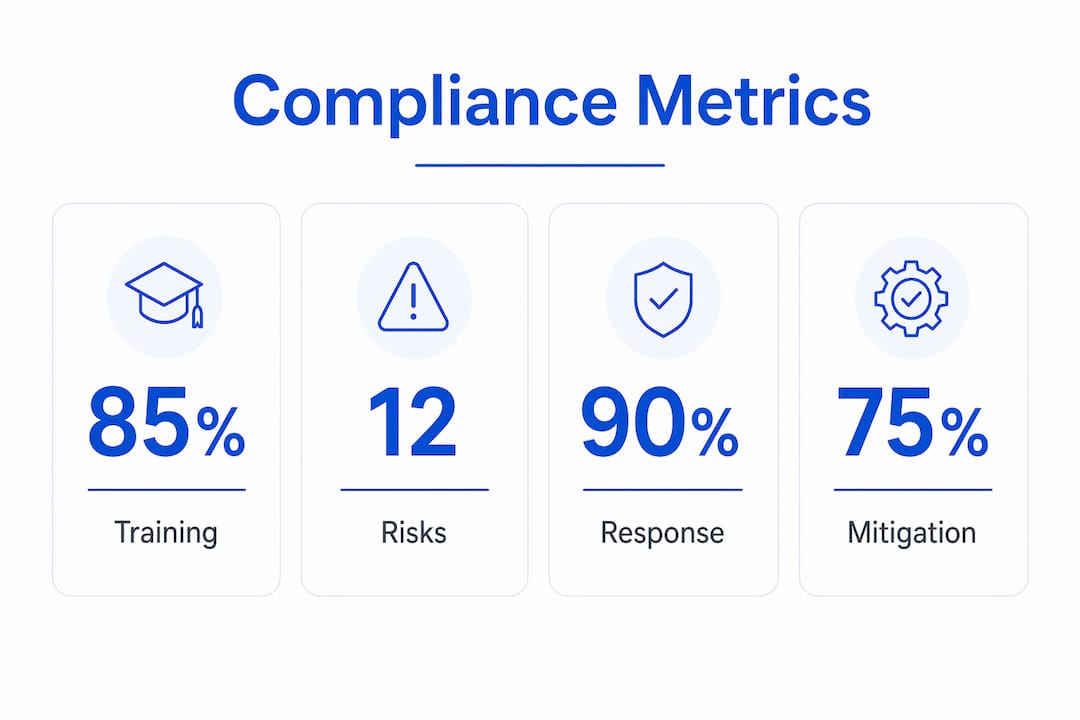
Two industry benchmarks illustrate what "good" looks like in practice. High-performing compliance programs achieve hotline caller identification rates of 75% or more, which reflects strong psychological safety in the organization. Average programs sit around 50%. Separately, best-in-class programs maintain hotline abandonment rates below 1%, while many average programs see rates of 15–19%. These benchmarks give you a calibration point when setting your own thresholds.
Leading organizations track 35–60 total compliance and risk metrics, with 10–15 elevated for executive decision-making. That ratio matters: most of your data lives at the operational level, but your scorecard surfaces only what leadership needs to act on.
Pro Tip: Start with 10–15 metrics maximum when building your first scorecard. A focused set of meaningful indicators gives clearer risk visibility than a sprawling list that no one reads.How to build a compliance scorecard for government tender applications
Building a scorecard that actually improves your tender outcomes requires more than copying a template. The process has six distinct steps, and skipping any one of them produces a scorecard that looks good on paper but fails under scrutiny.
- Identify the relevant regulations and contract requirements. Pull the specific compliance obligations from the tender document, the Public Finance Management Act (PFMA), the Preferential Procurement Policy Framework Act (PPPFA), and any sector-specific regulations. Each obligation becomes a candidate metric.
- Anchor metrics to a risk taxonomy. Group your metrics by risk category (financial, operational, reputational, regulatory). This structure makes it easier to explain your scorecard to evaluators and aligns with how procurement authorities think about risk.
- Set calibrated thresholds and escalation levels. Setting calibrated thresholds for each metric allows early risk flagging and appropriate governance actions. Define green, amber, and red zones for every indicator. An amber rating should trigger a review. A red rating should trigger an escalation to senior management.
- Assign metric ownership. Every metric needs a named owner who is responsible for data accuracy and timely reporting. Ownership without accountability produces stale data.
- Set a review cadence. Monthly reviews work for most operational metrics. Quarterly reviews suit program maturity indicators. Tender-specific metrics should be reviewed before every submission.
- Integrate the scorecard into your tender documents. A scorecard summary attached to your bid demonstrates that your compliance program is active and governed. Understanding the difference between an RFQ and an RFP also helps you calibrate how much compliance detail to include in each type of submission.
Common pitfalls that undermine compliance scorecards
Most scorecards fail not because of bad data, but because of bad design choices made at the start.
- Tracking too many metrics. Effective compliance scorecards focus on limited, targeted indicators to highlight risk buildup, weakening controls, and stalled remediation. Data overload reduces scorecard utility and causes decision fatigue at the board level.
- Confusing KPIs with KRIs. A training completion rate (KPI) tells you nothing about whether your staff actually understand the policy. An increase in policy exception requests (KRI) tells you something is breaking down. Treating one as the other creates operational risk blind spots.
- Focusing only on static scores. A score of 85% means nothing without trend data. A score that dropped from 95% to 85% over three months signals a problem. A score that rose from 70% to 85% signals improvement. Context and direction matter more than the number itself.
- Neglecting metric ownership. A metric without a named owner becomes outdated within one reporting cycle. Outdated data in a tender submission damages credibility faster than having no scorecard at all.
- Failing to align with tender evaluation criteria. Each government tender has specific compliance requirements. A generic scorecard that does not map to those requirements adds no value to your bid. Customize the scorecard for each major tender category you pursue.
Pro Tip: Review and recalibrate your scorecard at least once every six months. Regularly revisiting compliance scorecards is critical to maintain relevance as regulations and contract criteria change.
How compliance scorecards improve your chances of winning government contracts
A compliance scorecard does more than satisfy an auditor. Used well, it becomes one of the strongest supporting documents in a government tender submission.
- It builds documented credibility. Procurement evaluators cannot verify your internal processes during a bid review. A scorecard gives them a structured, verifiable summary of your compliance program's performance. That documentation replaces assertions with evidence.
- It demonstrates proactive risk management. Government buyers want contractors who identify and address problems before they become contract failures. A scorecard with trend data and escalation records shows that your organization catches issues early and responds to them.
- It aligns your data with tender evaluation frameworks. South African public procurement frameworks, including those governed by National Treasury guidelines, assess bidder risk as part of the evaluation process. A scorecard that maps directly to those risk categories speaks the evaluator's language.
- It supports continuous improvement narratives. A scorecard that shows improvement over time is more persuasive than a perfect score with no history. Evaluators understand that no organization is flawless. They want to see that you measure, learn, and improve.
- It strengthens your position in Gauteng and other high-volume tender markets. Contractors pursuing Gauteng government tenders face significant competition. A compliance scorecard that is current, specific, and well-documented differentiates your bid in a crowded field.
For technology sector contractors, understanding how IT tender compliance requirements are evolving in 2026 helps you build a scorecard that anticipates what evaluators will look for next.
Key Takeaways
A compliance scorecard built around the right metrics, clear thresholds, and named ownership is the most direct way to turn regulatory adherence into a competitive advantage in government tender applications.
| Point | Details |
|---|---|
| KPIs vs. KRIs | KPIs measure what you have done; KRIs signal what could go wrong next. |
| Metric volume | Track 10–15 focused metrics at executive level to avoid data overload. |
| Threshold setting | Define green, amber, and red zones for every metric to trigger timely governance actions. |
| Tender alignment | Customize your scorecard to match the specific compliance requirements of each tender. |
| Regular recalibration | Review and update your scorecard every six months as regulations and contract criteria shift. |
Why most contractors are using scorecards wrong
I have reviewed compliance submissions from contractors across multiple sectors, and the pattern is consistent. Most organizations treat the scorecard as a reporting artifact, something produced after the fact to satisfy an auditor or attach to a bid. That approach misses the point entirely.
The scorecards that actually win tenders are the ones built before the bid process starts. They are living documents that get updated monthly, reviewed by leadership, and calibrated against real regulatory changes. When a tender lands on your desk, your scorecard is already current. You are not scrambling to produce evidence. You are selecting the most relevant data from a system that already runs.
Combining KPIs and KRIs properly satisfies audit committees and board expectations by providing both performance and risk exposure perspectives. That dual view is exactly what procurement evaluators want to see. They are not just checking whether you followed the rules last year. They are assessing whether your organization will manage risk responsibly throughout the contract period.
The other mistake I see constantly is presenting raw percentages without context. A 92% training completion rate sounds impressive until you explain that it dropped from 98% because three departments missed the deadline. Framing metrics in terms of business impact rather than raw numbers engages procurement evaluators far more effectively. Tell the story behind the number. Evaluators are human. They respond to narrative, not spreadsheets.
Treat your scorecard as a strategic asset, not a compliance checkbox. Build it with the same care you put into your pricing model or your technical proposal. That shift in mindset is what separates contractors who consistently win from those who consistently wonder why they lost.
— Nkosi
Protenders gives you the tender intelligence to act on your compliance work
Building a strong compliance scorecard is only half the equation. You also need to know which tenders are live, which ones match your capabilities, and which procurement authorities are actively buying in your sector.
Protenders aggregates every live government tender in South Africa, from national departments to municipal buyers, and makes them searchable by keyword, region, and category without requiring a sign-up. Whether you are a small contractor building your first compliance program or an established business refining your bid strategy, Protenders gives you the tender data to put your compliance work to use. Find a government tender in seconds and match your compliance-ready profile to the right opportunity.
FAQ
What is the meaning of a compliance scorecard?
A compliance scorecard is a structured tool that tracks an organization's adherence to regulations, policies, and contract requirements using selected metrics and thresholds. It translates compliance obligations into measurable indicators that support risk management and decision-making.
What metrics should a compliance scorecard include?
A compliance scorecard should cover four dimensions: culture and engagement, detection and response, risk mitigation, and program maturity. Leading organizations track 10–15 metrics at the executive level, drawn from a broader pool of 35–60 operational indicators.
How does a compliance scorecard help win government contracts?
A compliance scorecard provides documented evidence of your compliance program's effectiveness, which builds credibility with procurement evaluators. It demonstrates proactive risk management and aligns your data with the evaluation frameworks used in South African public procurement.
What is the difference between a KPI and a KRI in a compliance scorecard?
A KPI measures compliance execution, such as training completion rates, while a KRI signals early risk exposure, such as unresolved exceptions trending upward. Confusing the two creates blind spots that mislead board-level decisions.
How often should a compliance scorecard be updated?
Operational metrics should be reviewed monthly, and the full scorecard should be recalibrated at least every six months. Regulations and contract criteria change frequently, and an outdated scorecard loses its value in tender submissions.
Recommended
- Gauteng Tenders 2026: Complete Guide to Government Opportunities | ProTenders
- Tender Documents South Africa: Checklist & Guide (2026) | ProTenders
- How to Submit on eTenders.gov.za, 7-Step Walkthrough (2026) | ProTenders
- B-BBEE Tender Requirements South Africa 2026: PPPFA 80/20 & 90/10 Explained | ProTenders