Do You Have to Pay for Tender? Costs Explained

Most government tenders do not require you to pay a submission fee. On major federal platforms like SAM.gov, registration is free, searching is free, and downloading solicitations costs nothing. The real expenses come from somewhere else entirely.
That said, the picture is not uniform. Here is what you actually need to know before you bid:
- Government portals are generally free. Federal platforms like SAM.gov and Australia's AusTender charge no registration or per-bid fees.
- Tender document fees exist in some sectors. Construction contracts and large infrastructure projects often require a non-refundable fee to access the full tender document pack. This is an administrative charge, not a submission fee.
- Earnest Money Deposits (EMD) are different from tender fees. An EMD is a refundable security deposit proving your commitment. A tender fee is non-refundable and covers document processing costs. Confusing the two can get your bid disqualified.
- Waivers apply in specific cases. Small and micro enterprises often qualify for tender fee exemptions on government portals.
- Labor is your biggest cost. Even when no fee is charged, preparing a competitive bid consumes significant staff time and resources.
Understanding the full fee structure before you commit to a bid is the difference between a profitable pursuit and an expensive mistake. *
What types of costs do tenders actually involve?
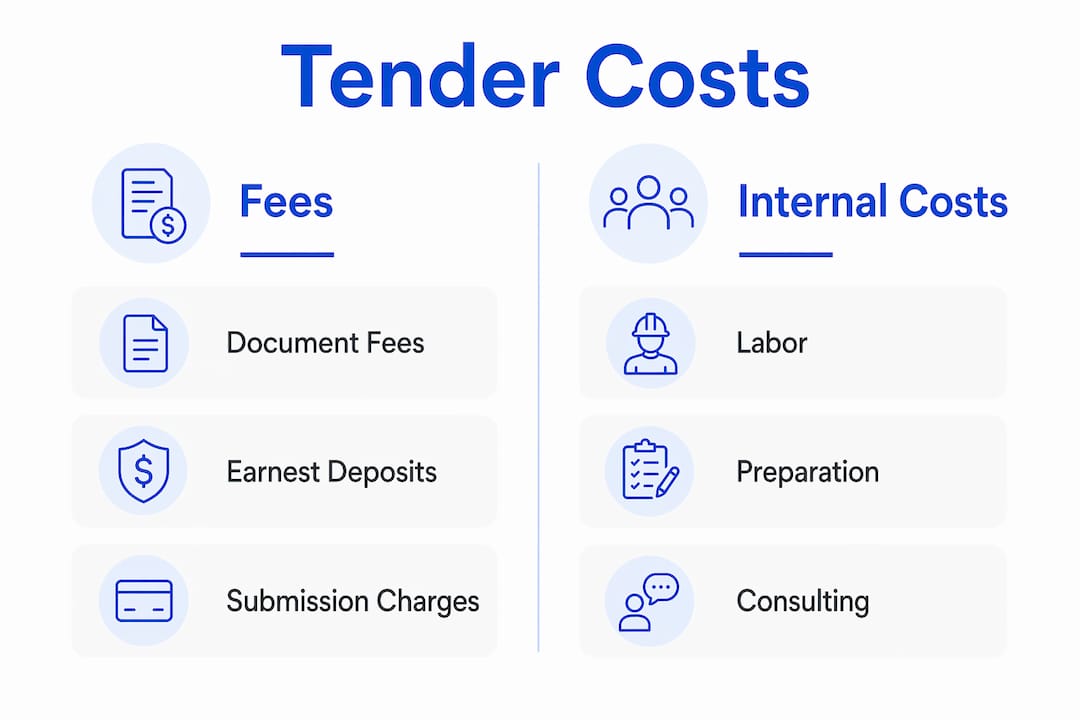
Tender costs fall into two broad categories: fees charged by the procuring entity, and the internal costs your business absorbs to prepare a bid.
 Tender document fees are non-refundable charges levied by the issuing authority for access to the full tender document. They are most common on state government portals, public sector units, and traditional procurement platforms outside the U.S. The fee amount typically scales with the estimated contract value. On India's government portals, for example, these fees can range from a nominal amount to significant sums depending on contract size, but on the U.S. federal system, they generally do not apply at all.
Earnest Money Deposits work differently. An EMD is a refundable bid security, usually calculated as a percentage of the contract value, that guarantees you will honor your submitted price if you win. You get it back if you lose or if the tender is cancelled. Tender fees, by contrast, are gone the moment you pay them.
Bonding and insurance add another layer of cost, primarily in construction and larger service contracts. Bond premiums run as a percentage of the contract value and are only required when the solicitation specifically demands them. Many service and supply contracts require no bonding at all.
Indirect costs are where most businesses underestimate their exposure. These include:
Tender document fees are non-refundable charges levied by the issuing authority for access to the full tender document. They are most common on state government portals, public sector units, and traditional procurement platforms outside the U.S. The fee amount typically scales with the estimated contract value. On India's government portals, for example, these fees can range from a nominal amount to significant sums depending on contract size, but on the U.S. federal system, they generally do not apply at all.
Earnest Money Deposits work differently. An EMD is a refundable bid security, usually calculated as a percentage of the contract value, that guarantees you will honor your submitted price if you win. You get it back if you lose or if the tender is cancelled. Tender fees, by contrast, are gone the moment you pay them.
Bonding and insurance add another layer of cost, primarily in construction and larger service contracts. Bond premiums run as a percentage of the contract value and are only required when the solicitation specifically demands them. Many service and supply contracts require no bonding at all.
Indirect costs are where most businesses underestimate their exposure. These include:
- Staff hours for writing, pricing, and reviewing the proposal
- External consultants or legal reviewers
- Travel to mandatory site visits or briefings
- Printing, binding, and document translation
- Compliance certifications and registration maintenance
 *
*
How much does it typically cost to bid on a tender?
The honest answer is that labor dominates the cost. A single mid-complexity government bid can represent $1,000–$4,000 of staff time even when no submission fee exists. For larger or more technical contracts, that figure climbs considerably.

Research on competitive tendering in Ghana found that contractors spent an average of US$539 per tender on preparation costs, representing roughly 0.33% of the tender value. Contractors in the UK and Australia generally spend significantly more per bid, reflecting more complex documentation requirements in those markets.
Several factors push costs up or down:
- Contract size and complexity. Larger contracts require more detailed technical responses, financial modeling, and compliance documentation.
- Sector requirements. Construction tenders typically demand more than supply contracts, with site visits, bonding, and detailed method statements adding hours.
- Documentation burden. Tenders requiring certifications, audited financials, or third-party legal reviews add direct cost on top of staff time.
- Your team's experience. A business bidding for the first time spends far more hours than one with a library of reusable templates and past responses.
Small businesses and new entrants feel these costs more acutely. When a larger firm can assign a dedicated bid team, a small business owner is often writing the proposal themselves, pulling time away from delivery and sales. The true cost of tendering includes that opportunity cost, not just the hours logged. *
What does it cost you when you lose a tender?
Losing a tender does not just mean missing the contract. It means absorbing the full preparation cost with zero return. For businesses chasing multiple bids simultaneously, those losses compound fast.
The strategic answer is cost-per-win. Divide your total annual tendering spend by the number of contracts you actually win. If you are spending $20,000 a year on bids and winning two contracts, your cost per win is $10,000. Whether that is acceptable depends entirely on the margin those contracts generate.
Most SMEs lose money by pursuing too many low-probability tenders. A bid where the incumbent supplier is clearly entrenched, the scope does not match your core capabilities, or the contract margin is too thin to justify the effort is a bid you should decline before you start writing.
Pro Tip: Build a simple bid/no-bid checklist before committing resources to any tender. Score each opportunity on contract fit, win probability, margin potential, and preparation cost. If it does not clear your threshold, walk away. A disciplined "no" saves more money than any last-minute proposal rush.Paid tender aggregation platforms can help by consolidating opportunities from multiple portals into a single feed, saving the hours spent manually checking each source. They do not provide exclusive access to tenders that are not publicly available, but the time savings are real for businesses running moderate to high bid volumes. For small businesses targeting tenders, the right tools reduce wasted effort and keep the focus on winnable work.
Tracking your actual versus planned effort after each submission builds the historical data you need to bid more accurately next time. Without that record, you are guessing at your real cost per bid.
*Key Takeaways
Most tender submission fees are zero on official government portals, but the real cost of tendering lies in labor, compliance, and preparation time.
| Point | Details |
|---|---|
| Government portals are free | SAM.gov and AusTender charge no registration or submission fees for standard bids. |
| Tender fees are non-refundable | Document access fees on some portals are administrative charges and are never returned, win or lose. |
| EMD differs from tender fees | An EMD is a refundable security deposit; a tender fee is a non-refundable document charge. |
| Labor is the dominant cost | A mid-complexity bid can cost $1,000–$4,000 in staff time even with no upfront fee. |
| Fee waivers exist for small businesses | Registered MSMEs and recognized startups qualify for tender fee exemptions on many government portals. |
FAQ
Do you have to pay a fee to submit a government tender?
On most official government portals, no. Platforms like SAM.gov in the U.S. and AusTender in Australia are free to register, search, and submit on. Some tenders, particularly in construction or on traditional procurement platforms, charge a non-refundable document fee to access the full tender pack.
Who pays the tender fee?
The bidder pays the tender fee directly to the procuring entity before the submission deadline. Registered MSMEs and DPIIT-recognized startups are exempt from these fees on many government portals.
Is a tender fee the same as an Earnest Money Deposit?
No. A tender fee is a non-refundable administrative charge for accessing tender documents. An EMD is a refundable security deposit, usually calculated as a percentage of the contract value, that guarantees the bidder will honor their submitted price.
What is the real cost of bidding on a tender?
Beyond any document fees, the dominant cost is labor. A single mid-complexity government bid can represent $1,000–$4,000 in staff time, and larger contracts cost considerably more once consultants, legal reviews, and compliance documentation are factored in.
Can tender fees be disputed or waived?
Fee waivers are policy-based, not negotiable on a case-by-case basis. If you qualify as an MSME or registered startup under the relevant procurement policy, the exemption applies automatically. If a fee was charged in error, contact the procuring entity's helpdesk with your registration proof before the submission deadline.