How to Write a Government Proposal That Wins Contracts

Writing a government proposal means following strict rules before you write a single persuasive sentence. The process starts with the Request for Proposal (RFP), a formal solicitation document that tells you exactly what to submit, how to format it, and how it will be scored. Get those mechanics right, and your content gets evaluated. Miss them, and your proposal gets rejected before anyone reads it.
Here is the core process at a glance:
- Read the RFP cover to cover, paying special attention to Section L (Instructions to Offerors) and Section M (Evaluation Factors for Award).
- Build a compliance matrix that maps every RFP requirement to the exact section of your proposal where you address it.
- Structure your submission into the mandated volumes: Technical Approach, Management Approach, Past Performance, and Price/Cost.
- Write to the evaluation criteria in Section M, not to impress generally, but to score specifically.
- Keep pricing out of your technical volume entirely.
- Confirm all certifications, representations, and required forms are complete before you submit.
- Submit electronically through the designated portal (typically SAM.gov for federal contracts or Grants.gov for federal grants) at least 24 hours before the deadline.
How to write a government proposal: start with the RFP
Every winning proposal begins with a thorough read of the solicitation. Rushing into writing without fully understanding the requirements is the most common reason proposals fail.
Two sections of the RFP carry most of the weight:
- Section L (Instructions, Conditions, and Notices to Offerors): Governs format, volume structure, page limits, font size, margin requirements, submission method, and file naming conventions. A typical Section L specifies font size, margins, and maximum pages per volume as required by the solicitation. Follow it exactly. Evaluators can reject a non-compliant proposal without reading it.
- Section M (Evaluation Factors for Award): Lists the scoring criteria and their relative weights. Technical Approach, Past Performance, Management, and Price/Cost are the standard factors, though their order of importance varies by procurement.
- Section C (Statement of Work or Performance Work Statement): Describes what the government needs done. Your technical volume must address every requirement here.
Once you have read all three sections, extract every mandatory and desired requirement into a checklist. Assign each item to a team member with a draft deadline. A short daily standup meeting keeps the team aligned and surfaces blockers before they become missed requirements. Pro Tip: Build a compliance matrix before you assign any writing. This spreadsheet maps every Section L requirement to the proposal volume and page where you address it. It takes two to four hours to build and catches missed requirements before they cost you the bid.
How proposal volumes are structured and what goes in each
Federal solicitations governed by FAR 52.215-1 specify a multi-volume structure. Section L defines the exact volumes required for each solicitation, but the standard organization looks like this: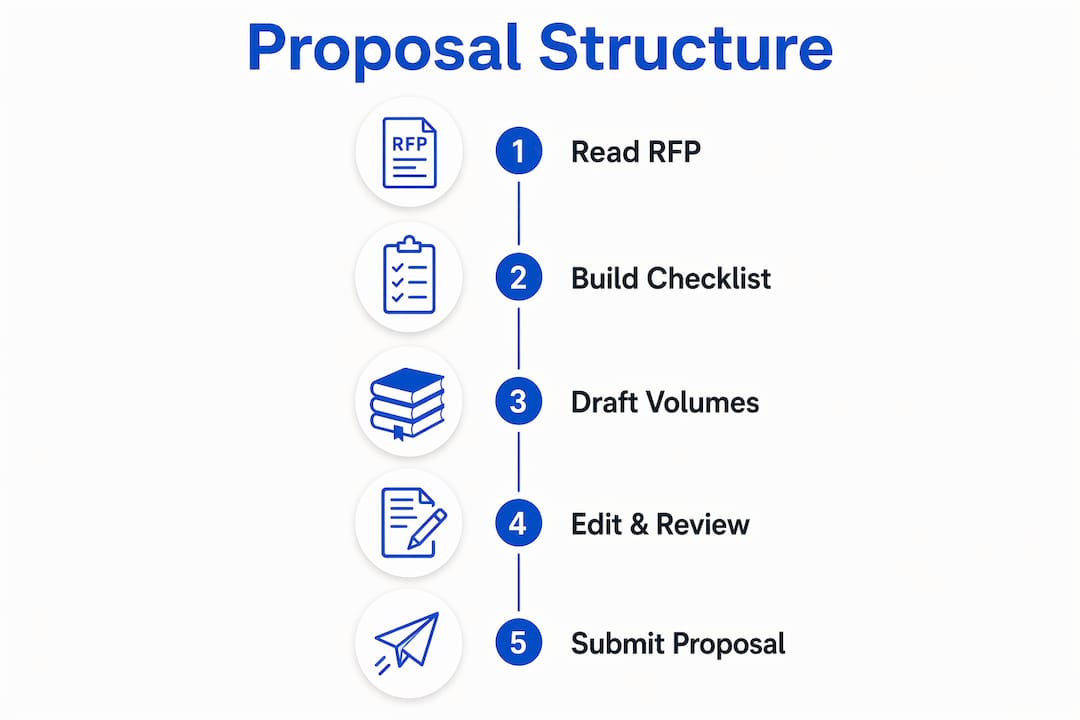
| Volume | Purpose | Core content | Typical evaluator |
|---|---|---|---|
| Volume I: Technical Approach | Demonstrate your solution methodology | Approach, tools, processes, staffing plan, transition plan | Technical evaluation panel |
| Volume II: Management Approach | Show how you will manage the contract | Org chart, key personnel resumes, quality assurance plan, risk management | Technical evaluation panel |
| Volume III: Past Performance | Prove relevant experience | 3 contract references with narratives, performance metrics, points of contact | Past performance panel |
| Volume IV: Price/Cost Proposal | Establish pricing | Completed CLINs, basis of estimate, labor rates, subcontractor costs | Procurement lead (often after technical scoring) |
| Administrative Volume | Satisfy compliance documentation | Certifications, representations, teaming agreements, small business plans | Procurement officer |
Writing strategies for clarity, compliance, and persuasion
Treat the proposal primarily as a compliance document, not a sales brochure. Evaluators score proposals using a checklist linked directly to Section M. If they cannot find where a criterion is met, no points are awarded, regardless of how well you actually meet it.
That said, compliance alone does not win. Here is how to write content that scores and persuades:
- Lead with compliance, then differentiate. Open every section by directly stating your compliance with the requirement. Then explain how your approach exceeds the baseline.
- Use the challenge-solution-benefit framework. State the problem the agency faces, describe your specific approach, and quantify the outcome. "We will deliver monthly performance reports within five business days of month-end" beats "we will provide timely reports" every time.
- Mirror Section M language in your headings. If the evaluation criterion is labeled "Technical Approach," your section heading should say exactly that. Evaluators score against a worksheet built from the RFP's own outline. When your document mirrors that outline, scoring is fast.
- Replace vague claims with measurable outcomes. Generic statements earn zero points. Specificity demonstrates competence.
- Use visuals strategically. Process flow diagrams, organizational charts, and schedules communicate complex approaches more clearly than dense paragraphs. Every graphic needs a caption and a callout explaining its significance.
- Avoid sales jargon. Words like "world-class" or "industry-leading" without evidence are red flags to experienced evaluators.
Strong technical proposals go beyond simple compliance to demonstrate thought leadership and present compelling, measurable outcomes aligned with agency goals. The executive summary is your best opportunity to show you understand the agency's situation, including complicating factors they may not have spelled out in the SOW. Pro Tip: Assign one strong writer to edit all volumes for voice and style before submission. Fragmented multi-author proposals read inconsistently and are penalized during evaluation.

For broader guidance on building a persuasive methodology, business coaching strategies that focus on demonstrating measurable value translate directly to how you frame your technical approach.
How proposals are scored and what gets you disqualified
Evaluation of government proposals follows Section M criteria, with Technical Approach, Management, Past Performance, and Price/Cost weighted differently depending on the procurement method. Two evaluation methods dominate federal contracting:
- Best Value Tradeoff: Technical quality can outweigh price. A higher-priced proposal with a superior technical approach can win.
- Lowest Price Technically Acceptable (LPTA): The cheapest compliant offer wins. If the RFP uses LPTA, do not over-propose. Meet every requirement, price competitively, and submit.
Past performance often accounts for 20-40% of the total score and requires relevant, verifiable references. New entrants to government contracting face a real disadvantage here, which is why many start as subcontractors to established prime contractors.
Common pitfalls that cost points or trigger disqualification:
- Exceeding page limits by even one page. Evaluators can and do remove excess pages before scoring.
- Using the wrong font size or margin width. Even minor deviations from Section L can result in a non-responsive determination.
- Including any pricing information in the technical volume. This violates compliance rules and risks rejection of the entire submission.
- Failing to address every evaluation criterion from Section M explicitly.
- Submitting past performance references without verifying that client-completed forms were returned to the agency on time.
- Using marketing language instead of evidence-based claims.
Finalizing the proposal: editing, reviews, and submission
Structured review cycles are the difference between a proposal that scores well and one that almost does. The standard color team process works like this:
- Pink Team (outline stage): Review the compliance matrix, outline, and win themes before significant writing begins. Catching a structural problem at this stage costs an hour. Catching it at 80% completion costs days.
- Red Team (full draft, roughly 80% complete): An independent reviewer who has not been writing scores the full draft against Section M criteria. This is your reality check. A kind Red Team produces a weak proposal.
- Gold Team (final quality check): One person verifies every mechanical requirement: page counts, font sizes, section labels, file names, and submission portal instructions. Use the compliance matrix as your checklist.
Submit at least 24 hours before the deadline. Technical issues with SAM.gov, email servers, and file size limits are common. Submitting early gives you time to troubleshoot without the deadline pressure. After submission, keep your proposal team available. The government may issue Evaluation Notices requesting clarifications that require a quick turnaround.
For a detailed walkthrough of electronic tender submission through official government portals, the process mirrors the federal approach: exact file formats, naming conventions, and confirmation receipts matter.
What you need to know about the FAR and proposal submission
The Federal Acquisition Regulation (FAR) is the primary rulebook governing federal procurement in the United States. Every federal RFP is legally binding and governed by the FAR, along with agency-specific supplements such as DFARS for defense contracts and GSAM for GSA procurements. This is fundamentally different from commercial proposals, which allow flexibility in format and approach.
FAR Part 15 covers negotiated acquisitions, including the proposal submission process. FAR 15.204 defines the Uniform Contract Format, which is why federal RFPs follow a predictable section structure from Section A through Section M. FAR 15.101-1 governs best value tradeoff procedures, and FAR 15.101-2 governs LPTA. Knowing which applies to your solicitation shapes your entire writing strategy.
State and local government RFPs follow their own procurement regulations, but the structural logic is similar: a technical volume, a management or staffing volume, a separately sealed price volume, and required certifications. The key difference is that state and local evaluators first test whether your submission is responsive (a pass or fail gate), then score responsive proposals against published, weighted criteria.
Incorporating mandatory certifications and representations
Federal proposals require certifications and representations that commercial proposals do not. These are not optional attachments. Missing one is usually grounds for rejection, not a request to fix it.
Standard certifications for federal proposals include representations under FAR 52.212-3 (Offeror Representations and Certifications) for commercial items, small business certifications if applicable, organizational conflict of interest disclosures, and non-collusion affidavits. Defense contracts may require additional DFARS certifications. GSA schedules carry their own compliance documentation requirements.
The administrative volume is where most of these live. Treat it as a checklist and verify every required document is included, signed by someone with authority to bind the company, and formatted on the agency's exact forms. Substituting your own version of a required form is a common responsiveness failure. Your SAM.gov registration must also be active and current at the time of submission for federal contracts.
Preparing and managing required attachments and exhibits
Attachments and exhibits are separate from your proposal volumes but equally subject to Section L requirements. Common required attachments include key personnel resumes (often with a specified page limit per resume), organizational charts, teaming or subcontracting agreements, facility clearance documentation, and small business subcontracting plans when the contract value exceeds the applicable threshold.
Past performance reference forms deserve special attention. Many agencies require that references complete and return forms directly to the contracting officer, not through you. Contact your references as soon as you decide to bid, confirm they are willing to respond, and send them the agency's form with a clear deadline that gives you a buffer before the proposal due date. A reference who misses the agency's deadline takes points off your score that no amount of excellent writing can recover.
Label every attachment exactly as Section L specifies. If the RFP says "Attachment A: Key Personnel Resumes," that is the label. Evaluators work from a checklist, and a mislabeled or missing attachment creates a compliance gap that can delay or prevent award even after a strong technical evaluation.
Developing a proposal compliance checklist and review process
A compliance matrix is both an internal quality control tool and an audit trail. Building it early mitigates the risk of missed requirements and gives your review teams a concrete scoring tool. For a practical look at how compliance documentation fits into a broader tender document checklist, the same principles apply across procurement contexts.
Structure your compliance matrix with these columns:
- RFP reference: The section and paragraph number (e.g., L.5.1.a).
- Requirement description: The exact "shall" or "must" statement.
- Proposal section and page: Where you address it.
- Author assigned: Who is responsible for that section.
- Compliance status: Not Started, Draft, In Review, or Complete.
Go through Sections C, H, J, L, and M line by line. Every "shall," "must," "will," and "is required to" statement is a requirement. Number them sequentially by section (C-001, L-001, M-001) so your review teams can cross-reference quickly. Your goal is 100% compliance before submission. Any gap identified during the Gold Team review needs an answer, not a workaround.
Addressing security and confidentiality requirements
Security requirements in government proposals vary significantly by contract type. Proposals for classified programs require cleared personnel and secure facilities for both writing and submission. The RFP will specify any clearance requirements explicitly. For unclassified proposals, the security obligation is less formal but still real: your pricing strategy, technical approach, and personnel information are sensitive and should be protected accordingly.

When using AI tools to assist with compliance matrix building or requirement extraction, choose tools that process documents locally without transmitting data to external servers. A technical approach uploaded to a cloud-based AI tool could expose proprietary information or pricing strategy before award.
Data security frameworks that may appear as proposal requirements include CMMC (Cybersecurity Maturity Model Certification) for defense contracts, FedRAMP for cloud services, and ITAR for defense-related exports. If the solicitation references any of these, your proposal must demonstrate compliance or a credible path to compliance. Stating that you "plan to achieve" certification without a concrete timeline and current status is a weakness evaluators will flag.
Apply proprietary markings to your proposal documents before submission. Mark each page containing trade secrets or confidential business information with the standard legend specified in FAR 52.215-1. This protects your information if the proposal is subject to a Freedom of Information Act request after award.
Key Takeaways
A compliant, well-structured government proposal built around Section L and Section M requirements gives you the best chance of reaching evaluation scoring.
| Point | Details |
|---|---|
| Read Section L and M first | Section L governs format and structure; Section M defines scoring weights and evaluation criteria. |
| Build a compliance matrix early | Map every RFP "shall" statement to a proposal section before writing begins to prevent disqualification. |
| Keep pricing out of technical volumes | Including any cost data in the technical volume violates compliance rules and risks rejection. |
| Past performance carries major weight | Past performance often accounts for 20-40% of the total score; request reference forms from clients well in advance. |
| Submit at least 24 hours early | Technical issues with submission portals are common; early submission gives you time to resolve them. |
FAQ
How do you write a proposal for a government contract?
Read the RFP's Section L for formatting rules and Section M for scoring criteria, build a compliance matrix mapping every requirement to your proposal, then structure your response into the mandated volumes: Technical Approach, Management, Past Performance, and Price/Cost.
What makes a government proposal winning?
A winning proposal addresses every evaluation criterion from Section M explicitly, uses specific and measurable claims instead of marketing language, and passes the compliance check before a single scored point is awarded.
What are the three C's of proposal writing?
Definitions vary across proposal writing guides, but a widely used version covers Compliance (meeting every Section L requirement), Completeness (addressing every Section M evaluation criterion), and Competitiveness (demonstrating measurable value beyond the minimum threshold).
What is the standard format of a government proposal?
Most federal proposals follow the Uniform Contract Format defined in FAR 15.204, organized into separate volumes: Technical Approach, Management Approach, Past Performance, Price/Cost, and an Administrative volume containing certifications and required forms.
How do you submit a government proposal electronically?
Federal proposals are typically submitted through SAM.gov or an agency-specific portal as specified in Section L. Verify the required file format, naming conventions, and size limits, then submit at least 24 hours before the deadline and save your confirmation receipt.
* Ready to find government tender opportunities that match your capabilities? Protenders aggregates live government tenders across South Africa, with compliance scorecards and document templates that help small businesses bid with confidence.
Recommended
- How to Write a Winning Tender Proposal: Complete Guide 2026 | ProTenders
- Municipal Tenders South Africa 2026: How to Win Local Government Contracts | ProTenders
- Cleaning Services Tenders South Africa 2026: How to Win Government Contracts | ProTenders
- RFQ vs RFP: Understanding the Difference in Government Tenders | ProTenders