PPPFA Points: R50m Rule, Formulas, SBD 6.1 for South African Bidders

The PPPFA points system splits every tender score into two parts: price and preference. Contracts worth up to a prescribed threshold use the 80/20 split (where price is weighted heavily and preference less so). Contracts above that threshold use a 90/10 split. Price gets scored through an official proportional formula, and preference points, tied to specific goals or B-BBEE status, get added on top to reach a maximum of 100. Bidders claim those preference points using the SBD 6.1 form.
*TL;DR:>
- Price scoring is based on a formula that awards maximum points to the lowest bid, with higher bids losing points proportionally, and must be calculated using the actual lowest acceptable price.*
- Preference points can be awarded for goals beyond B-BBEE, such as local content or enterprise subcontracting, but require documented proof; missing evidence results in zero points for that goal.
- The applicable points split depends on whether the contract value is below or above R50 million, with 80/20 for smaller tenders and 90/10 for larger ones, and some tenders may allow a choice between the systems.
- Common errors that cost points include outdated or missing preference documentation, claiming goals without evidence, and failure to verify the tender-specific goals listed in the invitation.
- Using platforms that provide current templates, compliance checklists, and live tender feeds can increase accuracy and streamline the process of claiming preference points correctly.
Table of Contents
- How the 80/20 and 90/10 splits actually work
- How price scoring is calculated (formula and worked example)
- Specific goals, B-BBEE, and the SBD 6.1 claim mechanics
- When 80/20 versus 90/10 applies, and what happens in unclear cases
- Common pitfalls and the safeguards that override a high score
- How to calculate your score and check compliance before you submit
- What we've learned watching SMMEs win (and lose) on points
- Start scoring tenders correctly with Protenders
- Where to verify the rules yourself
- Sources
- FAQ
How the 80/20 and 90/10 splits actually work
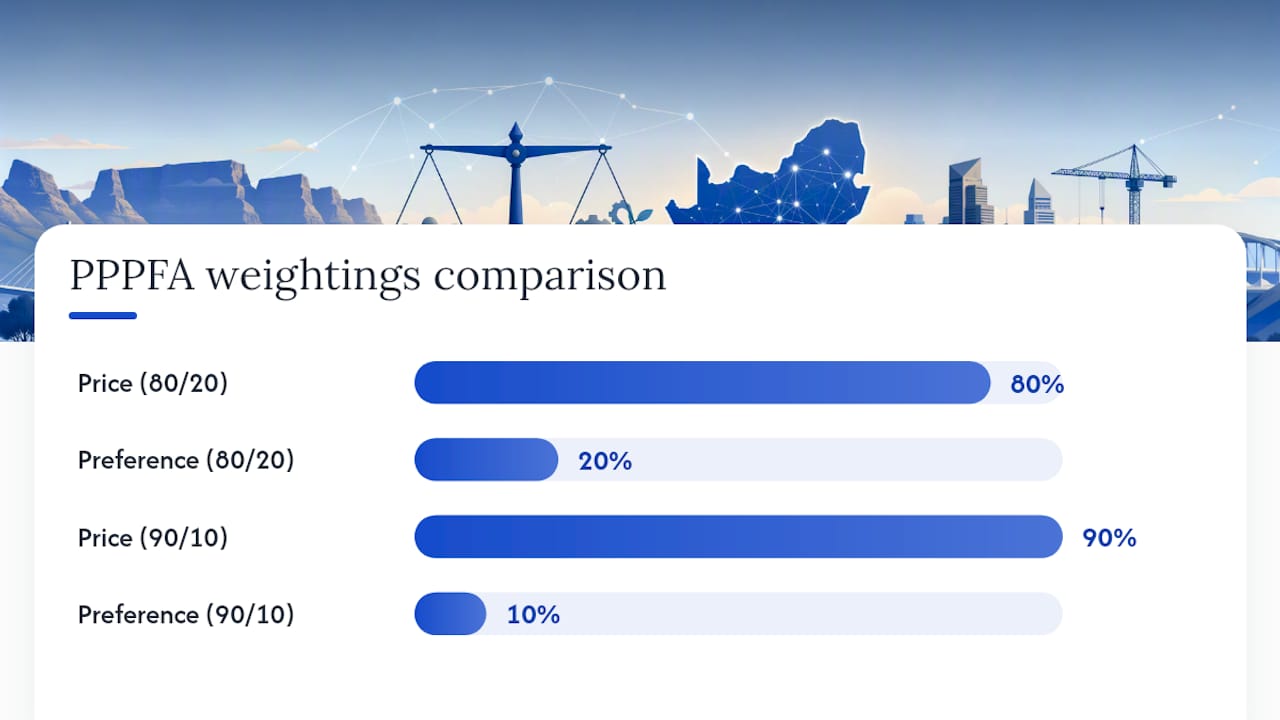
Price and preference measure completely different things, and confusing the two costs bidders points every week. Price is a pure mathematical score: the lowest acceptable tender price gets the full 80 or 90 points, and every higher bid loses points proportionally. Preference points reward something else entirely, usually B-BBEE status or a specific goal the organ of state has nominated for that particular tender, such as subcontracting to a small enterprise.
Here's the part most bidders miss: organs of state are required to list which specific goals apply in the tender documents themselves. You cannot assume B-BBEE is the only lever.
- Price component: 80 (under R50m) or 90 (over R50m) points, calculated by formula
- Preference component: 20 or 10 points, awarded for B-BBEE status level or listed specific goals
- Maximum combined score: 100 points, before any functionality weighting is applied separately
The practical effect is that a bidder with strong preference points can beat a cheaper competitor. Under the 80/20 system, a full preference point allocation corresponds to a significant price advantage, while under the 90/10 system, price carries more weight relative to preference points. It's why high-value tenders reward the sharpest price far more than smaller ones do.
How price scoring is calculated (formula and worked example)
The Preferential Procurement Regulations set out one formula with two multipliers. For 80/20 tenders:
Ps = 80 × (1 − (Pt − Pmin) / Pmin)For 90/10 tenders, swap 80 for 90. Here, Ps is the price score, Pt is the price of the tender being evaluated, and Pmin is the lowest acceptable tender price received.
Pro Tip: Always run the formula against the actual lowest acceptable price, not your own estimate of what competitors might bid. Bidders routinely miscalculate by guessing Pmin instead of waiting for it.For example, if the lowest acceptable bid is Pmin and another bid Pt is above that, the price points are calculated by the formula Ps = 80 × (1 − (Pt − Pmin) / Pmin) for the 80/20 system, awarding the maximum points to Pmin and proportionally fewer to higher bids.
Scores are rounded to two decimal places, following the Preferential Procurement Regulations. If a price looks abnormally low or clearly not market-related, the organ of state can query or reject it before the formula even applies.
Specific goals, B-BBEE, and the SBD 6.1 claim mechanics
The SBD 6.1 preference points claim form is where you formally claim your preference points, and it's also where most avoidable losses happen. Since the 2022 regulations, organs of state must name their specific goals in each tender's documents rather than defaulting to B-BBEE alone. Common goals include:
- Ownership by historically disadvantaged individuals (HDIs)
- Advancement of women or youth owned enterprises
- Local production and content requirements
- Subcontracting to EMEs or QSEs
- B-BBEE status level, still relevant, and often listed as one goal among several
The dtic has confirmed that the B-BBEE Act and Codes were never removed from the procurement picture. They sit alongside specific goals, not instead of them, so a valid B-BBEE certificate still matters even when other goals are listed.
Miss the proof for a claimed goal and the OCPO/Treasury FAQ is blunt about the consequence: you get zero points for that goal, no partial credit, no benefit of the doubt.
When 80/20 versus 90/10 applies, and what happens in unclear cases
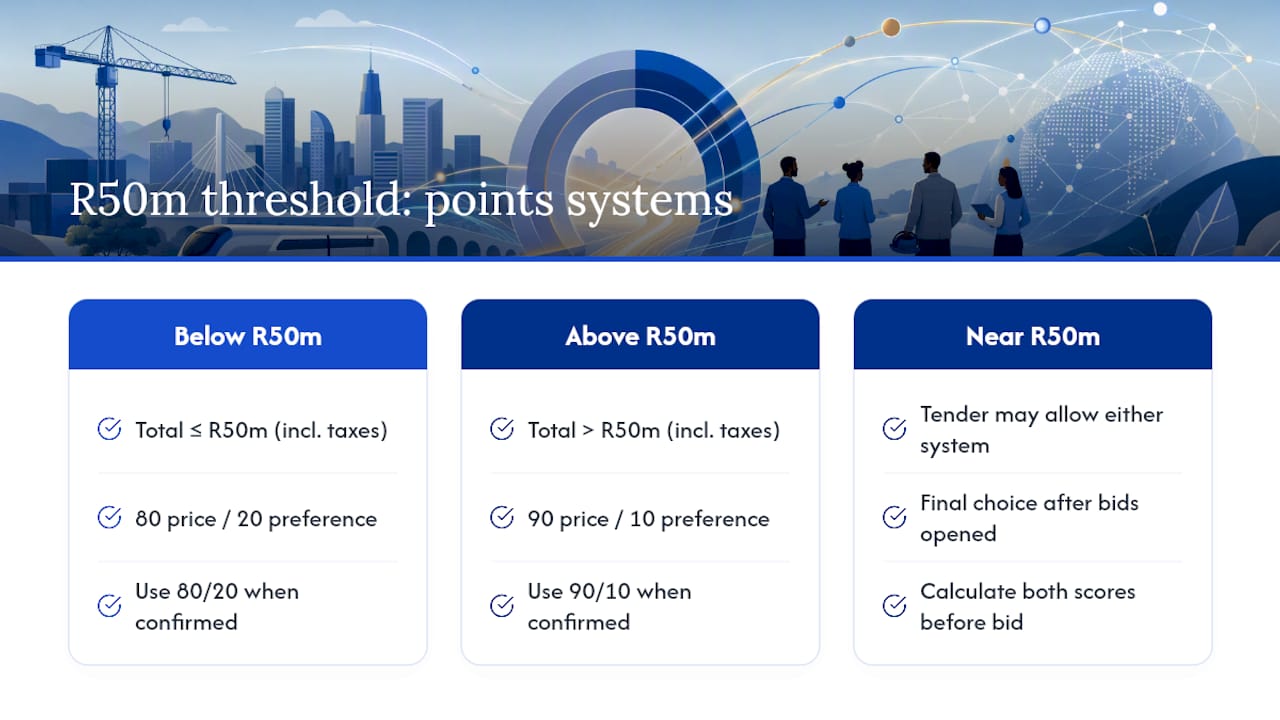
The rule is straightforward on paper: R50 million is the line, and that figure is inclusive of all applicable taxes. Below it, 80/20 applies. Above it, 90/10 takes over.
Real bids get messier near that threshold. The regulations allow a tender document to state that either system could apply, with the final decision made once bids are opened and the actual lowest or highest acceptable tender value is known. If your quote sits close to R50 million, calculate your score under both systems before submission, since the applicable one may only become clear after the fact. Certain procurement types, petty cash purchases among them, fall outside the points system altogether. Always read the tender-specific instructions rather than assuming the general rule applies unmodified.
Common pitfalls and the safeguards that override a high score
A perfect score doesn't guarantee an award. The Preferential Procurement Regulations include a market-related price safeguard: if the top-scoring bid is priced unrealistically, the organ of state can negotiate down or cancel the process rather than award automatically.
Bidders lose points for reasons that have nothing to do with their pricing strategy:
- Submitting an expired B-BBEE certificate or affidavit
- Using an outdated SBD 6.1 template that doesn't match the current specific goals
- Claiming a goal with no supporting evidence attached
- Subcontracting more than 25% of contract value to a party that doesn't qualify for the same points, without that subcontractor being an EME capable of doing the work
Where two bidders end up tied on total score, the regulations allow functionality or other objective criteria, set out in the tender document, to break the tie rather than defaulting to a coin toss.
How to calculate your score and check compliance before you submit
- Confirm the contract value and identify whether 80/20 or 90/10 applies, calculating both if you're near R50 million
- Calculate your price score using Ps = multiplier × (1 − (Pt − Pmin) / Pmin), rounding to two decimals
- Check the tender document for its listed specific goals and confirm which ones you qualify for
- Complete SBD 6.1 accurately, matching each claimed goal to its supporting evidence
- Attach proof for every claim: B-BBEE certificate or affidavit, ownership documents, local content declarations
- Add your price score and preference score to confirm your projected total out of 100
Reviewing your tender proposal format against the checklist above before submission catches most of the errors that cost bidders points unnecessarily.
What we've learned watching SMMEs win (and lose) on points
Most lost points aren't lost on price. They're lost on paperwork. The same handful of mistakes show up tender after tender: an outdated SBD 6.1 template, a B-BBEE affidavit that expired three months ago, a specific goal claimed with no evidence attached. None of that has anything to do with whether the business could deliver the contract.
The compliance scorecards and document templates were built specifically to address this common and avoidable gap. A bidder who checks their documentation against the tender's actual listed goals, rather than assuming last year's approach still applies, walks into the evaluation with a defensible claim instead of a hopeful one.
— Dolene April
Start scoring tenders correctly with Protenders
There are platforms that provide a live feed of every national, provincial, and municipal tender in one place, plus compliance scorecards and SBD templates that help you get your preference-points claim right the first time.
Instead of manually cross-checking specific goals against outdated templates, you can pull a current SBD 6.1 template, confirm what evidence a listed goal actually requires, and move straight to submission. If you're a smaller operator, the SME tender opportunities under R1 million page filters for the contracts where 80/20 typically applies and competition is more manageable. For a broader search, browse the live South African government tenders feed by keyword, region, or category, no signup required to start looking. Once you've found a fit, Protenders can also point you toward funding options to help execute the contract once it's awarded.
Where to verify the rules yourself
- Preferential Procurement Policy Framework Act 5 of 2000
- Preferential Procurement Regulations
- SBD 6.1 claim form
- OCPO/Treasury FAQ on the 2022 Regulations
- The dtic on B-BBEE and the 2022 PPPFA Regulations
Sources
- Preferential Procurement Policy Framework Act 5 of 2000
- Preferential Procurement Regulations
- SBD 6.1 preference points claim form (SBD 6.1)
- Frequently asked Questions and Generic Answers - Preferential Procurement Regulations 2022
- The 2022 PPPFA Regulations have not Exempted Organs of State and Public Entities from Implementing B-BBEE
FAQ
What are the latest PPPFA regulations?
The current framework is the Preferential Procurement Regulations of 2022, which introduced "specific goals" that organs of state must define per tender, replacing a rigid B-BBEE-only preference model while keeping B-BBEE relevant as one possible goal.
What does 80/20 mean in tenders?
It means 80 points go to price and 20 to preference for contracts valued up to R50 million, inclusive of taxes; above that threshold, the split moves to 90/10.
What are the 5 pillars of procurement?
Public procurement in South Africa is generally guided by five principles: value for money, open and effective competition, ethics and fair dealing, accountability and reporting, and equity, the last of which underpins the PPPFA preference points system itself.
How do I calculate a tender price score?
Use Ps = 80 × (1 − (Pt − Pmin) / Pmin) for 80/20 tenders, or substitute 90 for 90/10 tenders, where Pmin is the lowest acceptable price and Pt is the price you're scoring, then round the result to two decimal places.
What happens if I don't submit proof for a claimed preference goal?
You receive zero points for that specific goal, regardless of how strong the rest of your bid is, so every claim on SBD 6.1 needs matching documentary evidence attached before submission.