Procurement Market Intelligence: 2026 Guide for Sourcing Pros

Procurement market intelligence is the continuous process of gathering, analyzing, and applying external market data alongside internal spend data to drive smarter sourcing decisions. Unlike a one-time market study, it tracks supplier health, pricing trends, regulatory shifts, and competitive dynamics on an ongoing basis. The gap between teams that practice it and those that don't shows up fast: one group spots a price spike three months out; the other discovers it on the invoice.
The core components procurement teams monitor include:
- Supplier landscape: market share, financial health, and emerging competitors
- Pricing and cost trends: commodity indexes, freight rates, and currency moves
- Risk indicators: credit scores, geopolitical signals, and supply disruptions
- Regulatory shifts: trade policy, ESG requirements, and compliance changes
- Benchmarking: your spend rates versus peer organizations in the same categories
Traditional market research delivers periodic snapshots. Procurement market intelligence delivers continuous visibility, and that difference determines whether your sourcing strategy leads or reacts.
Why procurement market intelligence pays for itself
The financial case is straightforward. Intelligence programs typically cost between 0.1% and 0.3% of annual procurement volume and pay for themselves within 12–18 months through cost savings and risk reduction. The strategic case is even stronger.
Key benefits procurement teams see in practice:
- Cost savings: buying when commodity curves dip rather than at peak demand
- Negotiation leverage: walking into a supplier meeting knowing their margin pressure before they do
- Risk mitigation: detecting supplier financial distress early enough to qualify alternatives
- Faster category planning: reduced research time and faster sourcing strategy alignment
- Innovation access: identifying emerging suppliers while their technology is still fresh and their pricing is competitive
- Better forecasting: budget planning grounded in real market data rather than last year's actuals
The shift from reactive to proactive procurement is where the real value accumulates. When your team maps external indicators directly to internal spend data, you surface negotiation levers that a standalone market report simply cannot reveal.
What technology powers modern procurement intelligence?

AI and cloud analytics have changed what's possible. Platforms now combine automated commodity indexes, financial health alerts, and machine learning models to surface insights in minutes rather than weeks. Natural Language Processing scans unstructured news feeds and regulatory filings, flagging relevant signals before they reach mainstream headlines.
Key platform capabilities to evaluate:
- Spend data integration with ERP and contract management systems
- Real-time market data aggregation across supplier, commodity, and macro feeds
- Automated alerts for supplier financial events or pricing threshold breaches
- Negotiation brief generation combining spend history, benchmarks, and market context
- Continuous supply risk monitoring with recommended mitigation actions
Leading platforms in this space include:
- Coupa: spend management with embedded market benchmarking and supplier risk tools
- GEP: a global intelligence team of over 160 researchers supporting category and macroeconomic analysis across direct and indirect spend
- Dun & Bradstreet: supplier financial health scoring and continuous risk alerts drawn from balance sheet and payment data
- Ivalua: source-to-pay platform with supplier performance tracking and market data integration
- SAP: enterprise-grade procurement analytics connecting spend visibility to broader supply chain data
- Zycus: AI-driven spend analysis with category intelligence and supplier management modules
No single platform covers every angle. Most mature programs combine a core spend analytics platform with specialized commodity feeds and supplier risk tools layered on top.
How to implement procurement intelligence in your organization
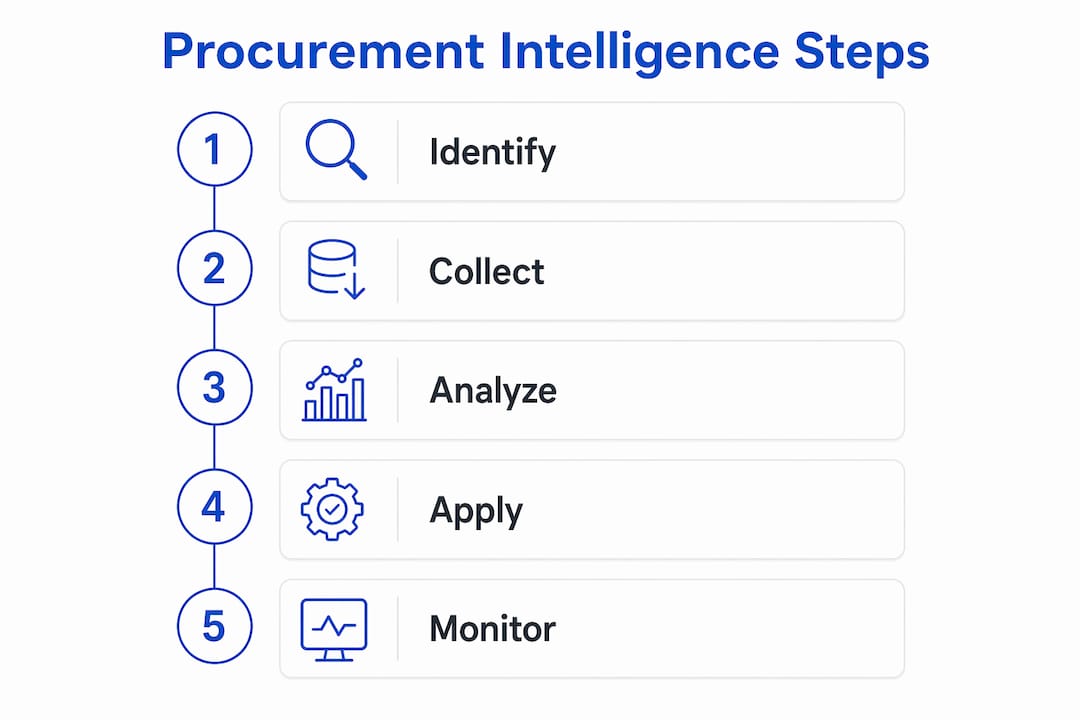
A structured rollout prevents the most common failure mode: buying a platform, then struggling to connect it to actual sourcing decisions.
- Identify priority categories. Focus first on categories where pricing volatility or supplier concentration creates the most spend risk. Not every category needs deep intelligence coverage.
- Integrate internal and external data. Connect transaction-level spend data, contract terms, and supplier performance records to external market feeds. Standalone reports are useful; integrated data is where decisions improve.
- Apply structured analysis methods. Porter's Five Forces, SWOT analysis, and scenario planning adapted to procurement help teams shift from reactive sourcing to anticipating market moves.
- Set up continuous monitoring. Annual market assessments miss too much. Automated alerts tied to commodity price thresholds, supplier credit events, or regulatory changes keep your team ahead of the curve.
- Embed intelligence into sourcing workflows. Market context should flow directly into negotiation preparation, category reviews, and supplier business reviews, not sit in a separate report nobody reads.
- Establish KPIs. Track data coverage rate, forecast accuracy, sourcing lead time reduction, and cost savings attributed to intelligence-driven decisions.
- Address data quality and cognitive bias. Structured analysis processes and diverse review teams reduce confirmation bias. Data quality scores and governance protocols keep market information reliable over time.
Pro Tip: Start with your top five spend categories by volume and risk. A focused intelligence program on a handful of categories consistently outperforms a broad but shallow one.
How leading teams apply intelligence: expert insights and real-world examples

Art of Procurement identifies a consistent pattern among high-performing teams: they don't just collect data; they translate it into communication tailored to specific categories and business functions. A negotiation brief that lands on a category manager's desk the morning of a supplier meeting is worth far more than a quarterly market report filed in a shared drive.
GEP's approach illustrates this at scale. Their library of over 250 off-the-shelf category reports gives sourcing teams a fast primer on any spend category, while custom research is contextualized to a client's industry, scale, and region. The combination of breadth and depth is what makes intelligence operationally useful rather than academically interesting.
A global procurement organization using category intelligence reduced research time by 65%, improved sourcing strategy alignment by 28%, and accelerated category planning cycles by 40%. Those gains came from connecting market data to actual spend, not from buying more reports.
The most effective programs build a continuous feedback loop: negotiation outcomes and live market conditions feed back into dynamic should-cost models, which sharpen the next round of sourcing decisions. Procurement stops being a cost center and starts functioning as a strategic business partner.
For teams operating in public procurement markets, platforms like Protenders provide local market intelligence alongside tender opportunity alerts, helping sourcing managers stay current on government buyer activity and category-level demand signals.
| Outcome | What drives it |
|---|---|
| Reduced sourcing lead time | Continuous market monitoring replaces manual research cycles |
| Stronger negotiation position | Integrated spend and market data reveals supplier pressure points |
| Earlier risk detection | Automated financial health alerts flag distress before headlines do |
| Better category planning | Scenario planning and benchmarks replace gut-feel assumptions |
Legal and ethical considerations in procurement market intelligence
Procurement intelligence programs operate in a legal and ethical environment that tightens every year. Three areas demand attention.
Data privacy and sourcing legality. External data must come from legitimate sources: public filings, licensed databases, and disclosed supplier information. Scraping private systems or using data obtained without consent creates legal exposure under regulations like GDPR and the California Consumer Privacy Act. Competitive intelligence boundaries. Gathering intelligence on supplier pricing and market positioning is standard practice. Obtaining confidential competitor sourcing strategies through improper channels is not. The line matters, and crossing it carries both legal and reputational consequences. ESG and supplier transparency. Regulatory pressure on supply chain ESG disclosure is accelerating. Procurement teams increasingly need to verify labor practices, carbon footprints, and compliance standards as part of supplier assessment. Intelligence programs that ignore ESG data leave organizations exposed to both regulatory risk and reputational damage.Governance frameworks, clear data sourcing policies, and regular ethics training for procurement staff are the practical controls that keep intelligence programs on the right side of these boundaries. Consulting specialists in category management implementation can help organizations build governance structures that scale with program maturity.
*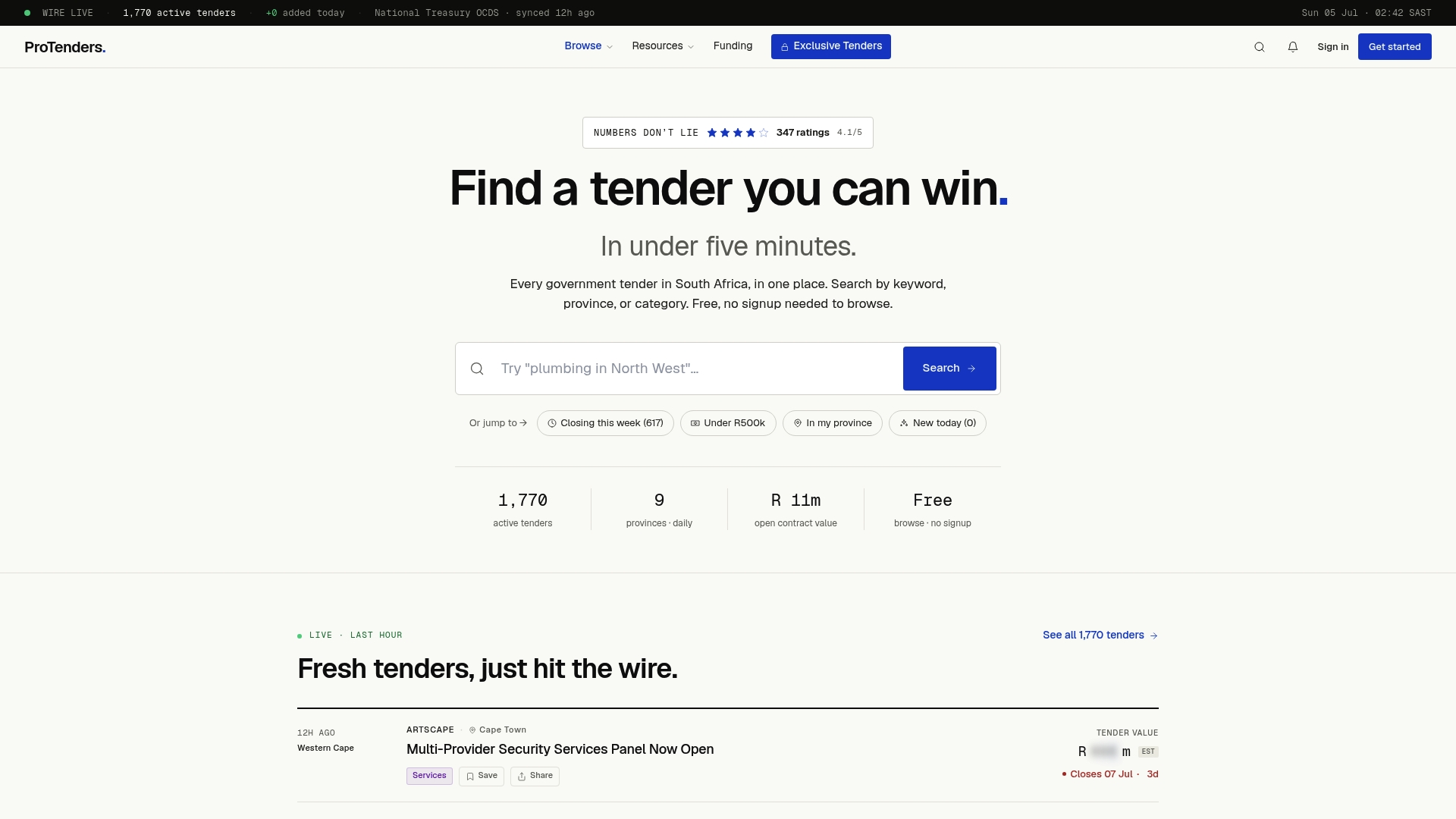 Protenders gives procurement teams in South Africa direct access to live government tender data, compliance tools, and market intelligence across national, provincial, and municipal buyers. Whether you're building a sourcing strategy for a new category or tracking public sector demand signals, Protenders puts the intelligence you need in one place, without requiring a sign-up to start searching.
*
Protenders gives procurement teams in South Africa direct access to live government tender data, compliance tools, and market intelligence across national, provincial, and municipal buyers. Whether you're building a sourcing strategy for a new category or tracking public sector demand signals, Protenders puts the intelligence you need in one place, without requiring a sign-up to start searching.
*
Key Takeaways
Procurement market intelligence delivers the most value when external market data is integrated directly with internal spend data, creating intelligence specific to your organization rather than generic market reports.
| Point | Details |
|---|---|
| Integration drives value | Mapping external indicators to internal spend data reveals negotiation levers no standalone report can surface. |
| Programs pay for themselves | Intelligence initiatives typically cost 0.1%–0.3% of annual procurement volume and recover that investment within 12–18 months. |
| Continuous beats periodic | Annual market assessments miss pricing windows and supplier risk signals; automated monitoring closes that gap. |
| Translation is the skill | High-performing teams turn raw data into category-specific briefs, not quarterly reports filed and forgotten. |
| Ethics and governance matter | Data must come from legitimate sources, and ESG compliance is now a core part of supplier intelligence. |
FAQ
What is procurement market intelligence?
Procurement market intelligence is the ongoing process of collecting, analyzing, and applying external market data, including supplier health, pricing trends, and regulatory changes, to guide sourcing decisions and risk management.
How does procurement market intelligence differ from spend analysis?
Spend analysis looks inward at your own purchasing data; procurement market intelligence looks outward at the market you're buying in. Together they give procurement teams the full picture needed for negotiation and category strategy.
What KPIs should you track in a procurement intelligence program?
Track data coverage rate, forecast accuracy, sourcing lead time reduction, cost savings from intelligence-driven decisions, and the number of supply disruptions avoided through early risk detection.
How much does a procurement intelligence program cost?
Typical investments run 0.1%–0.3% of annual procurement volume, covering platform licenses, external data sources, and qualified personnel, with payback usually within 12–18 months.
Which platforms support procurement market intelligence?
Platforms including Coupa, GEP, Dun & Bradstreet, Ivalua, SAP, and Zycus each offer spend integration, market data aggregation, and supplier risk monitoring, though most mature programs combine more than one tool to cover all category needs.
Recommended
- IT & Technology Tenders South Africa 2026: Complete Guide for Tech Companies | ProTenders
- Gauteng Tenders 2026: Complete Guide to Government Opportunities | ProTenders
- Infrastructure Tenders South Africa 2026: R1 Trillion Government Spend Guide | ProTenders
- Eskom Tenders 2026: Complete Guide to Energy Sector Procurement | ProTenders