Quotes and tenders in South Africa: what SMMEs need to know

Use a quotation (RFQ) for small, quick purchases where price drives the decision. Use a tender (RFT, RFP, or ITT) when the contract is high-value, complex, or publicly advertised and requires multi-stage evaluation. That single distinction shapes everything: the documents you prepare, the compliance you need, and the time you invest.
Three quick signals to check before you respond to any procurement opportunity:
- Contract value and threshold. Municipalities commonly issue tenders above the typical municipal threshold; national departments often set higher thresholds for tenders. Below those levels, an RFQ vs formal tender is the likely route.
- Required documentation. Public sector quotes still require a Central Supplier Database (CSD) profile and a valid SARS tax compliance pin. Formal tenders require additional compliance documents such as B-BBEE affidavit or certificate, signed Standard Bidding Documents (SBDs), and a functionality proposal.
- Procurement openness. An RFQ goes to a limited list of invited suppliers. A tender is publicly advertised and open to any qualifying bidder.
If the buyer is a public entity, check the advertised procurement method and confirm your CSD status before anything else. If the buyer is private, ask directly whether they want a written quotation or a formal bid proposal. *
Table of Contents
- What is the difference between a quote and a tender?
- How do quotes and tenders compare at a glance?
- How to prepare a winning quotation (RFQ)
- How to prepare a compliant tender submission in South Africa
- How are tenders evaluated in South Africa?
- Pre-submission checklist: are you ready to quote or tender?
- Common mistakes that get SMMEs disqualified
- Where to find RFQs and tenders in South Africa
- Key takeaways
- Why SMMEs should start with quotes and scale to tenders
- Protenders makes the jump from quotes to tenders easier
- Useful sources
- FAQ
What is the difference between a quote and a tender?
Both are procurement instruments, but they operate at different levels of formality, value, and risk.
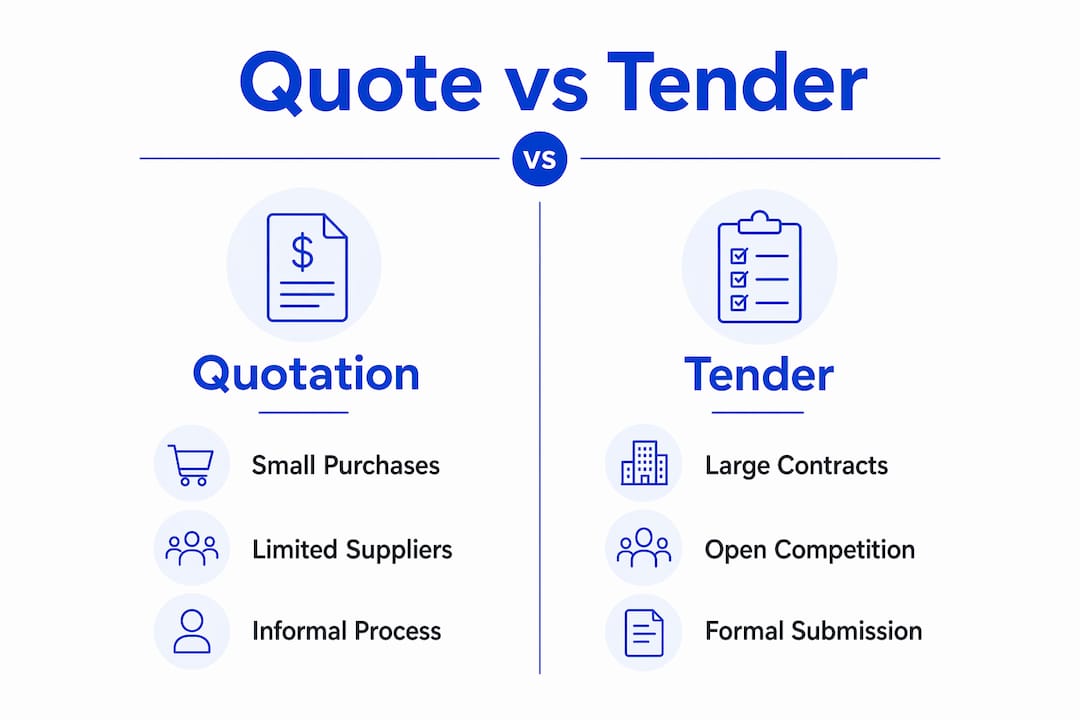
 Quotation (RFQ — Request for Quotation): A buyer contacts a limited number of suppliers and asks for a price. The process is short, usually 7–14 days, and the decision is primarily price-led. A local municipality asking three suppliers to quote for office stationery is a classic example. Even in the public sector, an RFQ still requires a CSD registration, a valid SARS tax compliance pin, and a B-BBEE affidavit or certificate where applicable.
Tender (RFT/RFP/ITT — Request for Tender, Request for Proposals, Invitation to Tender): A public or formal solicitation with detailed specifications, mandatory forms, and a structured evaluation process. A municipal roadworks contract or a provincial IT services contract are typical examples. Tenders are governed by the Preferential Procurement Policy Framework Act (PPPFA) and its regulations, which prescribe exactly how price and B-BBEE preference points are calculated.
Quotation (RFQ — Request for Quotation): A buyer contacts a limited number of suppliers and asks for a price. The process is short, usually 7–14 days, and the decision is primarily price-led. A local municipality asking three suppliers to quote for office stationery is a classic example. Even in the public sector, an RFQ still requires a CSD registration, a valid SARS tax compliance pin, and a B-BBEE affidavit or certificate where applicable.
Tender (RFT/RFP/ITT — Request for Tender, Request for Proposals, Invitation to Tender): A public or formal solicitation with detailed specifications, mandatory forms, and a structured evaluation process. A municipal roadworks contract or a provincial IT services contract are typical examples. Tenders are governed by the Preferential Procurement Policy Framework Act (PPPFA) and its regulations, which prescribe exactly how price and B-BBEE preference points are calculated.
Key named entities you will encounter in both processes:
- Central Supplier Database (CSD): Mandatory registration for any public procurement participation.
- SARS tax compliance status: A valid tax compliance pin is a non-negotiable prerequisite.
- B-BBEE affidavit / certificate: Exempted Micro Enterprises (EMEs) with turnover below R10 million may use a sworn affidavit, valid for one year, instead of a full verification certificate.
- PPPFA: The governing legislation that sets the 80/20 and 90/10 preference point systems used in tender evaluation.
*
How do quotes and tenders compare at a glance?
| Dimension | Quotation (RFQ) | Tender (RFT/RFP/ITT) |
|---|---|---|
| Purpose / when to use | Small, routine purchases below threshold | High-value, complex, or publicly advertised contracts |
| Formality and openness | Private; limited invited suppliers | Public; open to all qualifying bidders |
| Evaluation method | Primarily price-led | Multi-stage: admin check → functionality → price + preference points |
| Documentation required | CSD profile, tax compliance pin, B-BBEE affidavit | All RFQ docs plus signed SBDs, technical proposal, B-BBEE certificate |
| Typical threshold (public sector) | Below R350,000 (municipal) or R1 million (national) | Above those thresholds per MFMA or PFMA rules |
| Timeline | 7–14 days | 4 weeks from advertisement to award |
| Price weighting | Lowest price wins | 80 or 90 points for price; 20 or 10 points for B-BBEE preference |
The 80/20 system applies to contracts up to R50 million; the 90/10 system applies above R50 million. That threshold is set by the Preferential Procurement Regulations, 2022, not by the individual buyer's discretion.
One practical point worth knowing: the MFMA (Municipal Finance Management Act) and PFMA (Public Finance Management Act) set different thresholds for municipalities versus national and provincial departments. If you are targeting municipal tenders, confirm the specific municipality's procurement policy for the exact RFQ ceiling.
*How to prepare a winning quotation (RFQ)
Speed and clarity are what buyers want from an RFQ response. Over-engineering it wastes your time and can actually make a simple quote look suspicious.
- Confirm the scope first. Before pricing, verify quantities, delivery address, specifications, and acceptance criteria. A quote built on wrong assumptions loses the job even if the price is right.
- Build the price correctly. Include unit prices, a total lump sum, VAT treatment (state whether VAT is included or excluded), and a validity period. A well-structured quotation also shows a price breakdown, delivery schedule, payment terms, and any exclusions.
- State your commercial terms. Lead time, delivery schedule, warranty, and payment terms belong in every written quote. Leaving them out creates disputes later.
- Attach compliance documents. For public buyers, include your CSD profile confirmation and SARS tax compliance pin. Some buyers also request a B-BBEE affidavit and proof of capacity (company registration, bank details).
- Format it simply. A short cover note, an itemised pricing table, and a signed page. That is all. Anything longer than two pages for a routine RFQ is overkill.
Pro Tip: Build a reusable RFQ template with pre-filled line items, your standard terms, and a compliance attachments checklist. A template cuts response time from hours to minutes and reduces the risk of forgetting a required field. *
How to prepare a compliant tender submission in South Africa
A tender submission is a different beast from an RFQ. It rewards preparation, not speed. Start well in advance of the closing date to prepare a compliant tender submission.
Step 1: Read the full tender document. Note the closing date and time, any compulsory briefing sessions (missing these disqualifies you automatically at many entities), the scope of work, and the evaluation criteria. The evaluation criteria tell you exactly where to invest your writing effort. Step 2: Administrative checklist. Every document below must be current and correctly signed before you write a single word of your technical proposal:- Active CSD registration
- Valid SARS tax compliance pin
- B-BBEE affidavit (EMEs under R10 million turnover) or verification certificate, valid for one year
- Company registration documents (CIPC)
- Signed SBD forms: SBD 1, SBD 4, SBD 6.1, SBD 8, SBD 9 (and any entity-specific forms listed in the tender)
- Bank confirmation letter
How are tenders evaluated in South Africa?
Evaluation follows a strict three-stage sequence. Fail stage one and your technical proposal is never read.
Stage 1: Administrative compliance. Evaluators check that every mandatory document is present, signed, and current. Missing a signature on SBD 4 or submitting an expired tax compliance pin ends your bid here, regardless of how strong your proposal is. Administrative non-compliance is the most common cause of disqualification for SMMEs, not price. Stage 2: Functionality / technical assessment. Bidders are scored against pre-published criteria: methodology, relevant experience, team qualifications, resources, and quality assurance approach. A minimum qualifying score is set in the tender documents. Bidders who do not reach it are eliminated before price is even considered. The PPPFA Regulations require that evaluation criteria for functionality be objective and stated upfront. Stage 3: Price and preference points. Only bidders who pass stages one and two reach this stage. The 80/20 or 90/10 preference point system then applies:- 80/20 system: 80 points for price, 20 points for B-BBEE preference goals. Used for contracts up to R50 million.
- 90/10 system: 90 points for price, 10 points for B-BBEE preference goals. Used for contracts above R50 million.
Local content requirements can also be a specific tendering condition in designated sectors, per the dtic preferential procurement framework. If local content applies to your tender, it is stated in the tender documents and non-compliance is grounds for rejection.
*Pre-submission checklist: are you ready to quote or tender?
Run through this before you submit anything.
For any public procurement (RFQ or tender):- [ ] CSD profile active and all fields current
- [ ] SARS tax compliance pin valid (not expired)
- [ ] B-BBEE affidavit (EME, turnover below R10 million) or verification certificate on hand
- [ ] Company registration documents (CIPC) available
- [ ] Bank confirmation letter current
- [ ] Compulsory briefing attended (if applicable)
- [ ] All SBD forms downloaded from the correct tender document (SBD 1, 4, 6.1, 8, 9)
- [ ] Every signature page signed by the authorised person
- [ ] Technical proposal written to the stated evaluation criteria
- [ ] CVs and project references prepared and formatted
- [ ] Bill of quantities or priced schedule completed
- [ ] Submission format confirmed (electronic PDF, sealed envelope, or both)
- [ ] Closing date and time noted; internal deadline set 48 hours earlier
- [ ] Cost model reviewed and approved internally
- [ ] Working capital plan in place for 30–90+ day payment terms
- [ ] Subcontracting or consortium arrangements documented if needed
- [ ] Authorised signatory available before the closing date
Common mistakes that get SMMEs disqualified
Most disqualifications have nothing to do with price or quality. They come from paperwork.
Top administrative errors:- Missing or incorrect signatures on SBD forms (SBD 4 and SBD 6.1 are the most frequently unsigned)
- Expired SARS tax compliance pin submitted with the bid
- Incomplete or outdated CSD profile
- B-BBEE affidavit omitted or outside its one-year validity
- Using an old version of SBD 6.1 that does not align with the PPR 2022
- Underpricing to win, then failing to deliver because the margin cannot cover costs
- Writing a five-page RFQ response when a one-page itemised quote was requested
- Not reading the minimum functionality score before submitting, then scoring below it and losing despite a competitive price
- Ignoring the working capital requirement and accepting a contract they cannot finance
- Maintain a document library: current CVs, project references, CSD screenshots, and B-BBEE documents in one folder, updated quarterly.
- Run a mock evaluation against the tender's scoring rubric before you submit. Score your own bid honestly.
- Use a corporate RFP preparation framework to structure your technical responses more clearly, even for public tenders.
Where to find RFQs and tenders in South Africa
Primary official sources:- eTender Publication Portal (National Treasury): the central platform for national and provincial advertised tenders.
- Municipal bulletin boards and websites: each municipality publishes its own tenders; check weekly.
- State-owned enterprise portals: Eskom, Transnet, and similar entities publish on their own procurement pages.
- Provincial treasury portals: some provinces maintain separate tender bulletins alongside the national portal.
- Subscribe to buyer email lists directly from department procurement offices.
- Set keyword and region alerts so you are notified the moment a relevant opportunity is published.
- Check compulsory briefing notices immediately after a tender is advertised — missing a briefing can disqualify you even if you submit a perfect bid.
Key takeaways
Winning public procurement in South Africa comes down to one discipline: get your compliance documents right before you write a single word of your proposal.
| Point | Details |
|---|---|
| Choose the right method | Use an RFQ below the threshold (R350,000 municipal / R1 million national); use a formal tender above it. |
| Admin compliance is the gate | Missing signatures, expired tax pins, or an absent B-BBEE affidavit disqualify you before evaluators read your proposal. |
| Preference points follow the PPPFA | The 80/20 system applies to contracts up to R50 million; the 90/10 system applies above R50 million. |
| Working capital is non-negotiable | Government payment terms run 30–90+ days; plan your cashflow before accepting a contract. |
| Protenders centralises the process | Protenders aggregates live tenders, provides compliance scorecards, SBD templates, and funding connections for SMMEs. |
Why SMMEs should start with quotes and scale to tenders
The most common mistake I see SMMEs make is skipping the RFQ stage entirely and going straight for large tenders they are not yet equipped to win. An RFQ is not a consolation prize. It is how you build the references, delivery history, and compliance muscle that evaluators look for when they score your functionality proposal on a R5 million contract.
Start with what you can win cleanly. A few successful RFQ deliveries create the project references that lift your functionality score. They also reveal gaps in your admin: an expired B-BBEE affidavit or a CSD field you forgot to update is far less damaging when it costs you a R50,000 quote than when it disqualifies you from a R2 million tender. The progression from quotes to tenders is not just strategic; it is the safest way to build a procurement track record that holds up under scrutiny.
Protenders exists precisely to make that progression less painful. The compliance scorecard shows you what is missing before you submit. The template library means you are not starting from scratch every time. And when you are ready for larger contracts, the funding partnerships help bridge the working capital gap that stops many capable SMMEs from accepting the contracts they actually win.
*Protenders makes the jump from quotes to tenders easier
Searching for live tenders across dozens of municipal, provincial, and national portals manually takes hours every week. Protenders pulls all of that into one place, searchable by keyword, region, or category, with no sign-up required to browse.
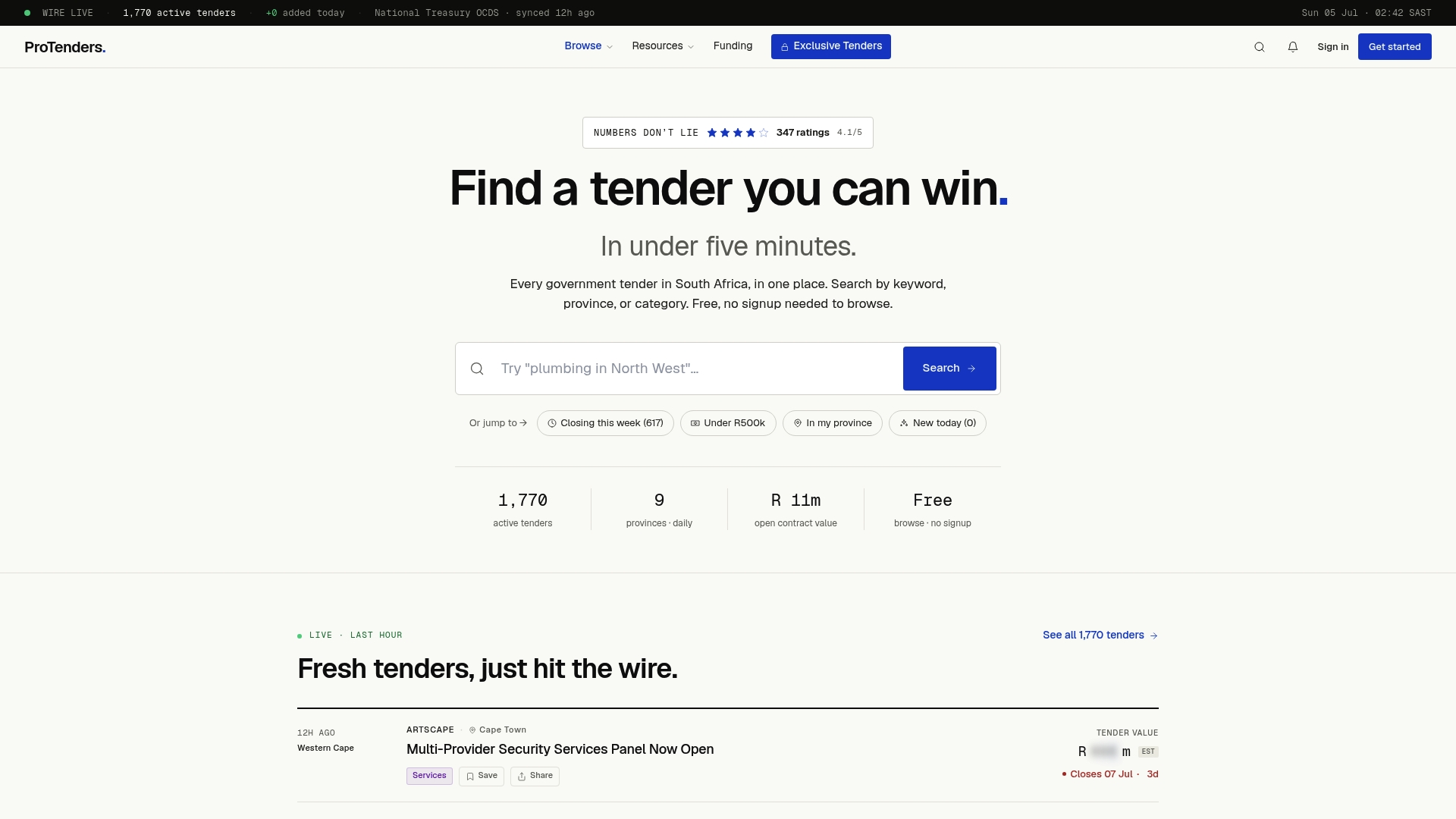
Beyond discovery, the platform gives SMMEs the tools that actually reduce disqualification risk: a compliance scorecard that flags expired documents before you submit, downloadable SBD templates pre-formatted to current PPR 2022 requirements, and a bid workspace where you can track multiple submissions at once. For suppliers who win contracts but struggle with the 30–90+ day payment gap, Protenders connects you with tender funding partners directly.
Whether you are responding to your first RFQ or preparing a multi-stage bid proposal for a provincial department, start with Protenders to find live opportunities and access the templates and compliance tools that give your submission the best chance of reaching stage three.
*Useful sources
"The PPPFA prescribes that the lowest acceptable tender must score 80 or 90 points for price. Tenders that quoted higher prices will score lower points for price on a pro-rata basis." — Preferential Procurement Regulations, 2022 Implementation Guide (National Treasury)
| Source | What you will find there |
|---|---|
| Public Procurement Act | The primary legislation governing all public procurement in South Africa; sets constitutional principles and institutional framework. |
| PPPFA Regulations | Detailed rules for 80/20 and 90/10 preference point systems, functionality evaluation, and local content requirements. |
| PPR 2022 Implementation Guide (National Treasury) | Practical guidance on applying the updated preferential procurement regulations, including SBD 6.1 requirements. |
| dtic: B-BBEE procurement and verification | Explains how B-BBEE status is verified, how preference points are awarded, and local content conditions. |
| CSD and compliance prerequisites (DOH-FS) | Practical guidance on CSD registration, SARS tax compliance, and B-BBEE affidavit rules including the EME R10 million threshold. |
| Protenders: live tender search and templates | Aggregated live government tenders, compliance scorecards, SBD templates, and funding connections for South African SMMEs. |
FAQ
What is the difference between a quote and a tender?
A quotation (RFQ) is a price request sent to a limited number of suppliers for small, routine purchases, evaluated primarily on price. A tender is a formal, publicly advertised solicitation for high-value or complex contracts, evaluated in multiple stages including administrative compliance, functionality, and preference points under the PPPFA.
How do you prepare a quote for a tender?
For an RFQ, include an overall price, a line-item breakdown, delivery schedule, payment terms, validity period, and any exclusions, as well as your CSD profile confirmation and SARS tax compliance pin for public buyers. For a formal tender, the pricing schedule must align with the applicable preference point system: the 80/20 system applies to contracts up to R50 million; the 90/10 system applies above R50 million; and must be submitted alongside signed SBD forms and a technical proposal.
What thresholds determine whether an RFQ or tender is used?
Municipalities commonly use tenders above R350,000 and national departments above R1 million, though exact thresholds differ between MFMA and PFMA entities. The preference point system threshold is separate: the 80/20 system applies to contracts up to R50 million; the 90/10 system applies above R50 million, per the Preferential Procurement Regulations, 2022.
What documents do you need to respond to a public tender in South Africa?
At minimum: an active CSD registration, a valid SARS tax compliance pin, a B-BBEE affidavit or verification certificate, company registration documents, a bank confirmation letter, and signed SBD forms (SBD 1, 4, 6.1, 8, and 9). Missing or unsigned documents are the most common cause of disqualification before evaluators even read the technical proposal.
How does Protenders help with quotes and tenders?
Protenders aggregates live government tenders from national, provincial, and municipal buyers into one searchable platform, and provides compliance scorecards, SBD templates, and a bid workspace to help SMMEs prepare compliant submissions and reduce the risk of administrative disqualification.
Recommended
- SMME Tenders South Africa 2026: Government Opportunities for Small Businesses | ProTenders
- How to Apply for a Tender in South Africa: Step-by-Step (2026) | ProTenders
- ProTenders | Find a Government Tender in 5 Seconds | South Africa July 2026
- How to Find Government Tenders in South Africa (2025 Complete Guide) | ProTenders