South Africa business opportunities: SMME tender guide
 *
*
TL;DR:>
- Register on the Central Supplier Database to meet eligibility requirements for most South African government tenders.*
- Start with municipal RFQs to build a track record and collect certificates that enable bigger contracts later.
The fastest route to South African government business opportunities is a three-step sequence: search the National Treasury eTender portal and municipal procurement pages, register on the CSD, then target RFQs and smaller municipal contracts to build your first completion certificates. Do those three things before anything else.
Your immediate action list:- Register on the Central Supplier Database (CSD) — it is a baseline eligibility requirement for most national and provincial tenders.
- Set up keyword alerts on an aggregator like Protenders so live opportunities reach you automatically.
- Shortlist two or three open RFQs or municipal notices in your sector and check your compliance documents against each one.
Table of Contents
- What registration documents do you need for South African tenders?
- How do you find the right tenders faster?
- How do you structure a proposal that actually wins?
- Why starting small builds a winning track record
- What funding options exist for SMMEs that win tenders?
- How long does it take to prepare and submit a tender?
- What happens after you win: delivery and compliance
- How does government score your bid?
- Legal and ethical requirements in government procurement
- What can you do if you lose a tender or want to challenge the outcome?
- How do you build relationships with government buyers?
- How do you manage risk in government contracting?
- Which sectors offer the most South African government tender activity?
- Protenders makes tender discovery faster for SMMEs
- FAQ
- Key takeaways
What registration documents do you need for South African tenders?
CSD registration is the foundation. You complete a two-stage self-registration: create a user profile, then add your supplier details including industry classification, commodities, delivery locations, tax information, directors, and B-BBEE status. Once submitted, you receive a Supplier Number and a 36-digit Unique Registration Reference Number.
Beyond the CSD, every bid package typically requires:
- A valid SARS tax clearance certificate (or Tax Compliance Status PIN)
- B-BBEE certificate or sworn affidavit (for EMEs and QSEs)
- CIPC company registration documents
- Certified ID copies of directors or members
- Three months of bank statements and a bank confirmation letter
- Completed SBD forms with original signatures
- CIDB grading certificate for construction-related tenders
Bids are frequently disqualified for expired tax compliance, missing signatures on SBD forms, or mismatched details between CIPC, CSD, and the bid itself. Run a compliance audit before you write a single word of your technical proposal. The dtic's B-BBEE guidance shapes how preference points are applied, so confirm your certificate level is current.
How do you find the right tenders faster?
National and provincial opportunities sit on the National Treasury eTender portal; municipalities post on their own Supply Chain Management pages and tender bulletins. Searching both manually is slow. Use keyword filters by commodity code or sector, set saved searches, and activate email alerts so you see new notices the day they publish.

RFQs differ from RFPs in one practical way: RFQs are lower-value, less formal, and usually have shorter closing windows. They are your entry point. RFPs and full tenders demand more documentation and longer preparation time, but they carry higher contract values. Work both channels, but weight your early effort toward RFQs.
Pro Tip: Save separate alert profiles for your top three commodity codes. A single broad alert floods your inbox; three narrow ones surface only what you can actually deliver.How do you structure a proposal that actually wins?
Mirror the buyer's language exactly in your technical proposal. Label your sections to match the scope of work and evaluation criteria in the tender document. Evaluators work through dozens of submissions; a response that maps directly to their criteria reduces their burden and improves your functionality score.
Tenders frequently apply functionality thresholds that require a minimum standard of capability. A weak methodology or capacity response eliminates your bid before price is even considered. Address every criterion explicitly, provide evidence (completion certificates, CVs, equipment lists), and never assume the evaluator will infer capability you have not stated.
Use your tender document checklist to verify every attachment is present, signed, and dated before submission.
Why starting small builds a winning track record
Treat tendering as a cycle: discovery, delivery, proof. Each completed contract produces a completion certificate, and those certificates are the evidence base for your next, larger bid. Without them, your methodology section is assertion without support.
Municipal contracts are the practical starting point. Lower advertised thresholds mean less competition, and faster procurement cycles mean you collect certificates sooner. Two or three municipal wins in twelve months positions you credibly for provincial or national tenders. The SMME tender guide covers this progression in detail.What funding options exist for SMMEs that win tenders?
Winning a tender without the working capital to deliver it is a real problem. Three options are worth knowing:
- SEFA (Small Enterprise Finance Agency): Government-backed loans and bridging finance for SMMEs, including purchase order funding.
- IDC and NEF: The Industrial Development Corporation and National Empowerment Fund offer sector-specific financing, particularly for manufacturing and black-owned enterprises.
- Tender funders (purchase order finance): Private funders assess the purchase order and the government buyer's ability to pay, then advance working capital against the contract. Fees apply, so factor the cost into your pricing.
Subcontracting and joint ventures are another route. If a contract exceeds R30 million, the Preferential Procurement Regulations may require the winning bidder to subcontract at least 30% to an EME or QSE. Positioning your business as that subcontractor is a legitimate entry strategy.
How long does it take to prepare and submit a tender?
RFQs can be turned around in two to five days if your compliance documents are current. Full tenders typically require two to four weeks of preparation: reading the specification, writing the technical proposal, gathering supporting documents, pricing, and internal review.
Bid bonds and performance guarantees are not universal, but larger infrastructure contracts often require them. A performance guarantee is typically a percentage of the contract value, issued by a bank or insurer. Budget for this cost before you bid, and confirm the requirement in the tender document.
What happens after you win: delivery and compliance
Post-award, your obligations shift from bidding to contract management. Key requirements:
- Deliver exactly what the scope of work specifies, on time and within budget.
- Invoice correctly: reference the purchase order number, VAT registration, and banking details that match your CSD record.
- Request a completion certificate from the buyer immediately after final delivery. Do not wait; some departments issue them slowly if you do not follow up.
- Keep all correspondence, delivery notes, and sign-off documents. You will need them for disputes and for future bids.
Contract variations must be approved in writing. Delivering outside the agreed scope without written approval creates payment disputes and can result in blacklisting.
How does government score your bid?
South African government uses two preference point systems under the Preferential Procurement Policy Framework Act:
- 80/20 system: Applies to tenders valued from R30,000 up to R50 million. Eighty points for price, twenty for B-BBEE preference.
- 90/10 system: Applies above R50 million. Ninety points for price, ten for B-BBEE.
Price dominates. B-BBEE status is a powerful tie-breaker but cannot rescue an uncompetitive price. If two bidders score equal total points, the contract goes to the higher B-BBEE scorer. Functionality scoring happens before price and preference are applied; fail the functionality threshold and neither your price nor your B-BBEE level matters.
Legal and ethical requirements in government procurement
The Public Procurement Act 28 of 2024 sets the current framework: fair, equitable, transparent, competitive, and cost-effective procurement across all spheres of government. Practically, this means:
- Never offer gifts, payments, or favours to procurement officials.
- Declare any conflict of interest on the SBD 4 form.
- Do not collude on pricing with other bidders.
- Misrepresentation on any SBD form is grounds for disqualification and potential criminal prosecution.
The Prevention and Combating of Corrupt Activities Act (PRECCA) applies to both the official and the bidder. A conviction can result in your company being listed on the National Treasury's database of restricted suppliers, which effectively bars you from all government contracts. This article is general information, not legal advice. Confirm current procurement rules with National Treasury or a qualified procurement professional for your specific situation.
What can you do if you lose a tender or want to challenge the outcome?
Losing a tender is not the end of the process. Request a debriefing from the procuring institution. Most departments will explain why your bid was unsuccessful, which tells you exactly what to fix next time.
If you believe the process was irregular, the Public Procurement Act provides for dispute resolution. You can lodge a formal objection with the procuring institution, escalate to the relevant treasury (provincial or national), or approach the Public Protector if you suspect maladministration. Keep all your submission records; you cannot mount a credible challenge without them.
How do you build relationships with government buyers?
Government buyers cannot discuss live tenders with bidders outside the formal process, but relationship-building happens legitimately in other ways. Attend supplier briefing sessions for tenders you plan to bid on; these are public, on the record, and give you direct insight into what the buyer actually needs. Industry bodies like the South African Forum of Civil Engineering Contractors (SAFCEC) and sector-specific chambers run events where procurement officials speak openly.
Register with the relevant government department's supplier database where one exists beyond the CSD. Some departments maintain their own preferred supplier lists for lower-value RFQs. Being on that list means you receive direct quotation requests without competing in a public tender.
How do you manage risk in government contracting?
Government contracts carry specific risks that private-sector work does not. Payment terms are typically 30 days from a valid invoice, but delays happen. Do not commit your full working capital to a single contract without a funding backstop.
Scope creep is common on infrastructure projects. Agree on a variation order process in writing at contract start. Price escalation clauses matter on contracts longer than twelve months; check whether the tender allows for CPI-linked adjustments. And always read the penalty clauses before you sign: late delivery penalties on government contracts can be significant.
Which sectors offer the most South African government tender activity?
Construction and infrastructure consistently attract the highest tender volumes, driven by the government's infrastructure investment priorities. IT and digital services are growing fast, particularly projects linked to the SA Connect broadband programme and e-government platforms. Health, education, and professional services (consulting, legal, audit) generate steady volumes at both national and provincial level.
For construction-specific opportunities, CIDB registration is mandatory; your grading determines which contract values you can bid on. The Gauteng tender market is the largest provincial market by volume and worth monitoring regardless of your sector.
Protenders makes tender discovery faster for SMMEs
Finding and tracking South African government tenders across national, provincial, and municipal sources manually takes hours every week. Protenders aggregates live notices from all those sources into a single searchable platform, no sign-up required to browse.
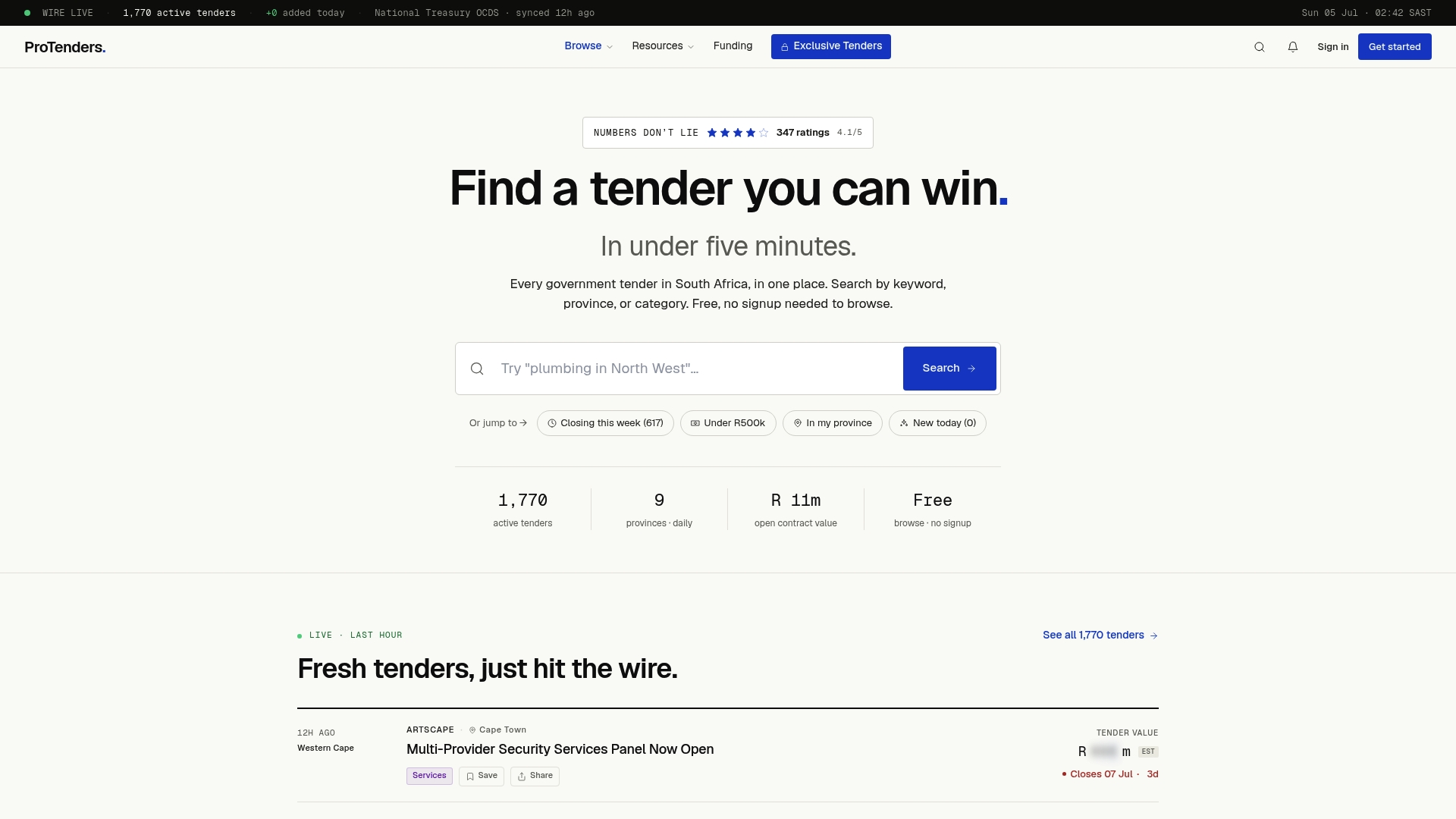
The platform is built around the SMME workflow: search by keyword, region, or commodity category; set automated alerts so new tenders reach you the day they publish; use the compliance scorecard to check your documents before submission; access SBD form templates and a bid workspace to keep your response organised. Funding partner connections are built in for SMMEs that need working capital to deliver after winning. The B-BBEE tender guide on the platform covers preference point strategy in detail.
Search live government tenders on Protenders now, free, with no account needed. Run your compliance checklist before you submit any bid.FAQ
What is the CSD and why do I need it?
The Central Supplier Database is the South African government's single supplier registry. CSD registration is a baseline eligibility requirement for most national and provincial tenders.
How does the 80/20 preference point system work?
Tenders valued between R30,000 and R50 million use the 80/20 system: 80 points for price, 20 for B-BBEE preference. Price is the dominant factor; B-BBEE breaks ties.
What is the fastest way to get my first government contract?
Target RFQs and smaller municipal tenders first. They have lower experience requirements, shorter preparation times, and faster payment cycles, and each completed contract produces a completion certificate you need for larger bids.
Can I bid for tenders if I have no track record?
Yes, but start with RFQs and low-value municipal contracts where experience requirements are minimal. Build completion certificates from those wins before bidding on tenders that require demonstrated prior contracts.
Where are South African government tenders published?
National and provincial tenders appear on the National Treasury eTender portal; municipalities post on their own Supply Chain Management pages. Protenders aggregates all of these into one searchable feed.
Key takeaways
Winning South African government tenders requires CSD registration, compliance-first document preparation, and a deliberate start-small strategy to build the completion certificates that unlock larger contracts.
| Point | Details |
|---|---|
| Register on the CSD first | CSD registration is a baseline eligibility requirement for most national and provincial tenders. |
| Compliance beats everything | Bids are frequently disqualified for expired tax compliance, missing signatures, or mismatched CIPC and CSD details. |
| Start with RFQs | Municipal RFQs have lower thresholds and faster cycles; each win produces a completion certificate for your next bid. |
| Price dominates scoring | Under the 80/20 system, 80 points go to price; B-BBEE preference is a tie-breaker, not a substitute for a competitive price. |
| Use Protenders to search | Protenders aggregates live national, provincial, and municipal tenders with compliance tools and alerts built in for SMMEs. |
Recommended
- SMME Tenders South Africa 2026: Government Opportunities for Small Businesses | ProTenders
- How to Apply for a Tender in South Africa: Step-by-Step (2026) | ProTenders
- How to Find Government Tenders in South Africa (2025 Complete Guide) | ProTenders
- B-BBEE Tenders South Africa: Complete Guide to BEE Tender Opportunities 2026 | ProTenders