30 Day Payment Fix for South African Subcontractor Agreements: CIDB

A South African subcontract must be written, and it must nail down four things without ambiguity: scope of work, payment timing, liability allocation, and compliance with CIDB and industry standard forms. Skip any one of those and you're exposed to disputes that vague wording almost never survives in court. Payment should be made promptly after a valid statement, typically within a legally acceptable period. Everything else in this guide builds from that foundation.
*TL;DR:>
- A subcontract must clearly define scope, payment timing, liability, and compliance to prevent disputes and ensure enforceability under South African law.*
- The choice between lump sum, measured, or cost-plus pricing shifts risk and must be deliberate, not accidental, to match project needs.
- There are three main subcontractor types—domestic, nominated, and selected—that influence who bears cost and termination risks, especially if disputes arise.
- Payment terms should require prompt payment within 30 days of a valid statement, supported by certification to protect subcontractor cash flow.
- Using recognized standard contract forms like CIDB, JBCC, NEC, or FIDIC and verifying compliance documentation before signing reduces gap risk and project delays.
Table of Contents
- Essential clauses every South African subcontractor agreement must include
- What are the three types of subcontractors in South Africa?
- How should payment terms protect subcontractor cashflow?
- Liability, indemnities and insurance requirements
- How should termination and disputes be handled?
- Which standard contract forms should you use in South Africa?
- What permits and approvals must subcontractors obtain?
- Practical drafting checklist and sample clause bank
- Where to find compliant templates and compliance checks
- Author perspective: drafting for fairness and enforceability
- How Protenders helps you get tender-ready faster
- Sources
- FAQ
Essential clauses every South African subcontractor agreement must include
The single biggest reason subcontracts unravel in South Africa isn't bad faith. It's sloppy drafting. Courts and practitioners consistently point to vague scope language as the most common trigger for disputes, because contractual certainty is the bedrock of enforceability under South African common law. A scope clause that says "electrical works as required" invites argument the moment something goes wrong. A scope clause that references attached drawings, a bill of quantities, and a signed programme does not.
Beyond scope, a handful of clauses carry the real weight in any commercial subcontractor agreement:
- Scope of work and deliverables, tied to attached drawings, specifications, or schedules rather than described in the body text alone.
- Variation procedure, specifying who can authorise a change (by name or role) and requiring written instruction before extra work starts.
- Pricing model, whether lump sum, measured, or cost-plus, because each shifts risk differently between contractor and subcontractor.
- Invoicing mechanics, stating exactly what documents must accompany a claim (progress certificates, timesheets, delivery notes).
- Programme and milestones, so delay claims have a fixed reference point instead of a moving target.
Skipping the pricing model discussion is a mistake contractors make constantly. A lump sum shifts quantity risk onto the subcontractor. A measured contract shifts it back onto the employer's side of the chain. Neither is wrong, but the choice has to be deliberate, not accidental.
What are the three types of subcontractors in South Africa?
South African construction practice recognises three distinct categories, and each one changes who absorbs cost and termination risk. The CIDB's research on subcontracting in the local industry confirms this three-way split is standard, not a regional quirk.
- Domestic subcontractors are selected and appointed entirely by the main contractor, with no employer involvement in the choice. The contractor carries full risk for the subcontractor's performance and cost overruns.
- Nominated subcontractors are chosen by the employer or the principal agent, but the main contractor still administers the contract. Cost risk on nomination often sits closer to the employer, particularly under JBCC-style arrangements, though the contractor still manages delivery.
- Selected subcontractors sit somewhere between the two: the employer influences or approves the choice from a tender list, but the contractor negotiates and manages the appointment.
The distinction matters most at termination or when costs blow out. A domestic appointment leaves the contractor exposed with limited recourse. A nominated one can trigger relief provisions under the principal contract if the CIDB and JBCC framework allows for it.
How should payment terms protect subcontractor cashflow?
Late payment is the single biggest operational threat to a South African subcontractor's cashflow, and the drafting fix is straightforward even if the industry doesn't always apply it. CIDB's own standard for minimum requirements encourages that payment follow promptly after a subcontractor's valid statement, supported by certification evidence.
A few drafting points protect that cashflow in practice:
- Retention money typically runs at 5% to 10% of certified value, released in two tranches: half at practical completion, half at the end of the defects liability period.
- Interim payment certificates should be a contractual requirement, not a courtesy, with a fixed date each month for submission.
- Pay-when-paid clauses are a red flag. Making your payment conditional on the contractor first receiving payment from the employer shifts the employer's credit risk onto the smallest party in the chain, and industry guidance flags this as an unacceptable subcontracting practice.
Pro Tip: Replace "payment is due within 7 days of the contractor receiving payment from the employer" with a fixed calendar trigger: "payment is due within 30 days of the subcontractor's valid statement, regardless of the status of payment between contractor and employer." That single edit removes the enforceability risk entirely.
Require a certificate of completion or progress sign-off with every invoice. It closes off the most common excuse for delayed payment: "we're still checking the work."
Liability, indemnities and insurance requirements
Liability clauses do two different jobs, and conflating them is a common drafting error. An indemnity compensates for a specific type of loss (say, third-party injury on site). A liability cap limits the total financial exposure across the whole contract. You need both, worded separately, because a cap without an indemnity leaves gaps, and an indemnity without a cap leaves you exposed to unlimited claims.

South African law won't let you contract out of liability for gross negligence or wilful misconduct, no matter how the clause is worded. Attempting it just invites a court to strike the clause down, per the contractual principles established in South African case law.
Insurance cover should be non-negotiable in the agreement, not left to assumption:
- Public liability insurance, matched to project value
- Contractors' all-risk cover for works in progress
- COIDA registration and good standing, confirmed in writing before work starts
- Professional indemnity, if the subcontractor provides design input
A workable limitation clause states a maximum liability figure (often tied to contract value), excludes gross negligence explicitly, and requires mutual indemnities rather than a one-sided obligation resting only on the subcontractor.
How should termination and disputes be handled?
Termination clauses fail when they're vague about timing. "Material breach" without a defined cure period is an invitation to argue about what counts as material and how long is reasonable.
- Termination for cause should specify the breach, a written notice, and a fixed cure period, typically 7 to 14 days, before termination takes effect.
- Termination for convenience should state how outstanding work and payment are calculated at the break point, including a formula for the final account.
- Dispute escalation should default to negotiation, then mediation or adjudication, before either party can go to arbitration or litigation. Fast, cheap resolution mechanisms keep small disputes from becoming expensive ones.
Nominated subcontractors often carry different termination consequences than selected or domestic ones, because the employer's involvement in the original appointment can trigger relief clauses in the principal contract. Check compatibility before you finalise the wording.
Which standard contract forms should you use in South Africa?
Standard forms exist precisely so you don't have to draft from scratch, and using one properly is safer than writing bespoke clauses for every project. CIDB, JBCC, NEC, FIDIC, and SAICE each publish recognised templates, and the right choice depends on the principal contract you're working under.
- JBCC N/S Subcontract pairs with the JBCC Principal Building Agreement and is the default for most building projects.
- NEC subcontracts, including the NEC3 ECS form, suit civil and infrastructure work, particularly under NEC principal contracts.
- FIDIC forms appear on internationally financed projects and larger infrastructure work, guided by FIDIC and CIDB compatibility notes.
- CIDB labour-only forms fit smaller, trade-specific appointments where materials risk stays with the contractor.
The trap most contractors fall into is mixing a JBCC principal contract with a bespoke subcontract that uses different definitions for practical completion or defects liability. That mismatch creates gap risk, meaning nobody is actually liable for the difference. Check compatibility clause by clause, not just at a glance.
What permits and approvals must subcontractors obtain?
Regulatory compliance sits outside the commercial clauses but carries just as much weight, because an uncompliant subcontractor can stall an entire project or expose the main contractor to liability. The subcontract should state explicitly who obtains what, because assuming it's "obviously" the subcontractor's job leads to gaps.
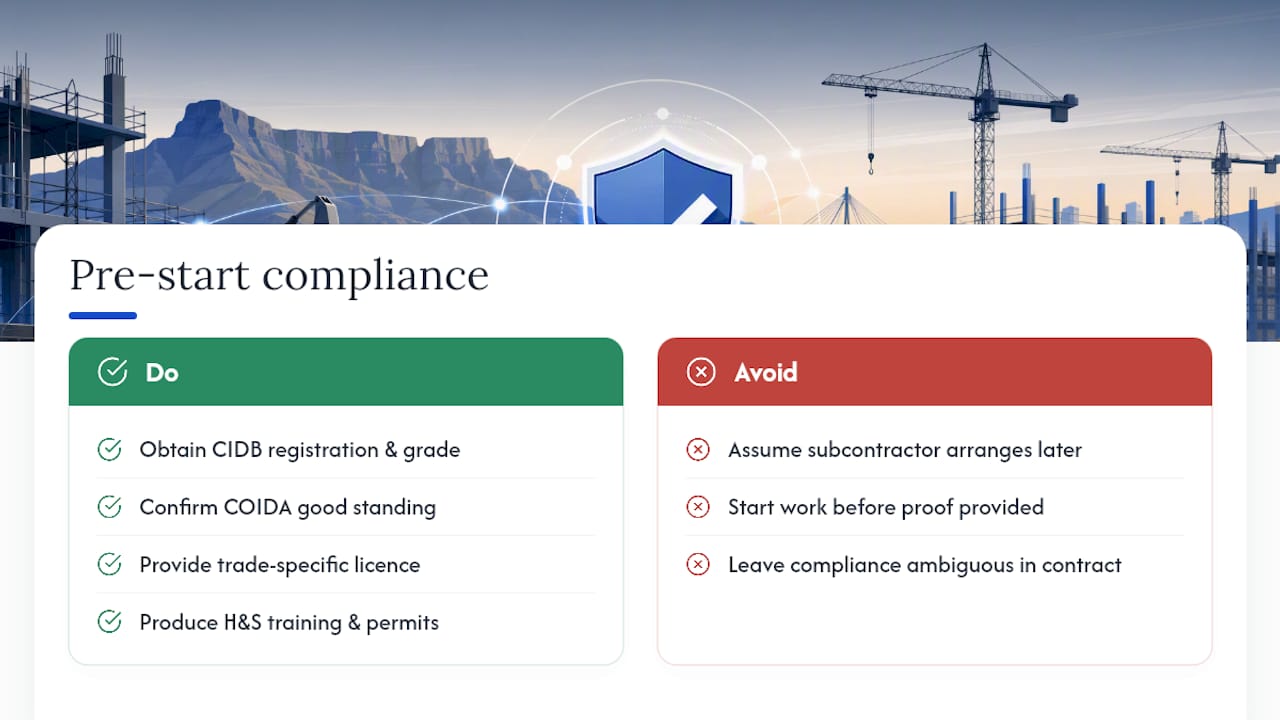
CIDB registration is the starting point for any subcontractor working on a graded project, and the minimum requirements standard treats it as a precondition to engagement, not an afterthought. Beyond CIDB grading, subcontractors typically need to demonstrate COIDA good standing, since the Compensation for Occupational Injuries and Diseases Act requires proof of registration before work on site begins.
Trade-specific licences add another layer. Electrical subcontractors need a valid Certificate of Compliance issued under the Electrical Installation Regulations. Plumbers working on regulated water systems need registration with the relevant professional body. Any subcontractor handling hazardous materials or working at height falls under specific Occupational Health and Safety Act regulations that require documented training and, in some cases, site-specific permits.
The subcontract should require proof of every relevant registration or licence before the subcontractor starts, not after. Building a simple compliance checklist into the appendices, with copies of certificates attached, removes any ambiguity about who's responsible when a municipal inspector or the Department of Employment and Labour asks for paperwork on site.
Practical drafting checklist and sample clause bank
Building an agreement from a checklist beats starting from a blank page, but only if you tailor every clause to the actual project. Copying a template wholesale, especially one built for a different contract value or scope, is how gap risk creeps in.
- Confirm both parties' full legal names, registration numbers, and signing authority.
- Attach scope appendices: drawings, specifications, bill of quantities.
- Fix the price schedule and payment trigger dates.
- State the invoicing protocol and required supporting documents.
- List required insurances and confirm COIDA status.
- Set warranty and defects liability periods explicitly.
- Include signature blocks with witness lines for both parties.
A few clause fragments worth adapting directly:
- Variation instruction: "No variation shall be valid unless issued in writing by [named role] prior to commencement of the varied work."
- Payment and interest: "Payment is due within 30 days of a valid statement; amounts unpaid after this period accrue interest at the prescribed rate."
- Termination for cause: "Either party may terminate on 14 days' written notice following a material breach not remedied within that period."
Confidentiality deserves its own clause too, particularly on projects involving proprietary designs or client data. Practical guidance on handling consultant confidentiality applies just as well to subcontractors who see sensitive drawings or client information during a project.
Where to find compliant templates and compliance checks
Drafting from scratch every time wastes hours you don't have during a live tender. A set of resources built specifically for South African procurement can help contractors move from template to signed agreement faster.
- Subcontract templates aligned to CIDB and JBCC structures, ready to adapt for scope and price.
- Compliance scorecards that flag missing registrations or documentation before a bid goes in.
- A tender glossary covering CIDB, JBCC, NEC and other acronyms that show up constantly in principal and subcontract documents.
- Guidance on CIDB registration and grading to confirm eligibility before appointing or accepting a subcontract role.
The workflow that works best: pick the standard form that matches your principal contract, tailor the schedules and price clauses to the actual project, then attach compliance evidence before submission. Verify anything contract-critical against the primary CIDB or JBCC documents rather than relying on a summary alone.
Author perspective: drafting for fairness and enforceability
Three things separate agreements that hold up from ones that collapse under pressure: name the scope in attachments, not prose; fix payment to a calendar date, never a condition; and never let a template's boilerplate override a project's actual risk profile. I've seen a single word, "similar" instead of "identical" in a scope clause, become the entire basis of a six-month dispute. Precision costs nothing at drafting stage. It costs everything later.
— Dolene April
How Protenders helps you get tender-ready faster
A platform provides South African SMMEs with streamlined access to public procurement opportunities without barriers like expensive retainers or mandatory sign-ups. Users can search live tenders by keyword, region or category, and access compliance tools and document templates to prepare subcontract paperwork efficiently before deadlines.
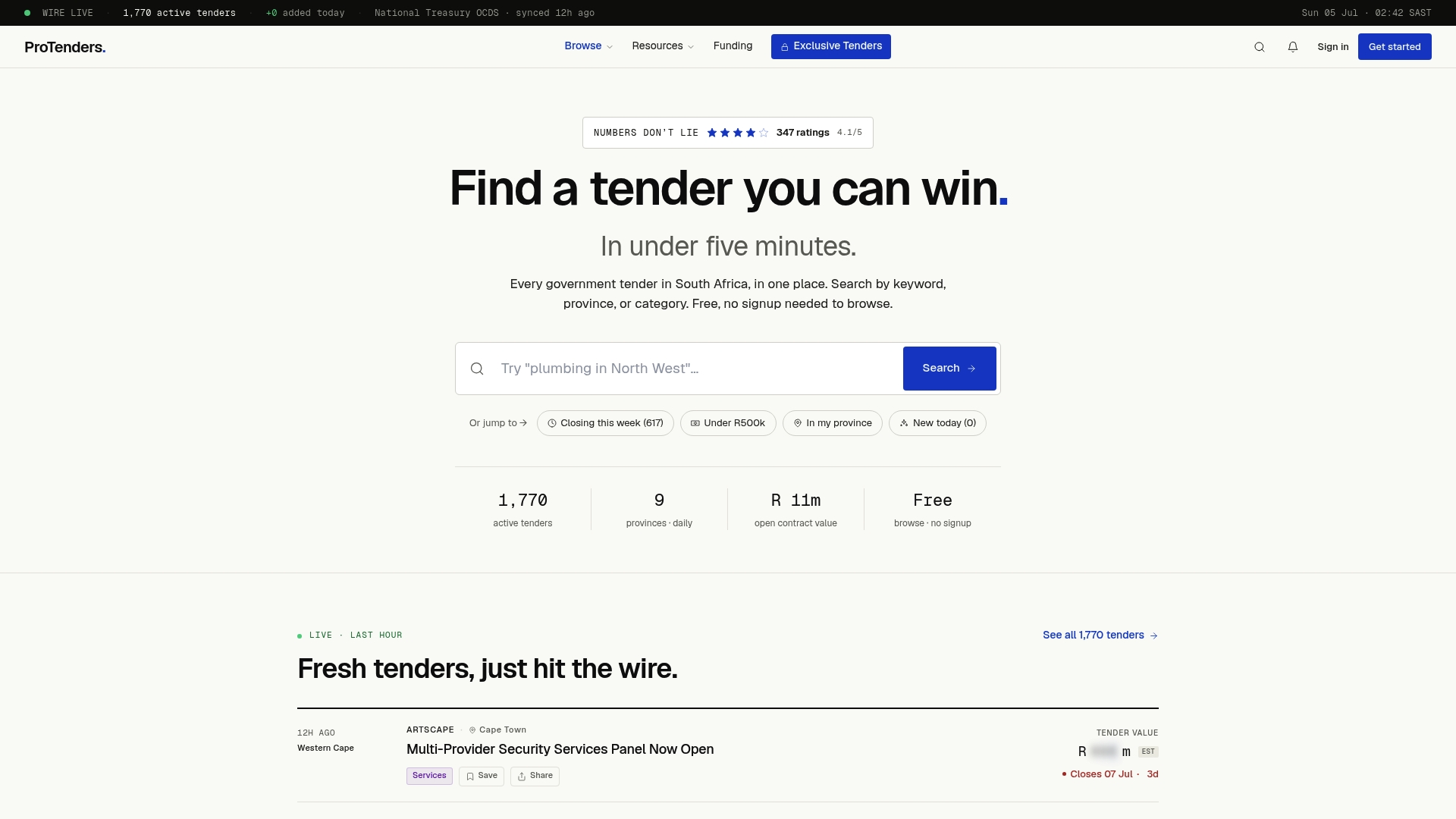
Beyond templates, some platforms aggregate live opportunities from national, provincial, and municipal buyers in one feed, simplifying the search for work that matches CIDB grading. If you're preparing a bid that will involve subcontractors, browse current government tenders now and check what compliance documentation the buyer expects before you draft a single clause.
Sources
Verify anything contract-critical against primary sources, not summaries. Start with the CIDB minimum requirements standard for registration and payment rules, the JBCC N/S Subcontract for building projects, NEC3 ECS for civil work, and BCEA, COIDA and the OHS Act for labour compliance. Case law on privity and termination limits is searchable through SAFLII.
- CIDB report — Subcontracting in the SA construction industry: opportunities for development
- Mayet & Associates — Subcontracting agreements in South Africa: key components for enforceability
- NEC3 ECS subcontract (download)
- SAFLII — South African Legal Information Institute
FAQ
How do I create a subcontractor agreement?
Start from a recognised standard form, JBCC, NEC or a CIDB labour-only template, then tailor the scope, price, payment terms and compliance clauses to your specific project rather than copying the boilerplate unchanged.
How does subcontracting work in South Africa?
A main contractor appoints a subcontractor for defined work, either directly (domestic), on the employer's instruction (nominated), or from an employer-approved list (selected), with each type shifting cost and termination risk differently.
What should be in a subcontractor agreement?
At minimum: a detailed scope with attachments, a fixed payment timeline within 30 days of a valid statement, liability caps and indemnities, insurance requirements, termination terms with notice and cure periods, and signatures confirming both parties' capacity.
What are the three types of subcontractors?
Domestic subcontractors are chosen entirely by the main contractor, nominated subcontractors are selected by the employer, and selected subcontractors fall between the two with employer input into an approved list.
Where can I find compliant subcontract templates in South Africa?
Some sources publish subcontract templates and compliance scorecards built around CIDB and JBCC structures, alongside standard forms available directly from CIDB, JBCC and SAICE.