6 Copy Ready Tender Clarification Questions for South African Bidders

Tender clarification questions are formal written queries you submit during a fixed window before bid closing, aimed at resolving gaps or ambiguity in the tender documents before you price and submit. Used correctly, they force the buyer to define vague requirements in writing, so you stop guessing what a scope clause or evaluation criterion actually means and start bidding on facts instead of assumptions.
*TL;DR:>
- Asking targeted clarification questions early in the window can significantly improve bid accuracy, especially on pricing, evaluation criteria, and contract terms.*
- Questions must specify the exact document location and seek a single, factual answer to avoid vague responses that won't clarify scope or compliance issues.
- Questions submitted through official channels before the cutoff are usually answered in an addendum or email, which should be carefully incorporated into your bid documents.
- Tracking all clarification responses in a dedicated log helps ensure that updates are correctly reflected in your bid and prevents missing critical amendments.
- Avoid asking vague or opinion-based questions late in the process, as responses may be rushed or unavailable, risking non-compliance or inaccurate pricing.
Table of Contents
- What are tender clarification questions and when do you use them?
- What questions do bidders typically ask, with examples you can adapt?
- How do you draft a clear, neutral clarification question?
- Where and when should you submit tender clarification questions?
- How do you track and apply clarification answers to your bid?
- When should you use clarifications strategically, and what should you avoid?
- What official guidance and tools support this process?
- Practitioner note: what I see bidders get wrong
- A faster way to stay on top of clarifications and deadlines
- Sources
- FAQ
What are tender clarification questions and when do you use them?
A clarification question is a written request to the buyer, submitted through the official channel named in the tender documents, asking them to explain or confirm something in the scope, specifications, pricing structure, or contract terms. You use them during the clarification window, which is the period between publication of the tender and a stated cutoff, usually days before the closing date.
This is different from a general enquiry about the process. A clarification is specific to a clause, a page, or a line item, and it produces a written answer that becomes part of the official record for every bidder, not just you. That distinction matters for how you word it, which the next section covers in detail.
The single biggest reason bidders skip this step is a false sense that asking questions signals weakness. In practice, the opposite happens. Silence forces you to bid on your own interpretation, and if that interpretation is wrong, you either lose on price because you padded for risk, or you win and then eat the cost of a scope you misread.
What questions do bidders typically ask, with examples you can adapt?
Most clarification questions fall into six recurring buckets. Here are examples from each, written the way you would submit them, referencing a clause or page number as every buyer expects.
Scope boundaries- "Clause 3.2 lists site preparation as a deliverable. Does this include removal of existing structures, or is that excluded from scope?"
- "Page 14 refers to 'ongoing maintenance.' Please confirm the maintenance period in months."
- "Section 5 lists a project start date but no interim milestones. Please confirm whether milestone dates will be issued at contract award or must be proposed by the bidder."
- "Annex B specifies a minimum throughput figure without a testing standard. Which testing methodology will be used to verify compliance?"
- "The pricing schedule in Annex C does not indicate whether VAT should be included in the unit rate. Please confirm."
- "Clause 7 references a preference point system. Please confirm whether this tender applies the 80/20 or 90/10 threshold, as this changes how price and B-BBEE points are weighted." The implementation guidance on PPR 2022 is explicit that buyers must state which threshold applies, so a missing reference is worth flagging directly.
- "Clause 12 requires professional indemnity cover. Please confirm the minimum cover value required."
How do you draft a clear, neutral clarification question?
A strong clarification question has three parts: the exact reference, the ambiguity, and one narrow ask. Skip any of the three and you either get a vague answer or no answer at all.
Here is the structure that consistently works:
- Cite the exact location. Name the clause number, page, or annex. "Clause 4.3, page 9" beats "the technical section" every time.
- State the ambiguity factually. Describe what the document says and where it falls short, without editorializing. "The document specifies X but does not define Y" is neutral; "the document is unclear" invites a non-answer.
- Ask one question. Bundling three questions into one paragraph means the buyer answers one and ignores two.
A usable template for the submission itself:
Subject: Clarification Request — [Tender Reference Number]>
Clause [X.X], page [XX], states [quote or paraphrase the relevant text]. Please confirm [the specific fact or classification you need].
Keep the tone factual, not persuasive. Every question and answer is typically published to all bidders, so phrasing that reveals your pricing approach or technical methodology hands that information to competitors for free. Ask for objective facts, definitions, or thresholds, not for permission to use a particular approach.
Common mistakes and quick fixes:
- Mistake: "We think the scope should include X, is that right?" Fix: "Please confirm whether X is included in the scope defined at clause 3.2."
- Mistake: Asking about your own proposed methodology. Fix: Ask what standard or classification applies, and decide your methodology privately.
- Mistake: Submitting five questions in one long paragraph. Fix: Number them and separate each with its own clause reference.
Pro Tip: Draft every question as if a competitor will read the published answer, because they will. If a question told a rival how you plan to price or deliver the work, rewrite it to ask for a fact instead of an opinion.
Where and when should you submit tender clarification questions?
You submit clarification questions only through the contact person or portal named in the tender document. General bid conditions are direct on this point: bidders must direct queries to the listed contact "in the stipulated manner," and going around that channel, emailing a different official, or phoning the department directly, can get your question ignored or your bid flagged, according to General Tender Conditions for goods.
A few operational rules to keep in mind:
- Most tenders set a clarification cutoff several days before the closing date. Miss it, and the buyer has no obligation to answer before you must submit.
- If a portal shows no response close to the cutoff, follow up once through the same channel rather than escalating elsewhere.
- Buyers usually publish answers as an addendum on the portal, or circulate them by email to all registered bidders, and answers are almost always anonymised so no one knows which bidder asked what.
- Submitting late or through an informal channel, a phone call, a LinkedIn message, a chance conversation at a briefing, means the answer likely won't be recorded, and unrecorded answers carry no weight if a dispute arises later.
If you're still learning which portals apply to which tiers of government buyer, a comparison of South African tender portals is worth bookmarking before your next submission.
How do you track and apply clarification answers to your bid?
Once answers start coming back, the real risk shifts from asking the right question to forgetting to act on the answer. Build a clarification log the moment the window opens, even if you have not submitted a single question yet, because buyer-issued clarifications sometimes arrive unprompted.
A working log needs five fields for every entry, inspired by examples like the SME Loan Documents Checklist which show how lenders and partners present document checklists.
- Question or addendum reference number
- Date and time received
- Full text of the answer (not a summary, the buyer's actual wording)
- Document section it affects
- Internal impact, a one-line note on what changes in your price, technical response, or compliance documents
Addenda carry more weight than an ordinary emailed answer. When a buyer issues a formal addendum, it amends the tender document itself, and construction procurement guidance is explicit that any clarification or change agreed during the process must be recorded and incorporated into the final contract, per the CIDB standard for uniformity in construction procurement. Treat every addendum as a trigger to re-check your pricing and technical response against the amended clause, not just a notification to file away.
Decide upfront who signs off on changes triggered by a clarification answer, whether that's a bid manager, technical lead, or finance approver, and stamp the updated submission version so there's no confusion about which draft is final. If an important question goes unanswered by the deadline, don't submit silently. Document your assumption directly in your technical or pricing response ("In the absence of clarification on clause X, this bid assumes Y"), so the buyer sees exactly what you interpreted and why.
Pro Tip: Update your tender cover letter to reference any addendum numbers you received. Evaluators check for this, and a missing reference can read as a compliance gap even if your pricing is correct.When should you use clarifications strategically, and what should you avoid?
Ask early. Questions submitted in the first half of the clarification window give the buyer time to research and answer properly, and give you time to reprice before your numbers are locked. Questions submitted the day before cutoff often get a rushed answer, or none at all.
Keep every question factual rather than exploratory, since published answers reach every competitor reading the same portal. A question that asks "what testing standard applies" is safe. A question that asks "would you accept a modular approach instead of the specified method" tells every rival exactly how you're thinking about the job.
A few more guardrails worth keeping in mind:
- Don't ask about anything that won't change your price, your compliance status, or your technical response. Every extra question is a chance to reveal more than you need to.
- If an answer confirms an interpretation you'd already assumed, document that in your response rather than treating it as new information. It closes the loop for the evaluator.
- Where a clarification narrows the field (say, it rules out a class of subcontractor), assess whether that changes your bid/no-bid decision entirely, not just your pricing.
What official guidance and tools support this process?
Clarification practice sits on top of a few documents worth knowing directly rather than by reputation. The Public Procurement Act sets the transparency and equal-treatment principles that require buyers to publish Q&A to all bidders, not just the one who asked. The PPR 2022 implementation guide covers how evaluation criteria and preference points should be stated and clarified. General bid conditions govern the mechanics of who you contact and how.
ProTenders' compliance scorecards, document templates, and tender alerts are built to slot into this same workflow, discovery, question drafting, and tracking answers, so the process described above doesn't live only in a spreadsheet you have to build from scratch.
This article is edited under Protenders' editorial standards for procurement content, drawing on documented regulatory guidance and practitioner experience with South African tender processes.
Practitioner note: what I see bidders get wrong
I've reviewed enough losing bids to know the pattern: the team that assumed instead of asked almost always priced conservatively out of fear, or missed a spec entirely. One bidder I'm aware of lost a services contract by assuming "ongoing support" meant twelve months. It meant thirty six. A ten-second question would have caught it.
My own checklist before submitting any question: does it cite a specific clause, does it ask for a fact rather than an opinion, and would I be comfortable if my toughest competitor read the answer tomorrow? If any answer is no, I rewrite it.
— Dolene April
A faster way to stay on top of clarifications and deadlines
Chasing addenda across dozens of municipal and provincial portals by hand is where most bidders lose track of a critical update. A platform pulls live tenders from national, provincial, and municipal buyers into one feed, so you're not manually checking separate portals to catch a clarification notice before it expires.
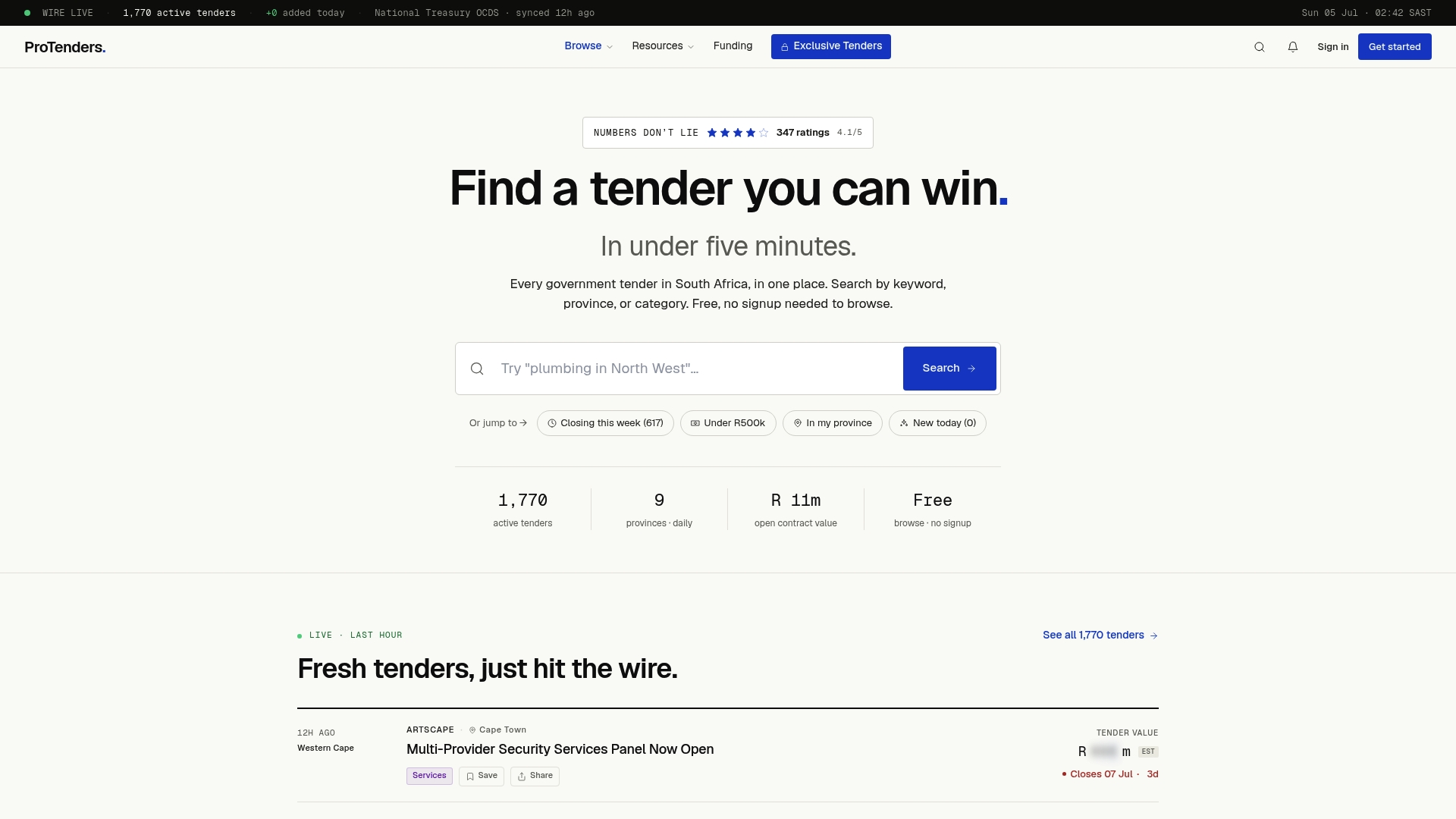
Beyond discovery, some platforms offer compliance scorecards and document templates to help turn clarification answers into updated, compliant submissions without rebuilding your bid pack from scratch. For frequent bidders, such tracking can mean the difference between catching an addendum early and missing it late. Browse the live government tender feed to see current opportunities and start building your clarification workflow around real, active tenders today.
Sources
- GENERAL TENDER CONDITIONS - GOODS
- IMPLEMENTATION GUIDE PPR 2022 - March 2023
- Standard for uniformity in construction procurement and best practice guidelines
- Public Procurement Act (2024) - Government of South Africa
FAQ
What is the 80/20 rule for tenders?
It's a preference point system used in evaluation where 80 points go to price and 20 to specified goals like B-BBEE status, applied to tenders under a set value threshold. Larger-value tenders typically use a 90/10 split instead, and the PPR 2022 guidance requires the buyer to state which one applies.
What are the 7 stages of the tendering process?
They generally run: needs identification, tender publication, clarification period, bid submission, evaluation, award, and contract signing, though naming varies slightly between buyers. Clarification questions sit specifically in stage three, before submission locks in your price.
What is a tender checklist?
A tender checklist is the list of documents, forms, and compliance items a bidder must include for a submission to be valid, such as tax clearance, B-BBEE certificates, and signed pricing schedules. A detailed South African tender documents checklist covers the standard requirements across most public tenders.
What are tender queries?
Tender queries and tender clarification questions refer to the same thing: formal written questions bidders submit to resolve ambiguity in the tender documents before the closing date. They're submitted through the official contact or portal named in the tender, never informally.
Can I ask a clarification question after the deadline has passed?
No. Once the clarification window closes, the buyer has no obligation to respond, and any unanswered ambiguity must be documented as an assumption in your submitted bid instead.