Tender Limits Explained: A Practical Guide for Small Businesses
 *
*
TL;DR:>
- Tender limits are the dollar thresholds that determine the procurement method government agencies must follow. Knowing and verifying these limits for each jurisdiction helps small businesses target the most accessible and less competitive quote opportunities.*
What are tender limits and why do they matter for your business?
Tender limits are the financial thresholds that government agencies use to determine which procurement process applies to a contract. Cross one threshold and you trigger a formal competitive bid. Stay below another and a simple quote process suffices. Drop under the floor and an agency can buy directly without any competitive process at all.
For small, medium, and micro enterprises (SMMEs) pursuing US government contracts, these thresholds are not bureaucratic fine print. They are the rules of the game. Get them wrong and your bid gets rejected before anyone reads your proposal, regardless of how strong it is.
A few things every SMME should know upfront:
- Tender limits vary by jurisdiction, contracting authority, and contract type. There is no single national standard below the federal level.
- The Federal Acquisition Regulation (FAR) governs federal procurement thresholds, while state and local agencies follow their own statutory frameworks.
- Thresholds are periodically revised to account for inflation, sometimes every two to five years, so what applied last year may not apply today.
- The contracting unit's internal certifications, such as Qualified Purchasing Agent (QPA) status in New Jersey, can raise or lower the applicable threshold significantly.
Understanding where a contract sits relative to these thresholds tells you exactly which process to follow, which documents to prepare, and where your best opportunities actually lie.
Table of Contents
- How bid threshold limits differ across major US jurisdictions
- How procurement methods change when you cross a contract threshold
- Why verifying QPA status and specialized rosters can change everything
- How to find opportunities and bid successfully within procurement tender rules
- Key Takeaways
- FAQ
How bid threshold limits differ across major US jurisdictions
No two states handle procurement thresholds identically. The table below shows how three jurisdictions structure their bid and quotation thresholds, illustrating just how wide the variation can be.
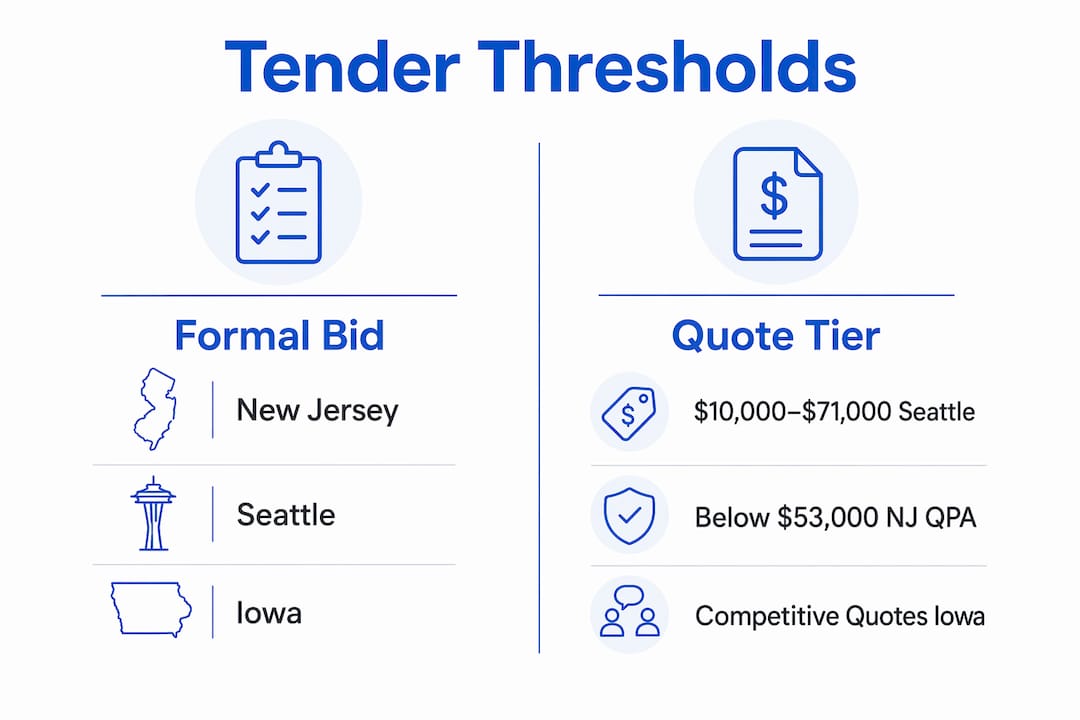
| Jurisdiction | Formal Bid Threshold | Informal/Quote Threshold | Direct Purchase |
|---|---|---|---|
| New Jersey (QPA units) | Above $53,000 | Quotes: $7,950–$53,000 | Below $7,950 |
| New Jersey (LPCL, no QPA) | Above $17,500 | Quotes: $2,625–$17,500 | Below $2,625 |
| New Jersey (PSCL, no QPA) | Above $39,000 | Quotes: $5,850–$39,000 | Below $5,850 |
| Seattle, WA | Above the formal bid threshold | Mid-range quote threshold requiring multiple quotes | Low-value direct purchase threshold |
| Iowa (public improvement) | Per Iowa Code 26.3 | Per Iowa Code 26.14 | Below quotation threshold |
Seattle's structure is straightforward by comparison. Contracts above the formal bid threshold require formal competitive bids. For mid-range contracts, agencies collect multiple informal quotes. Low-value contracts can be directly purchased without competitive processes.
Iowa ties its thresholds directly to statute, with Iowa Code 26.3 governing formal bids for public improvement projects and Iowa Code 26.14 covering competitive quotes for work that falls below the formal bid threshold but still requires some competition.
Key points to keep in mind across jurisdictions:
- Always confirm whether the contracting unit is subject to a state-specific law (like New Jersey's LPCL or PSCL) before assuming a threshold applies.
- Seattle's consultant roster applies to contracts under $420,000, creating a separate pathway for professional services that bypasses standard competitive solicitation.
- Iowa thresholds are updated regularly, so check the Iowa DOT's current threshold page before submitting any bid.
How procurement methods change when you cross a contract threshold
The threshold a contract crosses determines everything about how the procurement runs, from the paperwork required to the timeline you are working against.
 Formal competitive bidding kicks in above the bid threshold. Agencies must publicly advertise the opportunity, accept sealed bids, and award to the lowest responsive and responsible bidder. The process is transparent but slow, and competition is typically broader. For SMMEs, this is the hardest arena.
Competitive quotes apply between the quotation threshold and the bid threshold. The agency contacts a limited number of vendors, collects at least three written quotes, and awards based on price and qualifications. Less documentation, faster turnaround, and fewer competitors. This is where many SMMEs win their first government contracts.
Direct voucher purchases sit below the minimal threshold. Seattle, for example, allows direct purchases at $10,000 or under without any competitive process. The agency simply selects a vendor and issues a purchase order.
Formal competitive bidding kicks in above the bid threshold. Agencies must publicly advertise the opportunity, accept sealed bids, and award to the lowest responsive and responsible bidder. The process is transparent but slow, and competition is typically broader. For SMMEs, this is the hardest arena.
Competitive quotes apply between the quotation threshold and the bid threshold. The agency contacts a limited number of vendors, collects at least three written quotes, and awards based on price and qualifications. Less documentation, faster turnaround, and fewer competitors. This is where many SMMEs win their first government contracts.
Direct voucher purchases sit below the minimal threshold. Seattle, for example, allows direct purchases at $10,000 or under without any competitive process. The agency simply selects a vendor and issues a purchase order.
- Formal bids require public notice, sealed submissions, and a defined opening date.
- Quote processes are faster and often allow phone or email solicitation.
- Direct purchases carry the least administrative burden but are entirely at the agency's discretion.
Iowa's framework under Iowa Code 26.14 reinforces this. Competitive quotes for projects below the formal bid threshold offer a faster procurement path with simpler procedures, which translates directly into higher win rates for smaller businesses.
Why verifying QPA status and specialized rosters can change everything
One of the most common and costly mistakes SMMEs make is assuming a standard threshold applies without checking the contracting unit's actual status. In New Jersey, failing to verify QPA status means you might prepare a full formal bid for a contract that only required quotes, or worse, submit a quote for a contract that legally required public advertisement.
QPA certification allows a contracting unit in New Jersey to operate under a $53,000 bid threshold, meaning formal bidding is only required for contracts above $53,000. Without that certification, the threshold is $17,500 under the Local Public Contracts Law, requiring formal bidding for anything above that amount. PSCL units without QPA have a $39,000 bid threshold.
Specialized procurement rosters add another layer. Seattle maintains a consultant roster for professional services contracts below a high-value ceiling. Firms on that roster can be awarded contracts without a standard competitive solicitation, which is a significant advantage. Getting on the roster requires meeting qualification criteria upfront, but once you are listed, you are in the pool for contracts that never go to public bid.
Steps every SMME should take before pursuing a contract:
- Confirm whether the contracting unit holds QPA or equivalent certification in your target state.
- Check whether the contract type (consulting, technology, construction) falls under a specialized roster or panel.
- Review the agency's procurement manual or contact the purchasing office directly to confirm current thresholds.
- Understand that categories like IT and professional services often have separate procurement routes with their own threshold structures.
The verification step takes less than an hour. Skipping it can cost you the contract.
How to find opportunities and bid successfully within procurement tender rules
Knowing the thresholds is only half the work, and using proposal management software can streamline your government bid submissions. You still need to find the right opportunities, prepare compliant submissions, and avoid the compliance errors that disqualify otherwise strong bids.
Start with SAM.gov for federal contracts. SAM.gov is the central federal portal for government procurement listings. Every federal opportunity above the simplified acquisition threshold must be posted there. Register your business, set up keyword alerts, and check it regularly. Federal thresholds under the FAR include a micro-purchase threshold of $10,000, a simplified acquisition threshold of $250,000, and formal competition requirements above that level. For state and local contracts, go directly to agency portals. New Jersey's Division of Purchase and Property, Seattle's Office of City Purchasing, and Iowa DOT each maintain their own listings. Many states also aggregate opportunities through statewide procurement portals.- Monitor threshold changes. New Jersey's thresholds were adjusted in July 2025 on a five-year schedule. Iowa and other states update theirs on similar cycles. Set a calendar reminder to check for updates annually.
- Prepare your compliance documents before you need them. Business registration, tax clearance certificates, insurance certificates, and any required certifications should be current and ready to attach.
- When a contract triggers formal bidding, read the solicitation documents carefully. Bid rejection for technical non-compliance, such as a missing signature or incorrect bond amount, is common and entirely avoidable.
- For quote-tier opportunities, writing a strong proposal matters more than price alone. Agencies have discretion in the quote process, and a clear, professional submission stands out.
Non-compliance carries real consequences. Incorrect threshold application, missing documentation, or bidding on a contract your business is not registered to perform can result in immediate disqualification. Repeated violations can affect your standing with an agency for future opportunities. The risk of disqualification applies regardless of how competitive your pricing is.
Understanding the difference between an RFQ and an RFP is also worth your time. The distinction between these two instruments maps directly onto where a contract sits relative to the bid threshold, and confusing them is a common error among first-time government bidders.
Key Takeaways
US government procurement thresholds vary by jurisdiction and contracting authority status, and SMMEs that verify these limits before bidding avoid disqualification and find better opportunities in the competitive quote tier.
| Point | Details |
|---|---|
| Thresholds vary widely | New Jersey QPA units operate at a $53,000 bid threshold; non-QPA LPCL units face a $17,500 threshold, and non-QPA PSCL units follow a $39,000 bid threshold. |
| Quote tier is your best entry point | Contracts below the formal bid threshold attract fewer competitors and move faster. |
| QPA status changes the rules | Always verify whether the contracting unit holds QPA or equivalent certification before applying any threshold. |
| Rosters bypass standard competition | Seattle's consultant roster covers contracts under $420,000 without a public competitive solicitation. |
| Thresholds are updated regularly | New Jersey revised its thresholds in July 2025; check your target jurisdiction annually for changes. |
FAQ
What are tender limits in US government procurement?
Tender limits are the dollar thresholds that determine which procurement method a government agency must use. Contracts above the bid threshold require formal competitive bidding; those below may use quotes or direct purchase.
How do I find out the tender limit for a specific agency?
Check the agency's procurement office directly or review the relevant state statute. In New Jersey, Local Finance Notice 2025-08 sets current thresholds; Seattle publishes its annual bid limits table; Iowa DOT maintains a dedicated threshold page.
Does QPA status affect which tender limits apply?
Yes. In New Jersey, a contracting unit with a Qualified Purchasing Agent operates under a $53,000 bid threshold, those without QPA status under the Local Public Contracts Law face a $17,500 threshold, and those under the Public School Contracts Law without QPA have a $39,000 threshold.
What happens if a business ignores tender limit rules?
Non-compliance typically results in bid disqualification, regardless of proposal quality. Repeated violations can affect a business's standing with that agency for future contracts.
Where should small businesses start looking for federal tender opportunities?
SAM.gov is the official federal portal for procurement listings. Register your business there, set keyword alerts for your contract categories, and monitor it regularly for opportunities aligned with your capabilities.
Recommended
- Tender Alerts: Never Miss a Government Opportunity Again | ProTenders
- Understanding the eTenders Portal: A Complete Guide for South African Businesses | ProTenders
- How to Apply for a Tender in South Africa: Step-by-Step (2026) | ProTenders
- Tender Documents South Africa: Checklist & Guide (2026) | ProTenders