The Government Tender Landscape: A 2026 Guide for Businesses

The government tender landscape is the structured ecosystem where public sector buyers issue contracts and private suppliers compete through formal bids. Understanding this environment is the difference between winning contracts and wasting proposal hours. South African SMMEs, in particular, face a procurement system that spans national, provincial, and municipal buyers, each with distinct requirements and timelines. Platforms like Protenders aggregate these opportunities in one place, making the search faster and the compliance path clearer. This guide breaks down the components, process, pitfalls, and strategies you need to compete and win.
What does the tender landscape actually look like?
The government procurement environment is made up of three layers: buyers, platforms, and bidders. Buyers are government departments, state-owned entities, and municipalities. Platforms are the databases where tenders are published, including South Africa's Central Supplier Database (CSD), the eTenders portal, and international equivalents like SAM.gov and Contracts Finder. Bidders range from micro enterprises to large corporations, all competing under the same formal rules.
The documents that define each opportunity follow a standard structure. An Invitation to Tender (ITT) sets the scope and rules. A Request for Quotation (RFQ) is used for lower-value purchases. Specifications and pricing schedules complete the package. Knowing which document type you are responding to shapes every decision you make in the bid.

Certifications and classifications segment the competition significantly. In the US federal system, programs like 8(a), HUBZone, and WOSB create reserved pools of bidders. South Africa uses B-BBEE scoring and SMME designations to similar effect. Socioeconomic set-asides average only 3–4 bidders per opportunity, compared to 8 or more in open competitions. That reduction in competition is one of the most underused advantages available to qualifying businesses.
Contracting officers are the human gatekeepers in this system. They conduct market research, shortlist vendors, and evaluate bids. Getting on their radar before a tender is published is not just helpful. It is a measurable advantage.
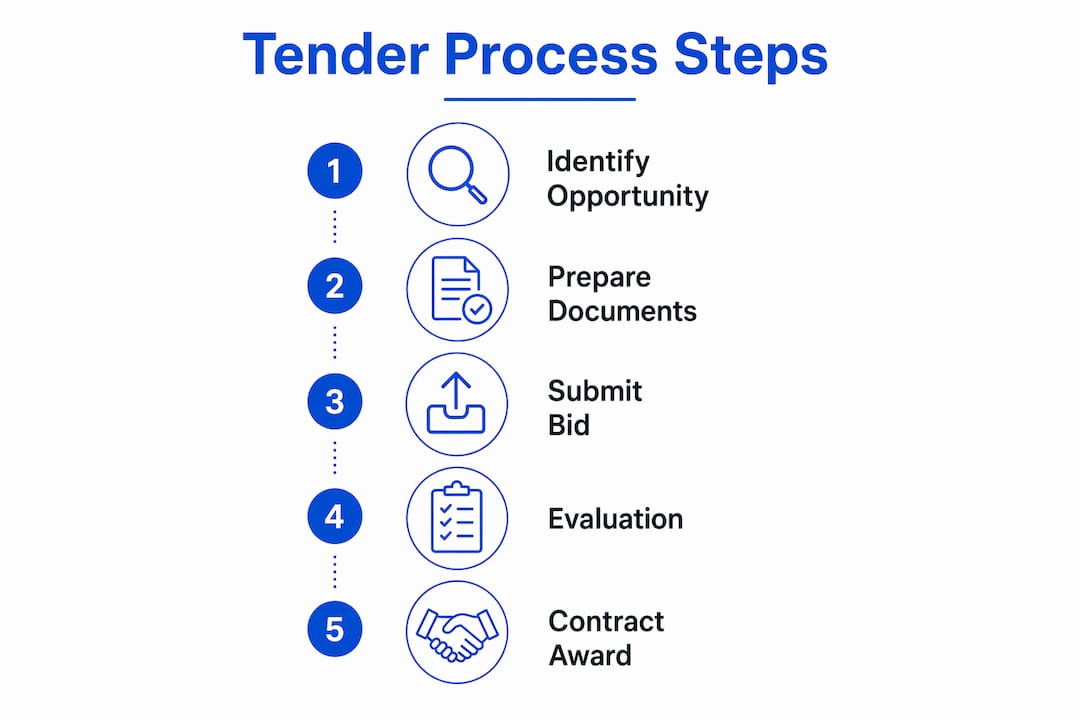
How does the tendering process work from search to award?
The process follows a defined sequence, and skipping any step creates risk.
- Search and filter. Use NAICS codes, commodity categories, geographic filters, and set-aside eligibility to narrow opportunities to those that genuinely fit your business. Broad searches waste time. Targeted searches surface winnable work.
- Engage early. Engaging 12+ months before an RFP release yields a 34% win rate, compared to 18% for businesses that engage only after the tender is published. Contracting officers use tools like Requests for Information (RFIs) and Industry Days to build vendor lists before solicitations go live.
- Make a bid/no-bid decision. Not every tender is worth pursuing. Evaluate alignment with your capabilities, your past performance record, and the buyer's history with your category. Selective bidding improves both proposal quality and win rate. Businesses that bid on everything win almost nothing.
- Prepare a compliant proposal. Follow the instructions in the solicitation exactly. Match your response structure to the evaluation criteria. Use the STAR framework (Situation, Task, Action, Result) to present past performance evidence clearly.
- Submit on time and through the correct channel. Late submissions are rejected automatically. South Africa's eTenders portal has specific file format and upload requirements. A step-by-step submission guide reduces the risk of technical errors at the final stage.
- Understand how you will be evaluated. The Most Economically Advantageous Tender (MEAT) model awards contracts based on a balance of price, technical quality, experience, and delivery approach. The MEAT evaluation model means the lowest price does not automatically win. Underpricing damages your reputation and signals risk to evaluators.
Pro Tip: Build a capability statement before you search for tenders. Contracting officers use these documents during pre-solicitation market research. A one-page capability statement with your NAICS codes, certifications, and three past performance highlights gets you on vendor lists before the competition starts.
What compliance mistakes get bids disqualified?
Non-compliance is the leading cause of bid disqualification, and most of the errors are avoidable. The following mistakes appear repeatedly across failed submissions:
- Missing deadlines. Portals close at the stated time. A submission one minute late is treated the same as no submission at all.
- Incorrect file formats. Buyers specify PDF, Word, or Excel for a reason. Submitting the wrong format triggers automatic rejection in many systems.
- Missing mandatory attachments. Tax clearance certificates, B-BBEE certificates, and CSD registration confirmations are not optional. Failing to include required attachments leads to exclusion before evaluators read a single line of your proposal.
- Exceeding page limits. Buyers set page limits to manage evaluation workload. Exceeding them signals that you cannot follow instructions, which is exactly the wrong message to send.
- Generic content. Evaluators quickly identify recycled bid content. A proposal that could apply to any buyer scores poorly against one tailored to the specific agency, project, and evaluation criteria.
The fix for most of these errors is a compliance matrix. Build it at the start of every bid. List every requirement from the solicitation in one column and your response reference in the next. This single document catches fatal errors before submission. Pro Tip: Assign a second person to check compliance before every submission. The writer is too close to the document to spot missing attachments or formatting violations. A fresh set of eyes catches what familiarity misses.
Fatal errors, like missing deadlines or unsigned declarations, cannot be corrected after submission. Fixable weaknesses, like a thin past performance section or a vague methodology, can be addressed in future bids through debriefs and deliberate improvement.
Which strategies actually improve your win rate?
Small businesses with disciplined bid/no-bid processes achieve win rates of 28–35%, well above the 18% average for all bidders. The gap is not talent. It is focus and preparation.
| Strategy | What it does | Why it works |
|---|---|---|
| Use set-aside certifications | Limits competition to 3–4 bidders | Fewer competitors means higher win probability |
| Build past performance early | Establishes credibility with buyers | Evaluators weight proven delivery heavily |
| Submit capability statements | Gets you on pre-solicitation vendor lists | Early visibility shapes the RFP in your favor |
| Apply MEAT pricing discipline | Avoids the low-price trap | Balanced bids score better across all criteria |
| Request debriefs after losses | Reveals why you lost | Debriefs expose price, technical, or performance gaps |
Agency engagement before a tender is published is the highest-return activity in procurement. Attend Industry Days. Respond to RFIs. Send your capability statement directly to contracting officers. Capability statements are the single most effective tool for influencing vendor shortlists before the formal competition begins.
When you lose, request a debrief. Most procurement systems, including South Africa's, allow unsuccessful bidders to request feedback. Use that feedback to identify whether the loss came from price, technical approach, or past performance. Then fix the specific weakness before the next bid.
Key Takeaways
Businesses that combine early engagement, compliance discipline, and selective bidding consistently outperform those that treat tendering as a volume game.
| Point | Details |
|---|---|
| Early engagement wins | Engaging 12+ months before RFP release produces a 34% win rate versus 18% for late entrants. |
| Set-asides reduce competition | Certified businesses face 3–4 competitors in set-aside pools versus 8+ in open competitions. |
| Compliance is non-negotiable | Missing attachments, wrong formats, or late submissions trigger automatic disqualification. |
| MEAT rewards quality, not just price | Proposals are scored on technical approach, experience, and quality, not lowest price alone. |
| Debriefs drive improvement | Post-loss feedback reveals specific gaps in price, technical quality, or past performance. |
What I've learned about winning in government procurement
The biggest mistake I see businesses make is treating tendering as a numbers game. They submit as many bids as possible and hope something sticks. The data says the opposite works better. Focused, selective bidding on well-aligned opportunities produces win rates nearly double the market average.
The second lesson is about patience. Most businesses want to win their first tender within weeks of registering on a procurement database. The reality is that the best opportunities go to vendors who have already built relationships with contracting officers, responded to RFIs, and submitted capability statements months before the solicitation dropped. The work that wins tenders happens long before the tender is published.
Compliance saved more bids for businesses I've worked with than any clever writing ever did. A perfectly written proposal with a missing tax clearance certificate is a disqualified proposal. Build your compliance checklist before you write a single word of your response. Check it twice before you submit.
The feedback loop is where real improvement happens. Every lost bid is a free consulting session if you request a debrief. Most businesses skip this step. The ones who don't skip it get better with every submission, and eventually, they start winning. For South African SMMEs specifically, tools like Protenders' tender documents guide make the compliance preparation step significantly faster.
— Nkosi
How Protenders helps you find and win government tenders
Protenders gives South African SMMEs direct access to live government tenders from national, provincial, and municipal buyers, all in one place, without requiring sign-up to start searching.
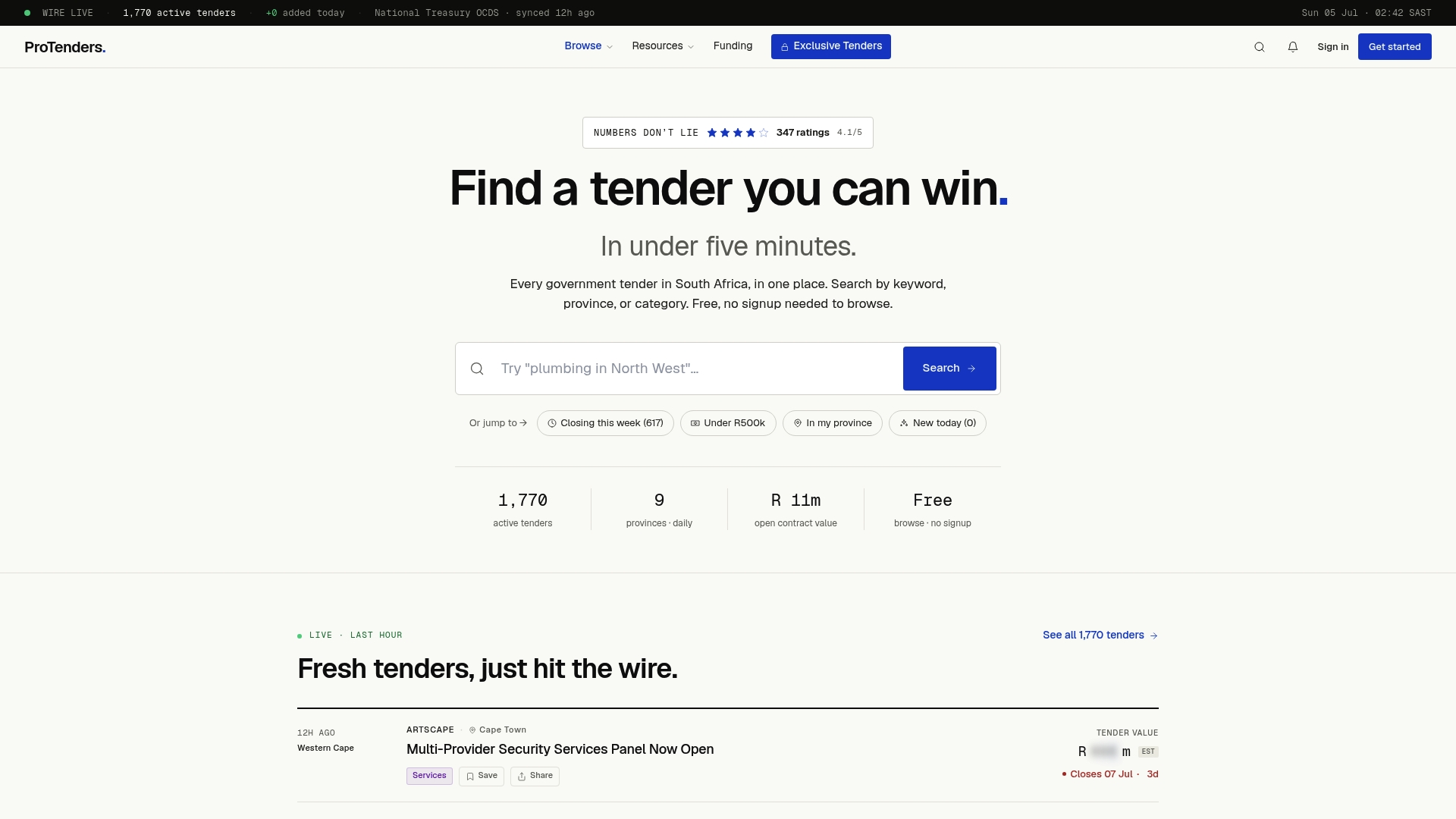
The platform filters opportunities by keyword, region, and category, so you spend time on tenders that fit your business rather than sorting through irrelevant listings. Compliance scorecards and document templates reduce the preparation time on each bid. For businesses targeting specific regions, Gauteng tender listings show active opportunities updated in real time. Whether you are submitting your first bid or refining a repeat strategy, Protenders gives you the tools to move from discovery to submission with fewer errors and better results.
FAQ
What is the government tender landscape?
The government tender landscape is the structured procurement environment where public sector buyers issue contracts and private suppliers compete through formal bids. It includes procurement agencies, online platforms like the CSD and eTenders portal, and a range of bidder types from micro enterprises to large firms.
How do set-aside programs improve my chances of winning?
Set-aside programs limit competition to certified businesses, reducing the average bidder pool to 3–4 competitors versus 8 or more in open competitions. Certifications like 8(a), HUBZone, WOSB in the US, and B-BBEE designations in South Africa qualify businesses for these reserved opportunities.
What causes most bid disqualifications?
Non-compliance is the leading cause, including missing deadlines, incorrect file formats, and absent mandatory attachments. These errors trigger automatic exclusion before evaluators review the proposal content.
Does the lowest price always win a government tender?
No. The MEAT evaluation model scores bids on price, technical approach, experience, and quality together. Underpricing can signal risk and damage your long-term reputation with buyers.
How do I improve after losing a tender?
Request a formal debrief from the contracting authority. Debriefs reveal whether the loss came from price, technical approach, or past performance gaps, giving you specific areas to address before your next submission.
Recommended
- Gauteng Tenders 2026: Complete Guide to Government Opportunities | ProTenders
- How to Find Government Tenders in South Africa (2025 Complete Guide) | ProTenders
- Infrastructure Tenders South Africa 2026: R1 Trillion Government Spend Guide | ProTenders
- ProTenders | Find a Government Tender in 5 Seconds | South Africa July 2026