Procurement Teams: Run the Two Envelope System with Protenders

The two envelope system separates a bid into a sealed technical envelope and a sealed financial envelope, with pricing opened only after the technical proposal passes a minimum threshold. Procurement teams use it for complex, quality-driven work like consulting, design, and specialized construction, where price alone shouldn't decide the winner. Simpler, commodity-style purchases rarely need it. Both the CIDB and National Treasury%20SPF%20GPG%20-%20Bid%20Evaluation,%20%20Negotiation%20and%20Award.pdf) frameworks treat it as a standard proposal procedure, not an exception.
*TL;DR:>
- The two-envelope system is best suited for complex, quality-driven projects where technical merit must be evaluated before price, not for simple commodity purchases.*
- Bidders must prepare and seal technical and financial packages separately, with the technical envelope containing methodology and credentials, and the financial envelope holding only pricing data.
- Evaluation matrices should use objective, pre-stated criteria, including a clear minimum threshold, to prevent subjective scoring and subsequent procurement disputes.
- A digital procurement platform can efficiently replicate sealed-envelope procedures through secure document storage, timestamped logs, and controlled access, reducing delays and errors.
- Most procurement challenges arise from unclear evaluation criteria, early opening of financial envelopes, and lack of audit records, making transparent, well-defined processes essential.
Table of Contents
- How the two envelope system works step by step
- Single-stage vs two-stage two-envelope procedures
- Building an evaluation matrix that actually holds up
- What goes in each envelope: a practical checklist
- Platform support: matching the process to your tools
- Where two-envelope tenders go wrong
- Why the two envelope system works, and when it doesn't
- Get your two-envelope submissions right with Protenders
- Where to read the primary guidance
- Sources
- FAQ
How the two envelope system works step by step
The mechanics are simple in theory and easy to botch in practice. Here's the sequence that keeps a two-envelope tender defensible from submission to award.
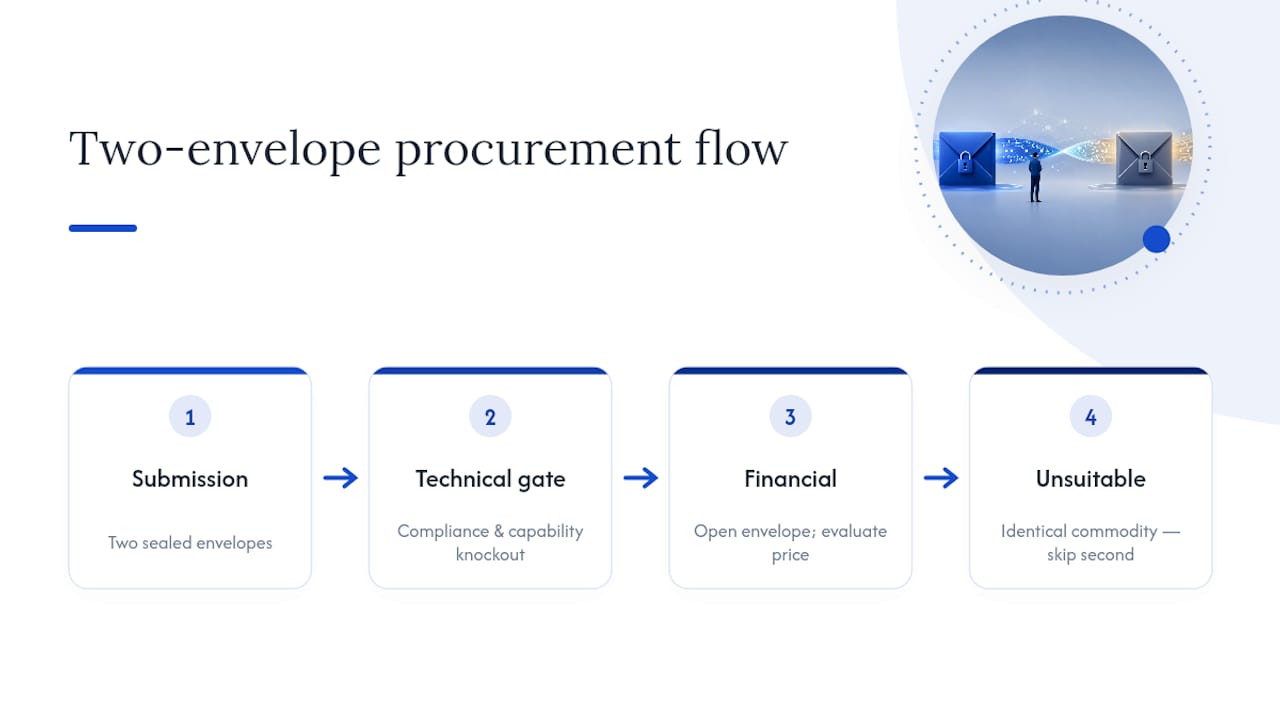
- Bidders prepare two sealed packages. The technical envelope holds methodology, staff CVs, references, and compliance documents. The financial envelope holds pricing only, with no cost figures leaking into the technical package (a common disqualification trigger).
- Both envelopes get labeled and submitted together, usually in a single outer package marked clearly by envelope type and sealed to prevent tampering.
- A custody log records receipt. Whoever receives the bids logs the date, time, and condition of each sealed envelope, and locks the financial envelopes away, untouched, until the technical stage clears.
- A technical evaluation panel scores each submission against a predetermined matrix, applying any knockout criteria before assigning weighted scores.
- Only technically compliant bids move forward. Bidders who fail to meet the minimum threshold have their financial envelopes returned unopened or destroyed under witnessed procedure, per the entity's own rules.
- Financial envelopes are opened, often in public, at a scheduled time, with the amounts recorded and checked against the technical scores to determine the award.
The CIDB standard reinforces this exact logic for construction procurement: financial proposals stay sealed until technical acceptability is confirmed. Skip a step here, and you've handed a disappointed bidder grounds for a formal challenge.
Single-stage vs two-stage two-envelope procedures
Not all two-envelope tenders run the same way, and picking the wrong variant creates friction you didn't need. The Asian Development Bank draws a clean line between the two:
- Single-stage two-envelope: bidders submit both envelopes at once. Evaluators work through technical first, then open pricing for qualifiers. There's no back-and-forth, no revision window.
- Two-stage two-envelope: bidders submit technical proposals first, sometimes without any pricing at all. The buyer reviews, may request clarifications or design changes, and only then invites qualifying bidders to submit or revise prices.
Two-stage adds weeks, sometimes over a month, to the timeline. It suits research contracts, complex consultancy, and projects where the buyer isn't entirely sure what "done" looks like until specialists weigh in. Single-stage fits everyday infrastructure and supply contracts where the scope is already fixed and the buyer just needs qualified bidders to price it accurately.
Building an evaluation matrix that actually holds up
An evaluation matrix is only as strong as its weakest criterion. Vague language like "demonstrates capability" invites subjective scoring and, eventually, a protest letter.
National Treasury guidance is direct on this point: functional evaluation must use objective criteria stated in advance, with a minimum threshold bidders must clear before their price is even considered.
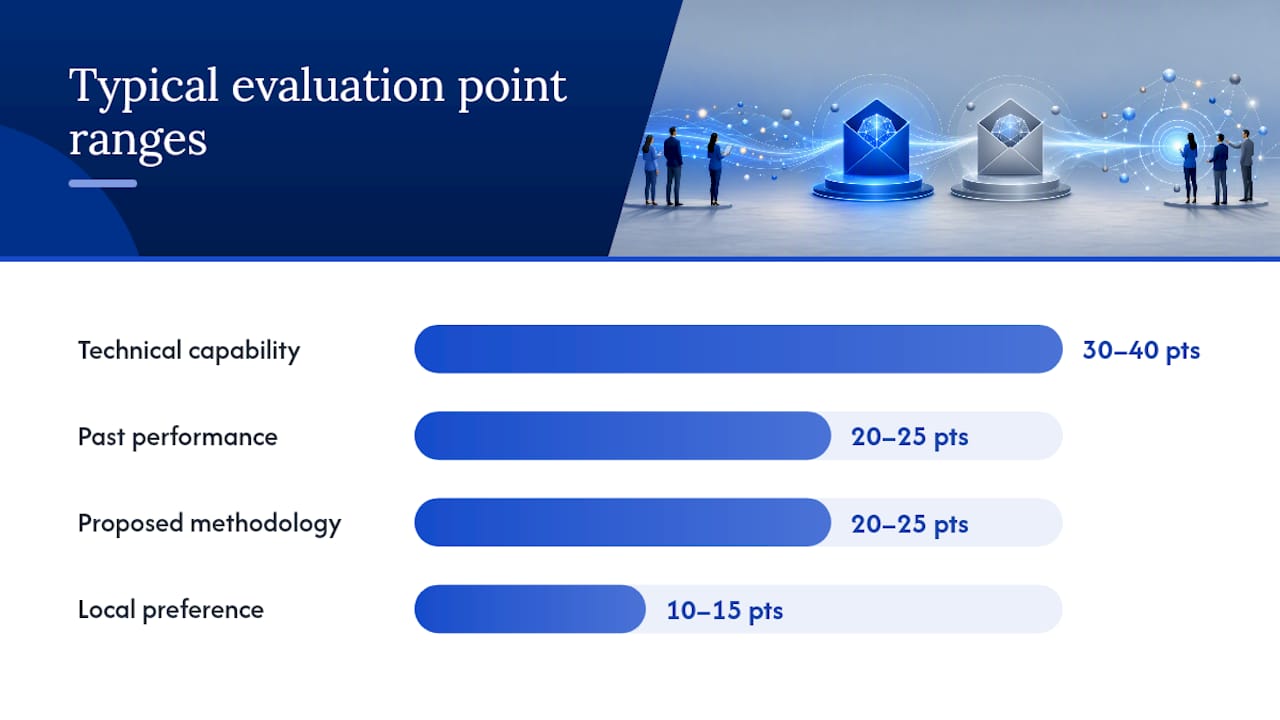
A workable matrix typically breaks down like this:
- Compliance (pass/fail): mandatory documents, certifications, and eligibility. No score, just a gate.
- Technical capability (30 to 40 points): methodology, equipment, technical staff qualifications.
- Past performance (20 to 25 points): verified references, completed projects of similar scope.
- Proposed methodology (20 to 25 points): how the bidder plans to execute, not just what they'll deliver.
- Local development or preference points (10 to 15 points): where applicable under the entity's own policy.
Set the minimum threshold, commonly somewhere in the 60 to 70 point range, and write it into the tender document itself, not a side memo evaluators consult later. Pro Tip: Write your knockout criteria as yes/no questions a first-year graduate could apply consistently. If two evaluators could reasonably disagree on a criterion, rewrite it before the tender goes out, not after a bidder complains.
What goes in each envelope: a practical checklist
Both sides have distinct jobs here, and getting them wrong wastes weeks.
For the procurement team issuing the tender:
- State the evaluation model explicitly in the invitation to bid, including the minimum threshold and weighting split.
- Define custody rules in writing: who holds sealed envelopes, where, and for how long.
- Publish the opening schedule for both technical and financial stages ahead of time.
- Prepare standardized scoring sheets before submissions arrive, not after.
For the bidder preparing a submission:
- Keep every cost figure out of the technical envelope. This single mistake disqualifies more bids than any other error.
- Format technical documents against the stated criteria, section by section, so evaluators can score without hunting.
- Seal the financial envelope separately and label it exactly as instructed.
- Budget extra weeks for two-stage procedures, since revision rounds and clarification requests extend the effective deadline.
Pro Tip: Build a submission template you reuse across tenders and only swap the numbers. A consistent proposal format cuts prep time dramatically once you've bid on more than two or three two-envelope tenders.
Platform support: matching the process to your tools
Physical envelopes work, but they're slow, and a misplaced folder can undo weeks of preparation. A digital procurement platform like Protenders maps directly onto the same custody and transparency requirements without the paper handling.
- Separate document stores for technical and financial submissions, so pricing never accidentally sits alongside methodology documents.
- Compliance scorecards that flag missing mandatory documents before submission, catching the errors that cause disqualification.
- Standardized document templates that match common evaluation matrices, reducing formatting mismatches between bidder and evaluator.
Electronic systems can substitute for sealed paper envelopes, but only if they log custody the same way: time-stamped uploads, restricted access until the scheduled opening, and a published window for when pricing becomes visible. A system that skips the audit log isn't actually equivalent, it just looks digital.
Where two-envelope tenders go wrong
Most disputes trace back to the same handful of avoidable mistakes:
- The evaluation model isn't stated upfront. Bidders assume price matters more than it does, then object when technical scores decide the outcome.
- Scoring criteria are subjective. "Strong methodology" means something different to every evaluator on the panel.
- Financial envelopes get opened too early, before technical scoring is finalized and signed off, giving grounds to claim bias.
- Minutes go unrecorded at the opening, leaving no defensible trail if a losing bidder challenges the result.
Clear, measurable knockout criteria remain the single strongest defense against a procurement protest, stronger than any amount of after-the-fact justification once a challenge lands.
Why the two envelope system works, and when it doesn't
Procurement teams over-engineer this more often than they under-engineer it. The two-envelope model exists to stop price from contaminating technical judgment, and it does that job well for consulting, design, and anything where methodology genuinely varies between bidders. But I'd push back on defaulting to it for straightforward supply contracts where every bidder is quoting the same commodity. There, the extra weeks and administrative load buy you nothing except delay.
The rule I'd give any procurement officer: if you can't articulate why price should wait until after technical scoring, skip the second envelope and run a standard evaluation instead. Reserve the two-envelope structure for tenders where technical quality genuinely changes the outcome, not as a default box to tick.
— Dolene April
Get your two-envelope submissions right with Protenders
Protenders is the practical alternative to juggling paper folders and spreadsheet trackers across a two-envelope tender. Every feature maps to the process this article just walked through: separate document stores that keep technical and financial submissions apart, compliance scorecards that catch missing documents before a panel ever sees your bid, and templates built around the exact criteria evaluators score against.
If you're preparing a submission right now, start with the live South African government tenders feed to find opportunities using this exact procedure, then build your technical package against a proven proposal format before your deadline creeps up on you.
Where to read the primary guidance
For the procedural detail behind this article, go straight to the source documents. The CIDB standard sets out the P6 proposal procedure in full. National Treasury's bid evaluation guidance covers functional scoring and thresholds. The ADB's bidding procedures page compares single-stage and two-stage models internationally.
Sources
- Amendments to the standard for uniformity in construction procurement (CIDB)
- Bid evaluation, negotiation and award (National Treasury guidance)%20SPF%20GPG%20-%20Bid%20Evaluation,%20%20Negotiation%20and%20Award.pdf)
- What bidding procedures are used for ADB-financed projects (ADB)
FAQ
What is an envelope system?
An envelope system in procurement separates different components of a bid, typically technical and financial, into sealed packages evaluated in a fixed order rather than all at once.
What is the two-stage two-envelope procedure?
It's a variant where bidders submit technical proposals first, sometimes with clarification or revision rounds, before the buyer invites qualifying bidders to submit or finalize pricing in a second envelope.
What is the two-envelope paradox?
The term most often refers to a probability puzzle in decision theory involving switching between two envelopes of unknown value, not a procurement concept. It isn't related to the two-envelope bidding procedure used in tenders.
What does the two-stage bid system mean?
A two-stage bid system evaluates proposals in two distinct phases, usually technical review followed by commercial or financial review, with only qualifying bids advancing to the second stage.
Do all tenders need the two-envelope system?
No. Straightforward supply or commodity purchases usually don't need it; the model earns its extra time and administrative load mainly on complex, quality-driven contracts like consulting or specialized construction.
Can digital platforms replace physical sealed envelopes?
Yes, provided the platform logs custody the same way sealed envelopes do, with time-stamped uploads, restricted access until a scheduled opening, and a recorded audit trail. Tools like Protenders build these safeguards directly into the submission workflow.