Compliance Requirements Explained: What U.S. Businesses Must Know
 *
*
TL;DR:>
- Compliance requirements are legal, regulatory, and internal obligations that organizations must meet to operate lawfully and avoid penalties.*
- Different categories include mandatory laws, agency mandates, industry standards, internal policies, and procurement rules essential for maintaining trust and avoiding disqualification.
Compliance requirements are the specific legal, regulatory, and internal obligations that businesses and individuals must meet to operate lawfully and avoid penalties. At the federal level, these include mandates like HIPAA for healthcare data, the Sarbanes-Oxley Act for financial reporting, PCI DSS for payment card security, and the California Consumer Privacy Act for consumer data rights. They are not optional guidelines. Violating them can trigger fines, criminal liability, and lasting reputational damage.
Every compliance framework, regardless of industry, shares a few core elements:
- Legal obligations: Federal and state laws that define minimum standards of conduct
- Regulatory mandates: Rules issued by agencies like the SEC, HHS, or FTC that carry the force of law
- Industry standards: Frameworks like PCI DSS that govern specific sectors even when not codified in statute
- Internal policies: Documented procedures, controls, and governance structures organizations set for themselves
- Procurement requirements: Eligibility and documentation rules that govern participation in government contracting and tendering
Understanding which category applies to your situation is the first step toward building a program that actually holds up under scrutiny.
What are the main U.S. federal compliance requirements?
The United States federal compliance landscape is shaped by a handful of major laws, each targeting a specific risk area. These laws do not exist in isolation. They interact with state regulations and industry guidelines, creating a layered system that most businesses must navigate simultaneously.
| Law / Standard | Sector | Core Obligation |
|---|---|---|
| HIPAA | Healthcare | Protect patient health information; implement administrative, physical, and technical safeguards |
| Sarbanes-Oxley Act | Public companies | Accurate financial disclosures; CEO/CFO certification of reports; internal controls over financial reporting |
| PCI DSS | Payment processing | Secure cardholder data; maintain firewalls, encryption, and access controls |
| CCPA | Consumer-facing businesses in California | Disclose data collection; honor opt-out requests; protect consumer privacy rights |
| Affordable Care Act | Employers with 50+ employees | Report health coverage to the IRS |
| ADA | All public-facing businesses | Ensure accessibility in physical spaces and digital properties |
State laws add another layer. California's CCPA is the most prominent example, but Virginia, Colorado, and Connecticut have passed their own consumer privacy statutes with overlapping but distinct requirements. A business operating across multiple states may need to satisfy several privacy regimes at once.
What businesses must do under each of these federal mandates:
- HIPAA: Conduct regular risk analyses, train staff on data handling, execute Business Associate Agreements with vendors, and maintain breach notification procedures
- Sarbanes-Oxley: Document internal controls, retain financial records for the required period, and certify the accuracy of public financial statements
- PCI DSS: Restrict access to cardholder data, run quarterly vulnerability scans, and complete an annual self-assessment questionnaire or third-party audit depending on transaction volume
- CCPA: Publish a privacy policy, provide a "Do Not Sell My Personal Information" option, and respond to consumer data requests within 45 days
- ADA: Audit websites for WCAG accessibility standards and remediate barriers in physical locations
Pro Tip: The OMB A-133 Compliance Supplement is the authoritative reference for organizations receiving federal grants. If your organization accepts federal funding, this document defines the specific audit requirements and allowable costs you must follow, and it is updated annually.
What types of compliance requirements apply to your business?
Not every compliance obligation looks the same. Grouping them by type helps you identify gaps and assign ownership more clearly.
Regulatory compliance
Regulatory compliance means following rules issued by government agencies. These rules carry legal weight even when they are not written directly into statute. The SEC's disclosure rules, OSHA's workplace safety standards, and the EPA's environmental reporting requirements all fall here. Regulatory compliance is not merely a cost but a foundation for risk management and a signal of trustworthiness to customers and investors.
Legal compliance
Legal compliance covers adherence to statutes passed by Congress or state legislatures. HIPAA, Sarbanes-Oxley, and the CCPA are all legal compliance obligations. The distinction from regulatory compliance is subtle but real. A statute sets the law; a regulation implements it. Both carry penalties for violations, but the enforcement mechanisms and responsible agencies differ.

Internal compliance
Internal compliance refers to the policies, procedures, and governance structures an organization creates for itself. Corporations face the strictest internal requirements, including holding annual director and shareholder meetings, maintaining bylaws, issuing stock, and recording meeting minutes. LLCs have less strict internal requirements but are advised to maintain up-to-date operating agreements and document major decisions. Even sole proprietors benefit from keeping clean records, particularly if a legal dispute arises later.
Procurement and tender compliance
Procurement compliance is a distinct category that governs how organizations participate in government contracting. Tender compliance requirements are the eligibility rules, documentation standards, and technical specifications that a bid must satisfy before it is evaluated on merit. Failure to meet any mandatory requirement results in automatic disqualification, regardless of price or proposal quality.
The tender compliance statement is the formal declaration a bidder submits confirming that their proposal meets all specified requirements. Vague language is a common and costly mistake. Writing "Noted" next to a compliance clause instead of "Comply" is enough to get a bid thrown out. The statement must be explicit, clause by clause, with no ambiguity.
Industry-specific compliance requirements vary significantly:
- Healthcare: HIPAA, state medical privacy laws, Joint Commission accreditation standards
- Finance: Sarbanes-Oxley, SEC rules, FINRA regulations, Bank Secrecy Act
- Data and technology: PCI DSS, CCPA, state breach notification laws, FTC Act Section 5
- Environmental: EPA reporting, Clean Air Act permits, RCRA hazardous waste rules
- Government contracting: FAR (Federal Acquisition Regulation), OMB circulars, procurement compliance policies specific to each agency
Pro Tip: When preparing a tender compliance statement, work through the tender document clause by clause and respond to each requirement individually. A compliance matrix, with each requirement in one column and your explicit response in the next, is the clearest format and the one most evaluators prefer.
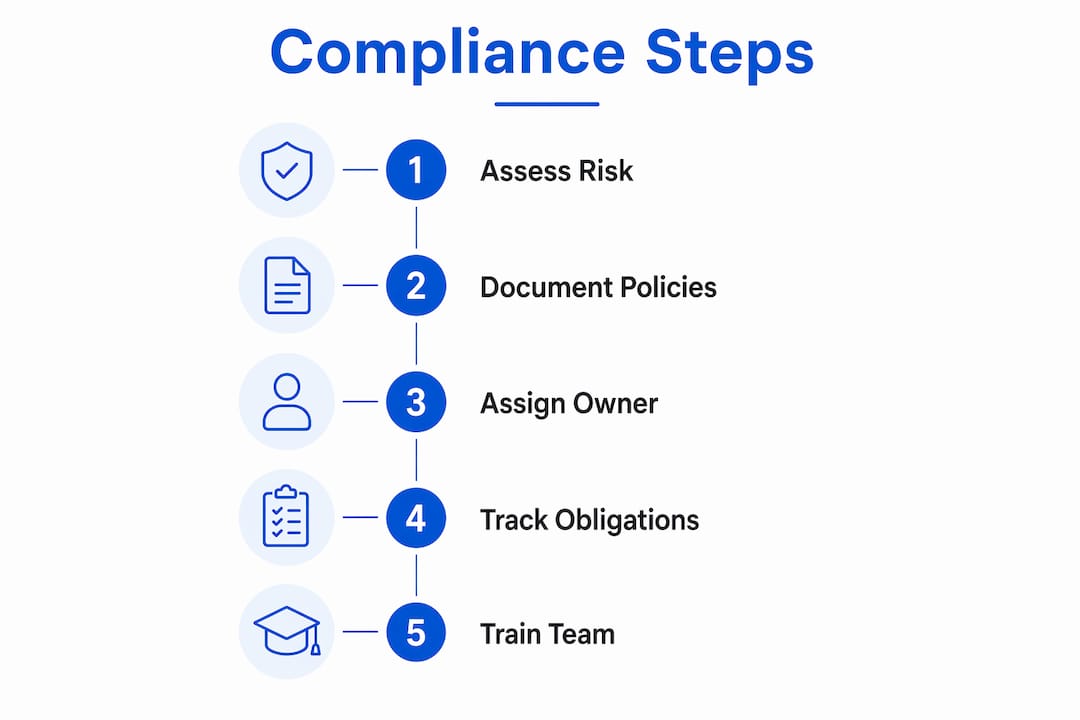
How do you build a system for managing compliance?
Compliance is a dynamic, ongoing process, not a checklist you complete once and file away. A documented compliance plan with defined roles, policies, training schedules, and monitoring systems is what separates organizations that stay ahead of regulators from those that scramble after an audit notice arrives.
Start with a risk assessment
Before writing a single policy, map the regulations that apply to your business. A healthcare startup faces different exposure than a retail chain or a federal contractor. Identify which laws govern your sector, which data you collect, and where your processes are most likely to break down. Risk assessment is not a one-time exercise. Regulations change, businesses grow, and new risks emerge.
Document everything
Regulators and auditors want evidence, not assurances. Every policy, training session, vendor agreement, and internal audit should be documented and stored where it can be retrieved quickly. For businesses filing annual reports with state agencies, filing fees can exceed $300 depending on the state, and missing a deadline can trigger penalties separate from any substantive compliance failure.
Assign clear ownership
A compliance program without named owners is a program that nobody actually runs. Larger organizations typically employ a Chief Compliance Officer or a dedicated compliance department. Smaller businesses often assign compliance responsibilities to a senior manager or outside counsel. Either way, someone specific must own each obligation, track deadlines, and escalate issues.
Use technology to track obligations
Compliance management software can centralize policy documents, automate deadline reminders, and generate audit trails. Regulatory compliance increasingly involves ongoing risk assessments, documentation, training, and technology to adapt to evolving legal requirements. AI-assisted tools are now being used to monitor regulatory changes and flag new obligations before they take effect, which is particularly useful for businesses operating across multiple jurisdictions.

Train your team consistently
A policy nobody has read is not a control. Regular training, tailored to each employee's role and the specific regulations they interact with, is what converts written policies into actual behavior. Training records also serve as evidence of good-faith compliance efforts if a regulator investigates.
Prepare for audits before they happen
"Compliance is a dynamic, ongoing process requiring a clear, documented roadmap with roles and policies, not merely a static checklist." Treating audit preparation as a year-round activity, rather than a fire drill, is what distinguishes organizations that pass cleanly from those that spend weeks reconstructing records under pressure.
For tender submissions specifically, a two-stage verification process works best: a pre-drafting audit to confirm all mandatory requirements are understood, and a final review immediately before submission to catch last-minute gaps. Missing a single mandatory document at submission is the kind of preventable error that ends an otherwise strong bid.
Strategies for staying current with changing requirements:
- Subscribe to regulatory agency newsletters and Federal Register updates
- Set calendar alerts for annual filing deadlines and license renewals
- Join industry associations that track sector-specific regulatory changes
- Engage outside counsel or a compliance consultant for high-stakes obligations
- Review your compliance program annually and after any major regulatory change
Real-world examples of compliance requirements U.S. businesses face
Abstract definitions only go so far. Here is what compliance requirements look like in practice, across the laws and standards that affect the widest range of U.S. businesses.
HIPAA in healthcare: A hospital must encrypt patient records, restrict access to authorized personnel, train staff annually on data handling, and notify affected individuals within 60 days of a data breach. A business associate, such as a billing vendor, must sign a Business Associate Agreement before receiving any protected health information. Sarbanes-Oxley in public companies: The CEO and CFO of a publicly traded company must personally certify the accuracy of quarterly and annual financial statements filed with the SEC. The company must also maintain internal controls over financial reporting and have those controls audited annually by an independent auditor. PCI DSS in retail and e-commerce: Any business that accepts credit cards must protect cardholder data through encryption, access controls, and network segmentation. Merchants processing high transaction volumes face mandatory third-party audits. Smaller merchants complete self-assessment questionnaires but are equally liable for breaches. CCPA for consumer-facing businesses: A California resident can ask any covered business what personal data it holds, request deletion, and opt out of data sales. The business has 45 days to respond. Violations carry significant civil penalties enforced by the California Attorney General. Environmental compliance: A manufacturing facility must track and report emissions under EPA rules, manage hazardous waste under RCRA, and obtain the correct permits before expanding operations. Failure to file required reports can result in fines per day of violation.Common compliance examples across industries include data protection rules, financial transparency measures, labor law adherence, and environmental controls.
The consequences of non-compliance extend well beyond fines:
- Civil and criminal penalties: HIPAA violations can result in fines that range broadly depending on the severity and violation category. Willful violations can lead to criminal prosecution.
- Reputational damage: A publicized data breach or regulatory action can cost a business customers and investor confidence that take years to rebuild.
- Operational disruption: Regulatory investigations consume management time, legal resources, and staff attention that would otherwise go toward running the business.
- Disqualification from government contracts: Non-compliance in procurement results in outright rejection, with no opportunity to correct the submission after the deadline.
The role of compliance officers has grown substantially as regulatory complexity has increased. A Chief Compliance Officer typically reports to the board or CEO, oversees the compliance program, manages regulatory relationships, and leads the response to any enforcement action. In smaller organizations, these responsibilities often sit with the general counsel or a senior operations leader. What matters is that someone has explicit authority and accountability, not just a vague mandate to "keep us legal."
Healthcare organizations face some of the most layered compliance challenges, balancing HIPAA with state medical privacy laws, Medicare and Medicaid billing rules, and Joint Commission accreditation standards simultaneously. Financial services firms contend with overlapping SEC, FINRA, and state securities regulations. Technology companies increasingly face a patchwork of state privacy laws that do not align neatly with each other. Each industry requires a tailored approach rather than a generic compliance program copied from another sector.
*Protenders helps South African SMMEs navigate government procurement compliance with tools built specifically for the tendering process. The platform's compliance scorecards, document templates, and bid workspace give businesses a structured way to check their submissions against mandatory requirements before they hit send. If you are looking for live government tenders across South Africa, Protenders aggregates opportunities from national, provincial, and municipal buyers in one searchable place, with no sign-up required to browse.
For businesses focused on Gauteng specifically, Gauteng tender opportunities are updated continuously, with alerts available so you never miss a deadline. Getting compliant starts with knowing what is out there.
*Key Takeaways
Compliance requirements are legal, regulatory, and internal obligations that businesses must meet continuously, not once, to avoid penalties, disqualification, and reputational harm.
| Point | Details |
|---|---|
| Compliance is mandatory, not optional | Federal laws like HIPAA, Sarbanes-Oxley, PCI DSS, and CCPA carry real penalties for violations. |
| Categories matter | Regulatory, legal, internal, and procurement compliance each have distinct rules and enforcement bodies. |
| Tender compliance is binary | Any non-compliant bid is disqualified outright; there is no opportunity to correct after submission. |
| Documentation is your defense | Regulators and auditors require evidence; undocumented compliance is treated as no compliance. |
| Staying current requires a system | Regulations change; a passive approach to monitoring new requirements creates gaps that audits expose. |
FAQ
What is the meaning of compliance requirements?
Compliance requirements are the specific legal, regulatory, and internal obligations that an organization or individual must satisfy to operate lawfully. They include federal laws, agency regulations, industry standards, and internal governance policies.
What are examples of compliance requirements?
Common examples include HIPAA's data safeguarding rules for healthcare, Sarbanes-Oxley's financial disclosure mandates for public companies, PCI DSS's payment security controls, CCPA's consumer privacy rights, and annual state filing requirements for registered businesses.
How do you determine which compliance requirements apply to you?
Start by identifying your industry, the type of data you handle, your business structure, and the states where you operate. Each of those factors points to a specific set of federal laws, state regulations, and industry standards that govern your obligations.
What does tender compliance mean in procurement?
Tender compliance means that a bid submission meets every mandatory eligibility rule, documentation requirement, and technical specification set out in the tender document. A non-compliant bid is disqualified automatically, regardless of its price or quality.
What happens if a business fails to meet compliance requirements?
Consequences range from fines and civil penalties to criminal prosecution, loss of government contracts, and reputational damage. For example, HIPAA violations can result in significant financial penalties and other enforcement actions.
Recommended
- CSD Registration 2026: Complete Central Supplier Database Guide | ProTenders
- CSD Registration South Africa 2026: Step-by-Step Guide for Suppliers | ProTenders
- B-BBEE Tender Requirements South Africa 2026: PPPFA 80/20 & 90/10 Explained | ProTenders
- Tender Documents South Africa: Checklist & Guide (2026) | ProTenders