Are you eligible for a B-BBEE affidavit, and where do you get one?

Yes. If your business is an Exempted Micro Enterprise (EME) with annual turnover under R10 million, or a Qualifying Small Enterprise (QSE) turning over R10 million to R50 million with at least 51% black ownership, a sworn B-BBEE affidavit is all you need, without requiring verification agency intervention or a scorecard audit.
- Download the correct template from the dtic or CIPC
- Complete it using your latest finished financial year
- Sign it in front of a Commissioner of Oaths
The affidavit is valid for a period of one year from the date you sign it, and after that, you need a fresh one.
Key Takeaways
A valid B-BBEE affidavit demands the correct dtic or CIPC template, an accurate completed financial year, and commissioning by an impartial Commissioner of Oaths within a strict 12-month validity window.
| Point | Details |
|---|---|
| Confirm eligibility first | EMEs under R10 million and QSEs with 51%+ black ownership can use an affidavit; others need SANAS verification. |
| Use the exact right template | Download the EME or QSE form from dtic or CIPC, and check for a sector-specific version before defaulting to general. |
| Fill every field | Mark non-applicable sections "0" or "N/A" rather than leaving them blank to avoid rejection. |
| Match your dates | The deponent's signature date and the commissioner's stamp date must be identical. |
| Track the 12-month clock | Set a renewal reminder before month 11 and re-sign immediately if turnover or ownership changes materially. |
| Keep your bid pipeline organized | Protenders lets you attach a compliant affidavit to live tender searches and track renewal timing in one workspace. |
Table of Contents
- What is a bbbee affidavit and which template applies to you?
- Do you qualify as an EME or a QSE?
- How do you complete and commission the affidavit correctly?
- When does a B-BBEE affidavit expire, and what makes one invalid?
- Which sectors don't accept a standard affidavit?
- What should you budget for commissioning and preparation?
- How does Protenders help you stay tender-ready with a valid affidavit?
- How do you verify a B-BBEE affidavit someone else sent you?
- What happens if you submit a false or incorrect affidavit?
- How do you document your financial information accurately?
- Can you amend an affidavit if your circumstances change?
- Sources
- FAQ
What is a bbbee affidavit and which template applies to you?
A bbbee sworn affidavit is a self-declared statement, signed under oath, that confirms your company's turnover band, black ownership percentage, and B-BBEE recognition level without needing third-party verification. It replaced accountant letters for most small suppliers after the Amended Codes took effect in 2013, and it remains the fastest route to procurement points if your business qualifies.
The dtic publishes separate templates for EMEs and QSEs, and CIPC hosts a parallel version of the EME form as a downloadable PDF. Both are functionally identical government documents, so use whichever is easiest to access.
- EME template: for businesses under R10 million turnover, available from dtic and CIPC
- QSE template: for businesses between R10 million and R50 million turnover, also on the dtic site
- Sector-specific templates: required where your industry falls under a gazetted sector charter (construction, tourism, ICT, and others each have variants)
Check your primary revenue activity first. If it maps to a sector code with its own charter, use that version, not the general one. Practitioners consistently flag sector mismatch as an avoidable but common reason affidavits get rejected during tender evaluation.
Do you qualify as an EME or a QSE?
Your turnover band decides everything. Below R10 million, you're an EME and automatically qualify as a Level 1 (100% black owned or 51%+ black owned) or Level 2 contributor, no scorecard needed. Between R10 million and R50 million, you're a QSE, and the affidavit route only works if black ownership sits at 51% or higher.
- EME (under R10 million): affidavit only, automatic level recognition
- QSE, 51%+ black owned (R10 million to R50 million): affidavit sufficient
- QSE, under 51% black owned: you need full scorecard verification through a SANAS-accredited verification agency, not an affidavit
- Above R50 million: generic enterprise, affidavit never applies regardless of ownership
Before signing anything, cross-check your VAT number, company registration number, and financial year end against your CIPC and SARS records. A mismatch between what's on the affidavit and what's on file is one of the quieter reasons procurement officers flag documents for review.
How do you complete and commission the affidavit correctly?
Work through this in order, ideally with your latest annual financial statements open in front of you.
- Pick the right template and confirm your sector code. Match your primary income stream to the correct dtic charter category before you type a single field.
- Fill in company details. Enter your registered company name, registration number, VAT number (if registered), and your most recently completed financial year, not the current or projected one. Using future or incomplete financial periods is one of the most common reasons affidavits get rejected.
- Complete ownership fields. Enter black ownership percentage, black women ownership, and any designated group breakdowns your template requests. Where a category doesn't apply to your structure, write "0" or "N/A" rather than leaving it blank, then tick the box matching your recognition level.
- Sign before a Commissioner of Oaths. The commissioner must be impartial (not a director, shareholder, or family member of the business), and the date you sign must match the date the commissioner stamps. Bring your ID and, if someone else is deposing on the company's behalf, proof of their authority to do so.
Pro Tip: Photograph or scan the signed affidavit immediately, before you leave the commissioner's office. A folded, smudged, or partially illegible copy is a frequent cause of "document unclear" rejections weeks later when you're rushing to submit a tender.
When does a B-BBEE affidavit expire, and what makes one invalid?
Your affidavit is valid for 12 months from the date of signature, inclusive of that day. Set a calendar reminder for month 11, not month 12. Procuring entities often reject documents that expire mid-evaluation, even if they were valid on the submission date.
- Blank ownership or turnover fields instead of "0" or "N/A"
- Using a projected or upcoming financial year rather than your last completed one
- Selecting the general template when a sector-specific version exists for your industry
- A commissioner who has a financial interest in your company, which breaks impartiality
- Signature date and commissioner stamp date that don't match
Procuring entities carry their own responsibility here. Fraudulent or careless affidavits cost genuine competitors procurement points, so a measured entity reviewing your bid should be checking your ID details, financial year, and commissioner stamp against your other tender documents, not just filing the affidavit unread.
Which sectors don't accept a standard affidavit?
Most industries accept the standard dtic or CIPC affidavit without question. Transport is the sector where this breaks down most often, because several transport sub-sectors haven't fully aligned to the Amended Codes, and a generic affidavit submitted there can be disqualified on sight.
Before you rely on an affidavit for a transport-related tender, confirm directly with the relevant sector council or check the dtic's sector charter listings for your specific classification. If your sector code isn't aligned, an accountant's or auditor's letter, or full SANAS verification, is the safer route rather than gambling on affidavit acceptance.
- Confirm your sector code against the current charter list, not last year's
- Call or email the sector council if the charter status is unclear
- Keep an accountant's letter on file as a fallback for ambiguous cases
What should you budget for commissioning and preparation?
Commissioning itself should cost you nothing. Most South African police stations commission affidavits for free, and many banks offer the same service to account holders.
Where costs creep in is preparation and verification, not commissioning:
- Self-prepared using the official template: free, beyond your time
- Private preparer or formatting service: roughly R200 to R500 for someone to fill and check the document for you
- QSE full verification through a SANAS-accredited agency (only needed if black ownership is below 51%): typically R5,000 to R20,000, depending on the complexity of your ownership structure
If your ownership structure is straightforward, sole proprietor, one or two shareholders, clean records, do it yourself with the official template. Complex shareholding, trusts, or multiple designated-group categories are where paying a consultant earns its cost back in avoided rejections.
How does Protenders help you stay tender-ready with a valid affidavit?
Preparing the affidavit is only half the job. Keeping it attached to the right bids, before it expires, is the part small businesses actually struggle with.
Protenders hosts compliance document templates alongside its live tender search, so you can prepare your affidavit, drop it straight into a tender document checklist, and match it against active B-BBEE-linked opportunities without hunting across government portals.
- Prepare your affidavit using the official dtic or CIPC template
- Upload it to your tender workspace alongside other compliance documents
- Set renewal alerts so a lapsed affidavit never costs you a bid you'd otherwise win
Pro Tip: Store your affidavit's expiry date, not just the document, somewhere you'll actually see it. A tender workspace that tracks renewal dates saves more submissions than any template ever will.
How do you verify a B-BBEE affidavit someone else sent you?
If you're the one receiving affidavits from suppliers or subcontractors, verification takes about five minutes if you know what to check. Start with the basics: does the company registration number and VAT number on the affidavit match what's on their other tender documents and CIPC records? A discrepancy here is the first red flag.
Next, check the financial year stated. It should be the supplier's most recently completed year, not a current or future period. Then look at the signature block: does the date the deponent signed match the date the Commissioner of Oaths stamped it? Those two dates should be identical, and if they're days or weeks apart, the affidavit was likely backdated or the commissioning step was mishandled.
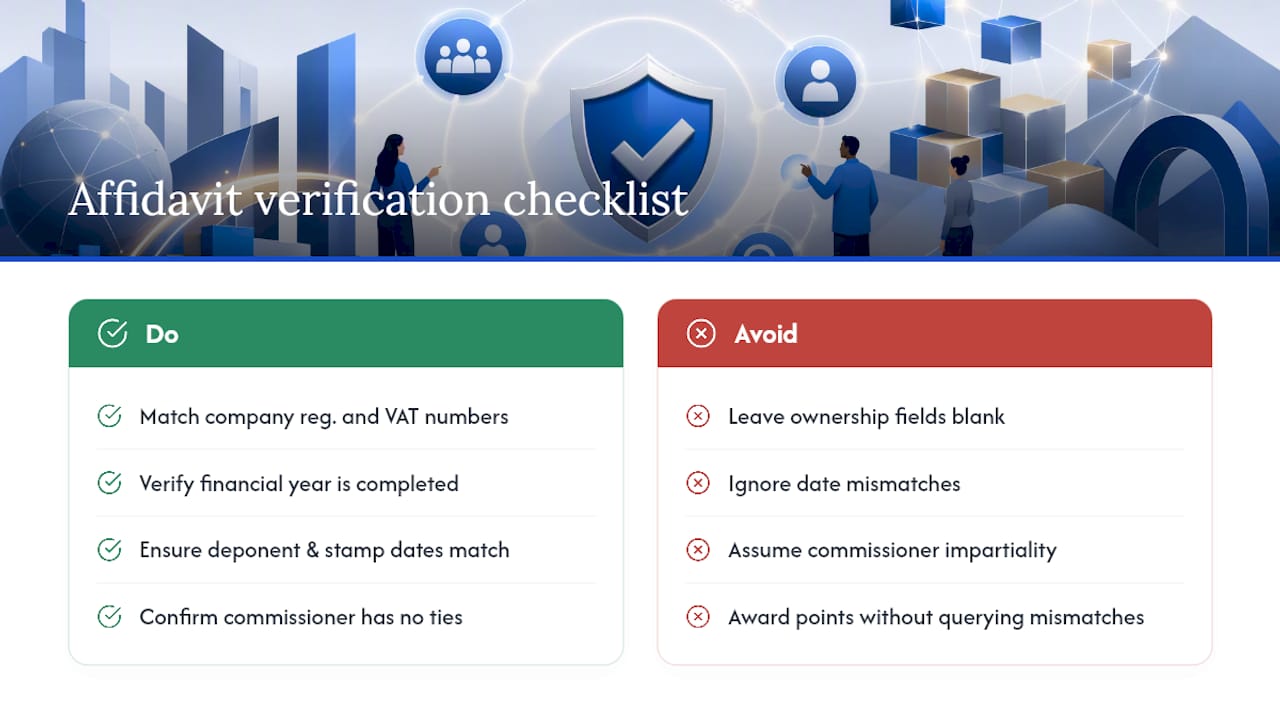
Confirm the commissioner had no financial stake in the business, no shared directorship, no family relationship, no shareholding. This is easy to overlook when a supplier's paperwork looks otherwise clean.
Finally, check that the ownership fields are properly completed, with "0" or "N/A" in non-applicable categories rather than blanks, and that the recognition level box ticked matches the turnover and ownership percentages stated elsewhere on the form. A mismatch between the declared level and the underlying numbers suggests either an error or something worth querying directly with the supplier before you award points based on it.
Build this into a standing checklist for every affidavit you receive. It costs you a few minutes per document and protects your own procurement scoring from a supplier's careless paperwork.
What happens if you submit a false or incorrect affidavit?
A B-BBEE affidavit is a sworn legal document, and lying on it is not a minor administrative slip. Under the Broad-Based Black Economic Empowerment Act, knowingly submitting false information to gain B-BBEE recognition is a criminal offense, punishable by fines or imprisonment, and it can result in your business being barred from public sector contracts for a set period.
Beyond the legal exposure, an incorrect affidavit, even an honest mistake rather than deliberate fraud, can unravel an entire tender award if it's discovered after the contract is signed. Procuring entities that later find a supplier misrepresented its ownership structure or turnover band can cancel the contract, claw back payments already made, and refer the matter for investigation.
For genuinely small errors, a wrong VAT number, a blank field that should have read "N/A", the fix is usually straightforward: correct it and get a fresh affidavit commissioned. The risk lies in inflating your black ownership percentage, understating turnover to stay in a lower band, or reusing an affidavit after your ownership structure has genuinely changed. None of those are clerical issues, and none of them are defensible as accidents once discovered.
If you're unsure whether your current ownership or turnover figures still match what's on file, don't guess. Get a new affidavit commissioned with correct figures rather than relying on an old one that no longer reflects reality. The cost of doing that is a signature and possibly a small preparer's fee. The cost of not doing it can be a cancelled contract and a procurement ban.
How do you document your financial information accurately?
The financial details on your affidavit carry more weight than any other section, because turnover is what determines whether you're an EME or a QSE in the first place. Get this wrong, and every other field on the document follows the wrong classification.

Start with your most recently completed financial year, not your current trading year and not a forecast. If your financial year ended in February, and you're completing the affidavit in June, you use the February figures, even though several months have passed since then. Using projected or future financial periods is one of the clearest ways to invalidate an affidavit.
Pull your turnover figure from your annual financial statements or your latest management accounts if statements aren't finalized yet. If you're VAT registered, cross-check that figure against your VAT returns for the same period. A turnover number on your affidavit that contradicts your own VAT submissions to SARS is exactly the kind of inconsistency that invites scrutiny.
If your business is newly formed and hasn't completed a full financial year yet, use your most recent management accounts or a reasonable estimate based on trading to date, and be prepared to explain the basis for that figure if asked. Sole proprietors and close corporations without formal audited statements can still use bookkeeping records or accountant-prepared summaries, as long as the numbers are accurate and defensible.
Keep a copy of whatever financial document you used to calculate the turnover figure alongside your signed affidavit. If a procuring entity or an auditor ever questions the number, you want to produce the backup immediately, not scramble to reconstruct it months later.
Can you amend an affidavit if your circumstances change?
An affidavit reflects a snapshot: your turnover band, ownership structure, and recognition level as they stood on the date you signed it. If any of those change materially during the 12-month validity period, a new share issued to a black investor, a merger that shifts your turnover band, a change in your primary sector of activity, the existing affidavit no longer accurately represents your business.
There's no formal "amendment" process for a sworn affidavit. You cannot cross out a field and initial the change. The correct approach is to complete an entirely new affidavit reflecting the updated facts and have it commissioned again, which then starts a fresh 12-month validity period from that new signature date.
This matters most in two scenarios. First, if a change pushes you into a higher or lower turnover band, say your revenue grows past R10 million and you move from EME to QSE status, your old EME-level affidavit is no longer accurate and should not be used for new bids. Second, if your black ownership percentage shifts, up through a new investment or down through a buyout, your recognition level likely changes too, and continuing to submit the old affidavit risks the false declaration issues covered earlier.
Practically, this means don't wait for the 12-month expiry if something significant changes sooner. Treat a material change in ownership or turnover the same way you'd treat expiry: as a trigger to get a new affidavit signed immediately, before you submit it with your next tender.
Author's short note: accuracy beats optimisation
Most affidavit disqualifications aren't fraud. They're a blank field, a wrong template, or a signature date that doesn't match the commissioner's stamp. Fix those small things and set a renewal reminder, and you'll outlast most of your competition on paperwork alone.
Protenders keeps your compliance documents ready when a tender deadline hits
Protenders gives you one place to search live government tenders and keep your compliance documents ready to attach, so you're not digging through folders the night before a submission deadline. Unlike hiring a consultant for every bid or tracking renewal dates in a spreadsheet, Protenders' tender workspace lets you upload your signed affidavit once and match it against live opportunities across national, provincial, and municipal buyers, including PURCO contracts.
Compliance scorecards and document checklists on the platform flag what's missing from your bid bundle before you submit, not after a procuring entity rejects it. Search current opportunities on Protenders' live tender feed and get your next bid document-ready today.
Sources
- Determining the validity of a sworn affidavit for B-BBEE compliance | RSM South Africa
- How to complete, read and verify a B-BBEE Affidavit - Siyakha Consulting
FAQ
How can I get a B-BBEE affidavit?
Download the EME or QSE template from dtic or CIPC, complete it with your latest financial year figures, and sign it before a Commissioner of Oaths.
How do I fill in a B-BBEE sworn affidavit?
Enter your company registration and VAT numbers, your most recently completed financial year, and your ownership percentages, marking any non-applicable field "0" or "N/A" before signing in front of an impartial commissioner.
How much does a B-BBEE affidavit cost?
Commissioning is typically free at police stations, while private preparers charge roughly R200 to R500, and QSE verification through a SANAS-accredited agency (only needed below 51% black ownership) runs R5,000 to R20,000.
Is there an example of a B-BBEE affidavit I can look at?
Yes, both the dtic and CIPC publish the official PDF templates directly, complete with all required fields and declarations already formatted.
How long is a B-BBEE affidavit valid?
Twelve months from the date of signature, inclusive of that day, after which you need a newly signed and commissioned document.
Recommended
- B-BBEE Tender Requirements South Africa 2026: PPPFA 80/20 & 90/10 Explained | ProTenders
- B-BBEE Tenders South Africa: Complete Guide to BEE Tender Opportunities 2026 | ProTenders
- Tender Glossary South Africa | Procurement Terms, Acronyms & Definitions | ProTenders
- SABS Tenders 2026 | ProTenders | ProTenders