Best e-signature software for South African SMMEs
 *
*
TL;DR:>
- South African government tenders require an Advanced Electronic Signature or similar accredited provider to ensure legal and compliance standards are met. Using tools like Protenders helps businesses gather necessary audit trails, compliance documents, and supporting evidence for successful submissions. Rushing the process without verifying AES, POPIA, and local hosting requirements risks disqualification and legal issues.*
For South African government tenders, use an Advanced Electronic Signature (AES) capable provider or an integrated compliance workspace like Protenders. Before signing anything, open the tender's RFQ or bid document and scan for explicit AES, SAAA accreditation, and data-hosting clauses.
Must-have capabilities for any tender submission:- AES support, or a documented path to SAAA accreditation under ECTA section 37
- Full audit trail: timestamps, IP address, signer identity method
- POPIA compliance statement and local South African hosting option
- Tamper-evident signed PDF output with time-stamping
- Exportable certificate of completion with full audit detail
- Integration with MS 365, PDF workflows, or tender platforms
Table of Contents
- Key takeaways: which solution class fits your tender?
- What tender evaluators actually look for
- Protenders helps you submit with confidence
- Useful sources for tender compliance and AES requirements
- Key takeaways
- What the industry gets wrong about e-signatures and tenders
- FAQ
Key takeaways: which solution class fits your tender?
For most SMMEs, the choice comes down to three practical options. Each carries a different compliance risk.
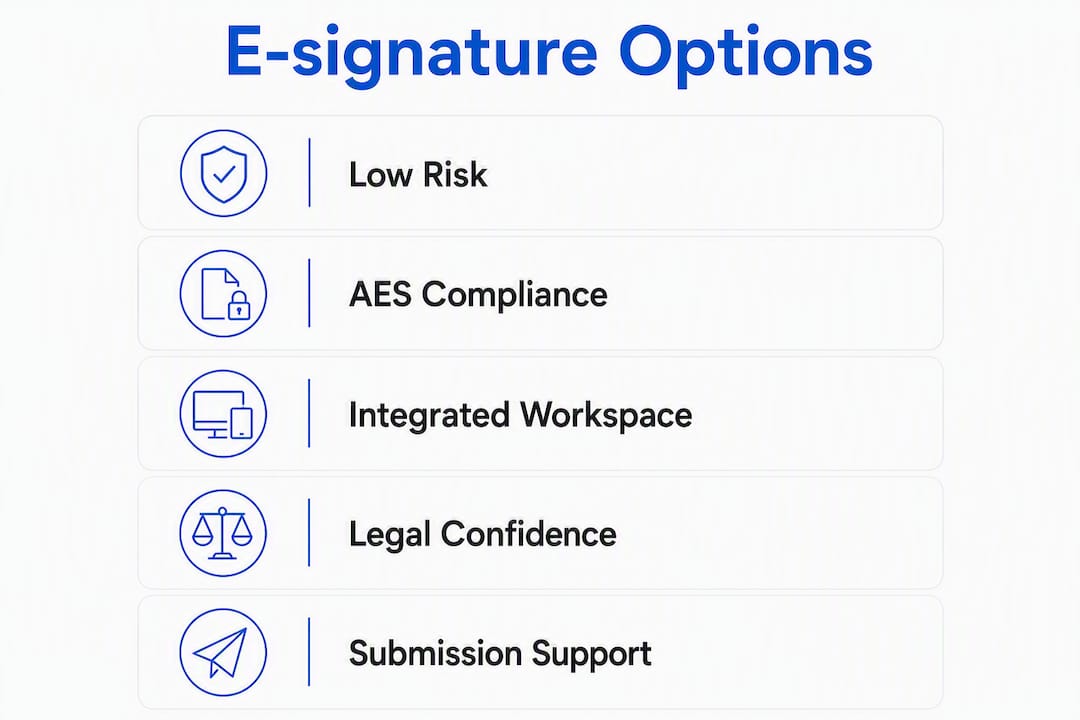 Simple e-sign apps (DocuSign standard tier, Adobe Acrobat Sign basic) work for low-risk internal documents. For government tenders, they fall short when the RFQ demands AES or SAAA accreditation evidence. The risk: disqualification at evaluation.
AES/SAAA-accredited providers meet the legal bar under ECTA. They issue certificates after verified identity checks (face-to-face or secure remote), and their audit exports satisfy DPSA electronic signature guidelines. The risk: setup takes time and costs more per signature.
Integrated tender compliance workspaces like Protenders bundle compliance scorecards, tender document templates, and a submission workspace that collects signed evidence alongside supporting documents. Best for SMMEs that need the whole compliance picture, not just a signing tool.
Simple e-sign apps (DocuSign standard tier, Adobe Acrobat Sign basic) work for low-risk internal documents. For government tenders, they fall short when the RFQ demands AES or SAAA accreditation evidence. The risk: disqualification at evaluation.
AES/SAAA-accredited providers meet the legal bar under ECTA. They issue certificates after verified identity checks (face-to-face or secure remote), and their audit exports satisfy DPSA electronic signature guidelines. The risk: setup takes time and costs more per signature.
Integrated tender compliance workspaces like Protenders bundle compliance scorecards, tender document templates, and a submission workspace that collects signed evidence alongside supporting documents. Best for SMMEs that need the whole compliance picture, not just a signing tool.
| Dimension | Simple e-sign app | AES/SAAA provider | Integrated workspace (Protenders) |
|---|---|---|---|
| AES support / SAAA path | No | Yes | Guides you to AES-capable vendors |
| Audit trail & identity verification | Basic (email, SMS) | Full (ID, biometric, bank verification) | Collects and organises audit exports |
| POPIA & local hosting | Varies | Often available | Compliance scorecard flags requirements |
| MS 365 / PDF integration | Yes | Yes | Yes, with tender workflow context |
| Pricing model | Per-sign or per-user | Per-user or enterprise | Freemium + paid subscription |
| Local support | Limited | Varies | South Africa-focused |
| Mobile signer experience | Good | Good | Good |
| Archival / time-stamping | Basic | Full | Stores exports in submission folder |
- Can you provide an SAAA accreditation certificate or evidence of the accreditation path?
- Does your audit export include timestamps, IP addresses, and signer identity method?
- Where is data hosted, and do you have a written POPIA compliance statement?
- Do you support bulk signing, role-based access, and MS 365 or PDF workflow integration?
- Can you supply a certificate of completion that I can attach directly to a tender submission folder?
What tender evaluators actually look for
Most SMMEs assume any electronic signature app is good enough. That assumption gets bids disqualified.
Procurement evaluators and legal teams do not just check whether a document is signed. They check whether the signature method matches what the RFQ specified, whether the audit trail is exportable and complete, and whether the hosting arrangement satisfies POPIA. Public-sector RFQs%20Solution%20including%20installation%20configuration%20integration%20training.pdf) routinely require a certificate of completion that includes the full audit trail, the final signed document, and confirmation of the identity verification method used. Miss any one of those, and the evaluator has grounds to query or reject the submission.

AES carries legal weight because it shifts the burden of proof. Under DPSA guidance, an AES is treated as prima facie valid evidence in a dispute. A standard e-signature is not. For high-value or high-risk tenders, that distinction has real financial consequences.
On timelines: getting AES capability through an accredited provider typically takes days to a few weeks, depending on identity verification requirements. Using Protenders as your internal compliance layer is faster. You start with the compliance scorecard and templates immediately, then connect to an AES-capable vendor for the signing step itself.
Protenders helps you submit with confidence
Signing a document is one step. Assembling a compliant tender submission is the whole job.
Protenders gives South African SMMEs the compliance infrastructure that standalone electronic signature apps do not. The platform's compliance scorecards flag AES and POPIA requirements before you sign anything. Tender document templates and sample tender documents mean you are not building submissions from scratch. The bid workspace collects your signed documents, audit trail exports, and supporting evidence in one folder, ready to upload to eTenders or attach to an RFQ response.
Start free: search live government tenders on Protenders, run a compliance check on your next bid, and use the template library to prepare your submission folder before you approach an AES vendor.
Useful sources for tender compliance and AES requirements
Every bidder should keep these primary sources accessible when preparing a submission folder.
- Electronic Communications and Transactions Act 25 of 2002 (ECTA): The governing legislation for electronic signatures in South Africa. Attach or reference section 13 (AES requirement) and section 37 (SAAA accreditation) in any bid that requires AES evidence.
- DPSA Electronic Signature Guidelines for the Public Service: Defines AES classes, identity verification levels, and certificate requirements. Use this to verify that your chosen provider meets the class 2 or class 3 certificate standard the RFQ specifies.
- eTenders RFQ: Provision of an AES Solution%20Solution%20including%20installation%20configuration%20integration%20training.pdf): A real public-sector RFQ showing exactly what government buyers require. Use it as a benchmark checklist when evaluating vendors.
- merSETA RFQ: Digital Signing Solution: Covers RBAC, SSO, bulk signing, POPIA, and local hosting requirements. Include your vendor's written response to these requirements in your submission folder.
- SAHPRA Electronic Signature RFQ: Specifies cloud access, mobile support, API integration, tamper-evident PDFs, and audit certificates. Cross-reference against your vendor's feature list before signing.
- CAF: Electronic signatures and their validity: Plain-language explanation of when AES is legally required. Share with your legal adviser or include a printed copy in your compliance folder.
| Source | What to include in your tender folder |
|---|---|
| ECTA (sections 13 & 37) | Reference clause confirming AES legal basis |
| DPSA guidelines | Certificate class and identity verification confirmation |
| Vendor audit export | Full certificate of completion with timestamps and IP |
| POPIA / hosting statement | Written confirmation of local data residency |
| Signed PDF | Tamper-evident final document with time-stamp |
Key takeaways
For South African SMMEs, the right e-signature approach for government tenders depends entirely on what the tender document specifies: always check for AES, SAAA, and POPIA clauses before choosing a tool.
| Point | Details |
|---|---|
| Check the tender document first | Every RFQ may specify AES, SAAA accreditation, and local hosting as mandatory requirements. |
| AES is legally required in many tenders | Under ECTA section 13, only an AES satisfies a legal signature requirement where no type is specified. |
| Audit trail exports are non-negotiable | Your vendor must supply a certificate of completion with timestamps, IP, and signer identity method. |
| POPIA and local hosting matter | Many public-sector RFQs require South African data residency and a written POPIA compliance statement. |
| Protenders as your compliance layer | Protenders' scorecards, templates, and bid workspace help SMMEs collect and organise all required evidence before submission. |
What the industry gets wrong about e-signatures and tenders
South African procurement is moving paperless fast. But the rush to digital has created a false confidence: many SMME owners believe that any signed PDF is a compliant signed PDF. It is not.
The real gap is not the signature itself. It is the evidence bundle around it. Evaluators at well-run procurement offices are trained to look for the audit certificate, the identity verification method, and the hosting statement. A beautiful UX on a signing app means nothing if the vendor cannot produce those three things on request.
There is also a timing problem that nobody talks about. SMMEs often discover the AES requirement on the day the bid closes. Getting accredited AES capability set up in 24 hours is not realistic. The fix is simple: read the tender document the day it is published, not the day before it closes. Protenders' tender alerts give you that lead time automatically.
One more thing: POPIA compliance is not a checkbox. It is a vendor conversation. Ask where your signed documents are stored, who has access, and whether the vendor has a written data processing agreement. Most generic electronic signature apps will not volunteer that information.
FAQ
What is an AES and when do South African tenders require it?
An Advanced Electronic Signature (AES) is an SAAA-accredited signature under ECTA section 37, involving verified identity. Tenders require it when the RFQ explicitly states AES or when the law mandates a signature without specifying type.
Does a standard DocuSign or Adobe Sign signature work for government tenders?
Standard tiers of these electronic signature apps may not meet AES requirements. Check the tender document: if it specifies AES or SAAA accreditation, you need a provider that meets that standard.
What documents must I include in a tender submission folder for e-signature compliance?
Include the tamper-evident signed PDF, the vendor's certificate of completion with full audit trail (timestamps, IP, signer identity method), and a written POPIA/local hosting statement from your provider.
How does Protenders help with e-signature compliance for tenders?
Protenders provides compliance scorecards, tender document templates, and a bid workspace where you collect signed documents and audit evidence, giving you a complete submission folder rather than a standalone signed file.
How long does it take to get AES capability set up?
Getting AES capability through an accredited provider typically takes days to a few weeks, depending on identity verification requirements. Use Protenders' compliance tools to prepare your submission while that process runs.
Recommended
- SMME Tenders South Africa 2026: Government Opportunities for Small Businesses | ProTenders
- South Africa business opportunities: SMME tender guide | ProTenders
- Understanding the eTenders Portal: A Complete Guide for South African Businesses | ProTenders
- Quotes and tenders in South Africa: what SMMEs need to know | ProTenders