Avoid Dead Tenders: South African 30–180 Day Bid Validity Period Rules

A bid validity period is the window during which a bidder's offer remains legally binding and open for acceptance by a procuring entity. If it expires without a timely, properly consented extension, the tender process ends and the bids on the table are extinguished, regardless of how strong the offer was. The rest of this guide covers how to calculate that window, what South African case law says about extensions, and the checklists both bidders and buyers need to avoid getting caught out.
*TL;DR:>
- Validity periods are strictly defined by the RFP and depend on procurement complexity, typically ranging from 30 to 180 days, with longer durations for complex projects.*
- The expiry date is calculated by adding the validity days to the closing date, considering whether the period counts calendar days or business days, which can significantly affect the deadline.
- Extensions must be requested and agreed upon in writing before the original validity period lapses; late or informal extensions have no legal effect.
- If a validity period expires without a valid, documented extension, the entire tender process legally ends and cannot be revived retroactively.
- Proper recordkeeping of extension requests and responses is essential to defend the process in case of legal review or dispute.
Table of Contents
- Understanding the bid validity period and why it exists
- How long should a bid stay valid, and how do you calculate it?
- What happens legally when a validity period expires without extension
- How bid validity extensions actually work (and where the law is still unsettled)
- What to do when you're asked to extend your bid
- Running a defensible extension process as a procuring entity
- How Protenders helps you stay ahead of expiry risk
- Where to read the primary sources
- The gap between the legal rule and how people actually behave
- Sources
- FAQ
Understanding the bid validity period and why it exists
The tender validity period meaning is straightforward once you strip away the legal jargon: it's the timeframe within which your submitted bid remains a firm, binding offer that a procuring entity can accept without you being able to withdraw or reprice it. Submit a bid with a 90-day validity period, and for those 90 days, you're locked in at your quoted price and terms. The organ of state can accept your offer any day within that window and you're contractually bound.
This isn't bureaucratic caution for its own sake. Government procurement involves layers of verification that private-sector deals skip entirely: tax compliance checks, BEE certificate verification, technical evaluation committees, budget sign off, and often a bid adjudication committee that meets on a schedule, not on demand. A validity period gives the buyer breathing room to work through all of that without the risk of a bidder walking away mid-process because market prices shifted.
You'll find the clause almost always in the request for proposals or terms of reference, usually stated as a fixed number of days calculated from the closing date. It works alongside, not instead of, the closing date. The closing date is when submissions stop; the bid validity period is how long those submissions stay alive after that point.
A few practical things to check when you read this clause:
- Whether the count starts from the closing date or from a separate "bid opening date" specified elsewhere in the document.
- Whether the RFP allows extensions at all, and if so, under what conditions.
- Whether bid security or a guarantee is tied to the validity period, since letting one lapse can affect the other.
- Whether the document specifies calendar days or business days, a detail that changes your actual deadline by more than a week over a 90 day period.
How long should a bid stay valid, and how do you calculate it?
Most South African tenders set validity periods varying by the complexity of the evaluation process, with more complex tenders generally requiring longer validity periods. There's no universal statutory figure. Each procuring entity fixes it in the RFP based on the scope, value, and expected evaluation timeline of that specific bid.
The calculation itself is simple arithmetic, but it trips people up more often than it should: take the closing date, add the number of validity days stated in the RFP, and that gives you the exact expiry date. If the document specifies calendar days, weekends and public holidays count. If it specifies business days, they don't, and that distinction can shift your real deadline by a week or more on a 90 day validity period spanning festive season closures.
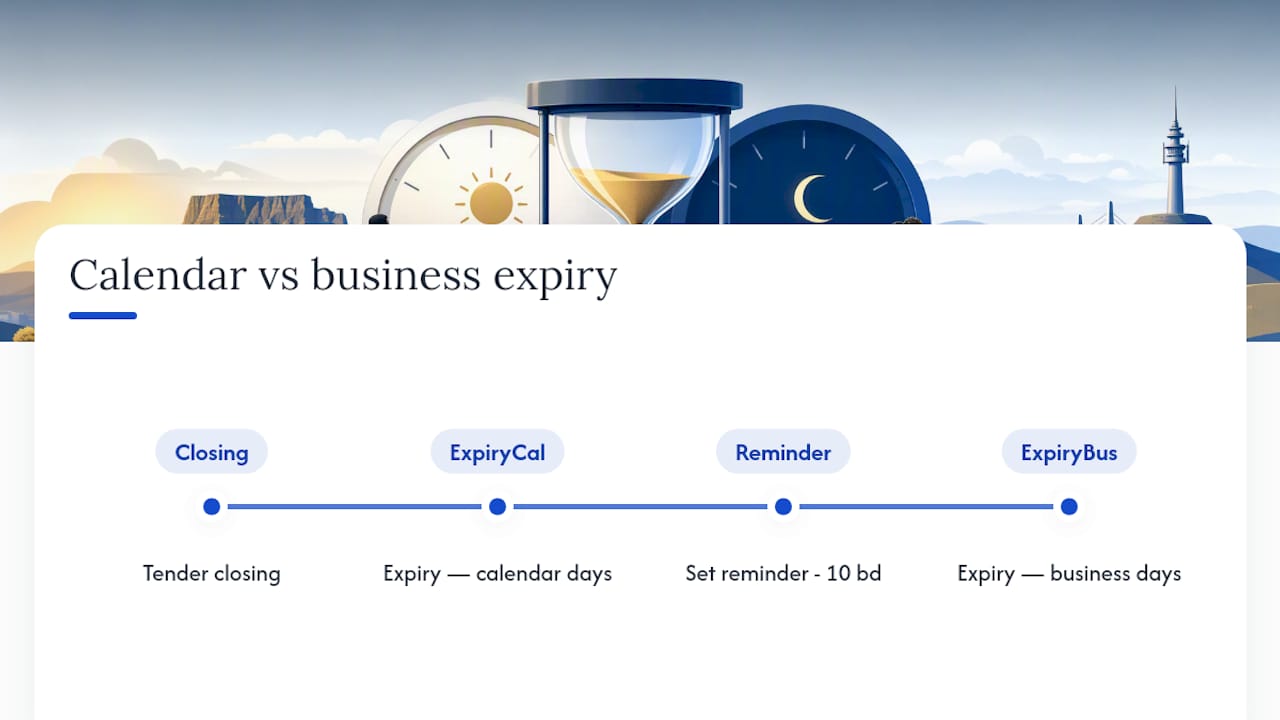
The duration of bid validity typically scales with the procurement complexity. Shorter validity periods usually apply for routine goods or services, while more complex infrastructure or professional services procurements require longer periods. For long-lead capital equipment or multi-year supply agreements, extended validity periods may be necessary, especially when involving additional funding or approval processes.
Pro Tip: Calculate your expiry date the moment you submit, not weeks later when you're chasing feedback. Mark it in a calendar with a reminder set at least 10 business days before expiry, so you're not blindsided by an extension request that lands with 48 hours to respond.The gap between a 30 day and a 180 day window isn't cosmetic. It changes how much price risk you're carrying on materials, labour, and currency exposure, and it should shape how you price the bid in the first place.
What happens legally when a validity period expires without extension
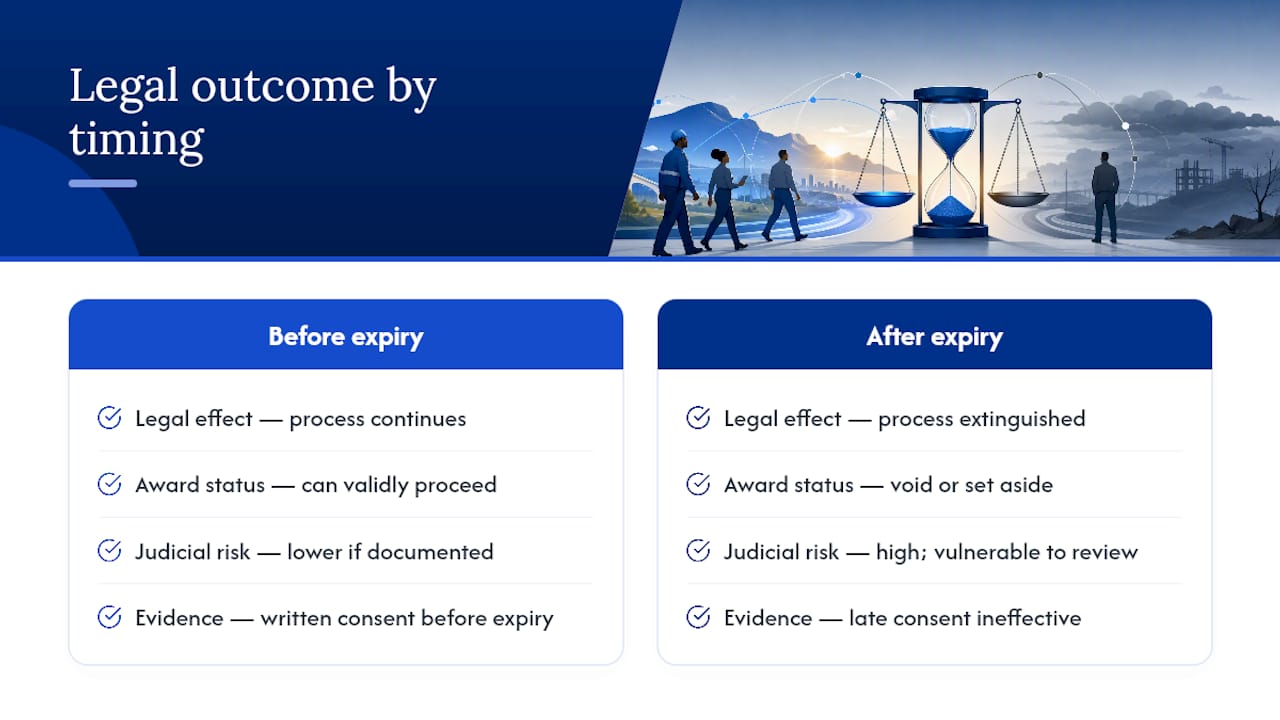
The core rule is unforgiving: if the validity period lapses and no valid extension was agreed before that lapse, the tender process ends and every bid on the table is extinguished. There is no revival. A procuring entity cannot simply decide, three weeks after expiry, to extend retroactively and carry on as though nothing happened.
This principle was confirmed decisively in City of Ekurhuleni Metropolitan Municipality v Takubiza Trading & Projects CC and Others, where the Supreme Court of Appeal held that any extension of a bid validity period must be completed before the original period expires. Miss that window, and the process is dead, not paused.
The extension must happen before expiry, not after. A tender that has lapsed cannot be resuscitated by a late request for consent, however well intentioned the procuring entity's motives.
That principle got tested again in the Siemens v Eskom Holdings litigation (2024), a high-value procurement dispute where the failure to lawfully extend tender validity became central to whether the eventual award could stand. The court's analysis reinforced that awards made after a validity period has lapsed are vulnerable to review and can be set aside, even where the underlying commercial deal made sense to all parties involved. Timing and documentation, not commercial logic, decide the outcome.
The practical consequence for anyone involved in a live tender: once the clock runs out, you're not looking at a technicality you can paper over later. You're looking at a process that has legally ceased to exist. Any award, negotiation, or further evaluation conducted after that point sits on shaky legal ground and invites a review application from any bidder with standing to challenge it.
Evidence and timing carry more weight than good intentions here. A procuring entity that can show it sent written extension requests three weeks before expiry, and received written consent two weeks before expiry, is in a fundamentally different legal position than one that scrambled to send requests the day before the deadline and is still waiting on replies when the period lapses.
How bid validity extensions actually work (and where the law is still unsettled)
Timing is everything in an extension request: both the request and the bidder's consent must happen before the original validity period expires. An extension agreed after the fact has no legal effect, no matter how reasonable the delay or how willing both parties are to proceed.
Who needs to be asked matters just as much as when. Guidance drawn from the Aventino v MEC for Roads and Transport SCA judgment makes clear that extension requests generally need only go to bidders still under active consideration. A bidder already disqualified on objective, documented grounds doesn't need to be canvassed for consent to extend, though procuring entities should be cautious about disqualifying anyone purely to shrink the consent list.
Form matters more than most people assume:
- Extension requests should be in writing, sent to each qualifying bidder individually, with a clear response deadline.
- Consent must also be in writing. Silence is not consent, and a procuring entity that treats non-response as agreement is building its award on unstable ground, a point reinforced by commentary on the Takubiza judgment.
- Records of when each request was sent and when each response arrived need to be preserved. If an award is challenged later, this paper trail is often what decides the case.
Pro Tip: If you're asked to extend and the request doesn't specify a deadline for your response, ask for one in writing. An open-ended extension request creates ambiguity about exactly when your consent needs to land, and that ambiguity works against you if the process is later challenged.
None of this is fully settled law yet. Scholarly analysis in the Law, Democracy & Development journal argues that draft regulations should codify exactly which bidders must be consulted, set firm timing rules for requests and responses, and clarify the legal consequences when a bidder simply refuses. Until that codification happens, procuring entities and bidders are working from case law principles applied to each new set of facts, which leaves room for genuine disagreement about edge cases.
What to do when you're asked to extend your bid
Getting an extension request doesn't obligate you to say yes, and treating it as a formality is where bidders lose money. Work through these steps before you respond:
- Confirm you're still in the running. If you haven't had any indication that your bid survived initial evaluation, ask before agreeing to extend anything.
- Insist on a written request with a stated deadline. Verbal or informal requests (a phone call, an email with no clear ask) leave you exposed if there's ever a dispute about whether consent was properly obtained.
- Reassess your commercial exposure. Material costs, labour rates, and exchange rates move over 60 or 90 extra days. Recalculate your margin before you agree to hold your original price for longer.
- Consider negotiating terms, not just agreeing outright. You can ask for a price variation clause, propose a shorter extension than requested, or decline if the extension would leave you exposed to a loss.
- Check your bid security position. Extending your bid validity often extends the period your bid security or guarantee needs to remain in force, and letting that lapse separately creates its own compliance problem.
- Get legal input on high-value bids. For contracts where the numbers are significant, a lawyer reviewing the extension request and your response takes less time than unwinding a dispute later.
- Keep everything. Save the request, your response, and any correspondence in between. This is the exact evidence a review or dispute would turn on.
Pro Tip: You are under no legal obligation to agree to an extension. Refusing carries no penalty, and you remain free to bid on any re-tender that follows. Weigh the commercial upside of staying in a stalled process against simply waiting for a fresh opportunity.
Reviewing your original tender proposal format and pricing assumptions before you respond gives you a clearer basis for deciding whether an extension still makes commercial sense.
Running a defensible extension process as a procuring entity
Procuring entities carry the heavier legal burden here, because a mishandled extension doesn't just cost one bidder a fair chance, it can unravel the entire award. A few disciplines separate a defensible process from one that ends up in court.
- Track validity expiry dates actively, not reactively. Build a calendar flag well before the deadline, not when someone notices the date has already passed.
- Send written extension requests to every qualifying bidder still under active consideration, with enough lead time for a considered response.
- State an explicit deadline for consent in every request, and log exactly when each response arrives.
- Treat silence as refusal, not agreement. This protects the eventual award from a review challenge grounded in improperly assumed consent.
- If consent isn't received from enough bidders to proceed lawfully, cancel and re-tender rather than pushing an award through on an expired basis.
- Cross check every extension letter against the original RFP wording and your supply chain management policy, since inconsistency between the two is a common ground for procedural challenge.
Following the OCPO/Treasury SCM guidelines on written requests and recordkeeping isn't optional box-ticking. It's the documentation trail that determines whether an award survives a review application months later.
How Protenders helps you stay ahead of expiry risk
Protenders lists closing dates and full tender metadata for every live opportunity on the platform, which gives you the raw dates you need to calculate your own validity window the moment you submit. You can set alerts tied to specific tenders, so an approaching expiry doesn't sneak up on you while you're focused on other bids.
The compliance scorecards and document templates built into the platform help you produce exactly the kind of written evidence that case law demands, whether that's a formal response to an extension request or a paper trail showing when your consent was sent. Bid workspaces keep that correspondence organized in one place, which matters enormously if an award is ever challenged and you need to show precisely when you responded and what you agreed to.
None of this replaces legal advice on a high-value or contested bid. But for the calendar and evidence discipline that most disputes actually turn on, having your deadlines, templates, and correspondence in one system removes a lot of the risk that comes from tracking it across email threads and spreadsheets. You can start by browsing live government tenders to see how closing dates and validity terms are presented for current opportunities.
Where to read the primary sources
For readers who want the judgments and guidance in full rather than a summary: the Takubiza SCA judgment sets out the core rule that extensions must be completed before expiry. The Siemens v Eskom judgment applies that rule to a contested high-value award. The OCPO/Treasury SCM guidelines cover the procedural expectations for organs of state, and the Law, Democracy & Development journal analysis lays out where reform is still needed. Between them, they cover the legal principle, its real-world application, official process guidance, and the gaps still open for debate.
The gap between the legal rule and how people actually behave
The legal principle here is about as clear as South African procurement law gets: extend before expiry or the process dies. What the case law doesn't fully resolve, and what conventional advice tends to gloss over, is how much discretion sits inside "who counts as a qualifying bidder" and what happens when one bidder in a multi-party extension refuses.
Most guidance treats extensions as a simple yes or no transaction. In practice, refusal by even one bidder can throw the whole process into uncertainty, and procuring entities often handle that inconsistently because the regulations haven't caught up with the case law. That's not a reason for bidders to panic, but it is a reason to stop treating an extension request as paperwork and start treating it as a moment to actually reassess your commercial position.
If there's one thing worth prioritizing above everything else in this article, it's the calendar discipline, not the legal nuance. Courts have shown zero tolerance for late extensions regardless of how sympathetic the facts are. Track your dates, put requests and consents in writing, and keep the paper trail. The legal arguments about qualifying bidders and conditional consent only matter if your timing was right in the first place.
— Dolene April
This article is general information, not a substitute for advice from a qualified lawyer. Consult a qualified legal professional about your own circumstances before acting on anything here.
Sources
- City of Ekurhuleni Metropolitan Municipality v Takubiza Trading & Projects CC and Others (SCA 2022)
- Siemens (Pty) Limited v Eskom Holdings SOC Limited and Others (2024) ZAGPJHC 555
- OCPO / Treasury SCM guidelines
- The extension of public tender validity periods (G. Quinot, LDD journal 2025)
FAQ
How long is a tender valid?
A tender's validity period is set by the procuring entity in the RFP, typically ranging from 30 to 180 days depending on the complexity of the procurement, and runs from the closing date unless the document specifies otherwise.
What is the standard bid validity period in South Africa?
There's no single fixed standard. Routine goods and services procurements commonly use 30 to 60 days, while complex infrastructure or professional services tenders often run 90 to 180 days or longer.
What does bid validity period mean?
It's the window during which your submitted bid remains a firm, binding offer that the procuring entity can accept without you withdrawing or repricing it, starting from the closing date and lasting the number of days stated in the RFP.
How do you calculate bid validity?
Add the number of validity days stated in the RFP to the closing date to get your exact expiry date, checking carefully whether the document specifies calendar days or business days, since that distinction can shift the real deadline by more than a week.
What happens if a bid validity period expires without extension?
The tender process ends and all submitted bids are legally extinguished; South African case law confirms that an extension agreed after expiry has no legal effect and cannot revive the process.