BOQ pricing: how to price a bill of quantities correctly

BOQ pricing is the process of turning Bill of Quantities items into unit rates and a tender total. The formula behind every line is: rate = materials + labour + plant + subcontractors + overheads + profit. Get the rate wrong on one heavy item, and it can sink an otherwise competitive bid.
Before you copy a single figure onto the priced BOQ, do this:
- Run a shadow takeoff on the five or ten highest-value or highest-risk items to confirm the quantities actually match the drawings, a step Procore notes catches omissions that a straight read-through misses.
- Only after that verification should you start building rates line by line.
Key Takeaways
Accurate BOQ pricing depends on verified quantities, auditable unit rates, correctly applied overheads and contingency, and strict compliance with contract-specific pricing instructions.
| Point | Details |
|---|---|
| Verify before you price | Run a shadow takeoff on high-value items before copying quantities into your rate sheet. |
| Build auditable rates | Break every rate into materials, labour, plant, and subcontractor components you can explain. |
| Size contingency to risk | Use roughly 3 to 5% contingency for low-risk work and up to 10% for high-uncertainty projects. |
| Follow contract-specific rules | Priced BOQ formalities such as JBCC clause B2.5 and PG-02.2 EC override generic assumptions. |
| Use Protenders for readiness | Compliance scorecards and templates on Protenders help structure a defensible priced BOQ submission. |
Table of Contents
- How do you price a BOQ step by step?
- Building unit rates that survive scrutiny
- What overhead, contingency, and profit should you build in?
- What compliance checks apply to a priced BOQ?
- Which tools actually help with BOQ pricing?
- What mistakes cost contractors the tender?
- A worked example: pricing one BOQ line
- What experienced estimators keep repeating
- How Protenders helps you price and submit with confidence
- Sources
- FAQ
How do you price a BOQ step by step?
Pricing a BOQ is not a single task, it is a sequence, and skipping steps is how contractors underprice concrete or forget preliminaries.
- Open and parse the document. Check the BOQ is complete, correctly formatted, and matches the drawings and specification before you price anything.
- Shadow-take-off the risky items. Re-measure quantities on structural, mechanical, or high-cost trades where an error would move the total materially.
- Gather live inputs. Collect current supplier quotes, confirm labour rates and productivity, and price plant on realistic utilisation, not a catalogue rate.
- Request subcontractor quotes early. Late quotes force guesswork, and guesswork is where margins disappear.
- **Apply overheads, contingency, and profit. Then calculate VAT and any escalation the contract requires.
- Check the arithmetic. Verify every extension and total, then prepare the signed priced-BOQ copies the contract instructions demand.
Building unit rates that survive scrutiny
A defensible rate is not a single number pulled from memory, it is a build-up you can open and explain to an evaluator. Two contractors can land on the same total through completely different splits of materials, labour, and plant, which is exactly why estimating best practice treats each rate as an auditable calculation rather than a black box.
- Materials: use current supplier quotes, add delivery cost, apply a realistic waste allowance (5 to 10% for most trades, higher for cut material like tiling or rebar), and confirm whether VAT is included in the quoted price.
- Labour: build from an hourly wage plus statutory costs (UIF, compensation fund contributions), multiplied by a productivity assumption for that specific task, not a generic crew rate.
- Plant: decide hire versus owned cost based on utilisation over the programme, and load in fuel and maintenance rather than assuming the daily hire rate covers everything.
- Subcontractors: get written quotes with clear scope and exclusions listed, because a verbal "R450 per square metre" quote with no exclusion list becomes a dispute the moment site conditions differ from the drawing.
Pro Tip: Keep a running file per rate showing which supplier quote, wage rate, and productivity figure you used. When a client's quantity surveyor queries a rate six weeks later, you want the answer in thirty seconds, not a reconstructed guess.
What overhead, contingency, and profit should you build in?
Overheads recover the cost of running the business, not the site. Calculate your overhead percentage as: total annual overheads divided by annual turnover.
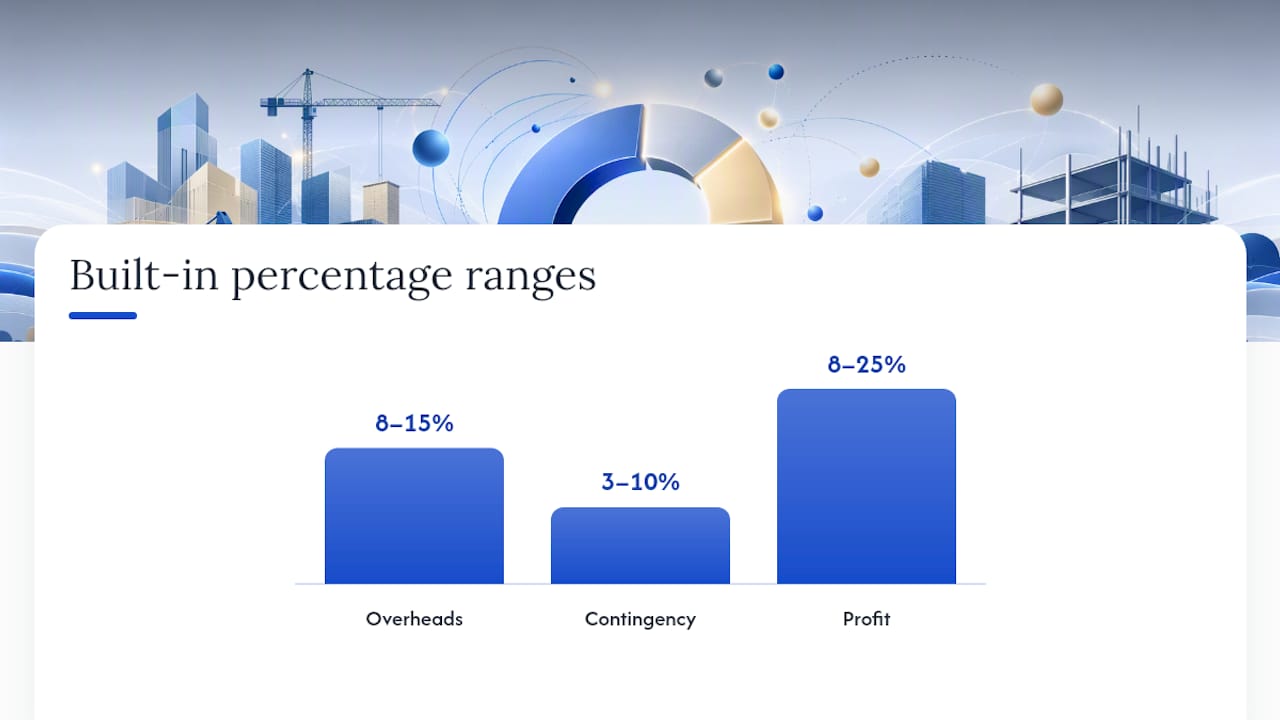
Contingency and profit move with risk. Tender pricing guidance commonly cites overheads in the 8 to 15% range, contingency between 3 and 10%, and profit margins spanning roughly 8 to 25% depending on how well-defined the scope is and how much competition you expect.
| Project complexity | Suggested contingency | Typical profit margin |
|---|---|---|
| Low (repeat scope, known site) | 3 to 5% | 8 to 12% |
| Medium (some design uncertainty) | 5 to 8% | 12 to 18% |
| High (unknowns, tight programme, new client) | 8 to 10% | 15 to 25% |
What compliance checks apply to a priced BOQ?
Pricing instructions usually sit in a project-specific document, often referenced as PG-02.2 EC in Public Works contracts, and they override generic assumptions about how you fill in a BOQ. Read them before you price a single item, not after.
- Priced BOQs generally follow JBCC clause B2.5_FFEBRUARY_2023_REV.pdf) for copy numbering, signatures, and submission to the principal agent or custodian.
- The CIDB's Practice Note #21 recommends requesting a priced BOQ specifically from the highest-ranked tenderer during evaluation, not from every bidder at closing.
- Arithmetical errors get corrected before award under the Public Works quantity surveying manual's own procedures, which means a mis-extended line does not simply void your bid, it gets fixed and can shift your total either way.
- Document every non-schedule rate you negotiate, and cross-reference it to the supplier invoice or quote that supports it.
One clause matters more than most estimators realise: arithmetic corrections happen automatically during evaluation under Public Works procedure, so an extension error you miss will still be caught, just not on your terms.
Which tools actually help with BOQ pricing?
Software helps when it makes your rate build-up faster to construct and easier to defend, not when it hides the calculation behind a single number.
- Parsing accuracy. The tool should read BOQ line items, units, and quantities correctly from PDF or spreadsheet formats without manual re-keying.
- Editable rate build-ups. Insist on seeing the materials, labour, and plant components separately, because a locked "black-box" rate cannot survive a client query or an evaluation panel's arithmetic check, a point worth treating as a hard requirement before you pay for any pricing tool.
- A local rate library. Current material and labour benchmarks save you from pricing off last year's quote.
- Audit features. Duplicate-item detection, version history, and arithmetic validation catch the errors a tired estimator misses at 11pm before a submission deadline.
Decide between software and a managed pricing service based on capacity, not preference. A small team facing three tenders in one week with no in-house estimator benefits more from a managed service than from learning a new tool under deadline pressure. Tools like RFP Forge AI can also help assemble the surrounding proposal documentation once your BOQ pricing is locked in, freeing up time for the numbers that matter most.
What mistakes cost contractors the tender?
Most losing bids fail on process, not on strategy. Run this check in the ten minutes before you submit:
- Recalculate extensions on your five highest-value lines by hand, since a spreadsheet formula error compounds across every row beneath it.
- Confirm units match the BOQ description, a rate priced per linear metre against an item measured in square metres is a common and expensive mismatch.
- Check preliminaries, general items, and provisional sums are all priced, not left at zero because they seemed like someone else's line.
- Verify VAT, escalation, and any contract-specific summary form are filled in exactly as instructed.
- Write down the assumptions behind unusual rates now, not after a dispute forces you to reconstruct them from memory.
A worked example: pricing one BOQ line
Take 1m³ of in-situ concrete, a common line item worth walking through in full.
- Materials: ready-mix at R1,450/m³, plus a 5% waste allowance = R1,522.50.
- Labour: placing and finishing at 1.5 hours per m³ at R180/hour loaded rate = R270.
- Plant: vibrator and mixer allocation at R95/m³ based on programme utilisation.
- Subtotal: R1,887.50 per m³.
- Overheads at 10%: R188.75. Profit at 15%: R311.14. Unit rate: R2,387.39/m³.
- Line extension for 40m³: R95,495.60. Recheck the multiplication before it goes on the summary page.
Record the supplier quote reference, the labour productivity assumption, and the waste percentage against this line. If a variation arises on site, that paper trail is what lets you substantiate a claim instead of arguing from memory.
What experienced estimators keep repeating
The same pricing pitfall shows up on nearly every tender I review: contractors copy quantities straight into their pricing sheet without checking them against the drawings first, then wonder why a concrete line comes in 15% short six months into the contract. A shadow takeoff on your biggest-risk items takes an afternoon. It has saved more margins than any clever profit percentage ever has.

Capturing your rate build-ups properly does more than protect one tender. It builds a private rate library that makes your next BOQ faster to price and harder to underprice by mistake.
How Protenders helps you price and submit with confidence
Finding the right BOQ tender is the first hurdle, and Protenders solves it by pulling every live national, provincial, and municipal tender into one searchable feed, no sign-up required to browse.
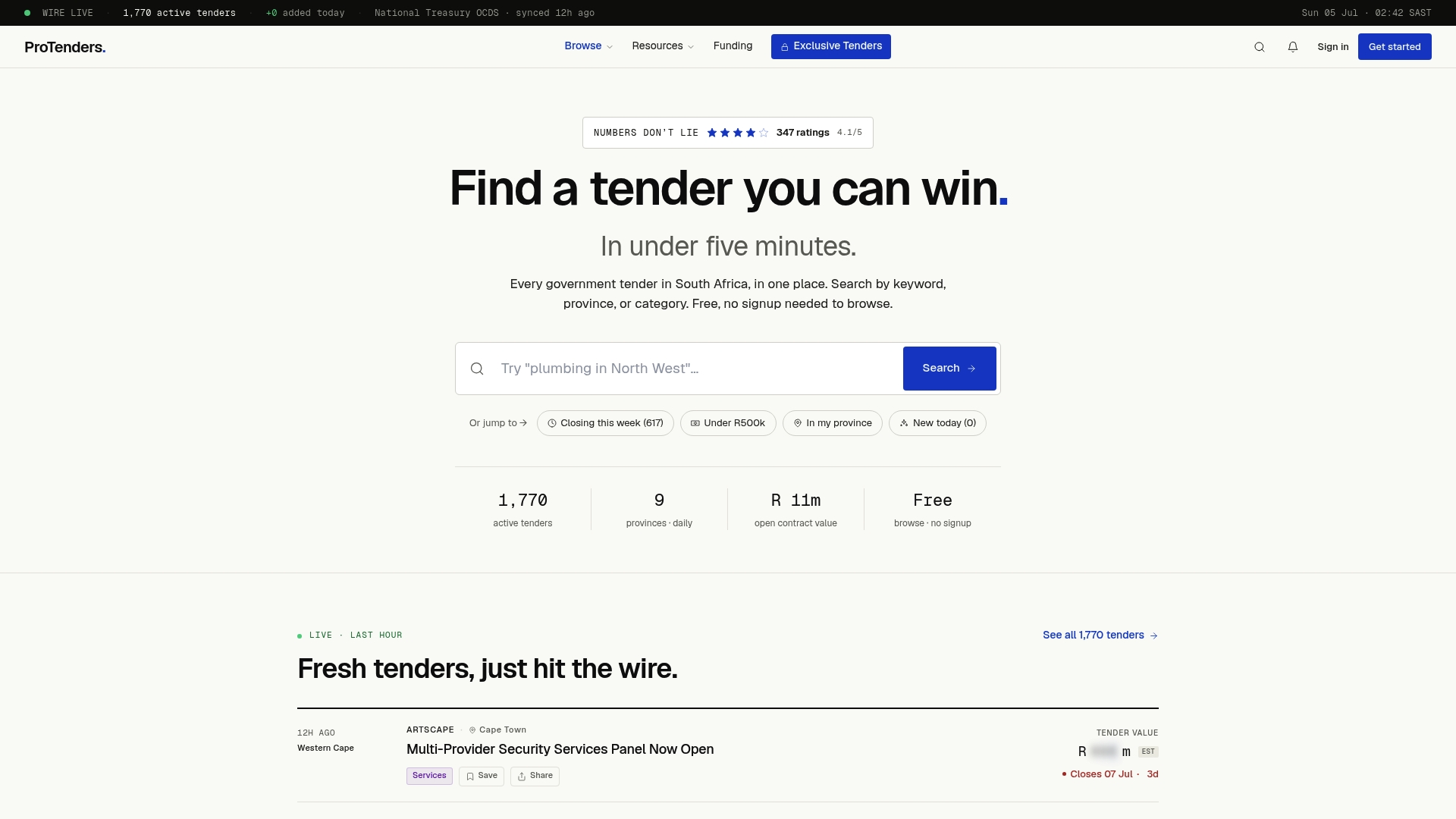
Once you've found a tender worth pricing, the platform's compliance scorecards flag gaps in your documentation before a client does, and its tender document templates give your priced BOQ the structure evaluators expect. Automated alerts mean you are not scrambling on a closing date because you missed an amendment. For SMMEs juggling limited estimating capacity, that combination of discovery and readiness tools matters more than any single feature. Browse live opportunities on the South African government tenders feed and start matching your next priced BOQ to a tender before the closing date creeps up on you.
Sources
This article draws on the CIDB's Practice Note #21 on bills of quantities, the Public Works Quantity Surveying Manual, and practical BOQ guidance from Procore and Build-Construct. For definitions of terms like priced BOQ and JBCC, see the tender glossary.
- Practice Note #21 – Bills of quantities (BoQ) (cidb)
- Bill of quantities in construction: How a BOQ works and why it matters (Procore)
- Bill of Quantities in Construction: How a BOQ works and why it matters (Build-Construct)
FAQ
What does "BOQ pricing" mean?
BOQ pricing means calculating a unit rate and line total for every item in a Bill of Quantities, built from materials, labour, plant, subcontractors, overheads, and profit.
How much do builders charge per square metre in South Africa?
Rates vary widely by finish level, region, and building type, so there is no single reliable per-square-metre figure. Build your own rate from current material and labour costs for the specific project rather than relying on a generic benchmark.
How much should a quantity surveyor charge?
Quantity surveying fees typically scale with project value and complexity rather than a flat rate, and vary by scope of service. Confirm current fee guidance directly with a professional body or the specific QS firm rather than assuming a fixed percentage.
How do you calculate a BOQ?
Calculate each BOQ item by pricing the unit rate (materials plus labour plus plant plus subcontractors plus overheads plus profit), multiplying by the quantity, then summing all lines and adding VAT and any required escalation for the total tender price.