Carpentry tenders in South Africa: 2026 guide

Where can you find live carpentry tenders right now?
South Africa's public procurement system runs through two primary channels, and knowing which one to check first saves you hours of searching. The e-Tender Publication Portal is the government's mandated single point of entry for all public sector tenders, covering national departments, provincial governments, municipalities, state-owned enterprises, and public entities. Access is free, no registration required to browse.

Beyond the official portal, Protenders aggregates all live government carpentry tenders across every sphere of government and layers on compliance tools, automated alerts, and bid management features that the raw portal does not offer.
Top platforms for live carpentry tenders in South Africa:- e-Tender Publication Portal (etenders.gov.za): official government source, free, covers all public sector buyers
- Protenders (protenders.co.za): aggregated view with keyword search, regional filters, compliance scorecards, and funding partnerships
- CIDB Current Tenders (cidb.org.za): tenders specific to the construction industry development board's own procurement
- Provincial portals: Western Cape, Gauteng, and other provinces publish tenders on their own treasury sites alongside the national portal
- Municipal noticeboards and local newspapers: the 30 Western Cape municipalities, for example, are required to advertise tenders locally in addition to the national portal
Table of Contents
- How do you find and monitor carpentry tenders consistently?
- What registration do you need to bid on government carpentry tenders?
- How do you prepare and submit a winning carpentry tender bid?
- How Protenders helps you find and win more carpentry tenders
- What mistakes do contractors make in carpentry tender bids?
- What are the typical timelines for carpentry tender submissions?
- How are carpentry tenders evaluated and scored?
- What do you need to do after winning a carpentry tender?
- How do you build a tender portfolio that wins more bids?
- Protenders gives you every South African carpentry tender in one place
- Key takeaways
- FAQ
How do you find and monitor carpentry tenders consistently?
Sporadic searching is how contractors miss deadlines. Contractors who win consistently have a system, not just a bookmark.
Build a monitoring routine using these methods:- Set keyword alerts on Protenders using terms like "carpentry," "joinery," "timber," "furniture supply," and "fitout" to catch relevant woodworking bids across categories
- Filter by province and municipality to focus on your operational footprint and avoid chasing contracts you cannot realistically service
- Check the e-Tender portal weekly at minimum, since tender windows can be as short as 14 days for smaller RFQs
- Subscribe to the Government Tender Bulletin, published weekly at gov.za, which lists all competitive bids above R1 million
- Follow provincial treasury pages directly for region-specific construction carpentry offers that may not surface immediately on the national portal
Organizing your pipeline matters as much as finding tenders. Keep a simple spreadsheet tracking tender reference numbers, closing dates, required documents, and CIDB grade requirements. Missing a closing date because of a disorganized pipeline is one of the most avoidable losses in this business.
*What registration do you need to bid on government carpentry tenders?
This is where many small contractors get caught out. CIDB registration is mandatory for any public sector construction contract exceeding R30,000 including VAT. Carrying out work without valid registration is a criminal offence under the Construction Industry Development Act.
Carpentry falls under the General Building (GB) class of works, defined as construction primarily concerned with the development, extension, installation, renovation, or alteration of permanent shelter. This covers fitouts, built-in furniture, structural timber work, and building renovations. You register in the GB class and the grade you qualify for determines the maximum contract value you can bid on.
Grades run from 1 to 9, with Grade 1 requiring no minimum financial or track record evidence and allowing contracts up to a moderate contract value. From Grade 2 upward, CIDB assesses your financial statements and verifiable project history.
CIDB grading summary for General Building (GB):| Grade | Max tender value | Best annual turnover (GB) |
|---|---|---|
| 1 | R500,000 | None required |
| 2 | R1 million | — |
| 9 | No limit | — |
How do you prepare and submit a winning carpentry tender bid?
A compliant bid gets you through the door. A well-constructed bid wins the contract.
Documents typically required in a carpentry tender submission:- Pricing schedule or bill of quantities with itemized costs
- Technical methodology: how you will execute the work, sequencing, materials, and quality standards
- Capacity statement: plant, equipment, key personnel, and subcontractor arrangements
- CIDB registration certificate (valid and correct grade)
- Tax Compliance Status (TCS) pin from SARS
- B-BBEE certificate or sworn affidavit
- Company registration documents and bank confirmation letter
- References and completion certificates from comparable past projects
Cost estimation deserves real attention. Underpricing to win is a trap: if your margin cannot cover materials, labour, and site overheads, you will either deliver poorly or absorb a loss. Build in contingency for timber price fluctuations, which have been volatile in recent years, and factor in VAT correctly throughout your pricing schedule.
Pro Tip: Use AI-assisted proposal tools to draft your technical methodology sections faster. A well-structured risk management and QA plan, even for a mid-sized carpentry contract, can be the deciding factor when two bidders are close on price. *How Protenders helps you find and win more carpentry tenders
Protenders is built specifically for South African SMMEs navigating public procurement. Rather than manually checking multiple portals and provincial sites, you get every live government tender in one place, searchable by keyword, region, or category without needing to create an account to browse.
The platform's compliance scorecards flag gaps in your documentation before you submit, which is particularly useful for contractors moving up CIDB grades and encountering new document requirements for the first time. Document templates take the guesswork out of formatting bid submissions to meet government specifications.
Funding partnerships are one of the more practical features for growing carpentry businesses. Winning a R5 million fitout contract is meaningless if you cannot finance the materials and labour upfront. Protenders connects awarded contractors with funding partners who understand the public procurement cycle, bridging the gap between contract award and first payment.
*What mistakes do contractors make in carpentry tender bids?
The most common reason a technically capable contractor loses a bid has nothing to do with their carpentry skills.
Frequent pitfalls to avoid:- Ignoring technical weighting: RFPs score methodology, risk management, and capacity heavily. Submitting a price with minimal technical content is a fast path to disqualification
- Incomplete documentation: a missing TCS pin, expired CIDB certificate, or absent B-BBEE affidavit will get your bid set aside before evaluation begins
- Underestimating costs: low-price bids that cannot be delivered at the quoted rate create contract disputes, penalties, and reputational damage
- Missing the closing deadline: late submissions are not accepted under any circumstances in public procurement
- Wrong CIDB grade: bidding on a contract above your registered grade is non-compliant and your bid will be rejected
What are the typical timelines for carpentry tender submissions?
Tender windows vary by contract size and procurement type. RFQs for smaller carpentry contracts can close within a short period after advertisement. Formal tenders for larger construction carpentry projects generally allow several weeks from advertisement to closing date, with some complex RFPs running longer.
Award notices for competitive bids above a substantial financial threshold must be published on the Government Tender Bulletin and the e-Tender portal. From closing date to award, expect 4–12 weeks depending on the complexity of evaluation and the number of bids received. Build this timeline into your cash flow planning: you may be preparing bids for contracts that will only start three months from now.
Always check the tender document for a compulsory briefing session date. Missing a compulsory site visit or briefing disqualifies your bid automatically, regardless of how strong your submission is.
*How are carpentry tenders evaluated and scored?
South African public procurement uses a preference point system under the Preferential Procurement Regulations. For contracts below R50 million, the 80/20 system applies: 80 points for price and 20 for B-BBEE status. Contracts above R50 million use the 90/10 split, with 90 points for price and 10 for B-BBEE.
Technical compliance is a pass/fail gate before scoring begins. Your bid must meet all mandatory requirements, including valid CIDB registration at the correct grade, tax compliance, and complete documentation, before the price and preference points are calculated. An RFP may add a separate technical evaluation stage where methodology and capacity are scored, with only bids above a minimum technical threshold proceeding to price evaluation.
Price is assessed on a comparative basis: the lowest compliant price scores the maximum 80 or 90 points, and other bids are scored proportionally below that.
*What do you need to do after winning a carpentry tender?
Winning is the beginning of the compliance obligation, not the end of it. Read the contract in full before signing. Government contracts typically reference standard conditions such as the General Conditions of Contract (GCC) or the JBCC Principal Building Agreement for building works, and deviations from these are uncommon.
Key post-award obligations for carpentry contractors include submitting performance guarantees or retention bonds where required, maintaining a site instruction register, submitting monthly progress reports, and keeping records of all variations and change orders in writing. Verbal instructions from a site supervisor carry no contractual weight.
Register the completed project on the CIDB Register of Projects once work is done. This is mandatory since April 2021 and the record feeds directly into your track record for future grade upgrades.
*How do you build a tender portfolio that wins more bids?
Your portfolio is your most durable competitive asset. Every completed project, regardless of size, should generate a completion certificate, a client reference letter, and a record of the final contract value. These three documents are what CIDB assessors and tender evaluators look for.
Start with smaller RFQ-level contracts to build documented experience at Grade 1 and 2. Each completed project with proper paperwork moves you closer to the next grade threshold. Photograph finished work, document the scope clearly, and get sign-off from the client promptly while the project is fresh.
Sector diversity also helps. A portfolio showing school fitouts, office furniture installations, and residential renovation work demonstrates broader capability than a single project type. When evaluators compare two Grade 3 contractors, the one with varied, well-documented references across different client types tends to score higher on capacity assessment.
*Protenders gives you every South African carpentry tender in one place
Every carpentry contractor in South Africa is competing for the same pool of government contracts. The difference between those who win consistently and those who miss opportunities is usually not skill. It is access to the right tenders at the right time, with the right documents ready.
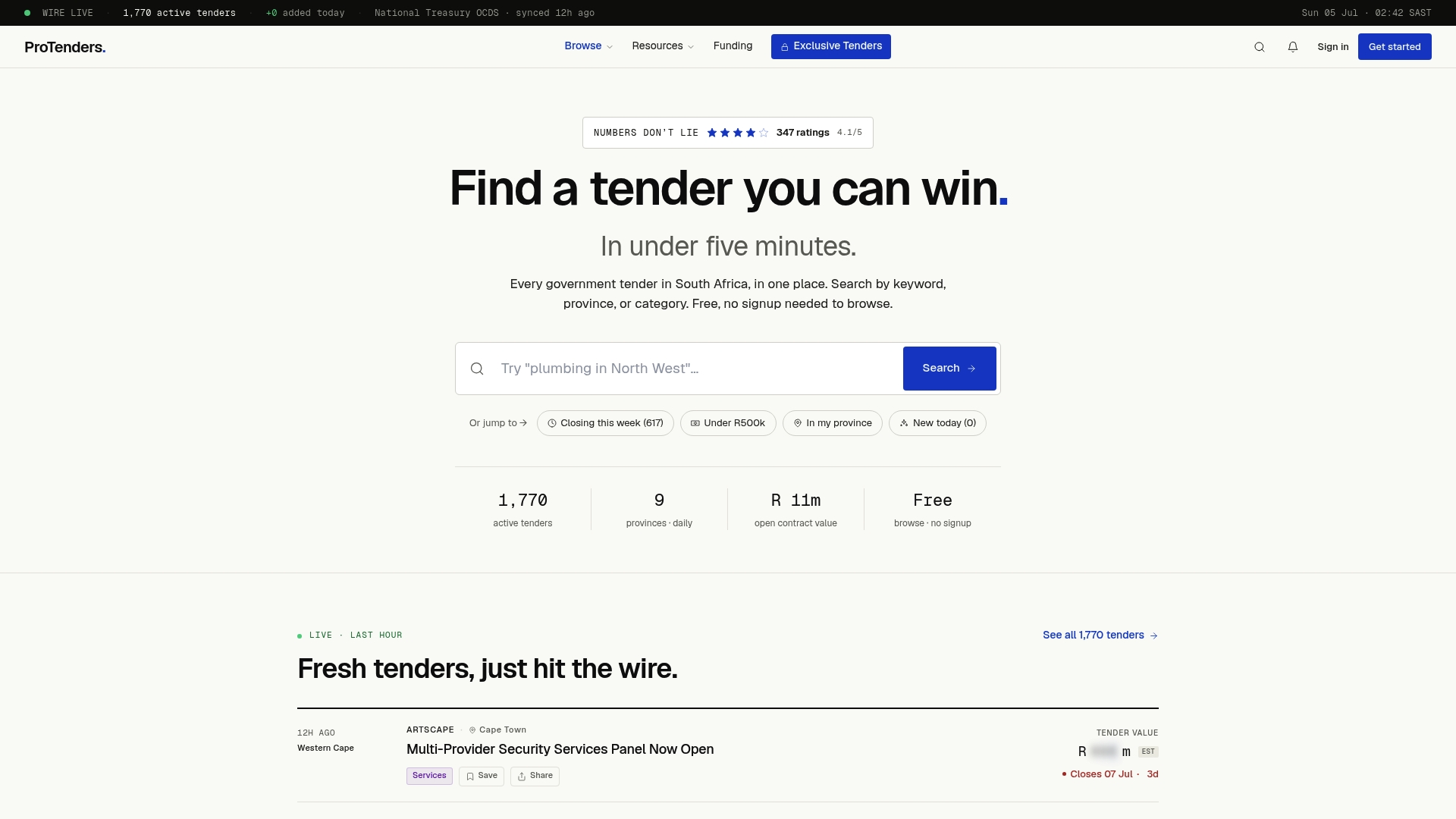
Protenders aggregates every live government tender across national, provincial, and municipal buyers, so you are not piecing together results from multiple portals. Search by keyword or region, get automated alerts the moment a relevant carpentry contract is published, and use built-in compliance scorecards to check your bid before submission. For contractors who have won work and need to finance execution, funding partnerships are available through the platform.
Browse live carpentry tenders on Protenders now, no sign-up required to start searching.
*Key takeaways
Winning carpentry tenders in South Africa requires CIDB registration in the General Building class, access to the right platforms, and a technically complete bid submission.
| Point | Details |
|---|---|
| Mandatory registration | CIDB registration is required for all public carpentry contracts over R30,000, with grades from 1 (up to R500,000) to 9 (unlimited). |
| Primary tender sources | The e-Tender Publication Portal is the official free source; Protenders aggregates all live tenders with search and compliance tools. |
| Bid evaluation system | Contracts below R50 million use an 80/20 scoring split between price and B-BBEE; technical compliance is a pass/fail gate before scoring. |
| Common bid killers | Missing documents, expired CIDB certificates, and ignored technical weighting disqualify bids before price is even considered. |
| Protenders advantage | Protenders aggregates all South African government tenders with compliance scorecards, document templates, and funding partnerships for SMMEs. |
FAQ
What does "carpentry tender" mean?
A carpentry tender is a formal procurement invitation from a government or public entity asking contractors to submit competitive bids for carpentry, joinery, or timber-related construction work. In South Africa, these are advertised on the e-Tender Publication Portal and must follow CIDB registration requirements for contracts above R30,000.
What are the three types of tenders in South African procurement?
The main types are the Request for Quotation (RFQ), the Request for Tender (RFT), and the Request for Proposal (RFP). RFQs are used for lower-value contracts, RFTs for straightforward larger contracts with defined specifications, and RFPs when the client is open to different technical solutions.
Do I need CIDB registration to bid on carpentry tenders?
Yes. Any public sector carpentry contract above R30,000 requires valid CIDB registration in the General Building (GB) class. Bidding or carrying out work without registration is a criminal offence under the Construction Industry Development Act.
What do most carpenters charge per hour in South Africa?
Hourly rates for carpentry work in South Africa vary by region, specialization, and project type and are not publicly standardized. For tender pricing, costs are typically submitted as a lump sum or itemized bill of quantities rather than an hourly rate.
How do I find current carpentry tenders in South Africa?
Browse the e-Tender Publication Portal for free, or use Protenders to search all live government tenders by keyword and region with automated alerts for new woodworking bids as they are published.