COIDA letter for tenders: how South African contractors get it

A COIDA Letter of Good Standing is the Compensation Fund's confirmation that your employer account is registered, your Return of Earnings is filed, and your assessed contributions are paid. For any government tender, it is not optional — procurement evaluators treat a missing or expired letter as grounds for immediate disqualification.
One legal point worth stating plainly: every employer with at least one employee must register with the Compensation Fund within seven working days of hiring. Skip that step and you carry personal liability for any workplace injury, on top of losing tender eligibility.
Your immediate next step: check whether you already have a Compensation Fund (CF) employer reference number. If you do, log in at cfonline.labour.gov.za.aspx) to confirm your account is in good standing. If you do not, start registration today.
*Table of Contents
- What is COIDA and what does a Letter of Good Standing actually prove?
- Why do procurement teams require a COIDA letter for government tenders?
- Who issues the letter and how do you verify it is genuine?
- Who must register and what happens if you miss the deadline?
- Step-by-step: how to get a COIDA Letter of Good Standing for a tender
- What to do if you are not yet registered: lawful options and shortcuts to avoid
- How much does getting a COIDA letter cost and how long does it take?
- How to attach the COIDA letter in a tender submission
- Common mistakes and red flags that get COIDA letters rejected
- Key takeaways
- The part most contractors get wrong about COIDA compliance
- Protenders keeps your tender compliance on track
- Useful sources
- FAQ
What is COIDA and what does a Letter of Good Standing actually prove?
COIDA stands for the Compensation for Occupational Injuries and Diseases Act (130 of 1993). It is the legislation that requires South African employers to contribute to the Compensation Fund, a statutory body administered by the Department of Employment and Labour. When a worker is injured on the job or contracts an occupational disease, the Fund pays out — not the employer directly. The Letter of Good Standing is the Fund's written confirmation that your account qualifies for that protection.
The letter is a status document, not a registration certificate. You must first register with the Compensation Fund and complete the W.As2 registration form before a letter can ever be generated. Once registered, the letter is issued only when your account is fully current.
A legitimate Letter of Good Standing typically shows:
- CF employer reference number — your unique account identifier
- Registered employer name — must match your CIPC or trading name exactly
- Good-standing status — confirms compliance at the date of issue
- Issue date and validity period — annual or monthly depending on your payment arrangement
- Certificate number — the reference used to verify authenticity on the portal
Only the Compensation Fund, operating under the Department of Employment and Labour, can issue a legitimate letter. No third party, agent, or consultant has that authority. *
Why do procurement teams require a COIDA letter for government tenders?
Procurement officers are not asking for this document out of habit. There are specific legal and risk-management reasons behind the requirement, and understanding them helps you anticipate what evaluators actually check.
- Legal compliance — government entities are required to contract with employers who meet statutory obligations; a valid letter proves you do.
- Worker protection — it confirms your employees are covered for workplace injuries, which limits the state's downstream liability on publicly funded projects.
- Risk transfer — without your own coverage, any injury on a government site could expose the contracting authority to claims.
- Subcontractor verification — under COIDA, if a subcontractor's employees are not covered, they are deemed your employees and their earnings must be included in your Return of Earnings. Procurement teams increasingly ask for subcontractor letters too.
- Avoiding downstream liability — an expired or absent letter signals that your account may have lapsed, which transfers risk to the buyer.
Disqualification for a missing letter is automatic on most tender boards. Beyond that, some clients specify that the letter must be recently issued at the time of submission — so a valid letter from eight months ago may still fail the freshness test. *
Who issues the letter and how do you verify it is genuine?
The Compensation Fund issues every legitimate Letter of Good Standing through its online systems: the CompEasy portal and the CF online services at cfonline.labour.gov.za. No other body, website, or individual can generate an official letter.
Verification is straightforward if you know where to look:
- Validate on the portal — go to cfonline.labour.gov.za.aspx) and enter the certificate number to confirm the letter's status.
- Check issue and expiry dates — confirm the letter falls within the tender's required freshness window (commonly 30–90 days).
Pro Tip: When submitting a tender, include both the letter PDF and a screenshot of the portal validation. Record the URL, date, and time of verification. Procurement officers who spot a questionable letter will check the portal themselves — having your own verification on file shows due diligence and speeds up any query. *

Who must register and what happens if you miss the deadline?
The legal requirement is clear: every employer with one or more employees must register with the Compensation Fund. There are no exemptions for small businesses, sole traders, or informal arrangements.
Register within 7 working days of hiring your first employee. Missing this deadline does not just delay your letter — it exposes you personally to liability for any workplace injury that occurs in the gap, and it disqualifies you from government tenders until registration and back-payments are resolved.
The consequences of non-registration stack up quickly:
- Personal liability for occupational injury claims
- Inability to obtain a legitimate Letter of Good Standing
- Automatic disqualification from government tender submissions
- Possible penalties for late registration
One more point that catches businesses off guard: even if you have paid your assessments, failing to submit your annual Return of Earnings.aspx) will automatically revoke your good-standing status. Payment alone is not enough. The ROE must be filed and accepted. *
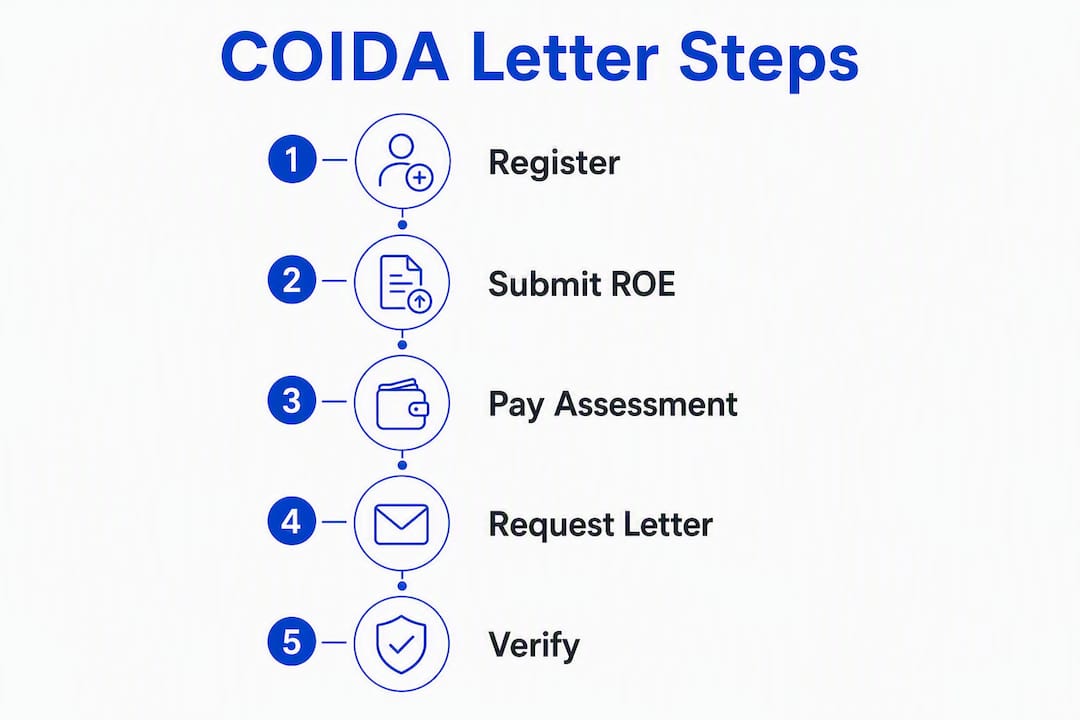
Step-by-step: how to get a COIDA Letter of Good Standing for a tender
Follow these steps in order. Skipping ahead — particularly trying to request a letter before your ROE is filed — will result in a system rejection.
- Confirm your CF employer reference number. Log in to CompEasy or check your original registration documents. If you cannot locate it, contact your nearest Department of Employment and Labour provincial office.
- Register if you have not already (W.As2 form). Complete the employer registration form and submit it with supporting documents to RegistrationCF@labour.gov.za.
- Submit your Return of Earnings (ROE). File via ROE Online at cfonline.labour.gov.za. Your ROE must reflect accurate total employee earnings for the relevant period.
- Pay your assessed contributions or arrange instalments. The letter is only issued once the assessment is paid in full, or a valid instalment plan is in place with at least 20% paid upfront.
- Request the letter via CompEasy or CF online. Once your account shows a current status, the system can generate the letter. The automated process typically takes 24–72 hours when everything is in order.
- If the system flags your account for manual review, visit your provincial Department of Employment and Labour office. CompEasy flags mismatches between employer details and CIPC records — a provincial officer can issue manual confirmation for urgent tenders.
Documents to have ready:
- CIPC registration certificate (for companies and close corporations)
- Certified ID copies of all owners or directors
- Proof of UIF registration
- Completed ROE or ROE submission confirmation
- Proof of payment or signed instalment arrangement
For urgent requests, use this subject line when emailing a provincial office: "Urgent: Letter of Good Standing request — CF number [XXXXXXX] — Tender deadline [date]." A clear subject line gets your email to the right person faster. *
What to do if you are not yet registered: lawful options and shortcuts to avoid
If a tender deadline is approaching and you are not yet registered, you have legitimate options — and some very risky ones to steer clear of.
Lawful routes:- Register immediately via the Department of Employment and Labour portal and submit the W.As2 form. Processing is not instant, but starting now is the only compliant path.
- File your ROE as soon as registration is confirmed, and arrange an instalment plan if you cannot pay the full assessment immediately.
- For genuinely urgent situations, visit a provincial DoEL office in person. Staff can sometimes provide manual confirmation letters or status emails that procurement teams will accept while the online system catches up.
- Offers to sell a Letter of Good Standing for a flat fee
- PDF letters with no certificate number or a certificate number that fails portal validation
- Letters issued in another company's name or CF number
- Requests to use a related entity's letter for your tender
How much does getting a COIDA letter cost and how long does it take?
There is no separate fee for the Letter of Good Standing itself. The Compensation Fund does not charge a "tender certificate" fee. What you pay are annual assessment contributions, calculated on your industry classification and your total employee earnings for the year. Higher-risk industries (construction, mining) attract higher rates than lower-risk ones (office administration).
| Stage | Typical timeframe |
|---|---|
| Initial employer registration typically takes about a week when done online, longer if manual review is required | |
| ROE submission processing usually takes several working days | |
| Automated letter generation | 24–72 hours (account must be fully current) |
| Manual provincial review time varies but can take about one to two weeks |
| Annual renewal occurs after the annual ROE is filed and the assessment is paid |
|---|
How to attach the COIDA letter in a tender submission
Getting the letter is only half the job. How you present it in the tender pack affects whether it passes the admin compliance check.
File naming: Use a clear, consistent format. Example:COIDA_LGS_[CompanyName]CF[Number][YYYYMMDD].pdf. Including the certificate number and issue date in the filename means a procurement officer can verify it without opening a second document.
Cover letter reference: When your tender includes a covering letter or compliance schedule, add one line referencing the document: "COIDA Letter of Good Standing attached — Certificate No. [XXXXXXX], issued [date], valid to [date], verified via cfonline.labour.gov.za."
For online tender portal uploads, upload the letter as a separate PDF in the compliance documents section. Do not embed it inside another document where it might be missed.
For physical tender packs, place the letter immediately after your tax clearance certificate and CSD printout. Attach a portal verification screenshot behind it. Procurement officers working through a physical pack appreciate documents in a logical compliance sequence — it reduces the chance of your submission being flagged for a missing document that is actually there.
Check the full tender documents checklist to confirm you have every required compliance document before submission.
*Common mistakes and red flags that get COIDA letters rejected
Even contractors who have a valid letter sometimes lose marks or get flagged. These are the errors that come up most often.
Common bidder mistakes:- Submitting an expired letter (check the issue date against the tender's freshness requirement)
- Employer name on the letter does not match the company name on the tender documents or CIPC certificate
- CF number on the letter differs from the number on the registration documents
- Missing ROE evidence — some tenders ask for proof of ROE submission alongside the letter
- Failing to obtain Letters of Good Standing from subcontractors whose employees are deemed your employees under COIDA
- Letters with no certificate number, or a certificate number that returns no result on the CF portal
- Low-resolution scans or obviously altered PDFs
- Letters sent from email addresses that are not @labour.gov.za
- A letter dated on a weekend or public holiday (the system does not generate letters on non-working days)
Key takeaways
A COIDA Letter of Good Standing is only issued after registration, ROE submission, and payment — and it must be current, certificate-numbered, and portal-verified to pass a government tender compliance check.
| Point | Details |
|---|---|
| Confirm your CF number first | Check CompEasy or your registration documents before requesting a letter. |
| ROE and payment are prerequisites | The letter is not issued until your Return of Earnings is filed and assessment is paid (or an instalment plan is active). |
| Register within 7 working days | Hiring staff without registering creates personal liability and blocks tender eligibility. |
| Freshness matters | Some tenders require a letter no older than 30–90 days — request a fresh one before each submission cycle. |
| Protenders for tender readiness | Use Protenders' compliance scorecards and document templates to track COIDA status alongside all other tender requirements. |
The part most contractors get wrong about COIDA compliance
Most of the advice on COIDA letters focuses on the steps to get one. That is useful, but it misses the real compliance risk: the letter is a lagging indicator. By the time you are scrambling to get a letter for a tender deadline, you have already lost the buffer you needed.
The contractors who consistently pass compliance checks are not the ones who know the portal best. They are the ones who treat COIDA maintenance as a standing monthly task: ROE filed on time, assessment paid or instalment current, letter requested at the start of each bidding cycle. That discipline means they never face a 72-hour panic when a tender opportunity appears.
There is also a subcontractor blind spot that catches main bidders off guard. Procurement teams are increasingly asking for Letters of Good Standing from every subcontractor named in a bid. If one of your subcontractors has lapsed coverage, their employees are legally your employees under COIDA — and their earnings should have been in your ROE. That is not a technicality; it is a liability that can disqualify your entire submission.
One practical tactic for urgent situations: if your letter is delayed because CompEasy has flagged your account for manual review, do not wait for the system to resolve itself. Email your provincial DoEL office with your CF number, ROE submission reference, and proof of payment, and ask for a written status confirmation. A dated email from a DoEL officer confirming your account is compliant is something most procurement committees will accept as interim evidence while the portal catches up.
*Protenders keeps your tender compliance on track
Winning a government tender requires more than a good price. The compliance pack — COIDA letter, tax clearance, CSD registration, B-BBEE certificate — has to be complete, current, and correctly formatted every time you submit.
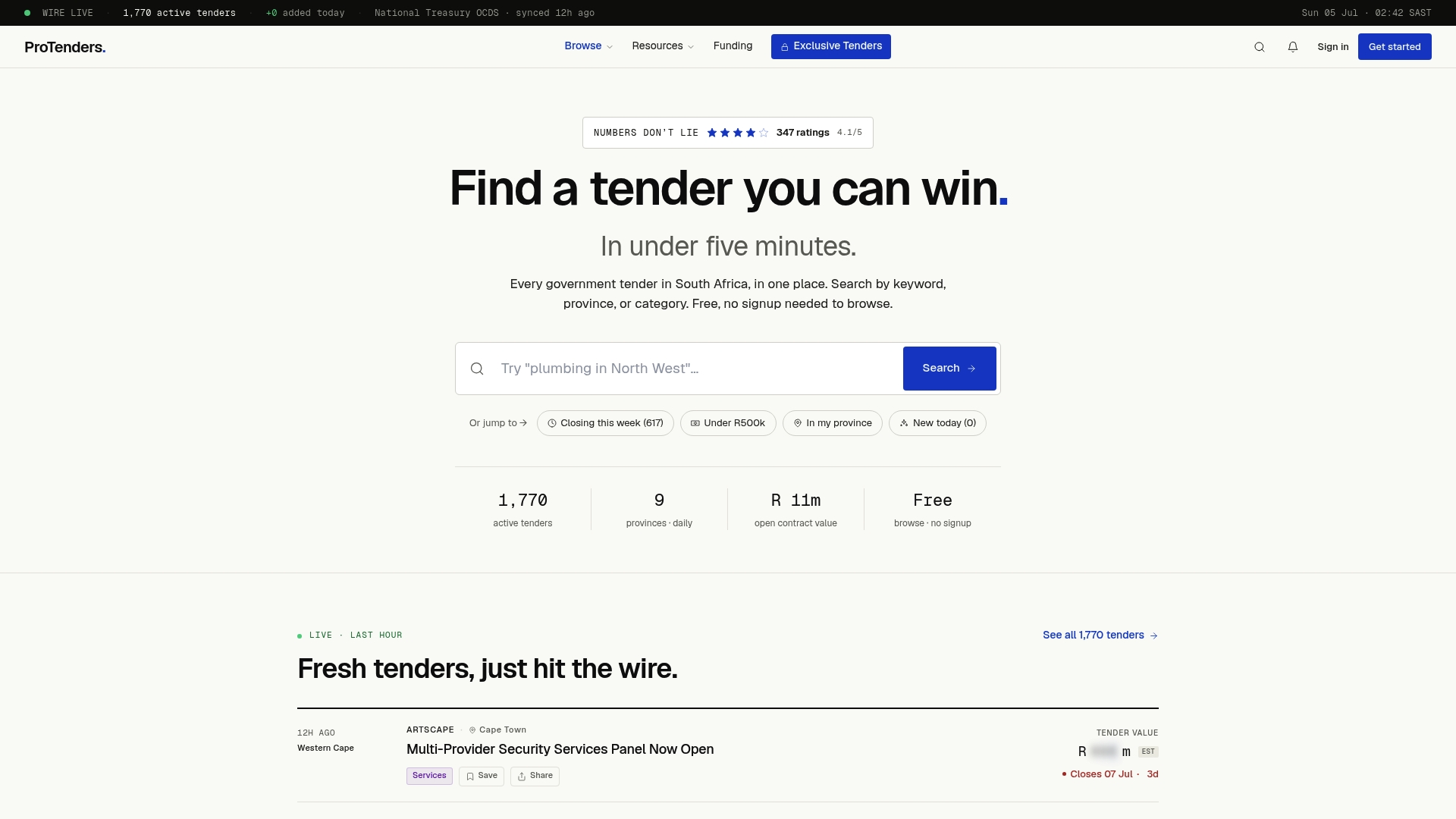
Protenders aggregates every live government tender from national, provincial, and municipal buyers in one place, so you spend less time hunting and more time preparing. The compliance scorecard shows you exactly which documents are current and which are about to lapse — including your COIDA Letter of Good Standing. Document templates mean your tender pack is formatted correctly before you upload it. Automated alerts notify you when a relevant tender is published, giving you enough lead time to request a fresh letter if yours is approaching the 30-day or 90-day freshness window some boards require.
Browse live government tenders on Protenders today and see which opportunities your business is already positioned to bid on. *Useful sources
These are the official and authoritative sources to use for registration, ROE submission, and letter generation. When in doubt, go to the primary source — not a third-party summary.
- Register with the Compensation Fund — South African Government: Start here to register as an employer and understand your obligations under COIDA.
- Compensation Fund: obligations of the employer — Department of Employment and Labour — Covers registration steps, ROE submission, instalment arrangements, and the Letter of Good Standing process. Includes the RegistrationCF@labour.gov.za contact address.
- ROE Online (cfonline.labour.gov.za).aspx) — .aspx): The portal for submitting your Return of Earnings and verifying letter certificate numbers.
- How to register with the Compensation Fund — Department of Employment and Labour — Step-by-step registration guidance including the W.As2 form and required supporting documents.
For manual assistance — particularly when CompEasy flags your account for review — contact your nearest provincial Department of Employment and Labour office directly. Provincial staff can issue written status confirmations that procurement committees accept while system issues are resolved. *
FAQ
How do I get a COIDA Letter of Good Standing?
Register with the Compensation Fund, submit your Return of Earnings via cfonline.labour.gov.za, pay your assessed contributions (or set up an instalment plan), then request the letter through CompEasy. The automated process takes 24–72 hours when your account is fully current.
How much does a COIDA letter cost?
There is no separate fee for the letter itself. You pay annual assessment contributions calculated on your industry classification and total employee earnings — the letter is issued as part of that compliance, at no additional charge.
How much does it cost to register with the Compensation Fund?
Registration with the Compensation Fund carries no direct registration fee. Your costs are the annual assessment contributions due after registration, based on your payroll and industry risk classification.
What happens if I do not have a COIDA letter for a tender?
A missing or expired Letter of Good Standing typically results in automatic disqualification from the tender. Some boards will not allow late submission of compliance documents once the closing date has passed.
Can I use a COIDA letter from another company for my tender?
No. The letter must be issued in your company's name and CF employer reference number. Using another entity's letter constitutes fraud and exposes you to disqualification, prosecution, and civil liability.
Recommended
- Tender Glossary South Africa | Procurement Terms, Acronyms & Definitions | ProTenders
- Construction Tenders in South Africa: How to Find and Win More Projects | ProTenders
- CIDB Tenders & Grades Explained - South Africa 2026 | ProTenders
- How to Apply for a Tender in South Africa: Step-by-Step (2026) | ProTenders