Easiest Government Contracts to Win in 2026: Small Business Guide

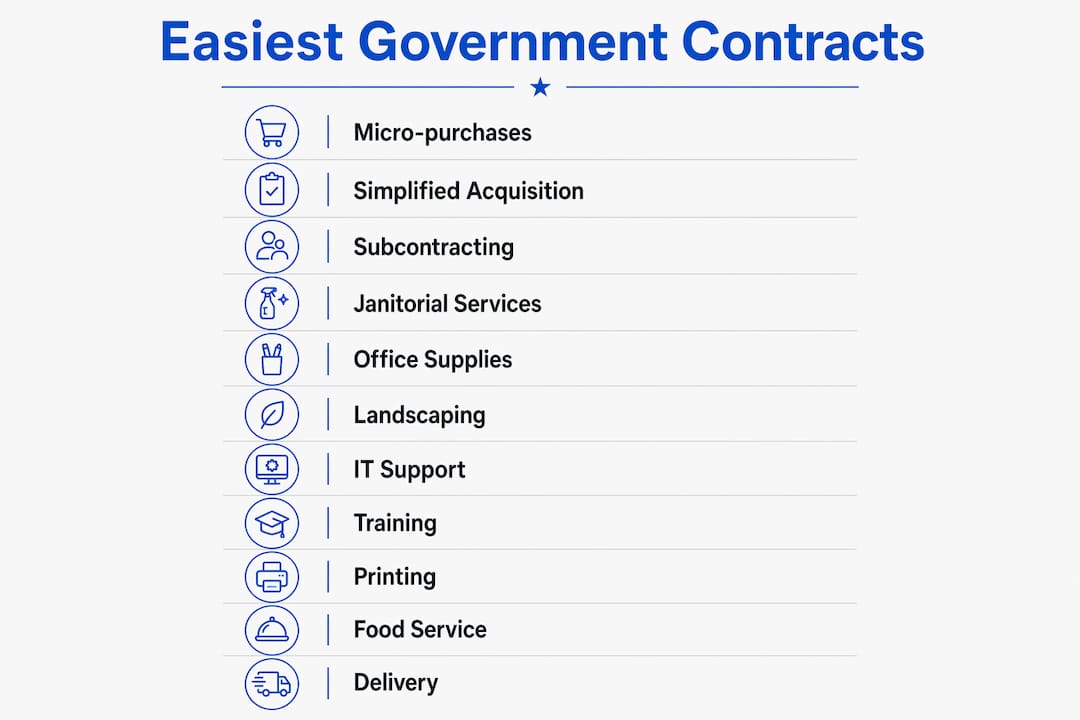
The easiest government contracts to win are micro-purchase contracts under $15,000, which require no competitive bidding, no formal proposal, and can be awarded within 48 hours using a government purchase card. Right above that tier sit Simplified Acquisition Procedures (SAP) contracts, covering contracts above micro-purchase levels up to moderate dollar thresholds, with shorter timelines and far less paperwork than full federal procurements. Add in small business set-aside programs that limit who can even bid, and the playing field tilts noticeably in your favor. Here is a quick look at the contract types most accessible to newcomers:
- Micro-purchase contracts (under $15,000, no competitive bidding)
- Simplified acquisition contracts ($15,000–$350,000, streamlined process)
- Subcontracting under an established prime contractor
- Janitorial and cleaning services contracts
- Office supplies and products contracts
- Landscaping and grounds maintenance contracts
- Basic IT support and help desk contracts
*
1. Micro-purchase contracts: the lowest barrier in federal contracting
Micro-purchase contracts are the single easiest entry point into government contracting. Awards typically happen quickly, often within a couple of days, agencies pay directly with a government purchase card, and there is no formal Request for Proposal to write or submit. Your SAM.gov profile does more work than your proposal skills at this level.
What agencies buy through micro-purchases covers a surprisingly wide range: office supplies, printed materials, minor repair services, software licenses, and basic cleaning products. A contracting officer can simply find your business in the federal system and place an order. Being discoverable, responsive, and reliable matters far more than having a polished pitch deck.
Pro Tip: Keep your SAM.gov profile updated with accurate NAICS codes and a clear capabilities statement. Contracting officers search by those codes when they need a quick vendor. *2. Simplified Acquisition Procedures (SAP) contracts
SAP contracts sit in the $15,000 to $350,000 range and are specifically designed to cut down paperwork and speed up awards. Federal regulations require agencies to consider setting these contracts aside exclusively for small businesses, which immediately shrinks the pool of competitors you face.

The proposal process is shorter than a full federal solicitation, and evaluation criteria tend to be simpler. You still need some relevant experience, but agencies are not expecting a 200-page technical volume. A clear, concise response that directly addresses the scope of work wins far more often than an elaborate one.
 *
*
3. Subcontracting under a prime contractor
Subcontracting is arguably the most underrated path for a brand-new small business. When a large prime contractor wins a federal contract, they often carry small business subcontracting plans that require them to actively seek qualified small business partners. You deliver the work; the prime handles compliance reporting, invoicing, and most of the administrative burden.

The real payoff comes later. Every subcontract you complete builds past performance, the currency that unlocks larger prime contracts down the road. Starting here is not settling. It is a deliberate strategy.
*4. Janitorial and cleaning services contracts
Janitorial contracts appear consistently across federal buildings, military installations, VA facilities, and federal courthouses. Agencies need these services on a recurring basis, which means repeat awards and predictable revenue once you are in. The cleaning services sector is one of the most accessible for small businesses precisely because the work is straightforward to scope and evaluate.
Competition exists, but set-aside designations frequently apply. A woman-owned or service-disabled veteran-owned small business can often compete in a pool of just a handful of bidders for the same contract a large company would otherwise dominate.
*5. Office supplies and products contracts
Selling office supplies, paper, toner, or basic equipment to federal agencies is one of the most repeatable small business government contracts available. The General Services Administration's Federal Supply Schedule (also called the Multiple Award Schedule) lets agencies buy from pre-approved vendors without running a full competition each time. Getting on the schedule takes effort upfront, but once you are listed, agencies can order directly from you.
Volume is the game here. Individual orders may be modest, but recurring purchases from multiple agencies add up quickly. Agencies like the Department of Veterans Affairs and the Department of Homeland Security collectively spend heavily on everyday supplies.
*6. Landscaping and grounds maintenance contracts
Federal properties, national parks, military bases, and government office campuses all require regular grounds maintenance. These contracts tend to be geographically specific, which naturally limits competition to businesses that can actually service the location. Local and regional small businesses have a genuine structural advantage here.
Contracts in this category often fall within the SAP threshold, meaning simplified procedures apply. A small landscaping company with solid local references and a clean SAM.gov registration can compete effectively against much larger firms.
*7. Basic IT support and help desk contracts
Federal agencies run thousands of internal systems and need ongoing technical support. Entry-level IT support contracts, covering help desk services, hardware installation, and basic network maintenance, regularly appear as small business set-asides. The technical bar is real but not extreme, and many of these contracts fall within the SAP range.
Agencies like the Department of Agriculture and the Social Security Administration post these opportunities frequently on SAM.gov. Searching by NAICS code 541512 (Computer Systems Design Services) or 541519 (Other Computer Related Services) surfaces relevant solicitations quickly.
*8. Training and professional development contracts
Federal agencies spend consistently on employee training, from compliance courses to leadership development. These contracts favor small businesses that can deliver specialized knowledge without the overhead of a large consulting firm. If your business has expertise in a specific area, such as cybersecurity awareness, HR compliance, or project management, there is likely an agency that needs exactly that.
Training contracts also lend themselves well to sole-source awards under set-aside programs, particularly for 8(a) certified firms. A sole-source award means no competition at all.
*9. Printing and document services contracts
Government agencies produce enormous volumes of printed materials: forms, reports, training manuals, and public communications. The Government Publishing Office (GPO) and individual agency contracting offices both award printing contracts, many of which fall under simplified acquisition thresholds. Small print shops with reliable turnaround times and competitive pricing win these regularly.
The key differentiator is reliability. A contracting officer who needs 500 training packets by Thursday is not looking for the cheapest vendor. They want the vendor who will actually deliver on time.
*10. Food service and catering contracts
Military installations, federal correctional facilities, and government conference centers all require food service support. Smaller catering and food service contracts, particularly for one-time events or short-term support, frequently fall within micro-purchase or SAP thresholds. Local businesses with proper food handling certifications and liability coverage are well-positioned to win these.
Geographic proximity matters here more than almost anywhere else in federal contracting. An agency is not going to fly in a caterer from across the country for a departmental lunch.
*11. Courier and delivery services contracts
Federal agencies need reliable local delivery services for documents, equipment, and supplies. These contracts are typically small in dollar value, often landing within micro-purchase territory, and agencies tend to reuse vendors they trust. Building a relationship with a single agency's administrative office can turn one small delivery order into a steady stream of work.
This is beginner government contracting at its most practical. Low complexity, fast payment cycles, and a clear path to repeat business.
*Why some government contracts are easier to win than others
The core reason certain contracts are more accessible comes down to three factors: competition limits, contract size, and process complexity.
- Set-aside programs restrict the bidder pool. Programs like the 8(a) Business Development Program, the Women-Owned Small Business (WOSB) program, the Service-Disabled Veteran-Owned Small Business (SDVOSB) program, and the HUBZone program each limit competition to certified firms. In some cases, agencies can make sole-source awards to 8(a) or SDVOSB firms with no competition at all.
- Dollar thresholds trigger simplified rules. Below $15,000, agencies skip formal solicitations entirely. Between $15,000 and $350,000, SAP rules apply, cutting paperwork and shortening timelines significantly.
- Government purchase cards bypass the proposal process. For micro-purchases, a contracting officer simply swipes a card. Your SAM.gov profile is your proposal.
- Geographic preference reduces national competition. For services that require physical presence, like landscaping, food service, or courier work, agencies naturally favor local vendors.
- Certification programs enable sole-source awards. SBA-certified firms can receive awards without any competitive bidding, up to substantial dollar values, depending on the program and contract type.
- Recurring service needs create repeat opportunities. Janitorial, IT support, and delivery contracts often renew annually, giving reliable vendors a significant incumbency advantage.
The federal government's own policy, codified in the Federal Acquisition Regulation (FAR) Part 19, directs contracting officers to consider small business set-asides before opening competition broadly. That policy is your structural advantage as a small business owner. *
How to actually win your first government contract
Winning small contracts is less about writing perfect proposals and more about being findable, eligible, and ready to deliver. Here is what works.
- Register in SAM.gov and get your Unique Entity ID (UEI). This is non-negotiable. An incomplete SAM profile gets you disqualified before a contracting officer ever reads your capabilities. Registration is free, but it takes time, so start before you need it.
- Pursue the right certifications. The 8(a), WOSB, SDVOSB, and HUBZone programs each open doors that are closed to uncertified businesses. Check eligibility at SBA.gov and apply early, since processing takes months.
- Start with subcontracting. Find prime contractors in your industry who hold federal contracts and pitch yourself as a subcontractor. This builds past performance without the full weight of prime contract compliance.
- Respond to Sources Sought notices. These are not solicitations. They are agencies testing the market before writing a solicitation. Responding positions you as a known vendor and sometimes shapes the final requirements in your favor.
- Search SAM.gov by NAICS code, not just keyword. Agencies categorize contracts by NAICS code. Knowing yours and searching by it surfaces opportunities that keyword searches miss.
- Avoid over-engineering your proposals. For SAP contracts, a clear, direct response that answers every requirement beats a lengthy, polished document that buries the key points. Contracting officers are busy.
- Build relationships before solicitations drop. Attend agency small business outreach events, respond to market research requests, and introduce your business to small business specialists at target agencies. Early engagement with agencies allows you to influence requirements before solicitations are even released.
Pro Tip: Fulfilling small, recurring micro-purchase orders reliably is the fastest way to build past performance. That track record is what moves you from micro-purchases into SAP contracts and eventually into larger opportunities. *
Understanding U.S. government procurement and small business set-asides
The federal procurement process starts when an agency identifies a need, posts a solicitation on SAM.gov, and evaluates responses according to the Federal Acquisition Regulation. For small businesses, the most important layer of that process is the set-aside system.
The federal government mandates that at least 23% of prime contracting dollars go to small businesses annually. In recent years, small businesses have secured around 26% of federal contract dollars, out of a total federal contracting spend that exceeds $700 billion annually, representing roughly $180 billion in small business opportunity. The SBA partners with agencies to achieve these goals and holds them accountable if they fall short.
"Federal agencies must publicly list their contract opportunities. Some of these contracts are set aside exclusively for small businesses. When a contract is set aside for one specific small business, it's called a sole-source contract." — U.S. Small Business Administration
The four primary set-aside programs each serve a distinct group:
| Program | Who qualifies | Key benefit |
|---|---|---|
| 8(a) Business Development | Socially and economically disadvantaged business owners | Sole-source awards; nine-year program with mentoring |
| WOSB / EDWOSB | Women-owned small businesses | Set-asides in underrepresented industries |
| SDVOSB | Service-disabled veteran-owned small businesses | Set-asides and sole-source awards |
| HUBZone | Businesses in historically underutilized zones | Price evaluation preference; set-asides |
The GSA's Federal Supply Schedule offers another accessible path. Agencies can buy directly from schedule vendors without running a new competition, making it a repeatable revenue channel once you are approved. The GSA's small business resources include step-by-step guidance on getting listed.
If you are exploring grant writing support alongside contracting, consulting firms that specialize in government funding can help you position your business for both contract awards and grant opportunities simultaneously.
*Key Takeaways
The easiest government contracts to win are micro-purchases under $15,000 and SAP contracts up to $350,000, both designed to reduce competition and paperwork for small businesses.
| Point | Details |
|---|---|
| Start with micro-purchases | Contracts under $15,000 require no formal proposal and can be awarded within 48 hours. |
| Use SAP contracts as your next step | The $15,000–$350,000 range uses simplified rules and is frequently set aside for small businesses. |
| Get certified for set-aside programs | Programs like 8(a), WOSB, SDVOSB, and HUBZone restrict competition and enable sole-source awards. |
| Register in SAM.gov first | An incomplete or inaccurate SAM profile disqualifies you before a contracting officer reads anything else. |
| Build past performance through subcontracting | Working under a prime contractor lets you deliver to government standards with lower compliance burden. |
FAQ
What is the easiest government contract to get?
Micro-purchase contracts under $15,000 are the easiest to win. They require no competitive bidding, no formal proposal, and agencies can award them within 48 hours using a government purchase card.
How hard is it to win government contracts?
Entry-level contracts, especially micro-purchases and SAP contracts set aside for small businesses, are genuinely accessible to new businesses. The main barriers are registration in SAM.gov, the right NAICS codes, and basic eligibility, not complex proposal writing.
How do I find federal contract opportunities?
Search SAM.gov by NAICS code or keyword to find open solicitations, Sources Sought notices, and pre-solicitation announcements. Anyone can search without creating an account, though a free account lets you save searches and follow specific opportunities.
Do I need certifications to win government contracts?
You do not need certifications to win micro-purchases or open-competition SAP contracts. However, certifications like 8(a), WOSB, SDVOSB, and HUBZone significantly increase your odds by restricting competition to a smaller pool of eligible firms.
What percentage of federal contracts go to small businesses?
The federal government is mandated to award at least 23% of prime contracting dollars to small businesses each year, out of a total federal contracting spend that exceeds $700 billion annually.
Recommended
- SMME Tenders South Africa 2026: Government Opportunities for Small Businesses | ProTenders
- Gauteng Tenders 2026: Complete Guide to Government Opportunities | ProTenders
- Free State Tenders 2026: Finding Government Opportunities | ProTenders
- Municipal Tenders South Africa 2026: How to Win Local Government Contracts | ProTenders