Win SA environmental plan tenders: exact returnables buyers score

To pass an environmental-plan tender you must submit a complete EMP or EMPr, site-specific method statements, validated CVs and professional registrations for key personnel, and proof you can maintain an on-site Environmental File for the contract duration. Buyers score these as compliance gates, not nice-to-haves, and most set a technical threshold of a high passing score before price and preference points even come into play. Start by downloading the actual tender PDF and its returnable annexures, then work through your checklist against them line by line.
*TL;DR:>
- Meeting the mandatory requirements involves submitting a complete environmental management plan, method statements, personnel CVs with registration numbers, and proof of maintaining an environmental file on site.*
- Tenders are scattered across multiple portals, so setting up keyword alerts, region filters, and a centralized monitoring system helps track relevant notices efficiently.
- Differing scopes include document-based EMPs and site-based EMPrs, with construction-related scopes demanding ongoing physical responsibilities from day one.
- Evaluation scores depend on the presence of detailed impact assessments, mitigation measures, monitoring schedules, and personnel credentials, with a strong focus on completeness and compliance.
- Preparing standardized templates, checklists, and an environmental file ahead of time significantly increases the chances of timely, accurate bid submission and ongoing contract compliance.
Table of Contents
- Where to find environmental plan tenders and how to monitor them
- Common tender types and what each one actually asks for
- What buyers mean by environmental returnables
- How evaluators score environmental returnables and preference points
- Step-by-step checklist from tender reading to submission
- What contract-stage environmental obligations look like
- Templates and starter resources worth preparing in advance
- What experience with hundreds of tenders actually teaches you
- Find live environmental tenders faster with Protenders
- Sources
- FAQ
Where to find environmental plan tenders and how to monitor them
Environmental plan tenders don't sit in one place. National departments, provincial buyers, municipalities, and state-owned entities like Transnet and Eskom each publish their own notices, and the returnables buried in those PDFs are where the real requirements live.
eTenders.gov.za remains the primary national portal for RFPs, RFQs and EOIs from departments such as the Department of Forestry, Fisheries and the Environment. Provincial treasuries and municipal supply chain management units run parallel notice boards, often with shorter lead times and less competition than national bids. Sector-specific aggregators, such as listings for environmental monitoring, assessment and consulting tenders, pull these scattered notices into one feed, which saves hours of manual searching across dozens of buyer sites.Setting up monitoring properly means more than bookmarking a page. Consider:
- Keyword alerts for terms like "EMP," "EMPr," "environmental management plan," and "rehabilitation" alongside your sector (mining, construction, waste, water).
- Region and category filters so you're not wading through irrelevant national notices when you only service one province.
- A closing-date tracker separate from your email inbox, because compulsory briefing sessions often carry their own RSVP deadlines buried on page three of the tender document.
- A shared folder structure per tender, so every annexure, addendum, and clarification notice lands in one place your whole team can access.
Once you spot a live notice, download every PDF immediately, including annexures that look like boilerplate. Transnet tenders, for instance, frequently reference a separate Minimum Environmental Requirements for Construction (MERC) document and a Project Environmental Specification (PES) that aren't always attached to the main RFP, they're linked or referenced by name, and missing them means missing scoring criteria entirely. Archive everything with a version date in the filename; buyers issue addenda more often than bidders expect, and working from an outdated PDF is a quiet way to lose points before you've even started drafting.
Common tender types and what each one actually asks for
Not every environmental tender wants the same deliverable, and misreading the scope is one of the fastest ways to price a bid wrong. Broadly, you'll encounter:
- EMP or EMPr compilation — a desk-based or field-based document setting out mitigation measures, monitoring schedules, and compliance obligations for a specific project or activity.
- Environmental monitoring assignments — ongoing site visits, sampling, and reporting against an existing EMP, usually over months or years rather than a single deliverable.
- Remediation and rehabilitation works — contractor-driven scopes where the environmental plan sits alongside civil works, and non-compliance carries direct financial penalties.
- Biodiversity or specialist assessments — narrower technical studies (wetland delineation, faunal surveys) that feed into a larger EMP but are tendered separately.
- Contractor EMPr for construction works — the type most tied to site establishment, where the successful bidder inherits day-one obligations like erecting site boundaries and briefing crews on environmental rules before a single trench is dug.
The gap between consultancy scopes and contractor works packages matters more than it looks. A desk-based EMPr assignment for a government department is largely a writing and research exercise. A construction-linked EMPr, by contrast, comes with physical responsibilities from day one, camp establishment, access control, topsoil stockpiling, on top of the paperwork.
Watch for tenders that quietly bundle immediate site establishment duties or multi-year monitoring commitments into what reads like a straightforward compliance document. Pricing a one-off EMPr fee against a scope that actually requires eighteen months of quarterly site visits is how bidders end up delivering at a loss.
What buyers mean by environmental returnables
Buyer documents rarely just ask for "an environmental plan." They itemize exactly what that plan must contain, and scoring is usually tied to whether each item is present, not just whether the document looks thorough.
A compliant EMP or EMPr typically needs to show:
- The name, qualifications, and CV of the person who compiled it, with professional registration numbers where applicable.
- Site maps and GPS coordinates, often specified in a particular coordinate system such as WGS-84, matching Transnet's stated requirements for contractor environmental documentation.
- An impact identification structure, commonly built around a driver, pressure, state, impact, response (DPSIR) framework or equivalent, linking each activity to its likely environmental effect.
- Mitigation measures mapped against each identified impact, with named responsible parties.
- A monitoring schedule stating frequency, method, and reporting lines.
- Rehabilitation and closure actions for any disturbed area, including timelines.
Buyers also ask for specific method statements covering discrete activities rather than the project as a whole. Recurring examples in transmission and Transnet tender packs include handling of hazardous chemicals, site establishment and crew camp management, stormwater and water management, dust and noise control, topsoil handling and storage, access control, and rehabilitation of disturbed ground once works finish. Each one needs to read as a standalone procedure a site supervisor could hand to a crew, not a paragraph lifted from a generic template.
Then there's the Environmental Bill of Quantity and the E.2 environmental requirements pro-forma, a scoring instrument some buyers attach directly to the tender so evaluators can tick items off against your submission. Transmission's returnable documentation sets a weighted average score of 80% as the bar for consideration, meaning a technically strong price bid still fails if the environmental section falls short. Some national assignments go further on presentation standards: the DFFE's RFP for the second State of Waste Report specifies high-resolution figures at 300 dpi and structured DPSIR reporting across a project period of over one year, which tells you evaluators are grading polish alongside content.
Pro Tip: Build a master Environmental File once, with placeholder maps, CV templates, and generic method statement structures, then swap in project-specific detail for each new tender. Bidders who do this consistently turn documents around in days instead of weeks.How evaluators score environmental returnables and preference points
Most public-sector environmental tenders run through three distinct phases, and understanding the order matters because failing early usually ends your bid before price is even considered.
First comes a compliance check, a pass/fail screen for mandatory documents: signed forms, CSD registration, valid tax clearance, and the environmental pro-forma itself. Miss a compulsory item here and you're often out before scoring starts.
Second is technical evaluation, where your EMPr, method statements, and personnel CVs get scored against a weighted rubric.
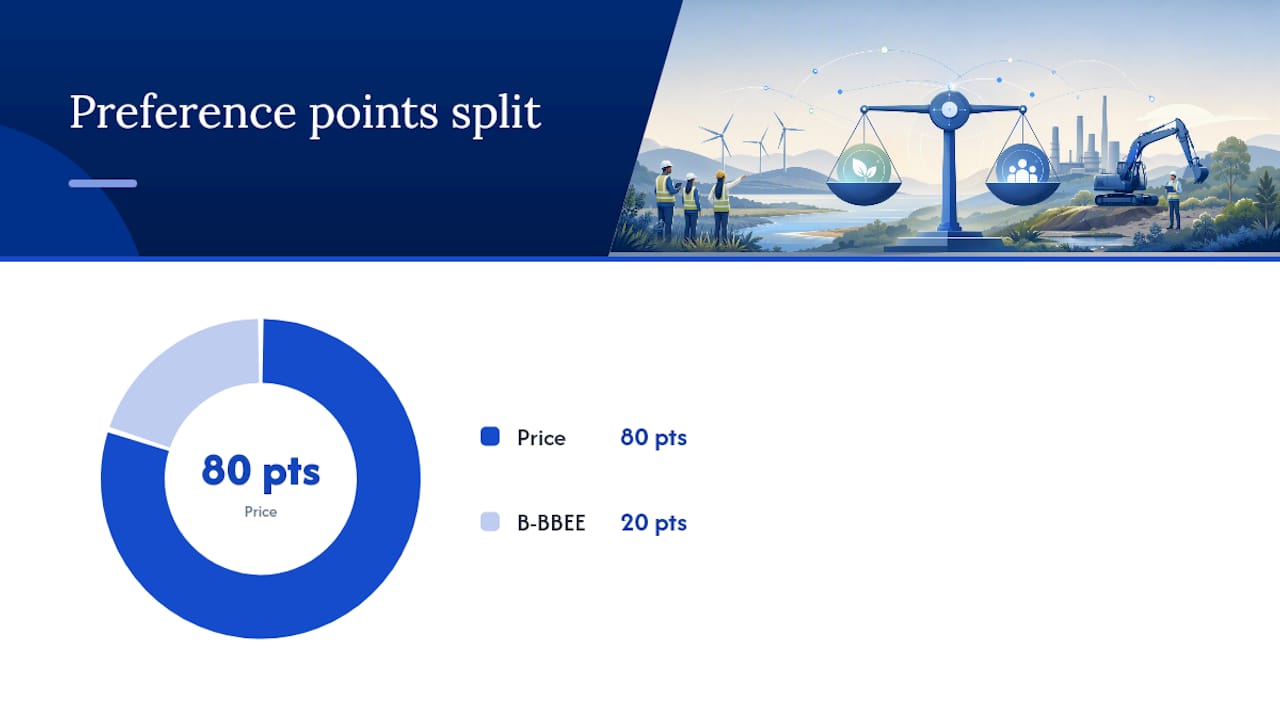
Third comes price and preference, governed for most public tenders by the Preferential Procurement Policy Framework Act. The standard mechanism for tenders under a set threshold is a preference point split with a majority of points for price and some for B-BBEE status preference point system, 80 points for price, 20 for B-BBEE status level, requiring specific documents:
- SBD 6.1 — the standard preference points claim form.
- B-BBEE verification certificate or a sworn affidavit for exempted micro enterprises and qualifying small enterprises.
- CSD number — your Central Supplier Database registration, cross-checked automatically against your submission.
The DFFE's State of Waste Report RFP applies a similar split for tenders below a significant monetary threshold, pairing it with a project delivery period of significant duration and detailed reporting standards, a useful benchmark for how national departments structure larger environmental assignments.
One detail bidders consistently miss: technical gates are usually "all or nothing" only up to a point. Transmission's tender documentation references a common buyer practice of allowing a period of days for tenderers to submit outstanding documents after initial evaluation, rather than disqualifying outright. That window exists for genuine oversights, not as a substitute for proper preparation, and it typically preserves your original evaluated score rather than boosting it.
Step-by-step checklist from tender reading to submission
Reading a tender document properly takes longer than most bidders budget for, and rushing this stage is where scope misunderstandings start.
Immediate actions, day one:- Download the full tender pack, including every annexure, not just the main RFP document.
- Log the closing date and any compulsory site briefing or clarification meeting date separately, ideally with a reminder set a week ahead.
- Map every required environmental annexure against your existing template library, noting which ones need net-new content versus adaptation.
- Flag any pro-forma scoring sheet (like the E.2 requirements form) and build your response structure to mirror its exact numbering.
- Draft or adapt your EMP/EMPr, including maps, GPS coordinates, and the impact and mitigation framework specific to this site.
- Write method statements for every activity the tender scope covers, hazardous substance handling, water management, dust and noise, topsoil, access control, rehabilitation, tailored to the actual project, not generic language.
- Compile the aspect and impact register, linking each project activity to a specific environmental effect and response.
- Finalize the monitoring plan with realistic frequencies your team can actually deliver.
- Attach CVs for the environmental practitioner and any appointed Environmental Officer, with registration numbers (EAPASA or SACNASP as applicable) clearly visible, not buried in a paragraph.
- Sign every declaration and pro-forma exactly where the buyer's template indicates, initialing pages where required.
- Confirm your standard bidding documents (SBD forms) are current and match the specific tender reference number.
- Verify your CSD number is active and your B-BBEE certificate or affidavit hasn't expired.
- Check file formats, pagination, and naming conventions against the tender's submission instructions, electronic portals often reject non-compliant file names automatically.
- Build a front-matter index that mirrors the buyer's own returnable list, so an evaluator can find each item in under a minute.
Formatting still trips up otherwise strong bids. A tender proposal format guide is worth reviewing before final submission, since layout and structure errors account for a surprising share of avoidable score deductions.
What contract-stage environmental obligations look like
Winning the tender is the start of the obligation, not the end of it, and this is where many contractors lose money they didn't budget for.
Most environmental contracts require an Environmental File to be kept on site for the full contract duration, updated as work progresses, not compiled once and filed away. Transnet's construction requirements specify this file should contain the approved EMP, method statements, monitoring records, incident reports, and evidence of ongoing compliance checks, available for inspection at any point.
Buyers also expect a named Environmental Officer or representative to remain available throughout the contract. If that person becomes unavailable, whether they leave the company or simply can't attend site, some buyers require formal approval before a substitute takes over. Submitting a contingency CV alongside your primary nomination, with a short note on succession, protects you against delays if your named EO needs replacing mid-contract.
Post-award, expect:
- Regular monitoring visits and reporting against the schedule set out in your EMP, not just at project close.
- Incident reporting obligations, particularly for any spill, breach, or non-compliance event, often with strict notification timelines.
- Internal audits the buyer may conduct or request evidence of, checking your actual site practice against your submitted method statements.
- Rehabilitation sign-off, where the buyer inspects disturbed areas against your stated closure commitments before releasing final retention or completion certificates.
Eskom and Transnet both run structured post-contract environmental reviews on larger works, and a poor review can affect your standing on future tenders with the same buyer, even when the current contract closes without incident.
Templates and starter resources worth preparing in advance
Waiting for a live tender to start drafting from a blank page is the single biggest reason bidders miss closing dates. Build these in advance:
- An EMP/EMPr template structured around impact identification, mitigation, and monitoring, ready to populate with site-specific detail.
- Method statement templates for the activities you're most likely to encounter, water management, dust control, hazardous handling, adapted from Protenders' method statement guide.
- An aspect and impact register template with standard categories pre-loaded.
- A monitoring schedule template with placeholder frequencies you can adjust per project.
- CV templates for your environmental practitioner and EO, with registration fields left blank for quick updates.
Adapting each template per tender mostly comes down to maps, GPS coordinates, and local legal references specific to that site's province or municipality. A full tender documents checklist is a useful companion resource for cross-checking your administrative returnables alongside your environmental ones.
What experience with hundreds of tenders actually teaches you
The pattern that shows up again and again isn't a lack of environmental expertise, it's missing registrations, method statements that read like they were written for a different site, and maps with no GPS coordinates at all. Buyers don't reward technical brilliance buried in a document that fails their own checklist.
The fix isn't more effort, it's earlier preparation. A pre-built Environmental File, a one-page evaluator summary mapped to the buyer's pro-forma, and an Environmental Officer appointed before you even submit, these three moves close most of the gap between bidders who win consistently and those who don't. Set up alerts, work from a checklist every time, and treat the buyer's own returnable document as the only scoring guide that matters.
— Dolene April
Find live environmental tenders faster with Protenders
A platform alternative exists to manually checking multiple buyer portals every morning for environmental notices. Some platforms aggregate live tenders from various buyers into one searchable feed, filterable by category and region, with compliance tools and document templates to assist with checklist work.
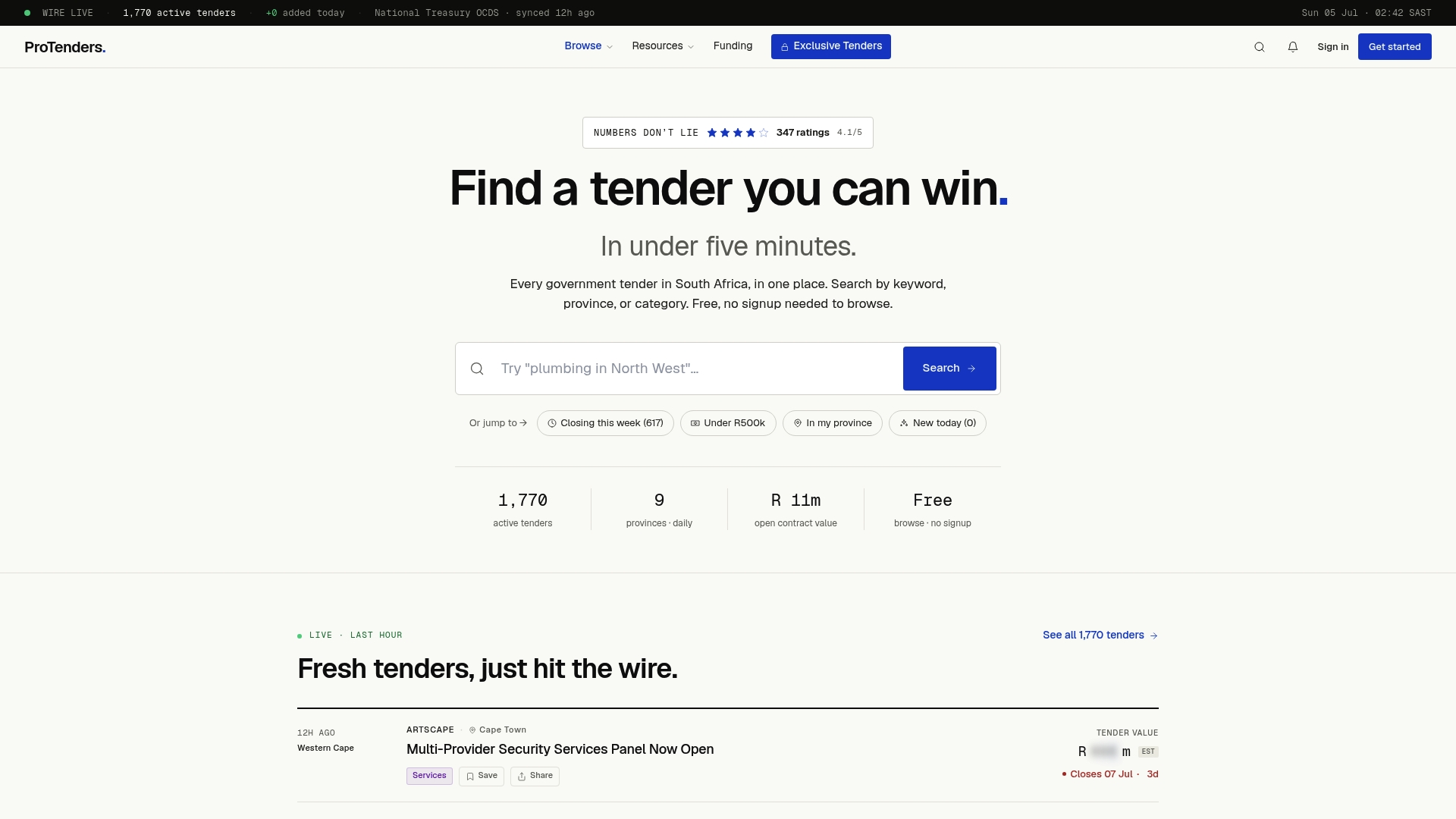
Instead of searching across multiple department sites for the next EMPr assignment or contractor works package, some services enable searching once to access returnable PDFs, closing dates, and briefing notices in one place. Compliance tools may flag gaps against buyer requirements before submission, and some document template libraries cover method statements and registers relevant to environmental tenders. Browse the live environmental tender feed now, or check what's published today to catch notices with shorter lead times before your competitors spot them.
Sources
FAQ
What documents count as environmental returnables in a tender?
Environmental returnables typically include a completed EMP or EMPr, project-specific method statements, an aspect and impact register, CVs and professional registrations for key personnel, and signed pro-forma declarations matching the buyer's own checklist.
What is a preference point split with a majority of points for price and some for B-BBEE status preference point system?
It's the PPPFA mechanism used for most tenders below a set value threshold, allocating 80 points to price and 20 points to B-BBEE status, verified through an SBD 6.1 form and a valid B-BBEE certificate or sworn affidavit.
What happens if I miss an environmental document at submission?
Buyer documents like Transmission's environmental returnable often allow a short window, commonly a period of days, to submit outstanding items after evaluation, though this usually just preserves your original score rather than improving it.
Where can I find live environmental plan tenders in one place?
Protenders aggregates national, provincial, and municipal environmental tenders into a single searchable feed, so you're not checking multiple buyer portals separately every day.What professional registrations do evaluators check for environmental personnel?
Buyers commonly treat EAPASA or SACNASP registration, or an equivalent approved CV for the appointed Environmental Officer, as a mandatory compliance check rather than an optional credential.