How to Read a Tender Document in South Africa

Read a tender in layers, not from page one to the last page. Start with the notice (who is buying, what, and when it closes), then the eligibility and mandatory requirements, then the scope, then the pricing rules, then the evaluation criteria and contract terms. Most bids that fail are not outbid. They are disqualified because something mandatory was missed or the bid arrived late. This guide shows you the order that catches those problems first.
TL;DR
- Check the closing date and time, the issuing organ of state and the eligibility rules before you read anything else. Late bids are not considered.
- Separate what you must return (forms, certificates, declarations) from what you must deliver (the scope of work).
- Read the evaluation criteria early: they tell you where to spend your writing effort and what evidence to attach.
- Price only what the scope describes, and check the contract data for payment terms before you commit.
- Decide bid or no-bid after one structured read, not after two days of drafting.
Table of Contents
- Why the reading order matters
- Layer 1: the tender notice
- Layer 2: eligibility and mandatory requirements
- Layer 3: the structure of the pack
- Layer 4: the scope of work
- Layer 5: pricing instructions and contract data
- Layer 6: evaluation criteria
- Decide: bid or no-bid
- Perspective
- A worked example of a 45-minute triage read
- How long does tendering take?
- Common reading mistakes
- Start from live tenders
- FAQ
- Sources
Why the reading order matters
A South African tender pack can run from a few pages for a simple quotation to hundreds for a construction or services contract. Reading it cover to cover the first time is slow, and it buries the details that decide your fate. A better approach is a triage read of 30 to 60 minutes that answers one question: can we qualify, and is this worth bidding for?
Only after that do you read the documents in depth. That second read is where you build the price, the method statement and the returnable documents.
The layers below follow that logic. Each one either ends your interest early, which saves you days, or gives you something concrete to act on.
Layer 1: the tender notice
The notice is the advertisement. It is short, and it holds the facts that can end your bid on the spot. Pull these out into a one-page summary:
- Tender or bid number. You will quote it on every form, envelope and email.
- The buyer. National department, provincial department, municipality or public entity. This tells you which supply chain rules and which delivery address apply.
- Description. What is actually being bought, in the buyer's words. Use the same wording in your response.
- Closing date and time. Treat the time as seriously as the date. Treasury guidance in Limpopo is explicit that bids received after the specified closing time are regarded as late and are not considered.
- Briefing session. Whether it is compulsory, where it is held, and whether you must sign an attendance register.
- Submission method. Physical tender box, email or an electronic portal. If the portal is eTenders, our walkthrough on how to submit on eTenders covers the mechanics.
- Contact person for queries and the last day queries are accepted.
If you find tenders through a single search rather than checking many buyer websites, it is easier to keep this summary consistent. You can browse live national, provincial and municipal listings on ProTenders without signing up, or narrow them by region with our guide to searching tenders by province.
Layer 2: eligibility and mandatory requirements
This is the layer that disqualifies people. Read it before the scope, because it does not matter how well you can deliver if you cannot be considered.
The Government Communication and Information System lists what a bid must contain in its tender procedures: a comprehensive proposal addressing the bid document, all attached SBD forms, and a valid tax compliance document from SARS, signed and dated and delivered before the closing date and time. Other buyers add their own items, so always check the specific pack.

Limpopo Provincial Treasury's guidance makes the same point from the evaluation side: bidders should analyse the requirements, and bids that do not meet mandatory requirements or the specification or terms of reference are unsuccessful.
Build a checklist with three columns: the requirement, where in the document it is stated, and whether you have it today. Typical items on that list include:
| Item to look for | What to do when you find it |
|---|---|
| Standard Bidding Documents (SBD forms) | List every form attached, fill in all fields, sign and date each one |
| Tax compliance status | Confirm it is valid and that the buyer's verification route works for your entity |
| Supplier database registration | Check whether the buyer requires it before or at award, and how long registration takes |
| Compulsory briefing attendance | Diarise it immediately, and note what proof of attendance is required |
| Minimum grading or registration (for example, construction grading) | Confirm your current status meets the stated minimum |
| Certified copies, company documents, B-BBEE evidence | Check the certification rules and that dates meet the stated validity |
| Financial evidence (bank letter, financial statements) | Start early, as third parties control these timelines |
If you have a mandatory requirement you cannot meet and cannot obtain before closing, stop here. That is a no-bid, and the hour you spent was cheap.
Layer 3: the structure of the pack
Tender packs are easier to read when you know how they are built. The Construction Industry Development Board (cidb) describes a procurement document as tender procedures and returnable documents, followed by contract documents: offer and acceptance, contract data, pricing data, scope of work and, for engineering and construction works, site information. Even outside construction, many buyers borrow this logic.
The cidb's numbering gives you a map you can use on almost any pack:
- Tender procedures (T-series). The rules of the process: how to submit, how queries work, how evaluation will happen.
- Returnable documents. What you must complete and send back.
- C1.1 Form of Offer and Acceptance. The page that becomes binding when the buyer accepts.
- C1.2 Contract Data. The applicable conditions of contract and the contract-specific risks, obligations and administration procedures.
- C2.1 Pricing Instructions. The assumptions behind the prices.
- C2.2 Activity Schedule or Bill of Quantities. Where your prices go.
- C3 Scope of Work. What must be supplied or done, and the constraints.
- C4 Site Information. What the site looks like at tender stage.
A buyer that does not use the labels will still have the same content somewhere. Find each of them and note the page numbers on your summary sheet. That alone turns a 500-page pack into something you can navigate in minutes.
Layer 4: the scope of work
The scope is the heart of the document, and it is where you decide whether you can actually deliver. The cidb says a scope should identify the goods, services or works, establish performance requirements and constraints, and contain enough information for tenderers to price and plan compliance. It should also describe the condition or outcome to be left after completion.
When you read it, mark three things in different colours:
- Deliverables: the physical or measurable outputs (units, sites, reports, hours, kilometres).
- Constraints: locations, working hours, safety rules, local labour or subcontracting requirements, reporting duties.
- Gaps: anything vague that would change your price if interpreted one way or the other.
The gaps become your clarification questions. Write them as short, numbered questions that quote the clause, and send them to the contact person well before the query deadline. Answers are normally issued to all bidders, so keep questions about the pack and never about your competitive position. The National Treasury evaluation guidance reminds buyers that clarifications may improve understanding but must not let a supplier alter its submission%20SPF%20GPG%20-%20Bid%20Evaluation,%20Negotiation%20and%20Award.pdf). So settle your questions before closing, not after.
Layer 5: pricing instructions and contract data
Many SMMEs read the price schedule and skip the rest. That is how people win contracts they then cannot afford to perform.
According to the cidb, pricing data is pricing assumptions plus an activity schedule or bill of quantities. Price exactly what the scope describes. The same guidance cautions that payment terms and inflation adjustment are not set in the pricing section: those sit in the contract data. So after the pricing pages, go to the contract data and read:
- Payment period. How many days from invoice to payment, and what the buyer needs from you before it pays (certificates, signed delivery notes, tax invoices).
- Price adjustment. Whether prices are fixed or can move with inflation or input costs.
- Delivery and completion obligations. Milestones, penalties and defect periods.
- Securities and insurance. Guarantees, retention and cover you must arrange.
This is also where you work out your cash-flow gap: the money you need to spend on stock, wages or materials before the first payment arrives. If the gap is bigger than your working capital, plan for it now. Our funding programmes page lists funders that look at awarded contracts, and the asset finance options cover equipment you may need to buy to deliver.
Layer 6: evaluation criteria
The evaluation criteria tell you how your bid will be marked. The National Treasury's guidance says submissions are evaluated against the criteria in the invitation%20SPF%20GPG%20-%20Bid%20Evaluation,%20Negotiation%20and%20Award.pdf), and that records of the evaluation should be kept. That means the buyer is supposed to mark what it announced, so you can plan your response around it.
Look for these elements:
- Pass/fail (responsiveness) tests. Mandatory documents and conditions. Fail one and you may not be scored at all.
- Functionality or quality. Experience, methodology, team, references, and the minimum score needed to move forward.
- Price and preference points. The Preferential Procurement Regulations, 2022 provide for an 80/20 system for acquisitions from R30 000 up to R50 million, and a 90/10 system above R50 million. The first figure is the points for price, the second for specific goals. Your pack states which one applies and what the specific goals are.
For every scoring line, write down what evidence earns the points. If functionality asks for three similar projects, attach three. If it asks for a named project manager with a qualification, attach the CV and certificate. Do not make evaluators hunt for proof: they mark what they can see.
Decide: bid or no-bid
After the six layers you have what you need for a sensible decision. A simple scorecard helps you keep emotion out of it. The approach in this bid/no-bid scorecard for small business shows how to weigh fit, eligibility and effort before you commit. Adapt the idea to your own situation with questions such as:
- Do we meet every mandatory requirement today, or can we before closing?
- Have we done something similar, and can we prove it?
- Can we price it profitably after payment terms and any penalties?
- Can we fund the gap between spending and first payment?
- Do we have the people and time to prepare a complete submission?
Three or more "no" answers is a clear signal. Walk away and spend the time on a better-fitting tender.
Perspective
We built ProTenders around a simple observation: SMMEs rarely lose tenders because their work is poor. They lose them in the first hour, when a requirement is missed or a document is wrongly completed. Reading the pack is a skill, and it can be systemised.>
That is why we put discovery, compliance and delivery in one place. When you can see a live tender, check it against a compliance scorecard, start from a document template and plan funding for the contract, the reading stage stops being a guessing game. Our claim is not that every bid will win. It is that every bid you decide to make will be an informed one.>
If you read only one thing in a pack, read the mandatory requirements. If you read two, add the contract data.>
Dolene April
A worked example of a 45-minute triage read
Imagine a municipal tender for grounds maintenance. Here is how the layers play out, without any invented numbers:
- Notice (5 minutes). Note the bid number, municipality, closing date and time, and whether a briefing is compulsory. Put the briefing date in your calendar right away.
- Mandatory requirements (10 minutes). List the SBD forms, tax status, registrations and any local-content or subcontracting declaration. Tick what you have, mark what you need.
- Structure (5 minutes). Find the scope, pricing schedule, contract data and evaluation section. Note page numbers.
- Scope (10 minutes). Highlight deliverables, constraints and vague points. Write your clarification questions.
- Pricing and contract data (10 minutes). Read the payment period and any penalties. Estimate your cash-flow gap.
- Evaluation (5 minutes). Note the functionality threshold and what proof earns points.
At the end you have a one-page summary and a go/no-go answer. If it is a go, you work back from the closing date. Our free bid calendar template helps you assign the tasks, and the electronic submission checklist helps you avoid last-minute upload errors.
How long does tendering take?
There is no single answer, because the clock is set by the pack in front of you. Three dates matter:
- The closing date. This is the only hard deadline for you. The advertising period is set by the buyer, and addenda can move it.
- The briefing and query deadlines. These come earlier than the closing date and are often missed.
- The validity period. Most packs state how long your offer must stay open after closing while the buyer evaluates and awards. Find this number and make sure your prices and any supplier quotes you rely on stay valid for it.
As a planning habit, allow weeks to prepare a proper response for anything above a simple quotation, and expect the buyer's evaluation and award to take considerably longer than the advertising period. Always take the actual schedule from the pack and any addenda.
Common reading mistakes
- Reading only the scope. The scope tells you what to do. The returnable documents and contract data decide whether you can bid and whether the job pays.
- Ignoring addenda. Buyers issue them for changed dates, corrected quantities and answers to queries. A bid that follows the old pack can become non-responsive.
- Assuming silence means yes. If the pack is unclear about something that affects price or eligibility, ask in writing.
- Mixing up price and contract terms. Do not bury payment terms in your pricing schedule, and do not assume the pack allows inflation adjustment because it seems fair.
- Reading at the last minute. Starting in the final week removes your chance to get certificates, letters and clarifications.
Start from live tenders
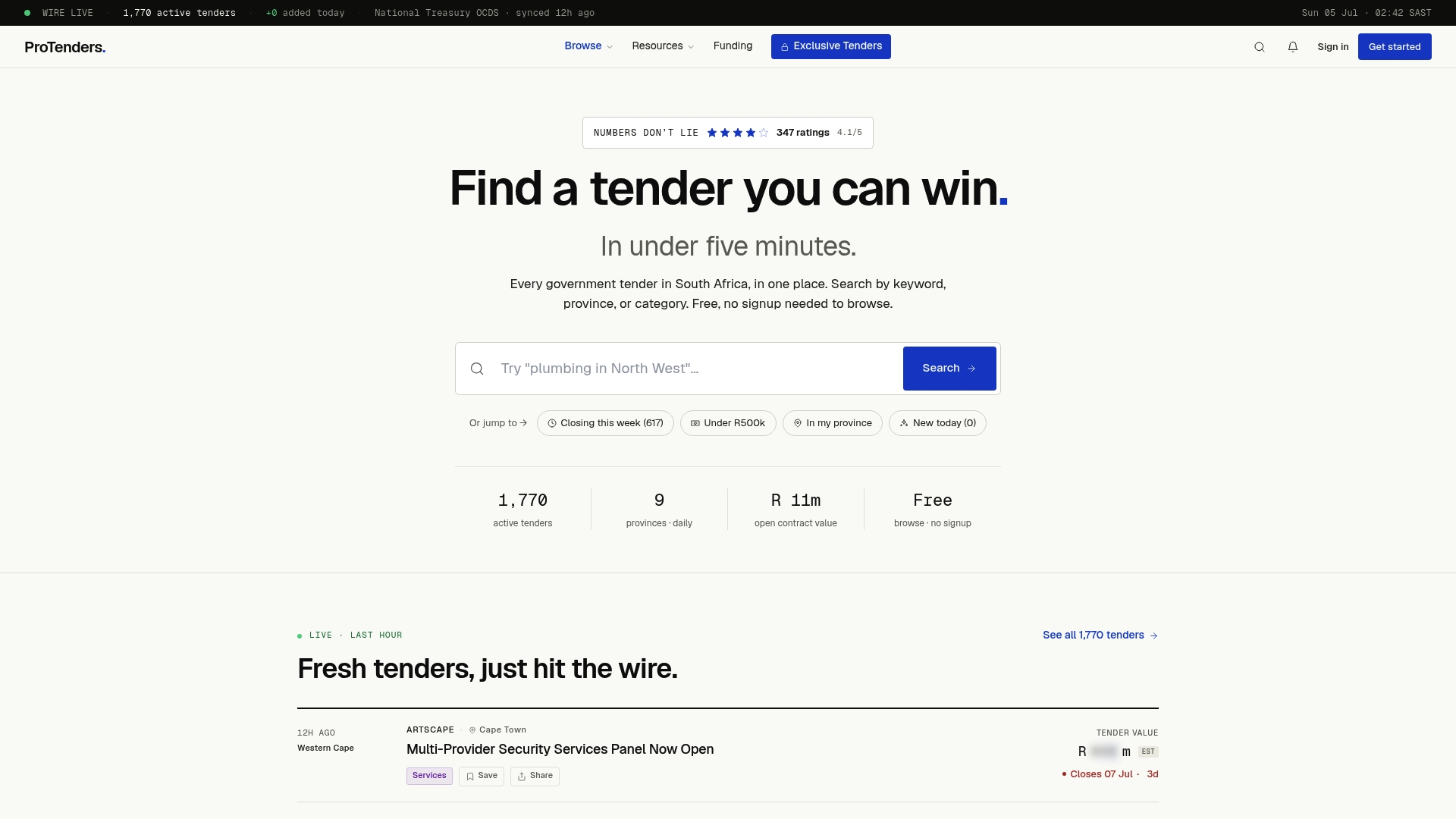
The quickest way to practise this is to read real packs. On ProTenders you can search every live national, provincial and municipal tender by keyword, region or category, and you do not need an account to browse. If you want alerts when new opportunities match your business, see our tender alerts.
For the tools that support the reading and bidding work (compliance scorecards, document templates, a bid workspace and funding introductions), our plans on the pricing page start with a Free plan. Pro is R1 990 per year, Business is R3 990 per year and Enterprise starts from R999 per month.
If you are new to the whole process, our guide on how to get government tenders in South Africa takes you from registration to submission.
FAQ
What is in a tender document?
A tender document normally holds the tender procedures, the documents you must return, and the contract documents. The cidb lists offer and acceptance, contract data, pricing data and scope of work, with site information for works contracts. Read them in that structure so each question has an obvious home.
What should I check first in a tender?
Check the closing date and time, the buyer, any compulsory briefing and the mandatory requirements. Bids that arrive after the stated closing time are treated as late and are not considered. If you cannot meet a mandatory requirement before closing, do not bid.
What are the stages of the tendering process?
The usual flow is advertisement, briefing and queries, submission, evaluation, award and contract signing. The buyer's evaluation follows the criteria in the invitation. Your reading work sits at the start: it decides whether you enter the process at all.
Can I ask the buyer to explain something unclear?
Yes, in writing and before the query deadline stated in the pack. Keep questions about the document itself. Clarification cannot be used to change your submission after closing, so resolve doubts early.
Sources
- Procurements Process, Limpopo Provincial Treasury
- Tender procedures, Government Communication and Information System
- Understanding the structure of tender and contract documents, cidb
- Formatting and compilation of procurement documentation, cidb
- Bid Evaluation, Negotiation and Award, National Treasury%20SPF%20GPG%20-%20Bid%20Evaluation,%20Negotiation%20and%20Award.pdf)
- Preferential Procurement Regulations, 2022, gov.za
- Bid/No-Bid Criteria: A Scorecard for Small Business