Cut Resubmission Cycles in Half with a Tender HSE Plan for South Africa

A tender-ready HSE plan is a site-specific, client-aligned document that proves you can control the project's actual risks from day one. It must be built around the client's own health and safety specification, not a recycled template, and it has to show HIRA results, written appointments with proof of competence, and a clear H&S file structure. Skip any of those and evaluators will mark it down before they even reach your price.
*TL;DR:>
- A compliant HSE plan must be site-specific, detailed, and built around the client's health and safety requirements, not just a generic template.*
- The plan should include project details, a chronological work programme, a comprehensive HIRA with control measures, and explicit appointment letters with proof of competence.
- Evidence linking the HIRA to safe work procedures and clear emergency, medical, PPE, environmental, and traffic management controls are essential for evaluation.
- The plan must be submitted before the contract award, cross-referenced with supporting documentation, and tailored to the site's risk level and project complexity.
- Regular on-site audits, a live non-conformance log, and keeping the entire documentation organized are vital for successful tendering and project safety compliance.
Table of Contents
- Why an HSE plan tender submission is a legal requirement, not a formality
- What must a tender-ready HSE plan include?
- Building the HIRA and turning it into safe work procedures
- Getting appointment letters and competence evidence right
- Emergency response, medical fitness and your PPE matrix
- Environmental controls and traffic management clients expect to see
- Submission, negotiation, approval and the H&S file handover
- Scaling detail, costing the plan and setting your audit schedule
- A copy-ready table of contents for your HSE plan
- What experienced HSE plan reviewers actually flag first
- Find the tenders and templates that make this easier
- Where to check the rules before you submit
- Sources
- FAQ
Why an HSE plan tender submission is a legal requirement, not a formality
Under the Construction Regulations 2014, a principal contractor must supply a "suitable, coherent, and site-specific" health and safety plan built on the client's own specification, and apply it from the first day of work. This isn't the same document as your safety file. The plan is your forward-looking commitment; the file is the accumulated proof that you did what the plan promised, and it gets handed over at project close.
CIDB best-practice guidance adds a second layer contractors often miss: the level of detail in your plan should scale with the size and complexity of the site, and clients are expected to review, negotiate, and audit whatever you submit, usually regularly, typically at least once a month.
- A one-page policy statement with no project detail will not pass evaluation on any government or municipal tender.
- The safety file is compiled after work starts; the HSE plan is submitted before you're awarded the contract.
- CIDB grading and contractor numbers on site both push the required plan detail higher.
What must a tender-ready HSE plan include?
Evaluators work through a fairly predictable checklist, so match your plan's structure to theirs.
- Project information: site address, client details, contract reference number, and project duration.
- Scope of work presented as a chronological programme, covering every phase and every subcontractor who will be on site.
- HIRA summary with control measures, linked to your organisational chart and appointment letters as evidence of implementation.
Get those three right and most of the remaining sections fall into place, because they all draw on the same source data.
Building the HIRA and turning it into safe work procedures
Start with the project information and a chronological activity programme. Lay out each phase of work in sequence, including subcontractor tasks and where different trades' activities overlap, since overlap is exactly where site incidents cluster. Evaluators want to see you've thought about interfaces, not just individual tasks in isolation.
Regulation 9 requires that a baseline risk assessment be completed before work starts, with documented mitigation, monitoring, and review dates built in. Each HIRA entry needs:
- The specific hazard (not a generic category like "working at height," but the actual task creating the exposure).
- A risk rating before and after controls are applied.
- The named control measures and who owns them.
- A responsible person, by title, not just "site management."
Once the HIRA is signed off, convert each significant item into a task-specific safe work procedure and slot it into the plan under the matching activity. A HIRA that never becomes a procedure is a paperwork exercise evaluators can spot immediately. Pro Tip: Build your HIRA in a spreadsheet with a column for "procedure reference number." When you write the safe work procedures, use that same numbering. It turns a two-hour cross-check for the client's H&S agent into a five-minute one, and fast reviews mean fewer resubmission cycles.
Getting appointment letters and competence evidence right
Construction Regulations 2014 require written appointments for key roles, and vague letters count as no evidence at all. Appointment letters must be explicit about duties and scope, so a one-line letter naming someone "responsible for safety" will be rejected on sight.
- Appoint, in writing, a construction manager, site supervisor(s), and a safety officer, each with dated, signed letters stating exact duties.
- Attach competence evidence for each appointee: relevant training certificates, prior project experience, and a short CV highlighting comparable work.
- Present an organisational chart that visibly links each named role to specific H&S outputs, like who signs off the HIRA and who runs toolbox talks.
Reviewers cross-reference the chart against the appointment letters. If the chart names a safety officer who has no letter attached, that's an instant flag.
Emergency response, medical fitness and your PPE matrix
Your emergency plan needs named response roles, updated emergency contact numbers, and clear evacuation and rescue procedures specific to the site layout, not a boilerplate paragraph copied from another project.
Medical surveillance matters more than most contractors budget for. Regulation 9 ties risk assessment directly to ongoing monitoring and review requirements, and certain tasks (working at height, confined spaces, noise exposure) trigger fitness-for-work certification you'll need to submit as proof, not just mention.
- List emergency roles by name and phone number, with a backup contact for each.
- Attach medical surveillance certificates for any task category the client's specification flags as high risk.
- Build a PPE matrix that maps each task to its required PPE item, drawn straight from your HIRA controls rather than a generic company-wide list.
CIDB guidance is blunt on this point: evaluators want verifiable, project-linked controls, not a generic binder of company policies dressed up as a plan.
Environmental controls and traffic management clients expect to see
Municipal H&S specifications routinely bundle environmental and traffic requirements into the same evaluation criteria as safety, so don't treat them as an afterthought section.
- Dust suppression measures for earthworks, plus a waste management and disposal plan naming your contractors.
- Stormwater protection during excavation or concrete work.
- Traffic management basics: designated vehicle routes, banksman deployment at site entrances, and signage compliant with the road authority.
Reference any adjacency hazards explicitly, like a live road, a school, or an operating facility next to your site boundary. A single sentence naming the hazard and your control is usually enough at tender stage.
Submission, negotiation, approval and the H&S file handover
Package your tender bundle so every claim in the plan has a matching appendix. An evidence map that cross-references each section to its supporting document, for example "Section 4.2: HIRA, see Appendix B, signed and competency evidence in Appendix C," speeds up review dramatically and cuts down on resubmission requests.
- Submit the plan alongside the client's own H&S specification, addressing every clause it raises rather than a generic industry template.
- Expect a feedback loop. Treat the plan as a negotiation with the client's H&S agent and plan to turn around requested edits within days, not weeks.
- Once appointed, compile the H&S file from day one using the same section structure as your plan, so appointment letters, training records, and inspection registers can be handed over cleanly at project completion.
Scaling detail, costing the plan and setting your audit schedule
CIDB guidance ties plan detail to contractor numbers and risk severity on site: a small renovation with two trades doesn't need the same page count as a multi-storey build with fifteen subcontractors. Match your plan's depth to that reality rather than padding it for appearance.
- Budget explicitly for H&S: PPE, signage, training sessions, medical surveillance, and safety officer time all belong in your tender price, not absorbed into general overheads.
- Municipal specifications often require you to allow for these costs explicitly in your priced bill of quantities.
- Set a regularly, typically at least once a month audit as the minimum cadence, with photographic evidence, signed checklists, and a corrective action log for anything found non-conforming.
Pro Tip: Keep a running non-conformance register from week one. When the client's auditor asks how you close out findings, a dated log with corrective actions beats a verbal assurance every time.
A copy-ready table of contents for your HSE plan
A workable structure runs: project information and OHS policy; scope of work and programme; organisational chart and appointments; HIRA and safe work procedures; emergency plan; medical surveillance and PPE matrix; environmental and traffic controls; training and induction records; monitoring, audit, and review schedule; H&S file handover procedure. Under each heading, attach the specific evidence, not a policy statement.
- Confirm every appointment letter is signed, dated, and states duties explicitly, not just a job title.
- Check the HIRA references match the safe work procedures numbering exactly.
- Tailor the whole document against the client's H&S specification clause by clause before you submit; a mismatch here is the single most common reason plans get bounced back.
What experienced HSE plan reviewers actually flag first
A generic plan doesn't get rejected for being poorly written. It gets rejected because the reviewer can't find a HIRA that maps to the actual site. The fastest correction is always the same: rebuild the risk assessment around the real scope of work, then let the appointments and procedures follow from that. Contractors who keep a live tender proposal structure and a compliance checklist on hand tend to cut their resubmission cycles in half, because the second draft only needs to fix specifics, not the whole framework.
— Dolene April
Find the tenders and templates that make this easier
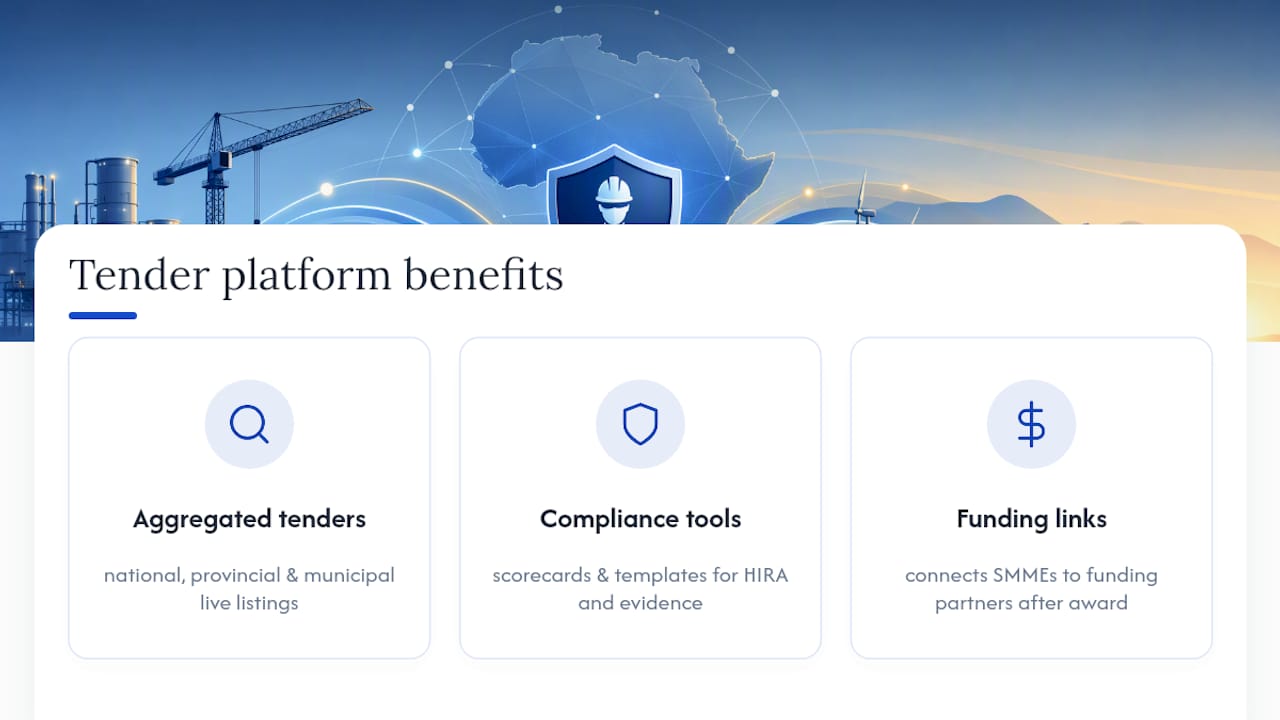
A comprehensive tender platform can help past the hardest part of HSE tendering: finding the right opportunity early enough to prepare a proper site-specific plan instead of a rushed one. The platform aggregates live government tenders from national, provincial, and municipal buyers in one searchable feed, so you're not chasing separate portals under deadline pressure. Compliance scorecards and document templates can help check your HIRA, appointments, and evidence map against what evaluators actually expect, before you submit rather than after a rejection. If funding to deliver an awarded contract is the next hurdle, such platforms often connect SMMEs to funding partners once the tender is won. Search current listings on the Protenders tender feed and start building your submission around a real, live opportunity today.
Where to check the rules before you submit
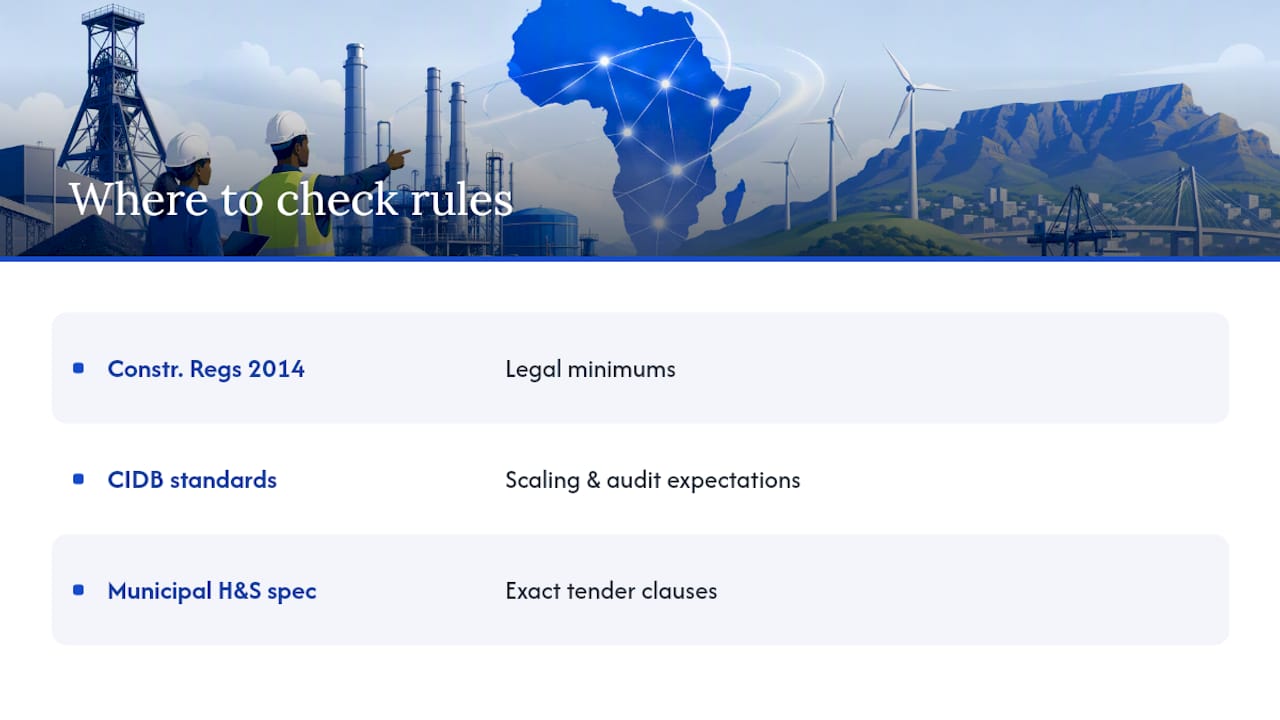
Verify requirements directly against the Construction Regulations 2014 for legal minimums, CIDB standards for scaling and audit expectations, and your specific municipal H&S specification for exact tender clauses.
Sources
- Construction Regulations 2014 — risk assessment for construction work
- Nelson Mandela Bay: Site specific health and safety specification (example)
FAQ
What Is the Difference Between an HSE Plan and a Safety File?
The HSE plan is the forward-looking document submitted at tender stage describing how risks will be controlled; the safety file is the accumulated proof, compiled during the project, that those controls were actually applied.
Does CIDB Require a Fixed Format for HSE Plans?
No, but CIDB guidance expects the plan's detail to scale with site complexity and contractor numbers, and clients will negotiate and audit whatever format you submit.
What Causes Most HSE Plan Rejections at Tender Stage?
Generic, non-project-specific plans and vague appointment letters that don't state explicit duties are the two most common causes of rejection.
How Often Should HSE Plans Be Audited on Site?
Client H&S specifications typically require audits regularly, typically at least once a month, with documented evidence and a corrective action log for any non-conformances found.
Where Can Contractors Find Tenders That Require an HSE Plan?
Government, provincial, and municipal tenders requiring HSE plans are listed on platforms like Protenders, which aggregates live opportunities alongside compliance templates.