Letter of authority for a tender: template and checklist for SA

If the tender documents include a returnable schedule (usually T2.2-07 or Annexure L), use that exact form. If they don't, use the ready-to-use template further down this page, put it on your company letterhead, and attach the right supporting documents for your entity type.
Before you draft anything, pull together what you'll attach: a certified or clear copy of the signatory's ID, your CIPC registration or CK document, and, where relevant, a board resolution or Power of Attorney. Missing one of these is the single most common reason bid administrators flag a submission as non-responsive.
At minimum, your letter needs:
- The full registered company name and registration number, matching your CIPC documents exactly
- The authorised person's full name, ID number, position, and a clearly stated scope of authority
- A signature, a date, and company letterhead
Key Takeaways
A valid letter of authority requires the tender's own returnable schedule when supplied, or a company-letterhead template with matching entity details, signature, and correct supporting documents.
| Point | Details |
|---|---|
| Use the tender's own form first | Complete Annexure L or T2.2-07 exactly as supplied before considering a generic template. |
| Match entity details precisely | Company name and registration number must mirror your CIPC documents exactly. |
| Structure changes the requirements | Companies need a board resolution; joint ventures need a POA from every partner plus the JV agreement. |
| Certify only when instructed | Commission copies with a Commissioner of Oaths only if the tender explicitly requires certification. |
| Run a two-person review | Have a second reviewer check names, dates, and file placement against the returnable schedule before you submit. |
Table of Contents
- What is a letter of authority for a tender, and why does it matter?
- Required fields and wording by business type
- Supporting documents: what to attach and how to certify them
- Preparing, signing, and submitting the letter correctly
- Why letters of authority get bid packages disqualified
- Ready-to-use templates for every business structure
- Where to find the official forms and reliable templates
- The legal framework that makes this document non-negotiable
- How this guide stays accurate for South African bidders
- Sources
- FAQ
What is a letter of authority for a tender, and why does it matter?
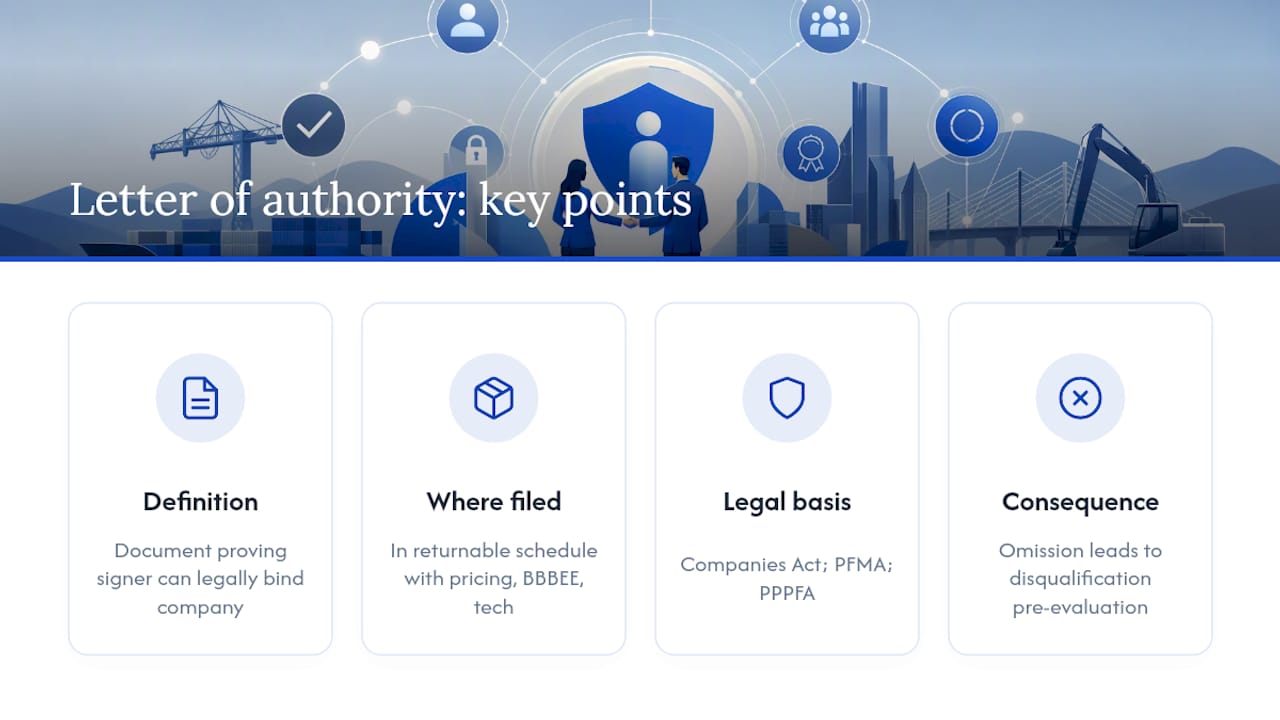
A letter of authority for a tender is a formal document proving that the person signing your bid is legally allowed to bind your company to that specific submission. Procuring institutions won't take your word for it. They want documentary proof, and in most public-sector processes that proof has to sit inside the returnable schedule set alongside your pricing, your BBBEE certificate, and your technical proposal.
Many procuring bodies pull this requirement directly from the standard T2.2-07 "Authority to submit a Tender" form, which is built into the eTenders returnable schedule bundle. The form isn't decorative. It's the mechanism through which a buyer confirms that the signature on your bid document actually carries legal weight.
Three statutory and administrative anchors sit behind this requirement: the Companies Act 71 of 2008, which governs how a company delegates authority to act on its behalf; the Public Finance Management Act (PFMA), which shapes how national and provincial departments run supply chain processes; and the Preferential Procurement Policy Framework Act (PPPFA), which sits alongside the evaluation criteria your bid gets scored against.
National Treasury's own supply chain provisions require tender documents to include declarations that the information submitted is true and that the signatory is duly authorised, with documentary proof requested where needed.
Skip this step, and the consequence isn't a warning. It's disqualification before an evaluator even reaches your pricing page.
Required fields and wording by business type
The exact wording you need changes depending on how your business is structured. Get the structure wrong and even a signed, dated letter can get rejected because it doesn't match what the procuring entity expects from an entity of your type.
- Company (Pty Ltd or equivalent). Include the full registered company name exactly as it appears on your CIPC documents, the registration number, your physical business address, the authorised signatory's full name and ID number, their position (director, company secretary, or an appointed representative), and an explicit statement of scope. A useful line to include: "This authority is granted per Board Resolution dated [date], resolution reference [number], authorising [name] to sign and submit tender [tender number] on behalf of [company name]." Attach the resolution itself, not just a reference to it.
- Partnership. List every partner by name and ID number, and include a statement that the partners jointly authorise the named representative to sign and submit the tender on the partnership's behalf. Something like: "We, the undersigned partners of [partnership name], hereby authorise [representative name] to submit tender [number] on our behalf." Leave space for each partner's individual signature underneath, not just the representative's.
- Joint venture (JV). This is where most submissions go wrong. A letter from one JV partner alone isn't enough. You need a signed Power of Attorney from every partner in the venture, plus the JV agreement itself, which should confirm joint and several liability and name the lead partner with authority to sign on the group's behalf. Sample wording: "The undersigned parties to the Joint Venture known as [JV name] confirm joint and several liability for tender [number], and hereby appoint [lead partner name] as lead partner with authority to sign and submit all tender documentation." Without both documents attached, evaluators generally can't confirm who is actually bound by the bid.
- Sole proprietor. This is the simplest case. A short owner declaration works: "I, [full name], ID number [number], trading as [business name], confirm that I am the sole proprietor of this business and am authorised to sign and submit tender [number] in my own capacity." No board resolution needed, since there's no separate legal entity to delegate from, but attach a certified ID copy regardless.
Attachments differ by structure too. Companies attach the board resolution and CIPC documents. Partnerships attach a signed partnership agreement or equivalent proof of the partnership's existence. Joint ventures attach the JV agreement and every partner's Power of Attorney. Sole proprietors attach an ID copy and, where the tender requires it, proof of any trading name registration.
Supporting documents: what to attach and how to certify them
Most tenders expect the same core bundle regardless of entity type: a copy of the signatory's ID, your CIPC registration or CK document, a board resolution or minute extract (for companies), a Power of Attorney (for joint ventures), and a valid B-BBEE certificate where the tender's scoring criteria call for one.

Certification requirements vary by tender, and that's where a lot of bidders trip up. If the tender instructions specifically call for certified copies, get them commissioned by a Commissioner of Oaths, typically available at your local police station or through a practising attorney, at no cost for the basic service. If the instructions don't specify certification, a clear scanned copy is usually sufficient, though some buyers still want the original available for inspection on request. Read the tender's own instructions to bidders section before assuming either way.
Currency matters more than people expect. A B-BBEE certificate that expired last month, even if it was valid when you started preparing your bid, can knock you out of a preference-point calculation entirely. Check every certificate's issue date and expiry date against the tender's closing date, not against today's date. The same applies to tax clearance and CIPC good-standing certificates: procuring entities increasingly cross-check these against live databases, and a lapsed certificate reads the same as no certificate at all.
Pro Tip: Keep a single "compliance pack" PDF on hand with your ID, CIPC documents, and latest board resolution already scanned and named. When a new tender lands, you're only swapping out the tender-specific fields rather than hunting for documents under deadline pressure.Preparing, signing, and submitting the letter correctly
Follow the tender's own returnable schedules first. If Annexure L or T2.2-07 is supplied, complete it exactly as laid out, don't rewrite the wording, and don't substitute your own letterhead version in its place. If no schedule is supplied, work through the steps below using the templates in this guide.
- Confirm authority internally. Get the board resolution passed, the partnership agreement signed, or the JV Power of Attorney executed before you draft anything else.
- Draft on letterhead. Use your company's official letterhead, not a generic Word template with your logo pasted in.
- Sign with the correct officer. The person signing must match the name stated in the resolution or POA, not a stand-in colleague.
- Commission if required. Only take the document to a Commissioner of Oaths if the tender instructions explicitly demand certification.
- Scan to a searchable PDF. Flatten the file so text and signatures don't shift, and confirm the file opens cleanly before uploading.
- Name the file clearly. Use a convention like
TenderNo_AuthorityLetter_CompanyName.pdfso evaluators can match it instantly against the returnable schedule checklist. - Place it correctly. Upload to the designated slot on the portal, or insert it in the correct tabbed section if you're submitting a physical file.
Check the specific portal's file size limits before uploading. Some tender portals cap uploads at a few megabytes per document, which catches out bidders who scan at unnecessarily high resolution. Only email a separate copy to the procuring entity if the tender instructions explicitly permit it. Most don't, and an unsolicited email attachment outside the formal submission channel can actually work against you.
Why letters of authority get bid packages disqualified
Most disqualifications tied to this document are administrative, not substantive. The letter itself is usually fine. What trips bidders up is a mismatch, a missing signature, or a document that simply isn't where the evaluator expects it to be.
- No signature at all. Drafts get uploaded by mistake more often than you'd think. Check every page before the final PDF gets saved.
- Company name mismatch. If your CIPC documents say "ABC Construction (Pty) Ltd" and your letter says "ABC Construction," that's a mismatch an evaluator can flag.
- Wrong signatory. The name on the letter has to match the name in the board resolution or POA. A director who isn't named in the resolution can't sign in their place.
- Expired B-BBEE certificate. Check the expiry date against the tender's closing date every single time, not just when you first prepared the pack.
- Missing Power of Attorney for a JV. One partner's signature covers only that partner, not the venture as a whole.
- Wrong file format or an unopenable scan. A corrupted or password-protected PDF is functionally the same as a missing document.
- Misfiled in the wrong returnable schedule slot. Portals and physical files both have a designated place for this document. Dropping it in the wrong tab causes evaluators to mark it as absent.
A simple two-person review before submission catches most of these. Have one person draft and sign, and a second person check the letter against the tender's returnable schedule checklist line by line, comparing names, dates, and reference numbers against your CIPC and resolution documents.
Ready-to-use templates for every business structure
Use these templates only when the tender doesn't supply its own returnable schedule. If Annexure L or T2.2-07 is provided, complete that document instead, using the wording it specifies.
Company template[Company Letterhead]>
Date: [DD/MM/YYYY]>
To: [Procuring Institution Name]>
Re: Tender No. [Tender Number] – Authority to Submit a Tender
We, [Company Name], registration number [CIPC Registration Number], hereby confirm that [Authorised Person Full Name], ID number [ID Number], holding the position of [Position/Capacity], is duly authorised to sign, submit, and negotiate on behalf of [Company Name] in respect of the above-mentioned tender, per Board Resolution dated [Date], reference [Resolution Number].>
This authority is limited to Tender No. [Tender Number] and shall remain valid until [Tender Closing Date / Contract Award / Revocation Date, whichever applies].>
Signed: _______________________Note: to narrow the scope, add the tender number directly into the authority statement, as shown above. To set an expiry, name the exact date or event that ends the authority. Partnership template
Name: [Authorised Person Full Name]
Position: [Position]
Date: [Date]
[Company Letterhead]>
Date: [DD/MM/YYYY]>
We, the undersigned partners of [Partnership Name], hereby jointly authorise [Representative Full Name], ID number [ID Number], to sign, submit, and negotiate on our behalf in respect of Tender No. [Tender Number].>
Partner 1: _______________________ Name: [Full Name] ID: [Number] Date: [Date]> Joint venture template
Partner 2: _______________________ Name: [Full Name] ID: [Number] Date: [Date]
[Joint Venture Letterhead / Combined Letterhead]>
Date: [DD/MM/YYYY]>
We, the undersigned parties to the Joint Venture known as [JV Name], comprising [Partner A Name] and [Partner B Name], confirm our joint and several liability in respect of Tender No. [Tender Number], and hereby appoint [Lead Partner Name] as lead partner with full authority to sign, submit, and negotiate all documentation relating to this tender on behalf of the Joint Venture.>
This authority is supported by the attached Power of Attorney from each partner and the Joint Venture Agreement dated [Date].>
Partner A Signature: _______________________ Name: [Full Name] Date: [Date]Attach both the JV agreement and a separately signed Power of Attorney from each partner. A single combined signature page without the underlying POAs is routinely treated as insufficient proof. Sole proprietor template
Partner B Signature: _______________________ Name: [Full Name] Date: [Date]
[Letterhead, if applicable]>
Date: [DD/MM/YYYY]>
I, [Full Name], ID number [ID Number], trading as [Business Name], confirm that I am the sole proprietor of this business and am authorised in my own capacity to sign, submit, and negotiate in respect of Tender No. [Tender Number].>
Signed: _______________________If a tender's instructions mandate certification, add a Commissioner of Oaths block beneath the signature line on any of these templates: a statement reading "Certified a true copy / true signature," followed by the commissioner's name, registration number, stamp, and date.
Name: [Full Name]
Date: [Date]
Where to find the official forms and reliable templates
The official returnable schedule on eTenders is always your primary source when a tender supplies one. Never substitute a generic template when Annexure L or T2.2-07 is explicitly required.
- Annexure L: a standalone Authority to Submit a Tender template with the wording and signature blocks procuring bodies expect.
- ProTenders: offers templates and compliance tools built to match South African tender document checklists, useful once you know which returnable schedule format a specific buyer expects.
- GenieAI's South Africa Tender Authorization Letter template: a commercial template option worth cross-checking against the buyer's own returnable schedule rather than using unchanged.
Get legal or company-secretarial advice for anything unusual: a JV with more than two partners, a dispute between partners over signing authority, or an indemnity clause a buyer inserts outside the standard returnable schedule wording. A twenty-minute consultation is far cheaper than a disqualified bid.
The legal framework that makes this document non-negotiable
Procurement law doesn't leave signatory authority to informal trust. Legislation and Treasury practice both demand documentary proof, and that requirement is what allows a buyer to disqualify a bid on administrative grounds alone. The Companies Act 71 of 2008 sets out how a company delegates signing authority, the PFMA governs how national and provincial supply chain units run their procurement processes, and the PPPFA shapes the preference point scoring your bid gets measured against.
Tender documents must stipulate a declaration that the information submitted is true and correct and that the signatory is duly authorised, with the buyer entitled to request documentary proof at any stage of evaluation.
The OCPO's Implementation Guide for the Preferential Procurement Regulations adds another layer: it clarifies how institutions must frame their 80/20 or 90/10 preference point systems in the tender pack, which means the returnable schedule section, including your authority letter, has to sit inside a tightly specified document structure. Get a field wrong, and you're not just risking a lower score. You're risking outright disqualification before scoring even starts.
Procurement rules are also shifting. The draft General Public Procurement Regulations represent an evolving framework for how procuring institutions apply norms and standards across all three tiers of government. Check each tender's own instructions rather than assuming last year's format still applies.
How this guide stays accurate for South African bidders
This guide draws directly on eTenders' own returnable schedule documents, National Treasury's PFMA supply chain provisions, and the OCPO's implementation guidance for preference point systems, cross-checked against how practitioners actually assemble tender packs day to day.
Editorial input on the practical checklist and template wording came from Dolene April, reviewed against ProTenders' own compliance tooling built for South African SMMEs preparing government tender submissions.
Every law, form reference, and threshold in this guide applies specifically to South Africa. Generic templates, including the ones above, are a starting point. Always check the specific tender's own returnable schedule before assuming a standard format will be accepted unchanged.
A tender specialist's quick tip
Run a two-person check before you submit: one person drafts and signs, another checks every name and date against your CIPC documents. The most common failure isn't a missing signature. It's a company name on the letter that doesn't quite match the name on the CIPC registration, often because of an old trading name lingering in a template.
Sources
These official downloads and tools take priority over any generic template, including the ones in this guide.
- Implementation Guide PPR 2022 (OCPO)
- Draft General Public Procurement Regulations, 2026 (National Treasury notice)
Search live opportunities and download each buyer's own returnable schedules directly through ProTenders' government tender feed, which aggregates listings from national, provincial, and municipal buyers so you're always working from the correct source document rather than a guess.
This article is general information, not a substitute for advice from a qualified lawyer. Consult a qualified legal professional about your own circumstances before acting on anything here.
FAQ
Where can I get a letter of authority in South Africa?
Check the specific tender's returnable schedules first, since many South African buyers supply their own form such as T2.2-07 or Annexure L through eTenders. If none is supplied, use the templates in this guide and adapt them to your entity type.
Can you show an example of a letter of authority for a South African tender?
Yes. This guide includes complete, editable templates for companies, partnerships, joint ventures, and sole proprietors, each with placeholder fields for company details, signatory information, and the tender number.
Can you write your own letter of authority?
Yes, as long as the tender doesn't supply its own returnable schedule. If it does, you must use that exact document rather than a self-drafted letter, since substituting your own wording is a common cause of technical non-compliance.
How do I get a tender authorization letter ready for submission?
Confirm internal authority through a board resolution or POA, draft the letter on company letterhead, sign it with the correctly authorised officer, certify it only if the tender demands certification, then scan it into a clearly named PDF and place it in the correct returnable schedule slot.