List of Government Contracts Awarded: Your Official Access Guide

The official list of government contracts awarded in the United States lives on two free, publicly accessible portals: USAspending.gov and SAM.gov. Both carry .gov domain authority, operate over HTTPS, and draw from the same federal reporting pipeline. Federal agencies are required to report all contract actions valued at $10,000 or more, so the data is far more complete than most people expect.
Here is a quick breakdown of what each portal covers:
- USAspending.gov: The official open data source for all federal spending, including contracts, grants, and loans. Best for broad spending analysis, visualizations, and downloadable datasets.
- SAM.gov: The federal procurement lifecycle hub. Best for live procurement activity, detailed award records, set-aside filters, and awardee-specific searches.
- SAM.gov DataBank: Generates standard and ad hoc reports on contract activity, filterable by agency, geography, business type, and product or service category.
- Defense.gov contract announcements: The Department of Defense publishes daily contract award press releases, useful for tracking recent high-value awards.
- Agency-specific portals: Many agencies, including the GSA and HHS, publish their own award summaries alongside the central databases.
How to search for awarded contracts on USAspending.gov
USAspending organizes federal spending data into a searchable interface that requires no login. The Advanced Search tool at usaspending.gov/search is where most contract research starts.
Step-by-step search process:- Go to usaspending.gov and click Award Search in the top navigation.
- Select Contracts as the award type to filter out grants and loans.
- Apply filters: awardee name, awarding agency, funding agency, place of performance (state or congressional district), NAICS code, and date range.
- Review results in the table view, which shows award amount, recipient, agency, and period of performance.
- Click any award to open a detail page with the full obligation history, modifications, and sub-award data.
- Use the Download button to export results as a CSV for offline analysis.
- NAICS code: Narrows results to your specific industry or service category.
- Award amount range: Cuts out noise when you are looking for contracts above a certain dollar threshold.
- Place of performance: Useful for identifying local contract winners and regional spending patterns.
- Date range: Lets you pull recent government contracts or historical award data by fiscal year.
How to use SAM.gov to find contract award records
SAM.gov's contracting domain handles both pre-award opportunities and post-award records, which is what sets it apart from USAspending. You can move between solicitations and final awards in the same interface.
Step-by-step process for contract award searches:- Navigate to sam.gov and select Contract Awards under the Contracting section.
- Use the search bar to enter a keyword, agency name, or NAICS code.
- Apply advanced filters: set-aside type (small business, veteran-owned, 8(a), HUBZone), award type, agency, and date range.
- Review the results list, which shows the awardee, award amount, contracting agency, and award date.
- Click an award record to see full details including the period of performance, place of performance, and contract type.
- For bulk data and reports, go to the DataBank and select a standard or ad hoc report under Contract Data.
- Login not required for most public award searches, but a free account unlocks DataBank reporting features.
- Set-aside filters are particularly useful for small businesses checking whether contracts in their space are reserved for specific business categories.
- DoD unrevealed data is restricted temporarily for a limited period after signing from the award date for non-DoD users, so some defense contracts will not appear immediately.
Understanding key terms in government contract award lists
Contract award data uses terminology that can trip up even experienced researchers. Getting these definitions right changes how you interpret the numbers.
Quick-reference glossary:- Award: A final executed contract between a federal agency and a vendor. Awards cannot be bid on; they are already decided.
- IDV (Indefinite Delivery Vehicle): An umbrella contract vehicle, including FSS (Federal Supply Schedule), GWAC (Government-Wide Acquisition Contract), BPA (Blanket Purchase Agreement), BOA (Basic Ordering Agreement), and IDC (Indefinite Delivery Contract).
- BPA Call: A specific order placed against a Blanket Purchase Agreement.
- Delivery/Task Order: An order for supplies or services placed against an IDV.
- Definitive Contract: A fully negotiated, signed contract with a fixed scope and price.
- Obligated Amount: The dollar amount the government has formally committed to pay. This is the real money on the table.
- Ceiling Value: The maximum potential value of the contract, including all options. Reported contract values typically represent ceiling figures, not actual obligated amounts, so a $500 million contract may have only $20 million obligated at award.
- Period of Performance: The start and end dates during which work must be completed.
- NAICS Code: A six-digit industry classification code that categorizes the type of work being procured.
The single most common misreading of contract award data: treating the ceiling value as the amount a vendor will actually receive. The obligated amount is what has been committed. The ceiling is the upper limit if all options are exercised, which often does not happen.
How to analyze awarded contract data for market intelligence
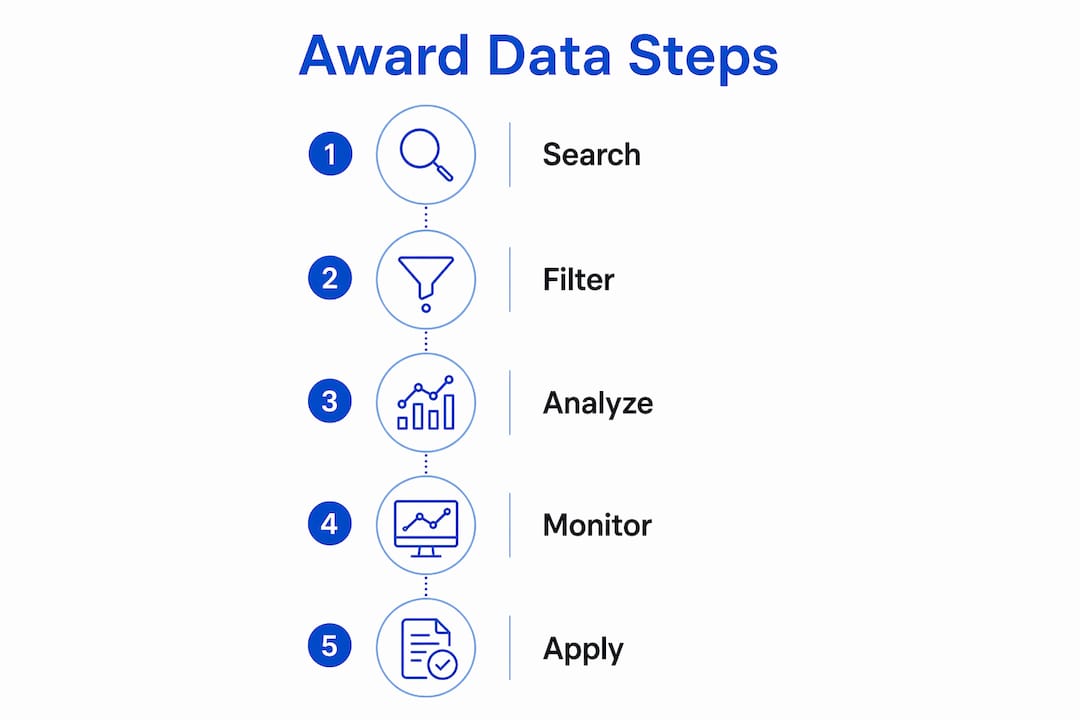
Past award data is one of the most underused tools in government contracting. Analyzing prior awards helps businesses identify which agencies spend in their space, who the incumbent vendors are, and when contracts are likely to come up for recompete.
Start by pulling awards filtered to your NAICS code and target agencies. Look at the period of performance end dates. A contract ending within 12–18 months is a recompete candidate, and the current awardee's name tells you exactly who you would be competing against. Obligated amounts over multiple years reveal whether an agency is a consistent buyer or a one-time spender.
 Set-aside programs reserve certain contracts for small businesses, veteran-owned firms, and other designated categories. Filtering for set-asides in your category shows you which opportunities you are actually eligible to pursue, rather than wading through full-and-open competitions where large primes dominate.
Pro Tip: Combine free portal data with a paid alert service to get notified when a contract in your NAICS code is about to expire or when a new award is posted. The free data is accurate; the paid layer saves you the manual monitoring.
Set-aside programs reserve certain contracts for small businesses, veteran-owned firms, and other designated categories. Filtering for set-asides in your category shows you which opportunities you are actually eligible to pursue, rather than wading through full-and-open competitions where large primes dominate.
Pro Tip: Combine free portal data with a paid alert service to get notified when a contract in your NAICS code is about to expire or when a new award is posted. The free data is accurate; the paid layer saves you the manual monitoring.
How often does government contract award data get updated?
USAspending.gov and SAM.gov both update on a near-daily basis for most federal agencies. Agencies submit contract action reports through the Federal Procurement Data System (FPDS), and that data flows into both portals continuously throughout each business day.
The practical reality is that there is always some lag. Agencies have reporting windows, and some smaller actions get batched and submitted weekly rather than daily. DoD contracts with unrevealed status add another layer of delay, sitting restricted temporarily for a limited period after signing before becoming visible to public users. For the most current government contract bidding results, checking SAM.gov directly tends to surface new awards faster than third-party aggregators.
How to access historical contract award information
Both portals hold years of historical data. USAspending.gov covers federal awards going back to fiscal year 2000 for most contract types, and the Advanced Search date filter lets you pull any custom range. SAM.gov's DataBank offers static pre-generated reports as well as fully customizable ad hoc reports, with historical contract activity available by fiscal year, agency, and geography.
For bulk historical downloads, USAspending.gov provides full dataset files by fiscal year, which researchers and analysts can download directly without running individual searches. The SAM.gov DataBank standard reports cover contract activity formatted for both government and public users, with options to filter by federal organization, geographic area, business demographics, and product or service type.
Who actually uses government contract award data, and why
The data serves a wider audience than most people realize. Here is how different groups put it to work:
Businesses and contractors use award data to map the competitive landscape, identify agency buying patterns, and time their business development efforts around recompetes. A company seeing that an incumbent has held the same IT services contract for six years knows a recompete is overdue. Researchers and journalists use USAspending.gov to track federal spending trends, identify concentration of awards among a small number of vendors, and investigate agency procurement practices. Small businesses use set-aside filters on SAM.gov to find contracts reserved for their category. Knowing that a specific agency consistently awards 8(a) set-asides in your NAICS code is the kind of intelligence that shapes a real business development strategy. For small businesses navigating public procurement, resources like SMME tender guidance illustrate how targeted search and compliance tools can sharpen a bidding approach.
Subcontractors search award data to identify prime contractors who have won large contracts in their space, then approach those primes directly about teaming or subcontracting opportunities.
*
Small businesses use set-aside filters on SAM.gov to find contracts reserved for their category. Knowing that a specific agency consistently awards 8(a) set-asides in your NAICS code is the kind of intelligence that shapes a real business development strategy. For small businesses navigating public procurement, resources like SMME tender guidance illustrate how targeted search and compliance tools can sharpen a bidding approach.
Subcontractors search award data to identify prime contractors who have won large contracts in their space, then approach those primes directly about teaming or subcontracting opportunities.
*
If you are tracking government contracts across multiple agencies and need alerts the moment a relevant award drops, Protenders offers an aggregated tender discovery platform built for exactly that kind of active monitoring. The tender alert tools are designed so you never have to manually check a portal again.
Key Takeaways
Federal agencies must report all contract actions above a minimum threshold, making USAspending.gov and SAM.gov the two most complete and authoritative sources for tracking government contract winners across every federal agency.
| Point | Details |
|---|---|
| Two official portals | USAspending.gov covers spending transparency; SAM.gov manages the full procurement lifecycle including live awards. |
| Reporting threshold | Federal agencies must report contract actions valued at $10,000 or more. |
| Ceiling vs. obligated | Ceiling value is the contract maximum; obligated amount is what the government has actually committed to pay. |
| DoD data delay | Defense contract awards can be restricted from public view for a limited period after signing. |
| Historical access | USAspending.gov holds federal award data going back to fiscal year 2000, searchable by date range, agency, and NAICS code. |
FAQ
Where can I see who won government contracts?
USAspending.gov and SAM.gov both publish the names of government contract winners alongside award amounts, agencies, and performance dates. Both are free and require no login for basic searches.
How many government contracts are awarded each year?
The federal government awards contracts across thousands of agencies annually, covering every category from IT services to construction. The total volume is tracked through FPDS and reflected in both USAspending.gov and SAM.gov, though a single annual count is not publicly summarized in one figure.
What are the easiest government contracts to get?
Contracts reserved through set-aside programs for small businesses, veteran-owned firms, and 8(a) participants typically have less competition than full-and-open awards. Filtering for set-asides in your NAICS code on SAM.gov shows which opportunities are restricted to your business category.
What is the difference between a contract award and a contract opportunity?
An award is a final, executed contract that has already been decided. An opportunity is an open solicitation inviting bids. Awards appear in the Contract Awards section of SAM.gov; opportunities appear under Contract Opportunities. You cannot bid on an award.
Recommended
- Gauteng Tenders 2026: Complete Guide to Government Opportunities | ProTenders
- Catering Tenders South Africa 2026: Food Services Guide | ProTenders
- Municipal Tenders South Africa 2026: How to Win Local Government Contracts | ProTenders
- How to Find Government Tenders in South Africa (2025 Complete Guide) | ProTenders