Municipal Tender Opportunities in South Africa: Where to Find Them and How to Bid

Municipal tenders are advertised by metros, district and local municipalities, and you can find them in one place: National Treasury's eTenders portal, which carries tender information from public-sector bodies at all spheres of government. To win one, you need an active Central Supplier Database (CSD) profile, a valid SARS tax compliance status, B-BBEE evidence and a complete bid in the right place before the closing time. This guide shows where to look, how to spot fake notices, what to prepare and how bids are scored.
TL;DR
- Search eTenders for open tenders from municipalities. A tender aggregator such as ProTenders lets you filter national, provincial and municipal tenders by keyword, region or category without signing up.
- Register on the CSD and get your SARS tax compliance status and B-BBEE evidence in order before a tender appears, not after.
- Verify every RFQ or tender with the issuing municipality, using contact details you find yourself, because fake RFQs using real department logos have cost businesses millions.
- Most bids are scored on price and preference points (80/20 or 90/10), and some must first pass a functionality threshold.
- A late or incomplete bid is rejected, so build a document checklist and submit early.
Table of Contents
- Where municipal tenders are advertised
- Local government tenders: what is usually on offer
- How to check a tender is genuine
- What you need before you bid
- From notice to submission
- How municipal tenders are scored and awarded
- Funding the work once you win
- Find and prepare for municipal tenders with ProTenders
- Common mistakes that cost SMMEs municipal bids
- FAQ
- Sources
Where municipal tenders are advertised
South Africa has no single municipal tender board. Each municipality advertises its own bids, and they appear in several places. Knowing all of them stops you missing work that sits in a small local municipality's notice board.
The eTenders portal. National Treasury's eTenders portal gives access to tender information from public-sector organisations at all spheres of government, and you can search open or active tenders. It is the official starting point. The municipality's own website. Most municipalities keep a tenders or supply chain management page with the full bid documents. Smaller municipalities often post documents there, and sometimes only there. For example, the Dr Beyers Naudé Local Municipality publishes the full notice and conditions for each tender on its site, and Drakenstein Municipality publishes its formal written price quotation documents online. Newspapers and the Tender Bulletin. Some notices still run in the press and in the Government Tender Bulletin. The Government Printing Works advises businesses to compare a tender's details with those in the Tender Bulletin when they are unsure it is real. Aggregators and alerts. Checking dozens of sites by hand is slow. An aggregator collects the live tenders from all tiers into one searchable feed. Our live feed of South African government tenders covers national, provincial and municipal buyers, and our tender alerts send matching tenders to you so you do not need to check every day. If you want to see how the options differ, the comparison of tender portals and the guide to platforms that list tenders lay it out by type.
Local government tenders: what is usually on offer
Municipalities buy what keeps a town running. Typical categories include:
- Electricity network maintenance and repairs
- Water and sanitation reticulation
- Roads, stormwater and civil works
- Waste collection and cleaning services
- Security, catering and facilities management
- Vehicles, equipment, uniforms and stationery
- Professional services such as engineering, legal and ICT support
Many of these are small enough for an SMME. A formal written price quotation, for example, is a lower-value process than a full open tender, and it suits a new supplier with limited track record. Playground installation, minor repairs and supply and delivery jobs are the kind of work that arrives this way.
A useful habit is to search by the service you deliver plus the municipalities within your reach, rather than by province. A plumber in Mpumalanga may find more work in four neighbouring local municipalities than in one large metro. Our municipal tenders guide goes deeper on how local government buyers work.
How to check a tender is genuine
Tender fraud is a real risk, and small businesses are the target. In February 2024 the Department of Public Works and Infrastructure warned the public about fraudsters using counterfeit RFQ documents carrying the department's logo and address, saying many businesses had lost millions. The department urged people to verify correspondence in its name.
Before you spend money on a tender, work through this checklist:
- Find the notice on the official site. The tender should appear on the municipality's own website or on eTenders, with the same reference number and closing date.
- Phone the municipality yourself. The Government Printing Works advises confirming a suspicious tender or quote with the department, without using the contact details printed on the tender document. Look up the number on the official website.
- Never pay to receive an order. A genuine municipal RFQ does not ask you to buy goods from a named supplier first and be reimbursed later.
- Check the email domain. Official municipal addresses end in .gov.za. Free webmail addresses are a warning sign.
- Check the scope against the municipality's needs. A tender for goods the municipality would never buy, or for a location it does not serve, deserves a call.
What you need before you bid
Paperwork is where most SMMEs lose municipal bids. The requirements are consistent across municipalities, so you can prepare most of the pack in advance.
Registration and tax
Municipal notices ask for CSD registration and a current SARS tax compliance status. The Dr Beyers Naudé notice, for example, requires CSD registration, a current tax-clearance certificate or verification PIN, municipal clearance and B-BBEE evidence, and says prices must include VAT if you are VAT-registered. Drakenstein's quotation document asks for company registration, banking, VAT and CSD details and a SARS Tax Compliance Status PIN.
If your CSD profile is not done, start there. Our step-by-step CSD registration guide walks you through it, and the complete CSD guide covers the details.
Municipal account and arrears
Municipalities check that you do not owe them money. Johannesburg Water's supplier form asks for a current municipal account or a valid lease agreement, and says arrears of more than 90 days require an acknowledgement-of-debt form. Settle or arrange any arrears before you bid.
B-BBEE evidence by company size
What you submit depends on turnover. Johannesburg Water's October 2024 form says EMEs with turnover up to R10 million may use an EME affidavit or specified certificates, QSEs with turnover between R10 million and R50 million may in specified cases use a sworn affidavit, and larger generic companies need a SANAS-accredited verification certificate. Always read the specific notice, because requirements differ between municipalities.
The standard bid forms
Most bid packs use the Standard Bidding Document (SBD) forms. GCIS's tender procedure lists the common ones: SBD 1 (invitation to bid), SBD 3.1 to 3.3 (pricing schedules), SBD 4 (declaration of interest), SBD 6.1 (preference points claim), SBD 8 (past supply chain management practices) and SBD 9 (independent bid determination). Each must be completed and signed where required.
From notice to submission
Treat each tender as a short project.
- Read the whole notice first. Note the closing date and time, the place of submission, whether there is a compulsory briefing, the evaluation method and the required documents.
- Check the fit. Do you hold the right registrations and experience? Can you deliver in that municipality at the price you will quote?
- Build a checklist from the document list, and tick off each item as it is completed and signed.
- Price carefully. Include VAT if you are registered. Cost transport, labour, materials and the time you will wait for payment.
- Submit early. The GCIS procedure requires completed bid documents and a signed, dated proposal at the specified place before the closing date and time, and late bids are not accepted. Drakenstein's document likewise states that late bids will not be considered.
As a rule, aim to have the pack ready a few days ahead. Printers fail, tax portals slow down and tender boxes have queues.
How municipal tenders are scored and awarded
Municipal procurement rests on the constitutional requirement that it be fair, equitable, transparent, competitive and cost-effective, as summarised in the vulekamali procurement guide. In practice the scoring follows set rules.
Functionality first, when it applies. GCIS says bids may be evaluated on functionality and then under the 80/20 or 90/10 system, and that bids below the functionality benchmark do not advance. National Treasury's MFMA Circular 53 says that when functionality is used, the invitation must state the criteria, each criterion's weight, the values and the minimum threshold. A bid that fails the stated minimum is disqualified, and only qualifying bids go on to the preference-point evaluation. Price and preference points. The GCIS procedure describes comparative price scoring followed by preference points, with totals rounded to two decimal places. The bidder with the highest total is generally awarded the contract, subject to the tender rules. With the 80/20 system, price carries up to 80 points and specific goals up to 20. With 90/10, price carries 90 and specific goals 10. Proof matters. The Dr Beyers Naudé notice states that it would use 80/20, required proof for specific-goal points and reserved the right not to accept the lowest or any tender. Claiming points without attaching proof usually means you do not get them, and the lowest price does not guarantee the award.
The practical lesson: read the evaluation section before you price. If there is a functionality threshold, write your technical response to the stated criteria and weights, not to what you think the municipality wants.
## Our view: win the paperwork before the price>
Most SMMEs we see treat municipal tendering as a price contest. It is closer to a compliance contest that ends in a price comparison. A bid that arrives late, with an expired tax status or a missing declaration, never reaches the price stage.>
That is why we built ProTenders around the whole cycle, not just the search box. You can browse every live national, provincial and municipal tender without signing up. Compliance scorecards show you what is missing before a deadline, document templates save you rebuilding the same forms, and a bid workspace keeps your team on one checklist. After an award, funding partners and RFQ and invoice tools help you deliver the work.>
Our advice is simple: get your CSD, tax status and B-BBEE evidence ready first, then set alerts for the services you can really deliver in the municipalities you can really reach. Fewer, better-fitted bids beat a scattergun approach.>
Dolene April
Funding the work once you win
A municipal award is good news and a cash-flow problem. You may need to buy materials, pay staff and wait for payment. It helps to think about funding while you bid, not after the award letter arrives, because a funder will want to see the award, your contract and your track record.
On ProTenders you can look through business funding programmes and follow links to specific options, such as infrastructure financing, a loan for early-stage businesses and small business development funds. Each programme has its own criteria, so read them against your contract value and stage of business.
Find and prepare for municipal tenders with ProTenders
Browsing tenders on ProTenders is free, and you do not need an account to search by keyword, region or category. When you are ready to bid regularly, the paid plans add the tools that save time. The Pro plan is R1,990 per year and the Business plan is R3,990 per year. Enterprise starts from R999 per month. You can compare what each includes on the pricing page.
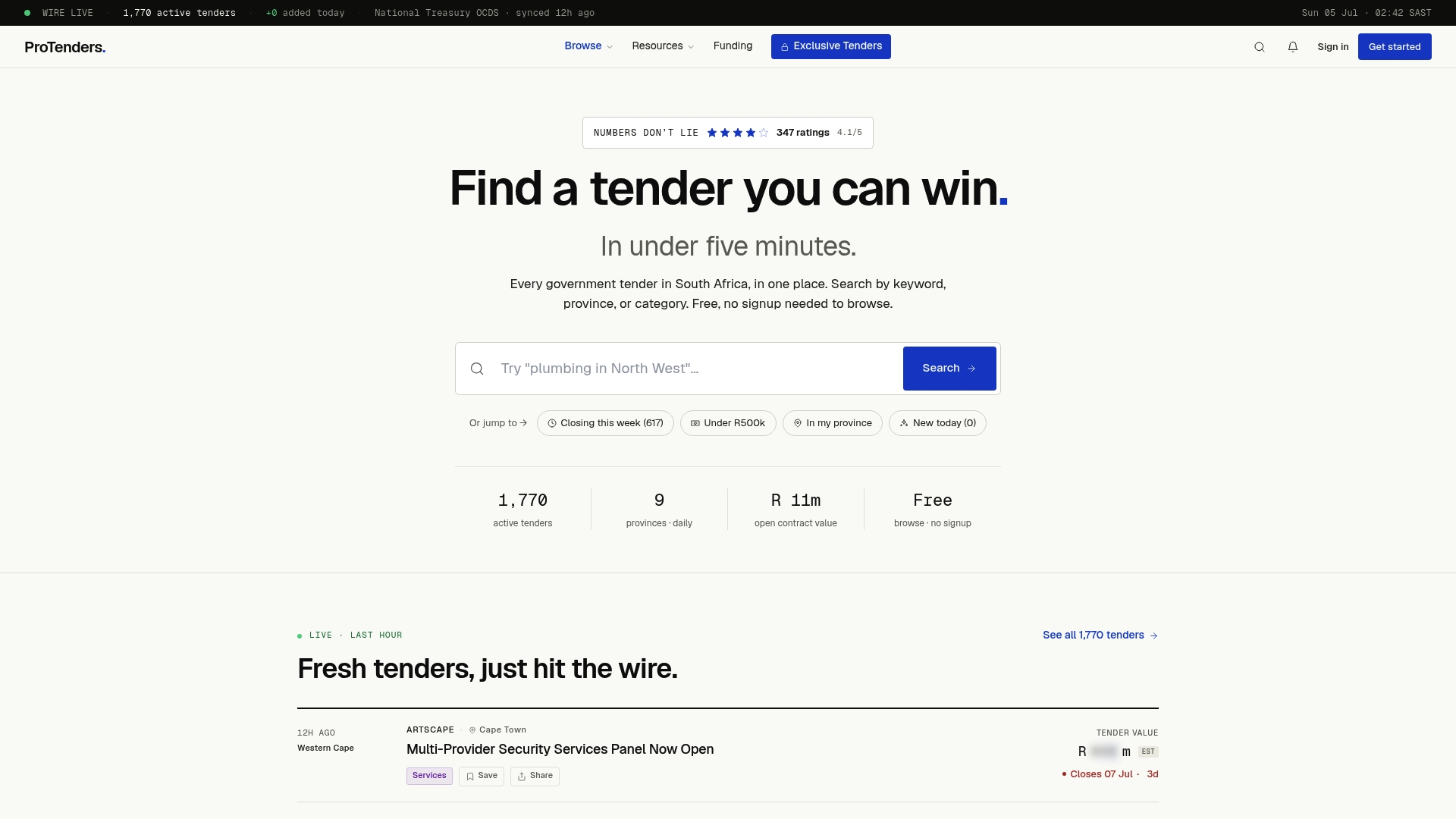
To start, search live government tenders, filter by your province and trade, and set up an alert so the next suitable municipal tender reaches you early. If you are weighing the official portal against an aggregator, our side-by-side comparison with eTenders shows how they differ, and the eTenders feed on ProTenders shows the same listings in one place.
Common mistakes that cost SMMEs municipal bids
- Submitting at the last minute. Queues, load shedding and system failures are no excuse once the box has closed.
- Expired tax status. Check your SARS compliance status again on the day you submit, not weeks earlier.
- Unsigned or missing forms. Every SBD form the notice lists needs to be present and complete.
- Ignoring the evaluation method. Pricing without reading how points are awarded wastes the effort.
- Claiming points without proof. Attach the certificates or affidavits the notice asks for.
- Bidding outside your reach. A tender in a municipality you cannot service within the contract time is a risk to you and the buyer.
- Trusting unverified RFQs. Confirm with the municipality using contact details you found independently.
FAQ
Where can I find local government tenders in South Africa?
Start with the eTenders portal, which carries tender information from public bodies at all spheres of government. Then check the supply chain management page of each municipality you can serve. An aggregator such as ProTenders brings the live municipal, provincial and national tenders into one searchable list.
Do I need to be on the CSD to bid for a municipal tender?
Municipal notices commonly require CSD registration, as the Dr Beyers Naudé notice does. You should also have a valid SARS tax compliance status. Read the specific notice, because each municipality lists its own requirements.
How do I know if a tender or RFQ is a scam?
Confirm it on the municipality's official website, then phone the municipality using a number you looked up yourself. Government guidance advises not using the contact details on the suspicious document. Never pay money to receive an order.
Does the lowest price always win?
No. Bids are scored under the 80/20 or 90/10 preference-point system, and some must first pass a functionality threshold. The highest total points generally wins, and a municipality may reserve the right not to accept the lowest bid.
Sources
- eTenders Portal
- Public Works and Infrastructure warns public against fraudulent RFQs
- Government Gazette, Tender Bulletin guidance
- GCIS tender procedures
- Dr Beyers Naudé Local Municipality, Tender 18/2025
- Drakenstein Municipality formal written price quotation
- Johannesburg Water supplier database form, October 2024
- Vulekamali procurement guide
- National Treasury MFMA Circular 53