NEC contract types: what SA buyers and bidders need to know

The NEC suite is a modular family of works, services, and supply contracts. The NEC4 family covers more than a dozen distinct forms: the Engineering and Construction Contract (ECC), Engineering and Construction Subcontract (ECS), Engineering and Construction Short Contract (ECSC), Professional Services Contract (PSC), Professional Services Short Contract (PSSC), Term Service Contract (TSC), Term Service Short Contract (TSSC), Supply Contract (SC), Supply Short Contract (SSC), Framework Contract (FC), Facilities Management Contract (FMC), Design Build and Operate Contract (DBOC), Alliance Contract (ALC), and the Dispute Resolution Service Contract (DRSC). Each form targets a specific procurement relationship.
Quick reference by role:- Employer/buyer: Use ECC for construction and engineering works; PSC for professional services; TSC for ongoing maintenance; SC for goods supply.
- Main contractor: Understand which ECC payment option (A–F) the tender specifies — it determines your pricing strategy and risk exposure.
- SMME/subcontractor: The ECS or ECSC governs your subcontract. Check whether the main contract is NEC4 or NEC3, and confirm CE timeline allowances before signing.
Key takeaways
The NEC4 ECC, with its modular payment options and secondary clauses, is the dominant form for South African public-sector infrastructure, and programme discipline and timely compensation-event notices are the two non-negotiables that determine whether contractors recover their entitlement.
| Point | Details |
|---|---|
| NEC4 family structure | Works (ECC/ECSC), Services (PSC/TSC/FMC), and Supply (SC/SSC) cover every procurement relationship. |
| ECC option selection | Option A suits fixed-price, well-defined scopes; Option C suits uncertain scopes with shared cost management. |
| Administration non-negotiables | Raise early warnings promptly, maintain an accepted programme, and submit CE quotations within the contract timeline. |
| South Africa context | SANRAL, metros, and parastatals are the primary NEC users; CIDB grading affects SMME eligibility on NEC projects. |
| Protenders for SMMEs | Protenders aggregates live NEC-based tenders, provides compliance scorecards, and connects SMMEs with funding partners. |
Where to get authoritative NEC documents and South African procurement guidance
- NEC official contracts page (Institution of Civil Engineers): purchase NEC4 contract forms, guidance notes, and flow charts directly. This is the only authoritative source for contract text.
- Mott MacDonald's little book of NEC (hosted by APM): plain-language explanation of ECC structure, payment options, and core mechanisms. Free to download.
- ET Mentorship NEC4 training: South Africa-based NEC4 training and guidance, including practical contract administration.
- MDA Attorneys Construct NEC journal: South African legal commentary on NEC administration, programme duties, and compensation events.
- CIDB tenders and grading: explains CIDB grades and how grading affects eligibility for NEC-specified public-sector tenders in South Africa.
- Infrastructure tenders South Africa: market overview of public-sector infrastructure pipelines where NEC is commonly specified.
Table of Contents
- How the NEC contract family is organised
- ECC payment options A–F: what each one means for your bid
- How NEC manages change and risk: early warning, compensation events, and the programme
- NEC in South Africa: who uses it and how it compares with JBCC, GCC, and FIDIC
- NEC3 vs NEC4: the differences procurement teams must know
- How to choose the right NEC contract for your project
- Preparing SMMEs to bid on NEC-based tenders in South Africa
- Protenders gives SMMEs a faster route to NEC tender opportunities
- Sources
- FAQ
How the NEC contract family is organised
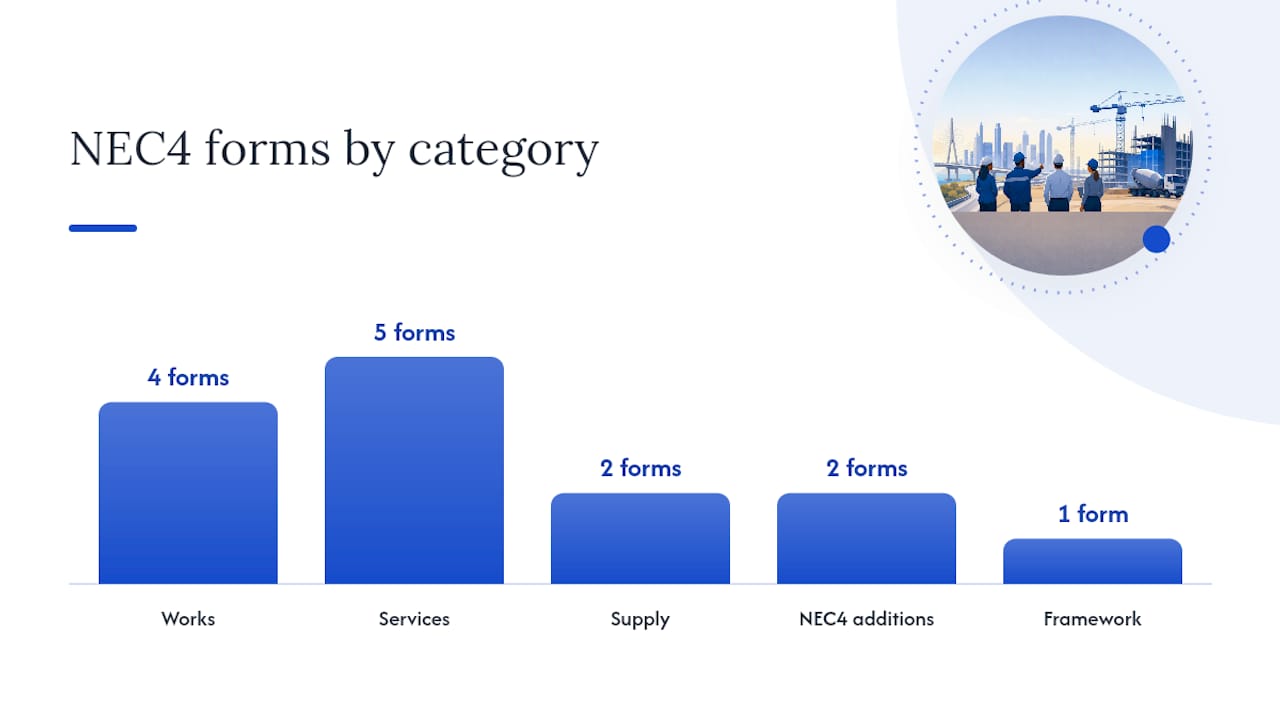
The NEC4 suite groups its forms into three practical categories: Works, Services, and Supply. Understanding the grouping matters because it tells you which form governs the relationship before you look at payment options or secondary clauses.
Works contracts- ECC (Engineering and Construction Contract): The flagship form. Used for construction, civil engineering, and infrastructure. Modular: core clauses plus a chosen payment option (A–F) and secondary options.
- ECSC (Engineering and Construction Short Contract): A simplified version for lower-risk, lower-value works where the full ECC's administrative demands are disproportionate. No payment options — fixed-price only.
- ECS (Engineering and Construction Subcontract): Back-to-back with the ECC. Mirrors the main contract's payment option and secondary options.
- ECSS (Engineering and Construction Short Subcontract): Paired with the ECSC for smaller subcontract packages.
- PSC (Professional Services Contract): Governs consultants, engineers, and project managers. Payment is either a lump sum or time-charge basis.
- PSSC (Professional Services Short Contract): Lighter-touch version for smaller or lower-complexity appointments.
- TSC (Term Service Contract): Designed for ongoing or maintenance services over a defined term. Common for road maintenance, facilities management, and utility upkeep.
- TSSC (Term Service Short Contract): Short-form equivalent for lower-value term services.
- FMC (Facilities Management Contract): An NEC4 addition for integrated facilities management arrangements.
- SC (Supply Contract): Governs the purchase of goods or equipment. Less common in SA public-sector infrastructure but relevant for plant and materials procurement.
- SSC (Supply Short Contract): Simplified supply form for lower-value or lower-risk goods.
The NEC4 suite introduced two integrated delivery forms that did not exist in NEC3:
- DBOC (Design, Build and Operate Contract): Combines design, construction, and long-term operation under a single contract. Suited to water treatment plants, toll roads, and energy facilities where whole-life performance matters.
- ALC (Alliance Contract): A multi-party form for complex programmes where risk and reward are shared across the client, contractors, and consultants. Increasingly favoured for large public-sector programmes.
FC (Framework Contract): Not a delivery contract itself, but a call-off mechanism that governs a panel of suppliers or contractors over time. Buyers use it to pre-qualify and then issue call-off orders under the ECC, PSC, or TSC. Short forms vs. full forms: The decision is straightforward. If the works or services are well-defined, low-risk, and below roughly R5 million, the short contract reduces administrative burden without sacrificing the NEC's core mechanisms. Above that threshold, or where design, compensation events, or programme disputes are likely, the full form is worth the overhead. *
ECC payment options A–F: what each one means for your bid
The ECC's modularity is its most distinctive feature. The core clauses stay constant; the payment option changes who carries cost risk and how the contract price is calculated.
Option A — Priced contract with activity schedule The contractor prices a list of activities. Payment is made when activities are completed. The contractor carries cost risk entirely. Best for well-defined scopes where the buyer wants price certainty and the contractor is confident in their estimate. Most common in South African public-sector infrastructure tenders. Option B — Priced contract with bill of quantities
Payment is based on measured quantities at tendered rates. The buyer carries quantity risk; the contractor carries rate risk. Familiar to quantity surveyors trained on traditional forms. Less common in NEC tenders but used where remeasurement is standard practice.
Option C — Target contract with activity schedule
A target price is agreed. Actual defined cost is reimbursed, and any saving or overrun against the target is shared between the parties at an agreed pain/gain split. Suits complex or uncertain scopes where collaboration on cost management is genuinely possible. SANRAL and major metros have used Option C on large infrastructure programmes.
Option D — Target contract with bill of quantities
Same pain/gain mechanism as Option C, but the target is set using a bill of quantities. Combines remeasurement with shared risk. Less frequently seen in SA practice.
Option E — Cost-reimbursable contract
The contractor is paid actual defined cost plus a fee. The buyer carries virtually all cost risk. Used where scope cannot be defined at tender stage, such as emergency works or highly complex investigations. Requires strong client-side cost management.
Option F — Management contract
The contractor manages a programme of work and subcontracts all physical work. Payment is defined cost of subcontracts plus a management fee. Suited to large, multi-package programmes where the client wants a single point of management responsibility.
Secondary options that shift risk and procurement outcomes:
Option B — Priced contract with bill of quantities
Payment is based on measured quantities at tendered rates. The buyer carries quantity risk; the contractor carries rate risk. Familiar to quantity surveyors trained on traditional forms. Less common in NEC tenders but used where remeasurement is standard practice.
Option C — Target contract with activity schedule
A target price is agreed. Actual defined cost is reimbursed, and any saving or overrun against the target is shared between the parties at an agreed pain/gain split. Suits complex or uncertain scopes where collaboration on cost management is genuinely possible. SANRAL and major metros have used Option C on large infrastructure programmes.
Option D — Target contract with bill of quantities
Same pain/gain mechanism as Option C, but the target is set using a bill of quantities. Combines remeasurement with shared risk. Less frequently seen in SA practice.
Option E — Cost-reimbursable contract
The contractor is paid actual defined cost plus a fee. The buyer carries virtually all cost risk. Used where scope cannot be defined at tender stage, such as emergency works or highly complex investigations. Requires strong client-side cost management.
Option F — Management contract
The contractor manages a programme of work and subcontracts all physical work. Payment is defined cost of subcontracts plus a management fee. Suited to large, multi-package programmes where the client wants a single point of management responsibility.
Secondary options that shift risk and procurement outcomes:
- X1: Price adjustment for inflation. Relevant on long contracts where CPI movement is material.
- X2: Changes in law. Allocates the cost of legislative changes to the employer.
- X5/X6: Sectional completion and bonus for early completion. Useful where phased handover is required.
- X13: Performance bond. Commonly required by South African public-sector buyers.
- X15: Limitation of contractor's liability. Caps the contractor's total exposure.
- X20: Key performance indicators. Ties payment or bonus to defined performance metrics.
- Y(ZA): South African law and adjudication provisions. Check whether the tender specifies local adjudication rules.
How NEC manages change and risk: early warning, compensation events, and the programme
NEC's collaborative risk-management model is built on three interlocking mechanisms. Miss any one of them and your entitlement to time or money can evaporate, regardless of how legitimate the underlying event is.
Early warningEither party can raise an early warning. The contractor is obliged to notify the Project Manager of any matter that could increase the total of the prices, delay completion, or impair performance. Early warnings are entered into a register and discussed at early-warning meetings. The practical effect: problems are surfaced before they become claims, and the party who fails to raise an early warning may find their compensation event assessed on the assumption that they had.
Compensation eventsProgramme maintenance and timely CE quotations are often decisive for entitlement. The process runs on strict timelines: the contractor notifies a compensation event within eight weeks of becoming aware of it (NEC4). The Project Manager has two weeks to respond. The contractor then has three weeks to submit a quotation. Missing these windows does not automatically extinguish the event, but it hands the Project Manager the right to make their own assessment, which is rarely in the contractor's favour.
The programmeThe accepted programme is not a planning document. Under NEC it is an entitlement document. A contractor without a current, accepted programme cannot demonstrate the time impact of a compensation event. The contract requires regular updates at intervals stated in the Contract Data. Clients and Project Managers who accept late or inadequate programmes are doing contractors no favours — the programme is the baseline against which delay is measured.
The Project Manager roleThe NEC Project Manager is not a neutral certifier in the traditional sense. They act for the employer, but the contract assigns them specific duties and timelines. A Project Manager who fails to respond to a CE notification within the stated period is deemed to have accepted the contractor's quotation. That procedural consequence is one of the most misunderstood features of NEC administration in South Africa.
Pro Tip: The three most common administration mistakes that erode contractor entitlement: (1) notifying compensation events late, (2) submitting programmes that show only activities without resource loading or logic links, and (3) failing to keep contemporaneous cost records under Options C and E. Fix these at project start-up, not after the first dispute. *NEC in South Africa: who uses it and how it compares with JBCC, GCC, and FIDIC
Four contract suites dominate South African projects: JBCC, NEC, GCC, and FIDIC. Each handles payment, variations, and risk differently, and each has a natural home in the SA market. Where NEC is used in South AfricaNEC is the preferred form for public-sector infrastructure and engineering works. SANRAL specifies ECC for national road construction and rehabilitation. Major metros use ECC and TSC for water, sanitation, electricity, and transport infrastructure. Transnet and other parastatals have used NEC on port and rail programmes. The PSC governs professional services appointments on these same programmes.
NEC's growth in SA public procurement reflects a deliberate policy shift toward collaborative, programme-driven contract administration. The CIDB's standard conditions and procurement guidelines do not mandate a single form, but NEC is increasingly specified in tender documents for projects above CIDB Grade 7.
How NEC compares with the other standard forms| Dimension | NEC (ECC) | JBCC | GCC | FIDIC |
|---|---|---|---|---|
| Primary purpose | Works (infrastructure/engineering) | Building works (private sector) | Government civil works | International/cross-border projects |
| Payment basis | Options A–F (activity schedule to cost-reimbursable) | Lump sum or remeasurement | Remeasurement (BoQ) | Lump sum, remeasurement, or cost-plus |
| Risk allocation | Shared; pain/gain available (Options C/D) | Contractor-heavy on fixed price | Employer retains quantity risk | Varies by sub-form |
| Administration role | Project Manager (employer's agent) | Principal Agent (architect/QS) | Engineer (employer's agent) | Engineer (dual role) |
| Typical SA users | SANRAL, metros, parastatals | Private developers, building contractors | National/provincial departments | International funders, PPP projects |
| SMME suitability | Short forms (ECSC) for smaller packages | JBCC Minor Works for small building | Limited short form | Low — complexity is high |
The CIDB's procurement prescripts require that tender documents comply with the Construction Procurement Standard. Buyers must specify the contract form in the tender data. For NEC tenders, bidders should check:
- Which edition (NEC3 or NEC4) and reprint is specified.
- Which payment option (A–F) applies.
- Which secondary options are activated.
- Whether a Y(ZA) clause or local adjudication provision is included.
- The CIDB grading required — NEC projects above a certain value typically require Grade 7 or higher, which affects SMME eligibility directly. Check CIDB grading requirements before pricing.
*
NEC3 vs NEC4: the differences procurement teams must know
NEC4 was published in 2017 and NEC3 remains in use on long-running legacy projects. The two editions are not interchangeable, and a bidder who applies NEC4 procedures to an NEC3 contract (or vice versa) can create procedural problems. Headline differences:- New contract forms: NEC4 added the DBOC, ALC, and FMC. These do not exist in NEC3.
- Terminology: NEC4 replaced "Employer" with "Client" and "Works Information" with "Scope." The substance is the same, but the wording in notices and correspondence must match the edition in use.
- Early contractor involvement (ECI): NEC4 introduced a formal ECI option within the ECC, allowing the contractor to be engaged during design development before the construction contract is executed.
- Defined cost: NEC4 clarified and tightened the Schedule of Cost Components, reducing disputes about what qualifies as defined cost under Options C, D, and E.
- Dispute resolution: NEC4 updated the adjudication provisions and introduced the DRSC as a standalone form.
- The edition and reprint number (e.g., NEC4 June 2017, or NEC3 April 2013 reprint).
- Secondary options listed (NEC3 and NEC4 use different X-clause numbering in some cases).
- The dispute resolution mechanism and adjudication rules.
How to choose the right NEC contract for your project
Matching a project to the correct NEC form is a procurement decision, not a drafting one. Work through these steps before issuing or responding to a tender.
- Define the scope category. Is this construction/civil works (ECC), professional services (PSC), ongoing maintenance (TSC), goods supply (SC), or an integrated design-build-operate arrangement (DBOC)? The scope category determines the contract family.
- Assess risk appetite and price certainty. If the scope is well-defined and the buyer wants a fixed price, Option A is the natural choice. If scope is uncertain or the buyer wants shared cost management, Option C or E is more appropriate. Option B suits remeasurement-based procurement where quantity risk sits with the employer.
- Decide on delivery model. Single contractor (ECC), multi-party alliance (ALC), or management contractor (Option F)? The delivery model drives the contract form.
- Choose secondary options. At minimum, consider: inflation adjustment (X1) on contracts over 18 months, performance bond (X13) for public-sector buyers, limitation of liability (X15), and local law/adjudication provisions (Y(ZA)).
- Check CIDB requirements. The CIDB grading required for the project value must match the contractor's registration. For SMMEs, confirm whether the project is structured to allow subcontracting at a lower grade.
- Assess administrative capacity. The full ECC requires programme updates, early-warning registers, and CE quotations on strict timelines. If neither party has that capacity, the ECSC is a better fit for lower-value works.
Questions to raise in tender clarifications:
- What is the required programme update interval (stated in Contract Data)?
- What is the buyer's expected early-warning meeting frequency?
- What are the CE notification and quotation timelines in the Contract Data?
- Is the Works Information/Scope complete, or will it be developed during the contract?
For subcontractors: Insist on back-to-back CE timelines that give you enough time to price and submit before the main contractor's deadline to the Project Manager. The CE timeline in back-to-back subcontracts is the single most common source of subcontractor disputes on NEC projects. Get it in writing before you sign. *
Preparing SMMEs to bid on NEC-based tenders in South Africa
Capacity to produce programme-compliant submissions and CE pricing within NEC timelines is often the limiting factor for SMMEs on NEC tenders. The contract is not hostile to smaller businesses, but it rewards preparation.
Practical steps before you submit:- Build a baseline programme. Even a simple bar chart with logic links and resource loading is better than none. The programme is your entitlement baseline from day one.
- Prepare a CE pricing template. A spreadsheet that captures defined cost (labour, plant, materials, subcontractors, fee) in the format the contract requires. Doing this before award means you can respond within the three-week quotation window.
- Set up an early-warning register. A simple log with date, description, potential impact, and status. Start it at project kick-off, not after the first problem.
- Nominate a contract administrator. Someone who knows NEC timelines and can draft notices correctly. On smaller projects this may be the site manager, but they need NEC-specific training.
- Programme (baseline, showing activities, durations, and logic).
- CE pricing worksheet (defined cost format).
- Early-warning log template.
- Quality and health-and-safety evidence pack (CIDB compliance, tax clearance, B-BBEE certificate).
Check the live tender feed to find active NEC-based tenders and confirm the contract form in the tender document before pricing.
Pro Tip: NEC's 'mutual trust and co-operation' clause is being interpreted practically in South African adjudications — it is an enforceable behavioural expectation, not a preamble. At your first project meeting, document the agreed early-warning meeting schedule, CE timeline expectations, and programme update intervals. That record protects you if the relationship deteriorates later. *What NEC projects have taught me about contract discipline
The most consistent lesson from NEC projects is that the contract rewards the party who does the administrative work first. Contractors who build their programme before mobilisation, set up their CE register on day one, and raise early warnings early tend to recover time and cost. Those who treat these as paperwork obligations to be caught up later tend to find their entitlement assessed by the Project Manager instead of their own quantity surveyor.
Three pitfalls appear repeatedly:
- Late CE notifications. Eight weeks sounds generous. On a busy site, it passes quickly. A rolling CE log reviewed weekly prevents the deadline from slipping.
- Inadequate programmes. A programme with no logic links and no resource loading cannot demonstrate delay. The Project Manager will reject it, and the contractor loses their baseline.
- Weak back-to-back subcontract terms. Main contractors who do not mirror CE timelines in their subcontracts find themselves caught between a subcontractor who cannot price in time and a Project Manager who will not extend the quotation deadline.
At project start-up, confirm three things in writing with the Project Manager: the programme update interval, the early-warning meeting schedule, and the CE quotation timeline. Everything else flows from those three agreements. *
Protenders gives SMMEs a faster route to NEC tender opportunities
Finding NEC-based infrastructure tenders across SANRAL, metros, and parastatals used to mean monitoring half a dozen portals manually. Protenders aggregates all live South African government tenders in one place, with CIDB grade filters and sector categories that surface NEC-specified opportunities without the manual search.
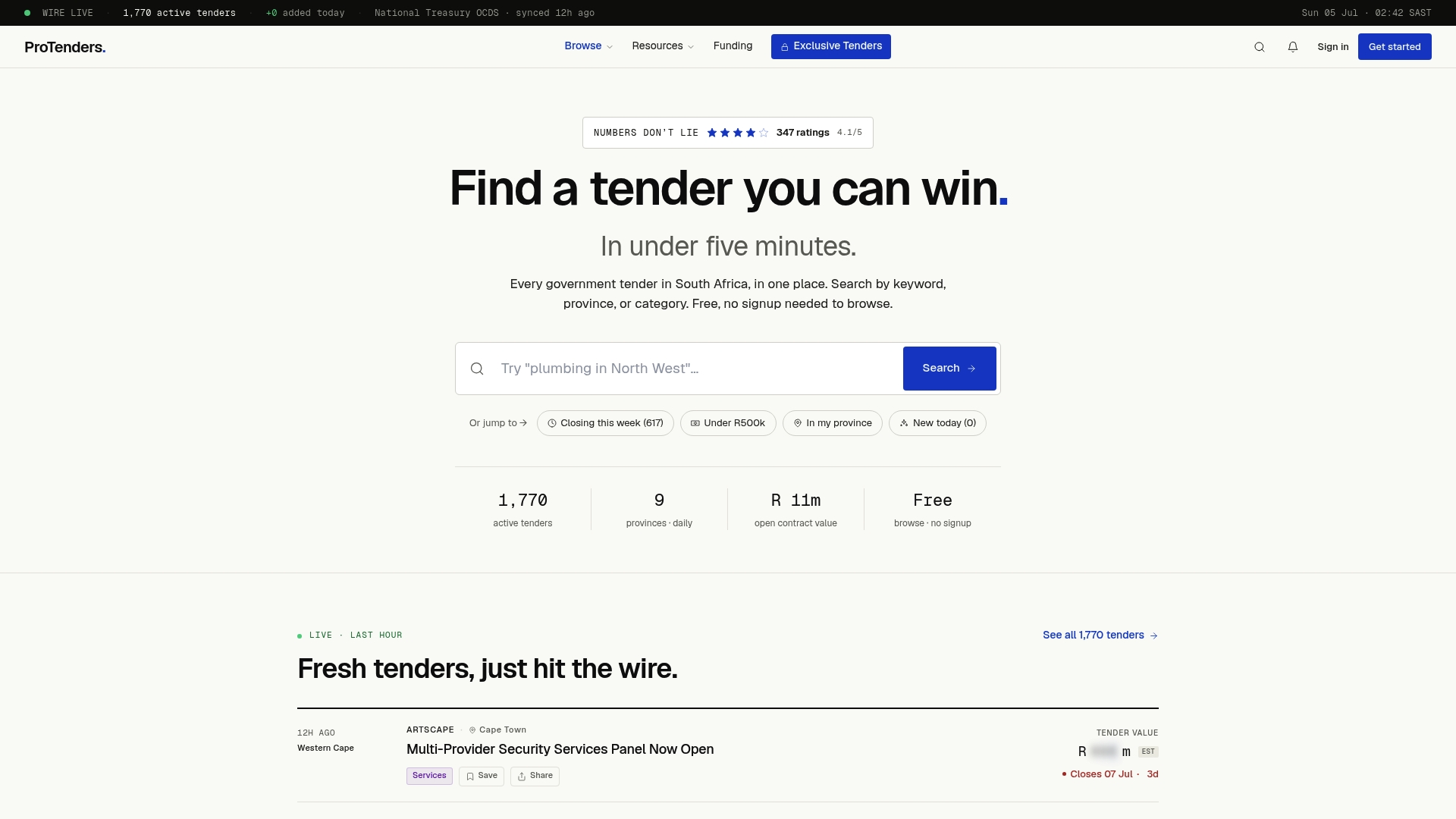
For SMMEs preparing to bid, the platform's compliance scorecard identifies gaps in your document pack before submission. Document templates cover the compliance requirements that appear consistently in NEC-based public-sector tenders. Funding partnerships help bridge the cash-flow gap between contract award and first certified payment, which is a real barrier under Option A activity-schedule contracts.
Search live government tenders now to find active NEC-based infrastructure opportunities, set a CIDB-filtered alert, and access the compliance tools that reduce preparation time on your next bid.
*Sources
- Contracts | Products
- NEC4 Contract Training | Engineering Training And Mentorship
- Construction contract types South Africa | JBCC, NEC, GCC, FIDIC | Wakha Blog
- Construct NEC (Edition 1) — MDA Attorneys (Construct Journal)
- LexisNexis legal guidance: NEC contracts (practice note)
FAQ
What are the main NEC contract types?
The NEC4 family includes the ECC (works), PSC (professional services), TSC (term services), SC (supply), FC (framework), FMC (facilities management), DBOC (design, build and operate), ALC (alliance), and the DRSC (dispute resolution), plus short-form and subcontract variants for each.
What is the difference between NEC3 and NEC4?
NEC4, published in 2017, added new forms (DBOC, ALC, FMC), replaced "Employer" with "Client" and "Works Information" with "Scope," introduced a formal early contractor involvement option, and tightened the defined-cost provisions. NEC3 remains in use on legacy projects.
What are the ECC payment options A to F?
Options A and B are priced contracts (activity schedule and bill of quantities respectively); Options C and D are target contracts with pain/gain sharing; Option E is cost-reimbursable; Option F is a management contract. The choice determines who carries cost risk and how the contract price is calculated.
How does NEC differ from JBCC and FIDIC in South Africa?
NEC is used primarily for public-sector infrastructure and engineering (SANRAL, metros, parastatals); JBCC dominates private-sector building works; FIDIC is used on international or donor-funded projects. NEC's distinguishing feature is its collaborative, programme-driven change-management model built around early warnings and compensation events.
Which NEC contract is most suitable for SMMEs in South Africa?
The ECSC (Engineering and Construction Short Contract) is the most accessible NEC form for SMMEs, with lower administrative demands than the full ECC. SMMEs working as subcontractors will typically operate under the ECS or ECSS, back-to-back with the main ECC.
Recommended
- Tender Glossary South Africa | Procurement Terms, Acronyms & Definitions | ProTenders
- Eastern Cape Tenders 2026: Government Opportunities Guide | ProTenders
- Gauteng Tenders 2026: Complete Guide to Government Opportunities | ProTenders
- Northern Cape Tender Bulletin — May 2026: Kimberley & Provincial Procurement Guide | ProTenders