Procurement Data Analysis: A South African SMME Guide

Procurement data analysis means collecting, cleaning and reading purchasing data so you can make better decisions. For a South African SMME, the most useful data is public: tender notices, awards, payments and supplier records. Read well, it shows who buys what you sell, at what prices, how often, and whether your business is ready to compete.
This guide covers what procurement data is, where to get it in South Africa, how to clean and analyse it, and how to turn the results into bidding decisions.
TL;DR
- Procurement data analysis is the process of collecting, cleansing, classifying and analysing spend and tender data to cut costs, improve efficiency and monitor compliance.
- South Africa publishes open procurement data through the National Treasury Transparency Portal, in CSV, JSON and Excel, plus a Procurement Payments Dashboard.
- For an SMME, the payoff is practical: find buyers, benchmark pricing, check competitors' awards and judge whether you can deliver and fund a contract.
- Public data is messy. Clean it first, and verify any AI-generated insight against the source.
- Start small: one category, one region, twelve months of awards.
Table of Contents
- What procurement data analysis actually is
- The kinds of procurement data you can analyse
- Where to find South African procurement data
- How to collect, clean and analyse the data
- From data to bidding decisions
- Where AI helps and where it does not
- Our perspective on procurement data for SMMEs
- Put the analysis to work with ProTenders
- A simple 30-day starter plan
- FAQ
- Sources
What procurement data analysis actually is
The National Treasury describes spend analysis as collecting, cleansing, classifying, enriching and analysing expenditure data%20SPF%20GPG%20-%20Data%20Collection%20and%20Analysis%20Narrative.pdf) to reduce procurement costs, improve efficiency and monitor compliance. It rests on three areas: visibility, analysis and process. The same document says an organisation's supply management success depends largely on its ability to access and interpret its spending data.
That definition is written for buyers inside government. As a supplier you sit on the other side of the same data. The buyer's spending is your market. Analysing it tells you where demand is, which departments and municipalities pay for what you offer, and what a winning price looks like.
There are two ways to use the discipline:
- Your own purchasing data. Invoices, purchase orders and supplier records. This is about controlling your costs as a business.
- Public procurement data. Tender notices, awards, contract registers and payment records. This is about winning work.
Most SMMEs chasing government work get the most out of the second, so that is where this guide spends its time. If you also want to analyse your own spend, the steps for cleaning and classifying data further down apply equally.
The kinds of procurement data you can analyse
Procurement data comes in several layers. Each answers a different question.
| Data type | What it contains | Question it answers |
|---|---|---|
| Tender notices | Description, buyer, closing date, category, requirements | What is being bought now, and by whom? |
| Awards | Winning supplier, contract value, date | Who wins, and at what price? |
| Contract registers | Contract numbers, values, start and end dates, project managers | Which contracts expire soon and will be re-tendered? |
| Payment data | Amounts paid to suppliers over time | Which buyers actually pay, and how much? |
| Supplier records | Registration and supplier details | Who are the active suppliers in my category? |
| Your own data | Costs, past bids, win and loss records | Where am I competitive? |
Where to find South African procurement data
The National Treasury Transparency Portal
The National Treasury Transparency Portal publishes detailed monthly public procurement data in Open Contracting Data Standard (OCDS) format. Downloads come as CSV, JSON and Excel, are available from May 2021 and are licensed under Creative Commons BY 4.0. The portal also offers a versioned JSON REST API for tools such as Power BI, Tableau and QlikView.
If you are comfortable with spreadsheets, start with the Excel or CSV files. If you have a developer or a data-minded team member, the API lets you refresh your analysis automatically.
The Procurement Payments Dashboard
The Treasury also launched a Procurement Payments Dashboard so the public can explore how government spends on goods and services. According to its User Guide, it draws on the Basic Accounting System (BAS), the Logistical Information System (LOGIS) and supplier data from the Central Supplier Database. It covers 1 April 2018 onward, with quarterly updates planned. We covered the launch in more detail in our piece on the procurement dashboard and tender corruption.
Payment data is where you see the difference between a contract awarded and money actually flowing.
Quarterly publication rules
National Treasury's PFMA SCM Instruction No. 10 of 2025/26 requires quarterly publication of procurement information. That means a steady flow of fresh data. Build your analysis as a routine you repeat each quarter, not a one-off project.
Municipal contract registers
Many municipalities publish their own registers. The Nelson Mandela Bay Municipality's Awarded Contract Register as at 28 February 2026 lists contract numbers, descriptions, awarded suppliers, contract values including VAT, start and end dates and project managers. End dates are especially useful: a contract that ends in a few months will probably come back to market.
Know the gaps
The Open Data South Africa Toolkit notes that the Treasury's tender information does not cover all procurement and government entities, for example RFQs issued by municipalities. If you sell small-ticket goods or services, combine the national dataset with municipal sources and a live tender feed such as our South African government tenders page, which brings national, provincial and municipal opportunities together.
How to collect, clean and analyse the data
A reliable process has four steps. They follow the same logic that procurement specialists use for spend analytics: consolidate, cleanse and normalise, classify, and enrich.

Step 1: Define one question
Do not download everything. Pick a question you can answer in a week:
- Which five buyers awarded the most contracts in my category in the last 12 months?
- What is the typical contract value for my kind of work in my province?
- Which contracts end in the next six months?
Step 2: Consolidate the sources
Download the relevant Transparency Portal files, add any municipal registers and your own bid history. Put them in one workbook or one database, with one row per tender or award.
Some information is hard to reach. OpenUp's Procurement Data Crash Course explains that much e-Tender notice detail sits in attached documents rather than the site database. It also shows how to scrape search results using the site's own query URLs and convert JSON to CSV for spreadsheet analysis. For OCDS data more broadly, the Open Contracting Partnership lists tools such as Kingfisher Collect and the Data Review Tool for downloading data from publishers and reporting structural errors.
Step 3: Cleanse and normalise
This is the unglamorous step that decides whether your conclusions are right. Typical jobs:
- Standardise buyer names (the same department may appear under several spellings).
- Standardise supplier names, which often differ by punctuation or "(Pty) Ltd".
- Convert all values to one basis, and note whether amounts include VAT.
- Remove duplicates and cancelled notices, or tag them so you can filter them out.
- Fix dates into one format.
Step 4: Classify and enrich
Group tenders into a simple category scheme that matches how you sell: for example, building maintenance, ICT services, security, catering. Then enrich with extra columns: province, municipality or department, contract duration, and whether you could have met the requirements. A hierarchy with two or three levels is enough for most SMMEs.
Step 5: Analyse and chart
Pivot tables will carry you a long way. Useful cuts:
- Award count by buyer: shows where the repeat demand is.
- Median award value by category: a realistic pricing and scale benchmark, better than the average, which a few large contracts will distort.
- Winner concentration: if three suppliers take most of a category, you need a specific angle. If winners are spread widely, entry is easier.
- Contract end dates: your forward pipeline.
- Seasonality: months when notices cluster, which tells you when to have documents ready.
From data to bidding decisions
Analysis only matters if it changes what you do. Here is how to apply it.
Finding opportunities
SME South Africa's guide to the e-Tender Publication Portal says the portal lets businesses search opportunities, view awarded, cancelled and closed tenders, identify competitors, analyse pricing and assess government demand for their products or services. That is the whole use case in a sentence: closed and awarded tenders are as informative as open ones.
A simple routine: each week, scan new notices in your category. Each quarter, update your award and contract-end-date tables. When a notice appears from a buyer you have seen award similar work, treat it as a priority.
Checking fit, compliance and readiness
Before committing hours to a bid, test the tender against your own business. Build a short checklist and score each tender against it:
- Category and scope. Does the work match what you have delivered before?
- Size. Is the typical award value in your category within your capacity and cash flow?
- Mandatory documents. Do you have the tax compliance status, supplier database registration, B-BBEE documentation and any specialist registrations the notice asks for?
- Experience requirements. Can you show comparable projects?
- Site visits and briefings. Can you attend, and are they compulsory?
- Timeline. Is there enough time between notice and closing date to prepare properly?
Your own win and loss records are the most valuable dataset you will ever have. Log every bid: buyer, value, your price, the winning price if published, and the reason you lost. After ten or so bids, patterns appear. Perhaps you are consistently above the winning price in one category but competitive in another. That is a decision you can only make with data.
Our guide to getting government tenders in South Africa walks through the registration and document requirements in more detail.
Reading price signals
Price is not the only criterion in public procurement, but it matters. According to The National, price accounted for 15.1% of recorded contractor choices in October in its reporting on the construction sector. Use award data to find the range winners price within, and build your own costing from the bottom up rather than guessing to undercut.
Assessing delivery and funding needs
Winning is half the job. Award and contract data also helps you plan to deliver.
Industry Insight's July 2026 Preferred Supplier Survey, based on contractors on 38 active construction projects worth about R11.0 billion, found that many projects awarded in 2022 to 2024 were still under construction or only recently started. Contractors cited funding shortages, delayed budget approvals, contractor withdrawals, rising costs and unresolved administrative processes. The National reports that contractors say it can take seven to nine months from award to start of work.
What this means for your analysis:
- Model your cash flow with a delay between award and first payment.
- Use payment data from the Treasury dashboard to see how the buyer has historically paid.
- Plan funding before you bid, not after you win. Working capital, materials and subcontractor costs come first, and payment comes later.
If you need finance to deliver an award, see the options on our business funding programs page.
Where AI helps and where it does not
AI tools can classify line items, summarise tender documents and flag patterns faster than a person. But they depend on the data underneath. IT-Online reports that South Africa faces a widening AI readiness gap in the supply function, driven by fragmented systems, poor data quality and skills shortages. Its source warns that if inputs are flawed, outputs will be flawed too.
SmartProcurement.co.za makes the same point practically: AI can produce errors, biased results or entirely fictitious answers, so procurement professionals should trust but verify. For you, that means:
- Let AI draft summaries and first-pass categories, then check a sample against the original notice.
- Never accept a closing date, value or requirement from an AI summary without opening the tender document.
- Clean your data first. A tidy spreadsheet beats a clever tool on messy input.
Our perspective on procurement data for SMMEs
Most SMMEs we speak to do not lack ambition. They lack visibility. Tenders are spread across national, provincial and municipal buyers, and the information that decides a bid sits in notices, attachments and registers that nobody has time to read side by side.>
We built ProTenders around the idea that discovery, preparation and delivery are one continuous job. Aggregating every live tender into one searchable place, by keyword, region or category and without a sign-up to browse, is the first step. Compliance scorecards, document templates and a bid workspace follow, so the analysis you do turns into a submission that is ready on time.>
Our view is that data analysis should shorten the path to a decision, not lengthen it. Pick a category, watch the buyers, track the awards, and bid on the ones you can deliver and fund. Funding partnerships then help you carry an awarded contract through the months before payment arrives.>
Dolene April
Put the analysis to work with ProTenders
If you would rather spend your time bidding than collecting spreadsheets, we have done the first part for you. ProTenders aggregates live tenders from national, provincial and municipal buyers, and you can search by keyword, region or category without signing up.
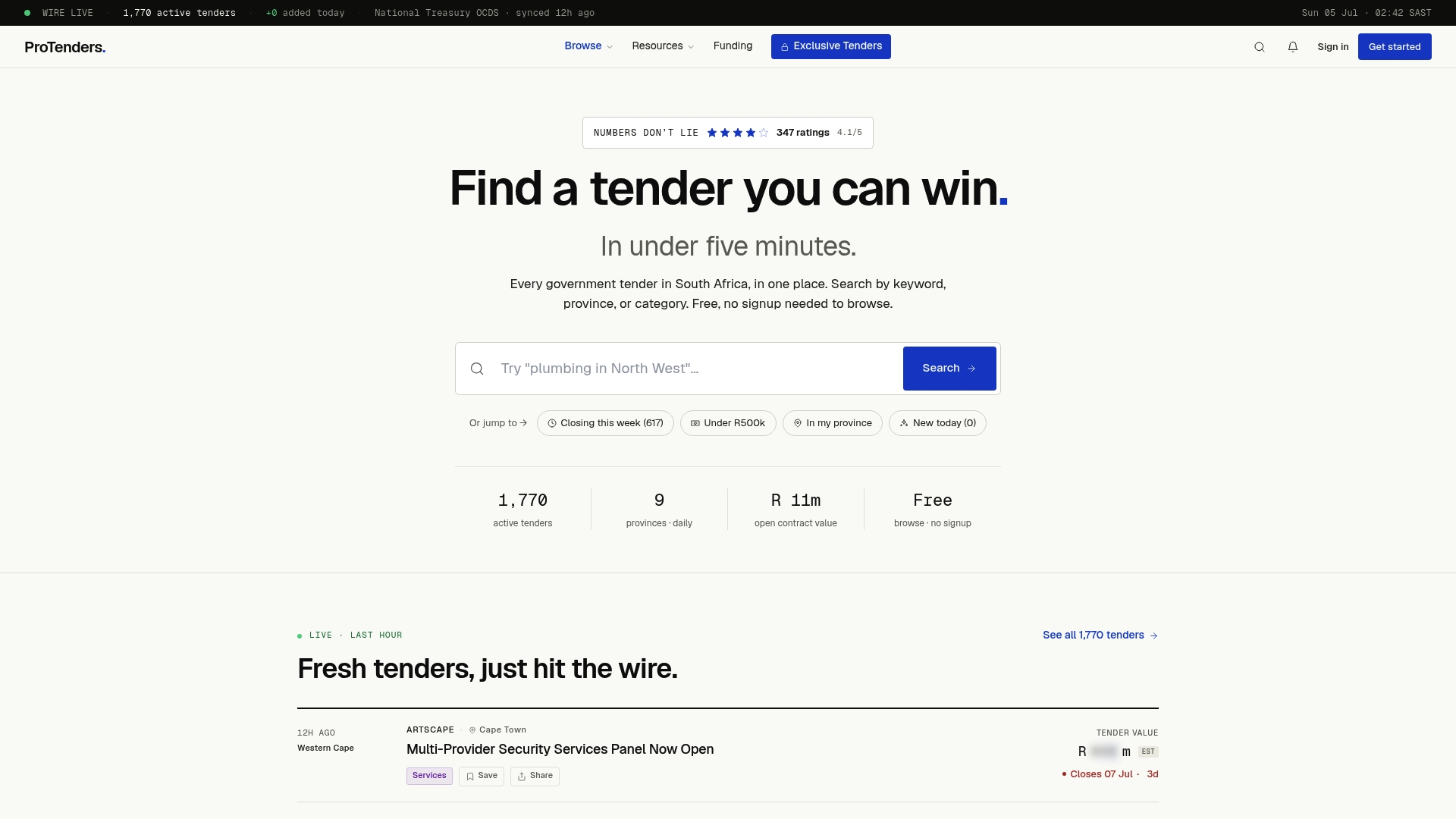
The Free plan lets you browse. Paid plans add advanced tools and alerts: Pro is R1 990 per year, Business is R3 990 per year, and Enterprise starts from R999 per month. Compare them on our pricing page, or set up free daily tender alerts for your category. For sector-specific feeds, see our building tenders and government IT tenders pages.
A simple 30-day starter plan
- Week 1: choose one category and one or two provinces. Download twelve months of award data from the Transparency Portal.
- Week 2: clean buyer and supplier names, tag VAT treatment and build a pivot of awards by buyer and by value.
- Week 3: list contracts ending in the next six months and score ten live tenders against your fit checklist.
- Week 4: prepare documents for the two best fits, plan funding and cash flow, and log everything in a bid tracker.
FAQ
What is analytics in procurement?
It is the use of quantitative methods to turn purchasing data into decisions. That includes spend, supplier performance, compliance and risk. For a supplier, the same methods applied to public tender and award data show where demand sits and what winning looks like.
Is South African procurement data free to use?
Yes, much of it. The National Treasury Transparency Portal publishes monthly procurement data in CSV, JSON and Excel, licensed under Creative Commons BY 4.0. Coverage does not include every entity or RFQ, so combine it with municipal registers and a live tender feed.
Do I need special software to analyse tender data?
No. A spreadsheet with pivot tables handles most SMME questions. If you want automated refreshes, the Treasury's JSON API connects to tools such as Power BI and Tableau. Start with the spreadsheet and move up only when it limits you.
Can AI replace manual procurement analysis?
AI speeds up classification and summaries, but it needs clean data and human checking. Verify values, dates and requirements against the original tender document before you act on any AI-generated insight.
Sources
- National Treasury: Spend Analysis, SPF GPG Data Collection and Analysis Narrative%20SPF%20GPG%20-%20Data%20Collection%20and%20Analysis%20Narrative.pdf)
- National Treasury Transparency Portal
- Procurement Payments Dashboard User Guide, February 2026
- PFMA SCM Instruction No. 10 of 2025/26
- Nelson Mandela Bay Municipality Awarded Contract Register, 28 February 2026
- Open Data South Africa Toolkit: finance and governance data resources
- Duja: Using Procurement Analytics to Identify Savings
- OpenUp Procurement Data Crash Course: web scraping
- Open Contracting Partnership: Using open contracting data
- SME South Africa: Guide to the e-Tender Publication Portal
- Industry Insight: July 2026 Preferred Supplier Survey
- The National: Why construction projects can take up to nine months to get under way
- IT-Online: Prepare for AI in the supply function
- SmartProcurement.co.za: AI in Procurement