Two Examples + NOSE Template for Proposal Writers' Executive Summary
An executive summary is a short, client focused argument that leads with the buyer's priorities and a single win theme, not a recap of your company. Write it last, after pricing and scope are locked, and open with the client's situation rather than your own history. Match its length to whatever the RFP specifies; when none is given, keep it brief.
*TL;DR:>
- An effective executive summary should open with the client's specific problem, not your company's history, and name a measurable outcome as the win theme.*
- Use the NOSE structure: needs, outcomes, solution, evidence, and next step, ensuring each part clearly supports the main argument.
- Write the summary after finalizing the proposal's scope and pricing, and always tailor it to the RFP's specific language and requirements.
- Keep the summary concise, ideally one to two pages, with clear headings, short paragraphs, and a specific next step to guide evaluators.
- Avoid vague claims, listing features instead of outcomes, and neglecting the evaluation criteria or mandatory documentation, as these mistakes can disqualify otherwise strong proposals.
Table of Contents
- What is a proposal executive summary and why does it decide shortlists?
- NOSE and the five parts: a practical structure you can apply immediately
- How do you actually write the executive summary, step by step?
- How long should an executive summary be, and does it always need one?
- What mistakes sink an otherwise strong proposal?
- How do you adapt an executive summary for a formal tender?
- A tender writer's honest take
- Sources
- FAQ
What is a proposal executive summary and why does it decide shortlists?
A proposal executive summary is the two-minute argument that decides whether the rest of your document gets read carefully or skimmed. Senior decision-makers often review only this section before delegating the technical detail to a committee. If the summary doesn't make the case, nothing on page twelve will save it.
That's why persuasion, not description, has to drive every sentence. Loopio's guidance on proposal executive summaries treats the section as a guided story built around one central message, not a compressed table of contents. The summary sits at the very front of the proposal, right after the cover page, and it frames how evaluators read everything that follows it.
The contrast between a strong and weak version is stark:
- A bland summary lists services offered and years in business.
- A persuasive summary names the client's specific problem, states a clear win theme, and previews the evidence that backs it up.
NOSE and the five parts: a practical structure you can apply immediately
Many proposal writers structure their summary around NOSE: Needs, Outcomes, Solution, Evidence. It maps neatly onto five practical components you can draft in order, according to Bidara.
- Client situation and needs (roughly 20% of the summary). State the buyer's problem in their own language, not yours.
- Win theme and desired outcomes (roughly 20%). One sentence that says what winning looks like for the client, framed as a result, not a feature.
- Proposed solution (roughly 30%). A short description of what you're delivering and how it solves the stated need.
- Evidence (roughly 20%). A specific proof point: a metric, a past result, a certification, a named reference.
- Clear ask or next step (roughly 10%). What you want the reader to do next, stated plainly.
Starter templates for each part help when you're staring at a blank page:
- Needs: "[Client] currently faces [specific problem], which costs [impact] every [timeframe]."
- Win theme: "We propose to [outcome], measured by [metric], within [timeframe]."
- Solution: "Our approach combines [method/tool] with [team or resource] to deliver [result]."
- Evidence: "In [past project], this approach delivered [specific result]."
- Ask: "We recommend proceeding with [next step] by [date]."
Pro Tip: Write the win theme sentence before anything else. Every other paragraph in the summary should support that one sentence, not compete with it.
How do you actually write the executive summary, step by step?
The order you write in matters more than most people assume. Draft a rough strawman summary early, once your team agrees on the win theme, then set it aside. Write the full proposal body: scope, pricing, methodology, team bios. Come back and rewrite the summary last, once every number in the proposal is final.
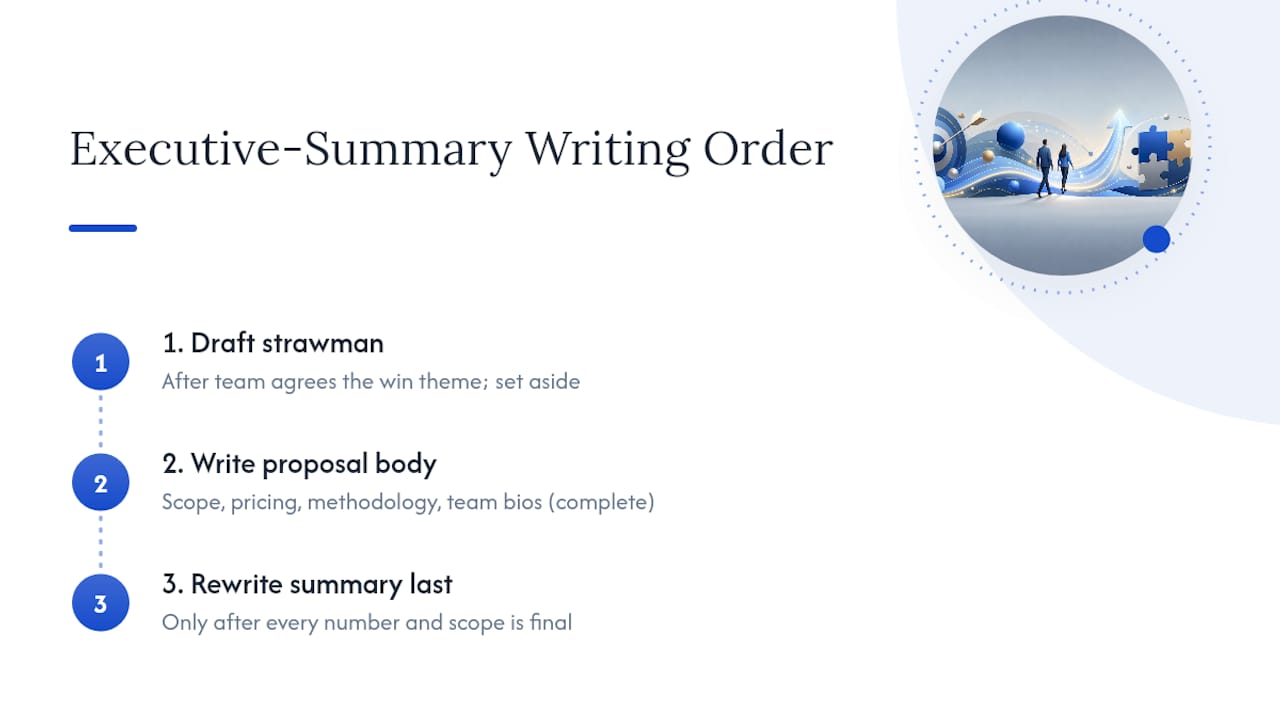
This two-stage approach exists for a reason. According to UMGC's executive summary writing guidance, the strawman version aligns the team early on strategy, while the final rewrite protects against promising something the body doesn't actually deliver. contrl.ai's guide to winning executive summaries makes the same case: finalise pricing and scope before you finalise the summary, never the other way around.
Two short examples show the difference between generic and sharp writing.
Example 1, a short project proposal:"Riverside Logistics loses an estimated six hours a week reconciling delivery data across three disconnected systems. Our proposal consolidates that data into one dashboard within 30 days, cutting reconciliation time by half. We've run this exact migration for two other regional logistics firms in the past 18 months, both live within the promised window. We recommend a kickoff call this week to confirm the data migration schedule."
Notice the opening names the client's actual cost, the win theme is the halved reconciliation time, and the evidence is a track record, not an adjective.
Example 2, a business proposal:"Coastal Retail Group wants to reduce customer churn without adding headcount to its support team. Our proposed loyalty and support automation platform is projected to lift repeat purchase rate within one quarter, based on results from three comparable retail clients. Implementation requires no new hires and integrates with your existing point-of-sale system. We're ready to begin onboarding within two weeks of signature."
Both examples open with the client's problem, name a single measurable outcome, and end with an explicit ask rather than a vague closing line.
How long should an executive summary be, and does it always need one?
An executive summary for a project proposal typically runs 1 to 2 pages, roughly 500 to 1,000 words. Always defer to the RFP's specified page or word limit when one exists; ignoring a stated limit can get a proposal disqualified before anyone reads your solution.
Formatting matters almost as much as content:
- Use short headings or bold lead-ins so evaluators can scan the argument before reading closely.
- Keep paragraphs to three or four sentences and use one callout for your strongest metric.
- State one clear ask; don't bury it in the final paragraph.
Skip a formal executive summary for very short, informal proposals, or when you're pitching a single decision-maker directly who already knows the context. A one-page quote to a familiar client doesn't need a five-part narrative.
What mistakes sink an otherwise strong proposal?
Most weak summaries make the same handful of errors, and evaluators notice them fast.
- Opening with company history instead of the client's problem.
- Making vague claims ("we deliver excellent results") with no supporting number or reference.
- Listing features instead of outcomes the buyer actually cares about, like cost savings or risk reduction, a distinction contrl.ai's guide highlights repeatedly.
- Ignoring the exact language used in the RFP, forcing evaluators to translate your terms into theirs.
- Ending without a specific ask or next step.
Before submission, run through this checklist:
- Client's correct name and project title appear in the first sentence.
- Language mirrors the RFP's own terminology.
- At least one specific evidence point (metric, reference, certification) is included.
- The ask or next step is stated plainly, not implied.
- Named contact and phone or email are correct.
- Formatting matches any RFP-specified structure or page limit.
- The summary reads correctly on its own, without the rest of the proposal attached.
How do you adapt an executive summary for a formal tender?
Government tenders raise the stakes considerably. RFPs commonly require an executive summary that demonstrates understanding of the requirements, outlines the proposed solution, and highlights relevant organisational experience and compliance, not just persuasive writing.
For a tender submission, a few adjustments matter:
- Mirror the RFP's exact terminology and evaluation criteria, rather than your own phrasing. Protenders' glossary of procurement terms is a fast way to check you're using the buyer's language correctly.
- Name a specific project lead, one measurable milestone, and one compliance or risk-mitigation statement where the RFP requires it.
- Use templates and compliance scorecards to organise supporting documents; Protenders' tender proposal format guide and document checklist both help SMMEs assemble procurement-ready submissions without missing a required attachment.
Treat compliance language as evidence, the same way you'd treat a client reference in a private-sector proposal.
A tender writer's honest take
Draft the strawman summary early, while the strategy conversation is still fresh, so your team locks in one win theme instead of three competing ones. Then rewrite it last, once pricing and scope are final, and name a real project lead alongside one concrete milestone. That single detail does more to reduce evaluator friction than another paragraph of company background ever will.
— Dolene April
Sources
- How to write an executive summary | Xero ZA
- Proposal executive summary guidance | Loopio
- How to write a proposal executive summary that wins | contrl.ai
- Bid document: Appointment of a service provider to provide Governance, Risk and Compliance system software in The Presidency
FAQ
What is an executive summary for a proposal?
It's a one to two page, client focused opening section that states the buyer's problem, your win theme, proposed solution, and a specific ask, written to be read on its own.
What are the five parts of an executive summary?
Following the NOSE structure, they are: client needs, win theme and outcomes, proposed solution, supporting evidence, and a clear ask or next step.
What is a good example of an executive summary?
A strong example names the client's specific cost or problem in sentence one, states one measurable outcome, backs it with a real evidence point, and closes with a concrete next step, as shown in the project and business proposal examples above.
Can you give an example of an executive summary for a grant proposal?
A grant summary should open with the community need in measurable terms, state the funded outcome you're proposing, cite a proof point (a past program result or partnership), and end with the specific funding amount requested and its intended use.
Ready to put this structure to work? Browse current opportunities on Protenders' live tender feed and match your next executive summary to a real RFP while the details are still fresh.