Win More SA Tenders with a Project Quality Plan Aligned to CIDB

A quality plan tender submission needs one thing above everything else: a project-specific PQP that proves, with evidence, how you'll deliver the contract's technical and inspection requirements. That means inspection and test plans, a data-pack index listing every certificate and record you'll produce, and named personnel with the competence to back it up. Build the checklist below into your returnable schedules and you'll score higher on functionality than a generic quality policy ever will.
*TL;DR:>
- A project-specific PQP must clearly demonstrate how technical and inspection requirements are controlled, referencing standards like ISO 9001:2015 and ISO 10005.*
- Submit the PQP within the specified deadline, ensuring it is accepted before work starts to avoid mobilisation delays and penalties.
- Include a navigation-friendly structure with concrete personnel names, referenced ITPs, and a cross-referenced data pack index to maximize scoring potential.
- Build detailed ITPs with explicit hold points, responsible persons, and clear acceptance criteria to meet evaluator expectations and avoid marks deductions.
- Tailor your PQP in length and depth to the contract scope while ensuring the index and references accurately match the tender's evaluation criteria.
Table of Contents
- What is a quality plan in a tender, and when do you submit it?
- What should a project quality plan for a tender include?
- How do you build ITPs and QCPs that pass tender scrutiny?
- What goes in the quality control data pack index?
- How do tender evaluators score a quality plan?
- Practical templates and how to adapt them for your tender
- Pre-submission checklist: catching mistakes before you submit
- How South African procurement rules shape PQP requirements
- What separates a winning PQP from a weak one
- How Protenders helps you turn a quality plan into a winning tender
- Sources
- FAQ
What is a quality plan in a tender, and when do you submit it?
A Project Quality Plan (PQP) is the document that tells the employer, in specific and checkable terms, how your quality system will operate on this particular contract. It's not the same as a Quality Control Plan (QCP) or an Inspection and Test Plan (ITP), though people use the terms loosely. The PQP is the umbrella document; QCPs and ITPs are the detailed schedules that sit underneath it, covering individual trades, activities, or work packages.
The confusion causes real problems at tender stage. Bidders submit a company-wide ISO certificate and call it a quality plan, then wonder why they scored poorly on functionality. Evaluators aren't asking whether you have a quality management system. They're asking whether you understand this contract's specific risks and how you'll control them.
Timing matters more than most contractors expect. Under TRANSNET's general quality requirements, the PQP must be submitted within the period stated in the contract, and work may not commence until the employer accepts it where that condition applies. That's a scheduling risk, not just a paperwork one. If your PQP gets rejected or sent back for revision after award, your mobilisation date slips and penalty clauses can start biting before you've moved a single piece of equipment onto site.
The standards to reference aren't optional extras, either. TRANSNET's requirements explicitly point bidders toward ISO 9001:2015 and ISO 10005 guidance for structuring quality plans. Citing these isn't about ticking a compliance box. It signals to the evaluator that your document follows a recognised structure they already know how to assess, which speeds up the review and reduces the chance of a misunderstanding costing you points.
Before you draft anything, confirm three things from the tender documents:
- The specific submission deadline for the PQP, separate from the general tender closing date.
- Whether the contract requires acceptance before work starts, or whether it's accepted concurrently with mobilisation.
- Which annexures, standard specifications, or employer requirements govern the PQP's format (CIDB conditions, TRANSNET annexures, or a bespoke employer specification).
Get those three answers early, and the rest of the drafting process becomes a lot less stressful. Miss them, and you risk building a technically sound plan that simply doesn't match what the tender documents actually asked for.
What should a project quality plan for a tender include?
Evaluators reading dozens of PQPs in a single sitting reward documents they can navigate fast. A templated, consistent contents structure does more for your score than beautiful prose ever will. Here's a contents list that maps cleanly onto most South African tender returnable schedules.
- Project and scope reference. State the tender number, contract title, and a one-paragraph description of the specific work scope this PQP covers. Generic plans that could apply to any project are an immediate red flag for reviewers.
- Quality policy and objectives. A short statement of your quality policy, tied to measurable objectives for this contract (defect rate targets, non-conformance closure time, first-time inspection pass rate).
- Organisation and responsibilities. Names, not just titles. List the site quality manager, ITP coordinator, and any independent inspection authority you'll use, with a line on each person's relevant experience.
- Applicable standards and specifications. Reference ISO 9001:2015, ISO 10005, and any project-specific specifications (SANS codes, employer technical specifications, TRANSNET annexures).
- Document and record control. How you'll number, version, store, and retrieve quality records for the duration of the contract, including who has authority to approve changes.
- Inspection and test plans (ITPs). A summary table for each major trade or work package, cross-referenced to detailed ITPs in the appendices.
- Non-conformance and corrective action procedure. How defects are raised, tracked, closed out, and reported to the employer.
- Quality control data pack index. A list of every certificate, test result, and inspection record you'll produce, organised by work stage.
- Method statements reference. A pointer to where method statements for specialised or high-risk activities sit, since these are often required as separate documents but referenced inside the PQP.
- Calibration and competence records. Evidence that measuring equipment is calibrated and that key personnel hold relevant certifications (welding qualifications, NDT certificates, trade licences).
Under each heading, include the minimum evidence an evaluator needs to award full marks, not the maximum you could possibly produce. A one-page organisation chart with names and CVs attached beats three pages describing your "commitment to quality culture."
Scale the contents by contract size. A small civil works package might need a four-page PQP with two ITPs attached. A multi-year infrastructure contract could run to forty pages with a dozen ITPs, a full method statement library, and a calibration register spanning multiple pieces of plant. The structure stays the same either way; only the depth of the appendices changes.

If the scope includes special processes, don't bury them in a general ITP. Welding, structural concrete, factory acceptance testing (FAT), and any activity with a defined code or standard behind it deserve their own dedicated section, because evaluators specifically look for evidence that you understand the extra control these activities demand.
Pro Tip: Build your contents list as a Word template with each heading pre-populated with a one-line prompt ("insert org chart here", "list ITPs by trade here"). Reuse it across every tender and you'll cut PQP drafting time from days to hours.For guidance on how the PQP fits inside the broader tender proposal format, check how returnable schedules are typically sequenced so your quality plan lands in the right section of your submission, not tacked on as an afterthought.
How do you build ITPs and QCPs that pass tender scrutiny?
An ITP is only useful to an evaluator if it answers four questions for every single activity: what's being checked, who checks it, what standard it's checked against, and what record proves it happened. Skip any of those four and the ITP reads as incomplete, even if the underlying work would have been done properly.
Structure each ITP row with these fields:
- Activity — the specific task (e.g., "reinforcement fixing before concrete pour").
- Inspection or test type — visual check, dimensional survey, material test, witness of a process.
- Hold, witness, or review point — whether the employer must be notified and must attend before work proceeds (hold point), may attend if they choose (witness point), or simply reviews records after the fact.
- Acceptance criteria — the specific standard or tolerance the work must meet.
- Record produced — the exact document generated (inspection checklist, test certificate, photograph log).
- Responsible person — named role, not just "site team."
Common hold points that evaluators expect to see explicitly addressed include reinforcement inspection before concrete placement, weld inspection before painting or coating, and factory acceptance testing before equipment leaves the supplier's premises. Witness points typically cover material delivery checks and compaction testing. If your scope touches structural welding, pressure vessels, or concrete with a specified strength grade, name the special process directly in the ITP rather than folding it into a generic "quality inspection" line.
Corporate quality documentation used across major South African contractors, such as WBHO's supplier and subcontractor quality management criteria, lists exactly this kind of field structure as the baseline expectation for QCP submissions. If your PQP's ITP format looks close to what a major contractor already demands from its own subcontractors, you're speaking a language the evaluator recognises instantly.
Personnel competence and calibration evidence don't need pages of narrative. A one-line entry per person, "J. Mokoena, site foreman, 8 years structural steel, valid welding coordinator certificate," tells the evaluator more than a paragraph about your training philosophy. For equipment, a calibration register extract showing the last calibration date and the next due date for each critical instrument (levels, concrete test cylinders, torque wrenches) is enough. Attach it as an appendix rather than describing it in prose.
Evaluators reviewing functionality submissions in South African tenders consistently mark down PQPs where inspection arrangements are ambiguous, meaning it's not clear who inspects what or when. A one-page ITP summary table per trade, with hold and witness points marked clearly and a named responsible person against each line, removes that ambiguity before it costs you marks.
What goes in the quality control data pack index?
The data pack index is the single document that tells an evaluator, at a glance, exactly what evidence you'll produce and when. It's essentially a table of contents for records that don't exist yet, organised by work stage rather than by document type.
A well-built index typically lists:
- Material certificates and mill certificates for structural steel, reinforcement, and concrete constituents.
- Test results for concrete cubes, compaction, and any specified material property.
- Inspection checklists tied back to each ITP hold and witness point.
- Welding procedure qualifications and welder certification records.
- Calibration certificates for measuring and test equipment used on site.
- As-built records and completion certificates for handover.
- Non-conformance reports and their close-out evidence.
Format the index the way you'd format a table of contents: work stage on the left, document type in the middle, a reference number linking back to the relevant ITP or QCP section on the right. Cross-referencing matters here. If your data pack index says "concrete test certificates, see ITP 4.2," the evaluator can flip straight to that section and confirm the two documents line up. A data pack that exists as a disconnected list, with no link back to the ITPs that generate the records, forces the evaluator to do that cross-checking themselves, and a tired reviewer working through a stack of submissions is unlikely to give you the benefit of the doubt.
Providing this index upfront, rather than promising to "maintain full records throughout the project," does more for your functionality score than almost any other single addition to a PQP. It proves you already understand what evidence the contract will generate, before you've been awarded a single day of work.
Pro Tip: Treat the data pack index as a living checklist rather than a static appendix. Once you win the contract, that same index becomes your site quality manager's tracking tool for what's outstanding at each handover milestone.How do tender evaluators score a quality plan?
South African procurement scores functionality qualitatively, on a scale that typically runs from poor through satisfactory, good, to very good, with a fixed number of points attached to each rating band. CIDB guidance requires tender documents to state the exact evaluation criteria and points available for functionality upfront, and specifies that any quality criteria used must be objective, directly related to the scope of work, and justifiable rather than arbitrary.
That last point matters more than it might seem. If a criterion can't be tied directly to a specific risk in the scope of work, the employer isn't supposed to be scoring it at all. That works in your favour as a bidder, because it means the evaluator is looking for direct relevance, not general quality credentials. Functionality scoring in South African construction tenders rewards PQPs that read as if they were written for this contract, not adapted from a filing cabinet template with the project name swapped out.
Map your PQP content directly to what tends to earn "good" or "very good" ratings:
- Scope relevance — every section references the actual work packages in this tender, not generic construction activities.
- Evidence index — the data pack index is present, complete, and cross-referenced to specific ITPs.
- Named competent staff — key roles carry real names, real experience summaries, and real certifications, not job titles alone.
- ITP clarity — hold and witness points are explicit, with acceptance criteria stated rather than implied.
- Direct standard referencing — ISO 9001:2015 and ISO 10005 (or the specific employer standard) are cited against the sections they actually govern, not dropped into an introduction and forgotten.
Formatting helps more than it should. A PQP with numbered headings, a table of contents, and consistent cross-referencing lets a reviewer working through their tenth submission of the day find what they need without hunting. That ease of review translates directly into a higher confidence rating, because the evaluator isn't left guessing whether missing information means it doesn't exist or was simply buried somewhere in forty pages of narrative.
Practical templates and how to adapt them for your tender
You don't need to write a PQP from scratch for every bid. A tested structure, adapted for the specific scope, gets you most of the way there in a fraction of the time.
A workable PQP snippet for the opening section reads something like this:
"This Project Quality Plan covers [Contract Title, Tender Reference]. It applies to [scope summary] and has been developed in accordance with ISO 9001:2015 and ISO 10005 guidance for quality plans. The Site Quality Manager, [name], holds [qualification/years of experience] and reports directly to the Contracts Manager for the duration of this contract."That's four sentences, and it already tells the evaluator the scope, the standards you're following, and who's accountable. Everything after it in the document should build on those same specifics rather than drifting into generic quality-management language.
For the ITP, a one-page layout per trade works best: activity down the left column, hold/witness/review classification next to it, acceptance criteria and record type across the middle, and the responsible person's name on the right. Keep the summary table to one page per trade, with detailed method statements and full test procedures pushed into appendices. That structure lets an evaluator check compliance from the summary alone, while giving your own site team the full procedural detail they need once work starts.
Adapt by project size in one direction only: add appendix depth, not contents-list complexity. A single-building renovation might need two ITPs and a two-page data pack index. A bulk earthworks and civil package could need eight ITPs covering different material types and testing regimes, but the PQP's core structure, and the way it's presented to the evaluator, stays identical.
| What you need | Where it goes in the PQP | Why it matters for scoring |
|---|---|---|
| Named site quality manager with CV | Organisation section | Proves competence beyond a job title |
| One-page ITP summary per trade | Inspection and test plans section, with detail in appendices | Speeds evaluator review, reduces ambiguity |
| Data pack index cross-referenced to ITPs | Dedicated data pack section | Shows you understand verification requirements upfront |
| ISO 9001:2015 / ISO 10005 reference tied to specific sections | Applicable standards section | Signals a recognised, checkable structure |
| Calibration register extract | Appendix, referenced from ITP section | Confirms measuring equipment is fit for use |
Pre-submission checklist: catching mistakes before you submit
Most PQPs that score poorly don't fail because the quality system behind them is weak. They fail because the document submitted doesn't clearly demonstrate what the bidder can actually do. Run through this before you finalise anything.
- Confirm the PQP references the exact tender number, contract title, and scope description, not a generic project name left over from a previous bid.
- Check every named person listed actually has a current CV or qualification record attached or available on request.
- Verify every ITP has acceptance criteria stated explicitly, not implied by the activity description alone.
- Confirm the data pack index cross-references back to specific ITP sections by number.
- Check that ISO 9001:2015 and ISO 10005 (or the employer's specified standards) are referenced against the sections they actually govern.
- Read the tender's functionality scoring criteria one more time, line by line, and confirm each criterion has a matching PQP section that addresses it directly.
- Have someone outside the drafting team review the document cold, without context, to check it reads clearly on a first pass.
The most common red flags that trigger low scores: a PQP copied from a previous, unrelated tender with only the project name changed; ITPs with no hold or witness points marked at all; and a total absence of named personnel, with roles described only by title. Any one of these tells an evaluator the plan wasn't built for this contract. Pro Tip: Build a two-person sign-off routine before submission: the person who drafted the PQP checks it against the tender's own evaluation criteria line by line, and a second reviewer checks it purely for clarity, as if they'd never seen the project before. Catching ambiguity before an evaluator does is the cheapest points you'll ever earn.
How South African procurement rules shape PQP requirements
South African public sector procurement doesn't leave quality scoring to informal judgement. CIDB guidance requires the tender documents themselves to spell out the functionality evaluation criteria and the points attached to each, and insists that any quality criterion used must be objective and directly tied to the scope of work rather than a subjective preference. That's a protection for bidders as much as a constraint, because it means a PQP that directly addresses the stated scope has a defensible claim to full marks.
TRANSNET's own contractor and supplier quality requirements go further on process. They specify that the PQP must be submitted within the contract period, must reference ISO 9001:2015 and ISO 10005 guidance, and must list QCPs, ITPs, and method statements as part of the submission package. Work may not begin until the employer accepts the PQP where the contract makes that a condition.
Where a contract specifies that work may not commence until the PQP is accepted, treat that acceptance as a milestone on your own programme, not a formality to chase after signing. A rejected or delayed PQP acceptance pushes your mobilisation date, and that risk sits entirely with the contractor, not the employer.
What that means practically for your submission: state your standards references explicitly and early in the document, don't bury the acceptance-timing requirement in an appendix where your own project manager might miss it, and treat the CIDB's scoring transparency requirement as your cue to map each PQP section directly against the tender's own stated criteria, sentence for sentence if necessary. When you draft against the actual clauses governing your contract, rather than a generic quality template, your PQP starts answering the exact question the evaluator is scoring.
For a wider view of contractor verification practices that often sit alongside quality documentation in a tender return, SzopaLabs' guide on verifying a construction contractor covers the kind of due diligence employers run before award, which is worth understanding from the other side of the table.
What separates a winning PQP from a weak one
Reviewing enough tender submissions teaches you that the difference between a PQP that scores "good" and one that scores "very good" is rarely the underlying quality system. It's almost always specificity. One submission listed a "site quality manager" with no name attached; another named the person, gave eleven years of relevant experience, and attached a one-page CV. Same job function, wildly different score, because one evaluator had something concrete to verify and the other had to take it on faith.
A second pattern worth flagging: bidders who treat the data pack index as an afterthought consistently underscore relative to bidders who build it as a genuine cross-reference to their ITPs. The index isn't decoration. It's the document an evaluator uses to confirm the rest of the PQP actually holds together.
Small contractors often assume they need heavy paperwork to compete with larger firms on quality scoring. They don't. Listing experienced subcontractors by name, attaching CVs for two or three key personnel, and committing explicitly to third-party calibration and certified welders costs almost nothing to produce and reads, to an evaluator, as exactly the kind of low-cost, high-clarity evidence that a bloated corporate quality manual often fails to deliver. Specificity beats volume every time it's been tested against a scoring sheet.
— Dolene April
How Protenders helps you turn a quality plan into a winning tender
Finding the right tender to attach your quality plan to is half the battle, and it's the half that eats the most time when you're doing it manually across dozens of buyer websites. Protenders aggregates every live tender from national, provincial, and municipal buyers in one searchable feed, so you spend your hours refining your PQP instead of hunting for opportunities that match your scope.
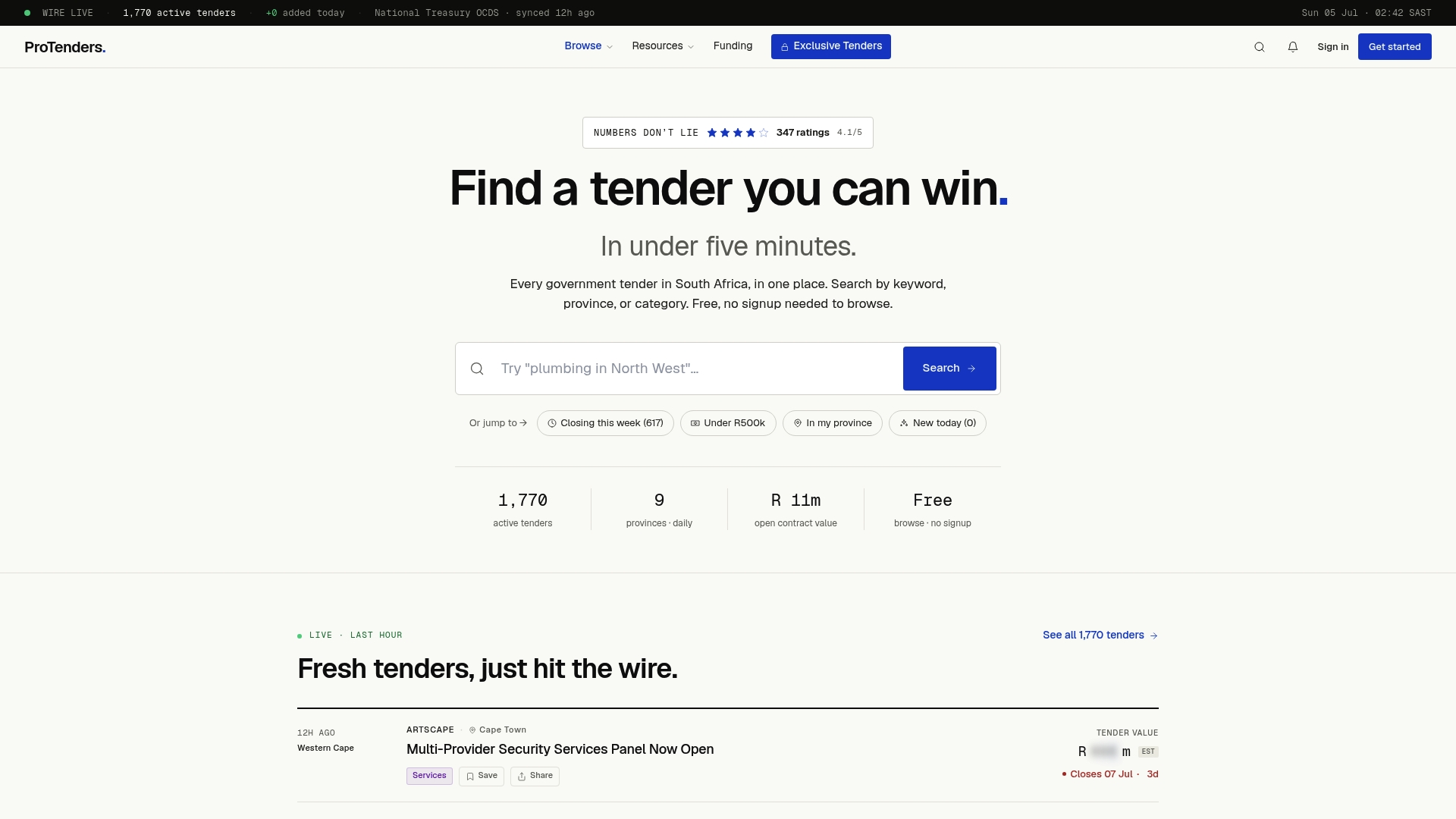
Beyond the search itself, the platform gives SMMEs and contractors compliance scorecards and document templates built to match the kind of returnable schedules this guide has walked through, letting you check your submission against what evaluators typically expect before you send it. Pair that with tender funding partnerships available through certain platforms, and you gain a potential path from finding a contract to actually being able to execute it once you win. Browse the live South African government tenders feed to find scopes that match your quality systems today, or start from the Protenders homepage to see the full set of templates and tools available to your business.
Sources
Keep these close whenever you're drafting a PQP, and always check the specific tender's own returnable schedules and contract data first. Employer-specific requirements override any general guidance, including this article.
- Annexure C: General quality requirements for contractors and suppliers (TRANSNET)
- Preparing procurement documents (CIDB guidance / Government of South Africa)
- WBHO: Criteria for suppliers and subcontractors quality management (sample corporate QCP guidance)
FAQ
What is a quality plan example in construction?
A typical example covers project scope, quality policy, named responsible personnel, applicable standards like ISO 9001:2015, a set of ITPs with hold and witness points, and a data pack index listing the records to be produced at each work stage.
What is a QA/QC plan?
A QA/QC plan combines quality assurance (the processes that prevent defects, like documented procedures and staff competence) with quality control (the checks that catch defects, like inspections and testing) into one document governing how work will be verified on a contract.
What should be included in a project quality plan?
At minimum: scope reference, quality policy and objectives, organisation and named responsibilities, applicable standards, document control procedures, ITPs, a non-conformance procedure, and a quality control data pack index.
What is a QA/QC checklist?
It's a structured list used to verify that each required quality step, an inspection, a test, a sign-off, has been completed and recorded before work proceeds to the next stage, often built directly from the ITP hold and witness points.
How do South African tender evaluators score a quality plan?
Most public tenders score quality as part of a functionality assessment, using qualitative ratings from poor to very good, with points awarded based on objective criteria stated in the tender documents, as required under CIDB guidance.