Free R1M on a R10M Job: Retention Bonds for South African Contractors

A retention bond is a guarantee issued by a bank or insurer that stands in for cash retention on a construction contract, letting the employer keep security against defects without the contractor's money sitting locked up until the defects liability period ends. On South African contracts using JBCC, FIDIC or NEC forms, that swap can release thousands of rands in working capital per project. The rest of this guide walks through the mechanics, the costs, and how to actually get one.
*TL;DR:>
- Using retention bonds can release up to 10% of contract value as cash, which can be used for project funding or bidding, instead of being locked until defect resolution.*
- The bond must be negotiated before signing the contract, with the guarantee typically expiring after 12 to 24 months following practical completion.
- The employer can only call on the bond if they provide proper notice and proof of unresolved defects within the bond's validity period.
- Underwriters evaluate financial history, contract documents, and guarantee facilities to determine premiums, which are usually justified by the capital freed for use.
- Proper drafting of the bond clause, clear beneficiary wording, and timely documentation are crucial to avoid disputes and ensure enforceability.
Table of Contents
- What is a retention bond? Definition and how it differs from cash retention
- How retention bonds work on South African contracts
- Who's involved, and what each party actually has to do
- Why the cash-flow case for a retention bond is so strong
- What a retention bond costs, and what underwriters want to see
- How to claim or release a retention bond
- Where retention bonds go wrong: legal risks and contract checkpoints
- Getting your SMME ready to use a retention bond
- A practitioner's view on negotiating retention bonds
- Protenders helps you get bond ready before you bid
- Sources
- FAQ
What is a retention bond? Definition and how it differs from cash retention
A retention bond, also called a retention guarantee or maintenance bond, is a written undertaking from a bank or registered insurer to pay the employer a set amount if the contractor fails to fix defects during the liability period. It replaces the cash an employer would otherwise withhold from each payment certificate. Instead of the money sitting in a project account earning the contractor nothing, the guarantor's signature does the job the cash would have done.
The distinction from other securities matters because contract drafters often mix these terms up:
- Cash retention is money physically withheld from certified payments, usually 5–10%, and released in stages.
- A retention bond replaces that withheld cash with a third-party guarantee, so the contractor gets paid in full.
- A performance bond covers a different risk entirely, the contractor's failure to complete the works at all, and is usually called at the start of the contract, not near the end.
- An advance payment guarantee secures money the employer pays upfront, before any work is certified.
You'll find retention guarantee mechanisms addressed explicitly in JBCC's principal building agreement, in FIDIC's Red and Yellow Books, and in NEC4's secondary option clauses. Each standard form treats the substitution slightly differently, so the specific wording in your contract, not the general concept, governs what you can actually claim.
How retention bonds work on South African contracts
The mechanics follow a fairly predictable sequence once you understand the moving parts.
- Negotiate the bond clause before signing. The right to substitute a bond for cash retention has to exist in the contract itself, either as a standard JBCC/FIDIC/NEC provision or as an amendment. Raising this after the contract is signed rarely works.
- Retention accrues on each interim certificate. Most South African contracts using these forms withhold 5–10% of each certified payment, calculated against the value of work done that month.
- The contractor arranges the bond with a bank or insurer. Once approved, the guarantee document is issued naming the employer as beneficiary, and the retained cash from that point forward is released instead of withheld.
- Half releases at practical completion. This is standard across JBCC and most FIDIC-based contracts in South Africa.
- The balance releases after the defects liability period, typically 12 to 24 months after practical completion, once any snagging items are resolved.
- The bond expires or is called. If no defect claim arises, the guarantor's obligation simply lapses at the expiry date stated in the document. If a valid defect claim is made and unresolved, the employer can call on it.
The expiry date and the beneficiary wording are where disputes tend to start. A bond that expires before the defects liability period actually ends leaves the employer exposed for the gap, and a badly worded beneficiary clause can make the guarantee hard to call on cleanly.
Who's involved, and what each party actually has to do
Three parties carry distinct obligations under a retention bond arrangement, and confusing them is a common source of contract disputes.
- The employer, as beneficiary, has the right to call on the bond if the contractor fails to remedy defects certified by the principal agent or engineer. The employer cannot call on it arbitrarily; most bonds require documentary proof of the defect and a notice period.
- The contractor must apply for the bond, keep it in force for the full contract period plus defects liability period, and cover the premium. Letting a bond lapse early is a breach in most standard forms.
- The guarantor or surety (a bank or registered insurer) is only liable up to the bond's face value and only within its stated validity period. It has no obligation to investigate whether the underlying defect claim is fair, it simply pays out against the documented conditions of the bond.
Where subcontractors are involved, main contractors often need to decide whether to pass retention terms down the chain or absorb that cash-flow gap themselves, since subcontractor retention rarely mirrors the main contract exactly.
Why the cash-flow case for a retention bond is so strong
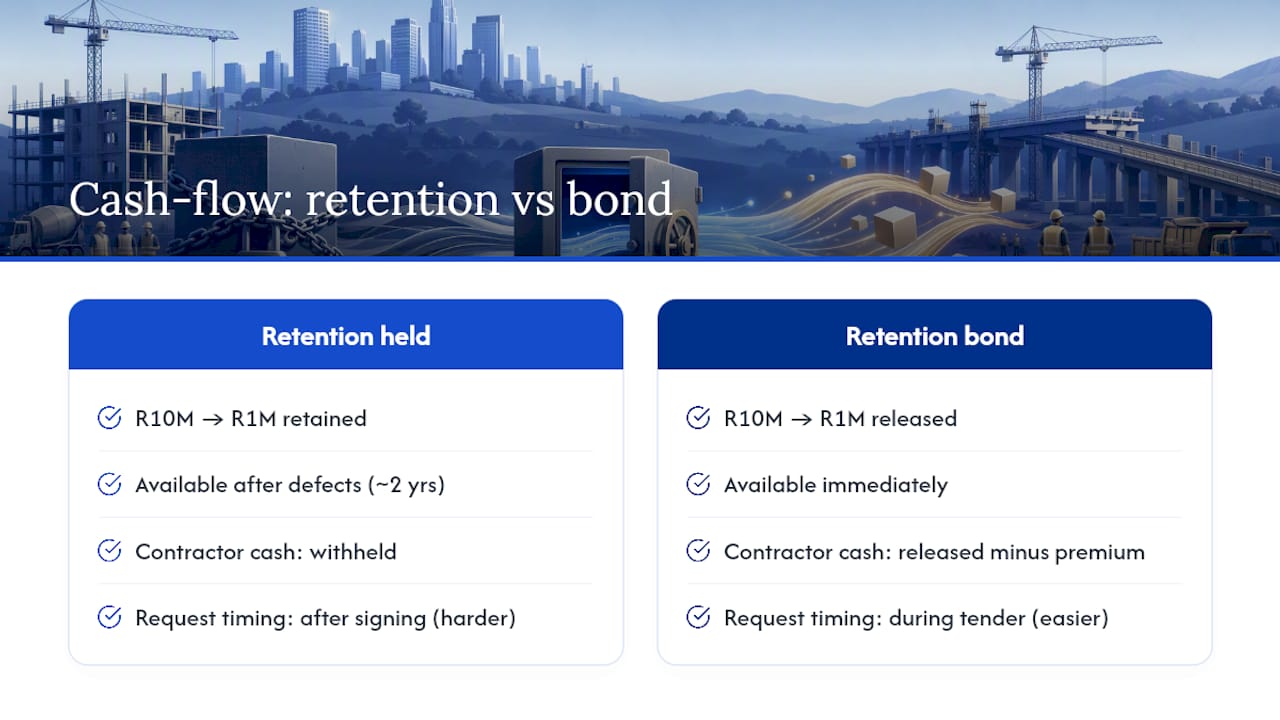
Run the numbers on a mid-size contract and the appeal becomes obvious. On a R10 million contract with 10% retention, R1 million sits withheld across the life of the project. Converting that to a bond means the contractor receives that R1 million as cash, immediately available for materials, wages, or bidding on the next tender, instead of waiting up to two years for the defects liability period to run out.
On large projects, insurer commentary suggests that the cash freed by a retention guarantee generally exceeds the premium cost of the bond, according to insurer commentary on South African contractor risk. That gap between premium and capital released is exactly why the bond makes financial sense on high-value works.Pro Tip: Ask for the retention bond option during tender negotiation, not after the contract is signed. Employers are far more willing to accommodate the clause before they've committed to a price, and it costs you nothing to ask.
Larger, better-capitalised clients, particularly parastatals and provincial departments used to structured procurement, tend to accept retention guarantees more readily than smaller private clients unfamiliar with the mechanism. If you're bidding on government tenders, that familiarity works in your favour.
What a retention bond costs, and what underwriters want to see
Premiums vary by project value and the contractor's own financial risk profile rather than following a flat rate card, so treat any number you hear from a competitor as a starting reference point, not a quote. Larger, well-capitalised contractors with clean credit histories generally get better pricing than smaller or newer entities.
Before quoting, underwriters typically ask for:
- Recent audited or reviewed financial statements
- A copy of the signed contract or letter of award
- A company profile, including trading history and key personnel
- Details of any existing guarantee facilities already in use, since exposure across multiple contracts affects capacity
These requirements come straight from how surety and guarantee underwriting works in South Africa: guarantors are pricing your risk of default, not just the project's. Turnaround for an approved facility can be quick once documentation is complete, but a contractor applying for the first time with incomplete financials should expect delays measured in weeks, not days. Weigh that premium against the opportunity cost of leaving cash tied up in a bank retention account earning little to nothing.
How to claim or release a retention bond
There's a meaningful difference between an agreed release, where the employer signs off that the defects liability period has ended cleanly, and an enforced call, where the employer draws on the guarantee because the contractor didn't fix something. The process differs for each.
- For agreed release: the contractor requests a completion certificate or final certificate from the principal agent, engineer, or architect once the defects liability period ends, confirming no outstanding defects. The guarantor releases its obligation on receipt.
- For a bond call: the employer must typically provide written notice of the defect, a reasonable period for the contractor to remedy it, and proof the remedy wasn't carried out, before the guarantor pays out.
- Keep every certificate. Interim payment certificates, the practical completion certificate, and any defects notices are the paper trail that determines who's entitled to what. Losing these documents weakens your position in any dispute.
- Where the employer withholds unfairly, South African case law has treated interim payment certificates as advances rather than final determinations, meaning entitlement to retained funds before completion depends heavily on the specific contract wording and the proof each side can produce. Disputes usually go to adjudication or arbitration under the contract's own dispute resolution clause before reaching the courts.
- If the contractor becomes insolvent, the guarantee generally still stands, since it's an obligation of the bank or insurer, not the contractor. This is actually one of the strongest arguments for using a bond over cash retention from the employer's side.
Where retention bonds go wrong: legal risks and contract checkpoints
Retention guarantees fail contractors and employers alike when the underlying clause is vague or the parties skip the fine print. Watch for these before you sign anything.
- Unclear beneficiary wording. If the bond doesn't name the employer correctly or link cleanly to the specific contract, a guarantor can refuse to pay.
- Expiry mismatches. A bond that lapses before the defects liability period genuinely ends leaves a coverage gap nobody notices until it's too late.
- No cession or assignment clause. If the contract changes hands or the employer's interest is assigned, the bond needs matching provisions, or it may become unenforceable.
- Strict notice periods. Many bonds require notice of a claim within a fixed window; miss it, and the guarantor's obligation can lapse entirely.
- Capped cover. The bond only pays up to its face value, not the full cost of any defect that exceeds it.
Local commentary on contract retention practice consistently points back to one fix: draft the substitution clause explicitly, naming the beneficiary, the trigger conditions, and the expiry date in plain terms, rather than relying on generic standard-form boilerplate.
Getting your SMME ready to use a retention bond
Most delays in getting a retention bond approved come down to missing paperwork, not underwriter reluctance. Retention guarantees are underutilised in South Africa largely because contractors don't prepare their financial pack until they urgently need one.
Before you approach a bank or insurer, have ready:
- Two to three years of financial statements
- A one-page company profile with trading history and key contract references
- An extract of the relevant contract clauses covering retention
- A list of any existing guarantee or bond facilities currently in use
Pro Tip: Raise the retention-bond option directly in your tender submission, not as an afterthought during contract negotiation. Naming it upfront signals financial sophistication to the evaluation panel.
Once a bond is in place, track the retention percentage, the release dates, and the bond's expiry against your project schedule. Treating retention as a scheduled receivable, the same way you'd track an invoice, prevents the kind of cash-flow surprise that catches smaller contractors off guard. Compliance scorecards and document templates built for South African tender requirements can shorten the time it takes to assemble that underwriting pack.
A practitioner's view on negotiating retention bonds
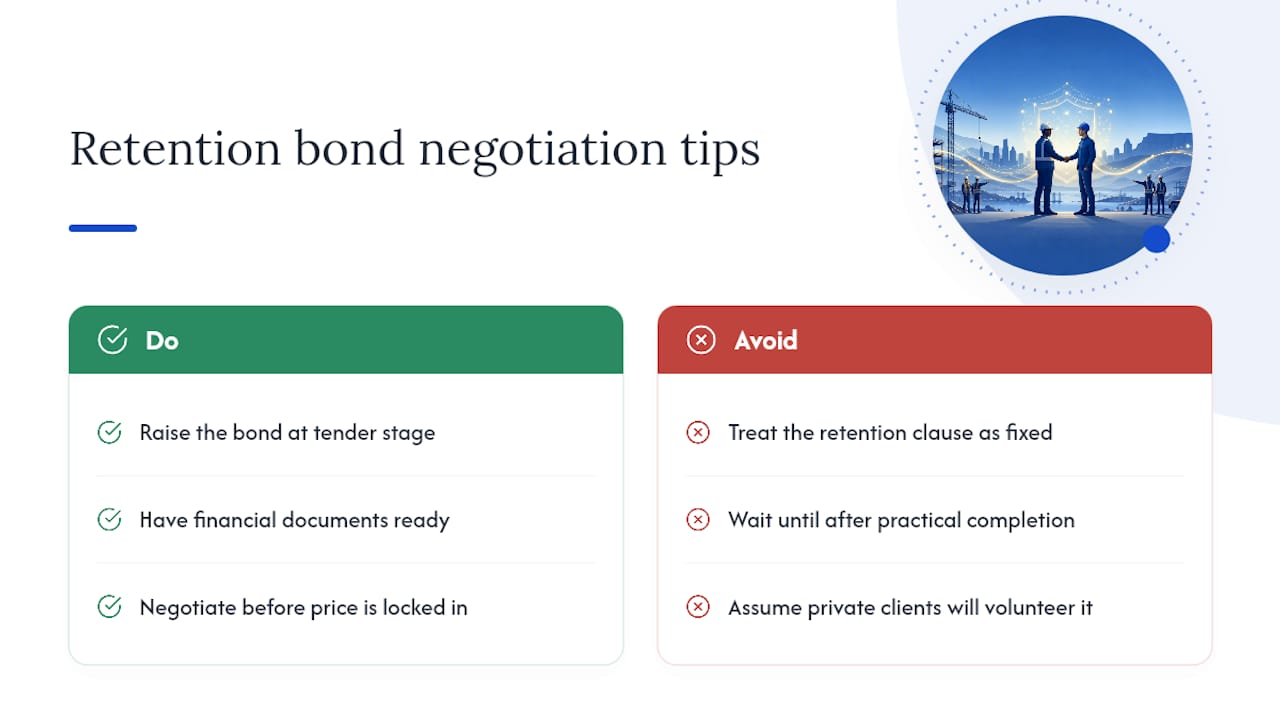
Most contractors treat the retention clause as fixed once the tender documents go out, and that's the single biggest mistake I see repeated across projects of every size. The clause is negotiable far more often than contractors assume, particularly with public-sector employers who already understand how guarantees work and have processed dozens of them before. The resistance usually comes from smaller private clients who've simply never been asked, not from any real contractual barrier.
Bring up the retention bond option at the tender stage, before price negotiations lock in, and have your financial documentation ready before you ask. Waiting until after practical completion to explore a bond defeats the entire purpose, since by then the cash flow problem it was meant to solve has already happened.
— Dolene April
Protenders helps you get bond ready before you bid
Retention bonds move faster when the underwriting pack is already sitting in a folder, not scattered across email threads the week a bank asks for it. Protenders gives South African contractors the compliance scorecards, document templates, and company profile tools to keep that pack current, so when a tender calls for a retention guarantee clause, you're not scrambling to pull financials together at the last minute.
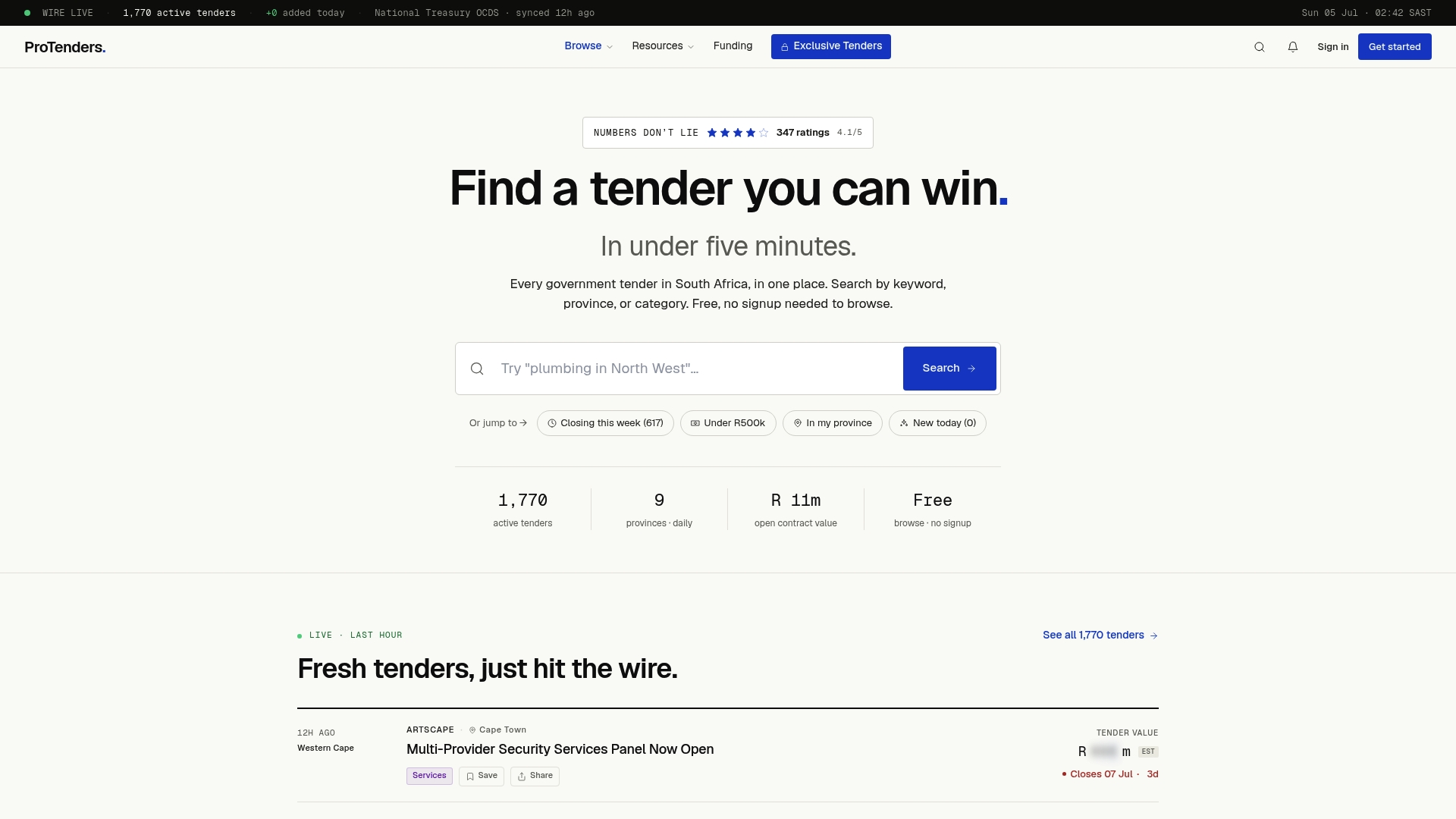
Beyond the templates, Protenders aggregates live government tenders from national, provincial, and municipal buyers in one searchable feed, filterable by keyword, region, or category, with no sign-up required just to browse. That matters because public-sector employers are typically the clients most comfortable accepting a retention guarantee in place of cash. Set up tender alerts on Protenders today to catch contracts where your bond strategy can actually pay off, and start building the documentation pack before your next bid, not after.
Sources
- Construction cash flow trap — IntoAEC
- What SA contractors get wrong — Berkley Risk
- Retention money: Does it belong to the contractor or the employer? — Arbitrators / legal commentary
- Surety, bonds and guarantees 101 — Aon South Africa
- Construction guarantees in South Africa: a complete guide — PCBS
FAQ
How do I claim retention money?
You request a completion certificate from the principal agent, engineer, or architect once the defects liability period ends with no outstanding defects. If the employer disputes release, the contract's dispute resolution clause, usually adjudication or arbitration, governs the next step.
What's the difference between a performance bond and a retention bond?
A performance bond covers the risk that a contractor fails to complete the works and is typically called early in the contract; a retention bond specifically replaces cash retention held against defects near the end of the project.
How long is retention held in construction?
Retention is usually withheld throughout the contract at 5–10% of each certified payment, with half released at practical completion and the balance released after the defects liability period, commonly 12 to 24 months later.
Can a retention bond be called if the contractor becomes insolvent?
Yes. Because the guarantee is an obligation of the bank or insurer rather than the contractor directly, it generally remains enforceable even if the contractor is placed in liquidation.
Do all South African contracts allow a retention bond substitution?
Not automatically. The right to substitute a bond for cash retention needs to be written into the contract, whether through standard JBCC, FIDIC, or NEC clauses or a specific amendment agreed before signing.