Win More Bids: 7 Part RFQ Response Format for South African Suppliers

A complete RFQ response covers seven parts: a vendor identification block, an executive summary, scope-of-work detail that mirrors the buyer's numbering, an itemised pricing table, delivery and shipping terms, a quote validity statement, and clearly labelled attachments. If the buyer supplies its own template, that layout overrides any format preference of your own. Evaluators spend most of their attention on the pricing table, so it has to be exact, itemised, and easy to compare against every other bid.
*TL;DR:>
- Pricing must be itemized, accurate, and include separate columns for taxes and shipping to enable straightforward comparison and prevent errors.*
- Always follow the buyer's exact format and numbering, and ensure all required documents are correctly named, current, and submitted via the specified channel to avoid disqualification.
- The vendor identification block should include legal details and the signatory's verification, while the executive summary should be completed last with a clear value proposition.
- Reconcile all totals meticulously using calculators or spreadsheets before submission, as pricing errors are the most common cause of rejection.
- Clarification questions should be asked all at once, referencing precise line numbers, to maintain credibility and reduce unnecessary back-and-forth.
Table of Contents
- What sections does a proper RFQ response format need?
- How do you build an RFQ response step by step?
- How should you present pricing without losing the bid?
- How do you format and submit an RFQ response correctly?
- How do you quality check an RFQ response before sending it?
- Where can you find ready RFQ templates and examples?
- What procurement practitioners wish more suppliers knew
- Sources
- FAQ
What sections does a proper RFQ response format need?
Every buyer scores submissions against a checklist, whether they say so or not. Miss a section and you're not just weaker on paper. You may get disqualified before anyone reads your price.
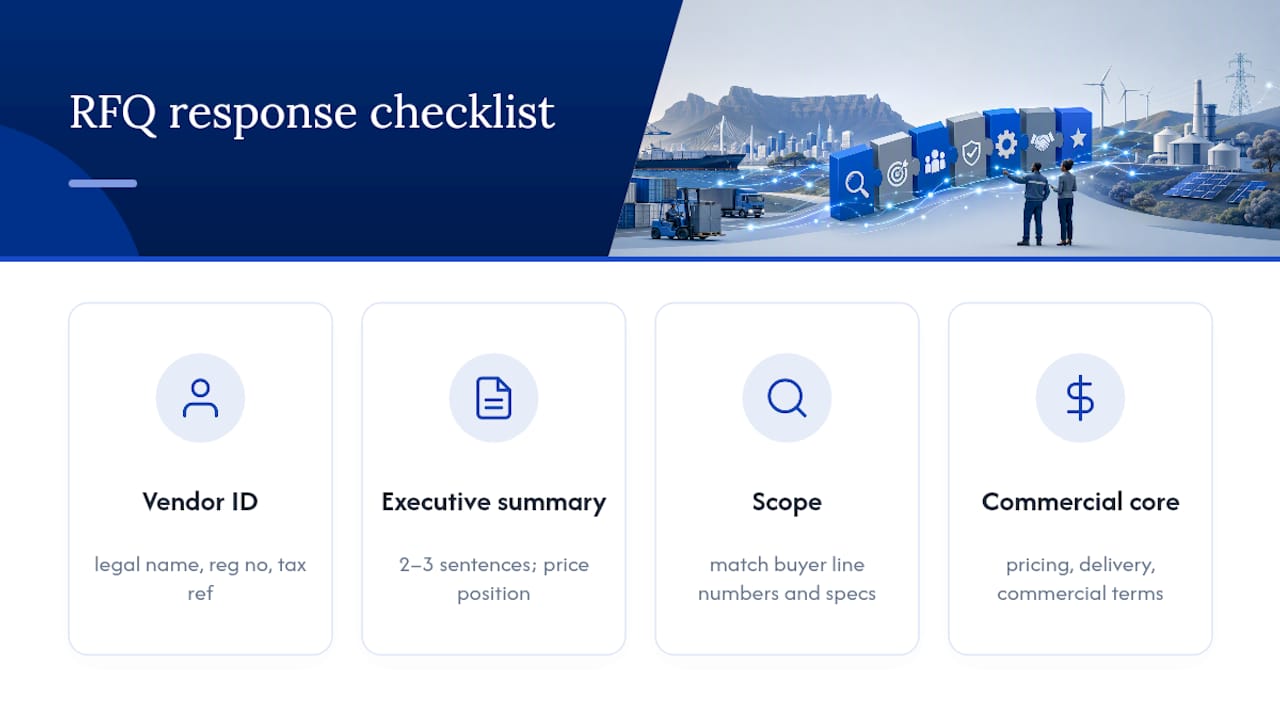 Vendor identification and cover letter. This block carries your legal trading name, registration number, tax reference, VAT status, physical address, and the name of the person authorised to sign on the company's behalf. Buyers check this first because it confirms you're a real, compliant entity before they bother reading anything else.
Executive summary. Two or three sentences stating what you're quoting, your price positioning, and one measurable point of difference, whether that's lead time, warranty length, or local stock availability. A short, quantifiable summary that highlights matching specifications tends to hold an evaluator's attention far better than a generic paragraph about company history.
Scope of work and item descriptions. Match the buyer's own line numbering, item codes, and technical specifications word for word. Renumbering or paraphrasing specs forces the evaluator to do extra reconciliation work, and tired evaluators reject ambiguous bids.
Pricing. Unit price, quantity, subtotal, tax, freight, any discount, and grand total, each on its own line.
Delivery and shipping terms. State lead time in days, the delivery point, who carries freight risk, and what happens if a delay occurs.
Terms and exclusions. Validity period, warranty terms, payment terms, and anything you are explicitly not quoting for.
Vendor identification and cover letter. This block carries your legal trading name, registration number, tax reference, VAT status, physical address, and the name of the person authorised to sign on the company's behalf. Buyers check this first because it confirms you're a real, compliant entity before they bother reading anything else.
Executive summary. Two or three sentences stating what you're quoting, your price positioning, and one measurable point of difference, whether that's lead time, warranty length, or local stock availability. A short, quantifiable summary that highlights matching specifications tends to hold an evaluator's attention far better than a generic paragraph about company history.
Scope of work and item descriptions. Match the buyer's own line numbering, item codes, and technical specifications word for word. Renumbering or paraphrasing specs forces the evaluator to do extra reconciliation work, and tired evaluators reject ambiguous bids.
Pricing. Unit price, quantity, subtotal, tax, freight, any discount, and grand total, each on its own line.
Delivery and shipping terms. State lead time in days, the delivery point, who carries freight risk, and what happens if a delay occurs.
Terms and exclusions. Validity period, warranty terms, payment terms, and anything you are explicitly not quoting for.
An RFQ is fundamentally a pricing document, and buyers expect price, delivery, and commercial terms to dominate the page, not marketing copy.
How do you build an RFQ response step by step?
Work through these steps in the order the buyer's RFQ presents them, not the order that feels natural to you.
- Read the entire RFQ once before writing anything. Note every required field, deadline, and returnable document so nothing surprises you halfway through drafting.
- Build the vendor identification block first. Capture your company registration number, VAT/tax number, primary contact name and email, physical business address, and banking details if the buyer requests them upfront.
- Draft the executive summary last, even though it appears near the top. You can only summarise value accurately once the pricing and scope sections are finished.
- Copy the buyer's line-item structure exactly into your scope and pricing sections. If the RFQ numbers items 1 through 14, your response numbers items 1 through 14 in the identical order, with no renumbering or grouping.
- Flag assumptions and exclusions immediately below the relevant line item, not buried in a final appendix. If you're quoting an equivalent brand instead of the specified one, say so directly beside that line, not three pages later.
- Ask clarification questions in a single batch, referencing exact RFQ line numbers. Bundling questions into one email cuts down the back-and-forth, and guessing at specifications instead of asking is one of the fastest ways to lose credibility with a buyer.
- Assemble attachments last, and name each file to match its reference in the body text. A file called
Tax_Clearance_Certificate.pdfreferenced as "see Attachment C" saves an evaluator from opening five documents to find the right one.
A standard BID_RFQ vendor sheet follows this same logic: structured fields, buyer-driven order, and a clear separation between instructions and the vendor's actual entries. Use that structure as your default whenever a buyer hasn't issued its own template.
How should you present pricing without losing the bid?
Pricing errors sink more RFQ responses than weak scope descriptions ever will. An evaluator comparing ten submissions will discard the ones where the numbers don't add up or where taxes are buried inside unit prices instead of broken out.
- Build one itemised table with columns for item, quantity, unit price, subtotal, tax, freight, discount, and total.
- Keep taxes, shipping, and surcharges in their own columns rather than folding them into the unit price, since separating these charges is what lets a buyer compare suppliers on equal terms.
- Recalculate every subtotal and the grand total by hand or in a spreadsheet formula before submitting, not just once at the draft stage.
- State a specific quote validity period, commonly 30 or 60 days, rather than leaving it open ended.
- Spell out payment terms (net 30, deposit required, progress billing) directly beneath the pricing table.
- If you're offering a substitute product or an alternative delivery method, put it in a clearly labelled second row or footnote, never mixed silently into the primary quote.
Pro Tip: Print your pricing table and check every row with a calculator before you submit. Spreadsheet formula errors are invisible on screen but jump out on paper, and a single misplaced decimal can make your quote look either predatory or absurd.
Reconciling taxes and totals separately from unit prices also reduces disputes after the fact, since both sides can trace exactly where a number came from.
How do you format and submit an RFQ response correctly?
Buyers reject technically strong quotes every week for arriving in the wrong file format or missing a signature page. Formatting discipline is not optional polish. It's part of the scoring.
- Use the buyer's exact template when one is provided; a deviation from that format risks rejection or extra admin work that counts against you.
- Check the required file type (PDF is standard, though some portals want editable Excel pricing sheets), the maximum file size, and any file naming convention specified in the RFQ.
- Confirm whether submission happens through a procurement portal or by email, and screenshot or save the confirmation either way as proof of timely receipt.
- Build a simple compliance matrix listing every required returnable document down one column and your matching file name down the next.
- Gather standard supporting documents early: tax clearance certificate, B-BBEE certificate, Central Supplier Database (CSD) report, and proof of insurance where applicable.
A compliance matrix mapping every returnable schedule to your evidence is the single most reliable way to avoid a disqualification on a technicality rather than on price or quality.
How do you quality check an RFQ response before sending it?
A rushed submission is where good pricing gets undone by a missing signature or a typo in the total column.
- Have a second person review the full response against your compliance matrix line by line.
- Re-add every column in the pricing table independently, without looking at your first calculation.
- Confirm the authorised signatory's name, title, and signature match your company registration documents, and attach power-of-attorney evidence if someone else is signing on the director's behalf.
- Open every attachment to confirm it's the correct, current version and matches the filename referenced in the body.
- Save the portal confirmation screen or email receipt with its timestamp, and file it somewhere retrievable if the buyer later disputes submission timing.
Where can you find ready RFQ templates and examples?
Most generic templates need three adjustments before they fit a real RFQ: local VAT treatment, the buyer's specific delivery point, and a validity period matched to that buyer's evaluation timeline. Copy a template blind and you'll likely misstate at least one of those three.
- Adjust VAT lines to match whether you're quoting inclusive or exclusive pricing, since buyers rarely specify this clearly.
- Confirm the delivery point (ex-works, delivered, or a named site) before locking in your freight line.
- Set validity to match how long the buyer's evaluation process typically runs, not a default 30 days out of habit.
A sample mapping looks like this: RFQ line item "Item 4, 50 units, office chairs, ergonomic, black" becomes a pricing row reading "Item 4, Qty 50, Unit Price $85.00, Subtotal $4,250.00, VAT $637.50, Total $4,887.50." Compliance scorecards and document templates are often built around this exact buyer-first structure, which speeds up completion when you're working against a tight RFQ deadline.
What procurement practitioners wish more suppliers knew
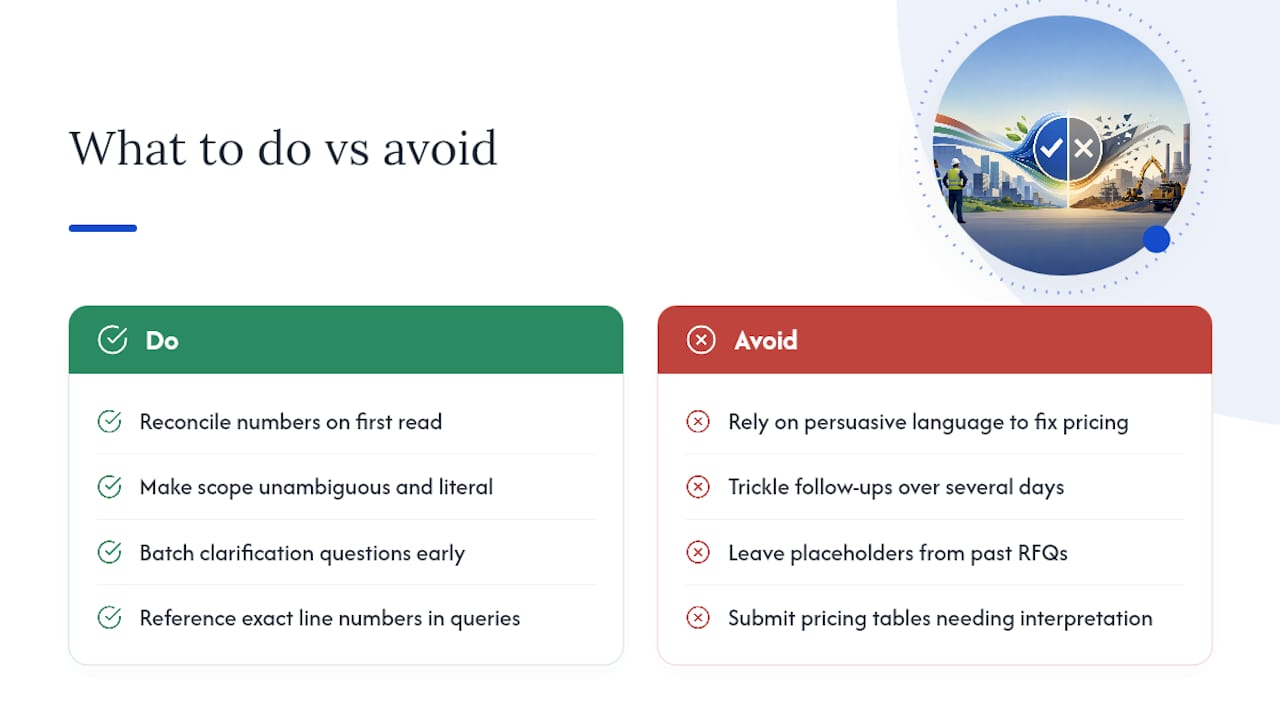
The suppliers who win consistently aren't the ones with the slickest cover letters. They're the ones whose numbers reconcile on the first read and whose scope section requires zero interpretation from the evaluator. Persuasive language rarely rescues a confusing pricing table.
Ask your clarification questions early, and batch them into one message referencing exact line numbers instead of trickling in follow ups over three days. Templates save real time, but only if you actually adapt every field to the buyer's own wording rather than leaving a placeholder from the last RFQ you answered.
— Dolene April
Sources
For deeper reference, IBM's structured RFQ template documentation shows a standard vendor-filled sheet format. Dock's RFQ response guide walks through executive summary examples. Protenders' own request for quotation guidance covers structure specific to South African procurement, and the tender cover letter template complements the vendor identification section above.
If you're actively bidding, live tender feeds aggregate current opportunities across national, provincial, and municipal buyers, alongside compliance scorecards and templates that make matching a response to a buyer's exact format faster.
- RFQ Response Template
- How to write a winning RFQ response (template + examples)
- RFQ Response Template: What to Include and Why - LegalClarity
- How to Respond to a Tender: A Guide for SA Teams
FAQ
How Do I Reply to a Request for Quotation?
Reply using the buyer's own template if one is provided, covering vendor identification, an executive summary, itemised pricing, delivery terms, and validity period, and submit through whichever channel (portal or email) the RFQ specifies.
How Do I Write a Strong Response to an RFQ?
Prioritise accuracy over persuasion: match the buyer's line-item numbering exactly, keep taxes and freight as separate pricing columns, and reconcile every total before submission.
What Does a Good RFQ Response Look Like?
A strong response mirrors the buyer's structure, states price and delivery clearly in an itemised table, includes a signed cover letter with legal identifiers, and attaches every compliance document the RFQ requests.
How Do I Write an RFQ Response Email?
Keep the email itself brief, referencing the attached formal response and confirming the vendor name, RFQ reference number, and submission deadline, then attach the full response as a labelled PDF or the buyer's required file type.