20 Point Safety File Audit Checklist for South African Contractors

A construction safety file is a legal requirement in South Africa under the Occupational Health and Safety Act 85 of 1993 and its Construction Regulations, and the principal contractor carries direct accountability for keeping one on site. At minimum it must hold a project-specific health and safety plan, risk assessments and method statements, signed legal appointments, inspection and equipment registers, and incident records. None of it can be generic. Every document must reflect the actual site, and the file has to be updated the moment personnel, equipment, or scope changes.
*TL;DR:>
- The safety file must be continuously updated for each project, reflecting site-specific risk assessments, legal appointments, and incident reports, especially after any scope or personnel changes.*
- Missing or unsigned appointment letters, expired medical and training certificates, or generic risk assessments are among the most common reasons for audit failures, and routine document control is essential.
- Auditors expect evidence of a functioning safety management system, such as documented inspections and signed roles, which can give contractors a competitive edge in tenders.
- A comprehensive safety file requires detailed indexing, regular reviews, and immediate updates following any incident, appointment change, or scope modification to stay compliant.
- Compliance success hinges on demonstrating site-specific, current documentation and maintaining a well-organized, accessible file that can withstand both regulatory and client scrutiny.
Table of Contents
- Meeting safety file requirements: the documents you must keep
- Which parts of the file need constant updates
- What the law actually requires and what happens if you ignore it
- Why safety files fail audits, and the fastest fixes
- The audit-ready checklist to run before an inspection
- What competitive tenders reveal about safety file quality
- Get compliance templates and live tender alerts in one place
- Sources
- FAQ
Meeting safety file requirements: the documents you must keep
Auditors and site inspectors work through a safety file in a fairly predictable order, and each category has to hold specific, dated, signed evidence rather than a boilerplate policy statement.
Company and legal documents come first: a valid Letter of Good Standing from the Compensation Fund, proof of COID/WCA registration, public liability insurance, and your company's written health and safety policy. The health and safety plan is the backbone document, and it has to mirror the client's Health and Safety Specification (HSS) point for point. If the client's HSS lists twelve requirements, your plan needs twelve matching sections, not a generic template with the client's name swapped in. Risk assessments and method statements follow, covering every task on site, from excavation to working at height. This includes SWMS (safe work method statements) and any DSTIs or permits to work required for higher-risk activities. Each one has to show who assessed the risk and what competence they hold to do so. Legal appointments are where most files fall apart. Every appointed role, from the construction manager and safety officer to first aiders and fire equipment inspectors, needs a signed appointment letter, an abbreviated CV, and proof of relevant competence or training on file. Registers and inspection records track the daily reality of the site: equipment inspection logs, a PPE issue register, scaffold and ladder inspection sheets, and fire equipment and first aid box checks — an approach detailed in weryfikacja wykonawcy budowlanego. Incident records close the file out: an incident register, investigation reports for anything that happened, and proof that reportable injuries were submitted to the relevant authority. According to the contractor SHE file assessment checklist used in public-sector audits, missing entries in any one of these six categories are among the most common reasons files fail review.Which parts of the file need constant updates
A safety file is not a folder you build once and forget. It is a living record, and parts of it must be rebuilt for every project rather than copied from the last one.
The health and safety plan, every risk assessment, all SWMS documents, legal appointments, and DSTIs must be site-specific. A generic risk assessment written for a different site, with the address changed, will not survive a competent audit. Industry guides on safety file requirements in South Africa make the same point: reviewers check for evidence the plan was actually written for the site it sits on, not lifted from a previous job.
Certain triggers demand an immediate update, not a scheduled one:
- A new person is appointed to a safety-critical role.
- New plant, equipment, or a subcontractor arrives on site.
- The design or scope changes.
- An incident occurs, however minor.
- A medical certificate, insurance policy, or training certificate approaches expiry.
Beyond those triggers, build in a routine review, weekly on active sites, monthly at a minimum elsewhere. Pro Tip: Keep a one-page document control register at the front of the file with a column for "last updated" and "next review due" against each major section. It takes ten minutes to set up and it is usually the first thing an auditor checks.
What the law actually requires and what happens if you ignore it
The Construction Regulations, 2014 define a "health and safety file" directly and place the duty to open and maintain one squarely on the principal contractor's shoulders. Regulation 7 and its related clauses require that the file stay on site, available for inspection at any time, and that a consolidated version, including drawings, designs, and materials used, be handed to the client on completion.
The obligations do not stop at the principal contractor. Where subcontractors are appointed, several duties flow down the chain, and mandatory agreements such as section 37(2) arrangements between client and principal contractor need to sit in the file too.
Non-compliance carries real consequences:
- An inspector can issue a compliance notice or a prohibition order that stops work on site immediately.
- Missing appointments or unsafe practices found during a fatality or injury investigation can expose directors and managers to criminal liability under the Act.
- Clients increasingly reject non-compliant contractors at the prequalification stage before work even starts.
Why safety files fail audits, and the fastest fixes
Most non-conformances are not exotic. They repeat across sites, and they are cheap to fix once you know where to look.
- Missing or unsigned appointment letters. Build a sign-off workflow the day someone takes on a role, and file their CV directly behind the letter.
- Expired medicals or training certificates. An expiry register, checked weekly, catches this before an inspector does.
- Generic templates that don't map to the client's HSS. A single-page mapping table showing which section of your plan answers which HSS clause closes this gap fast.
- Incomplete registers. Assign one person per site to complete daily and weekly registers rather than leaving it to whoever remembers.
- Poor document control. An index page and a document control sheet at the front of the file turn a chaotic folder into something a reviewer can navigate in minutes.
Pro Tip: Print the index page and stick it inside the front cover of the physical file. Auditors form their first impression before they read a single risk assessment.
The audit-ready checklist to run before an inspection
Public-sector audit checklists tend to ask for roughly the same core items, whether the project is a municipal water plant or a private commercial build. Here is what shows up most often:
- Company organogram and project organogram
- Health and safety plan mapped to the client's HSS
- Signed legal appointment letters with abbreviated CVs
- SWMS and task-specific risk assessments
- Equipment inspection registers
- PPE issue log
- Medical certificates of fitness for all workers
- Training matrix and certificates
- Incident and investigation register
- Public liability and COID insurance proof
- Letter of Good Standing
- Toolbox talk attendance records
- Scaffold, ladder, and excavation inspection logs
- Fire equipment and first-aid inspection records
- Construction work permit or notification (where applicable)
- Emergency procedures and evacuation plan
- Subcontractor compliance documents
- Legal register (relevant acts and regulations)
- Method statements for high-risk activities
- Document control sheet and index
Present the file as an indexed binder on site, or an indexed electronic folder with hyperlinks if you're running digital, and put a document control table on the very first page. The WBHO subcontractor safety file requirements document is a useful benchmark for what a large contractor expects before letting a subcontractor's people on site.
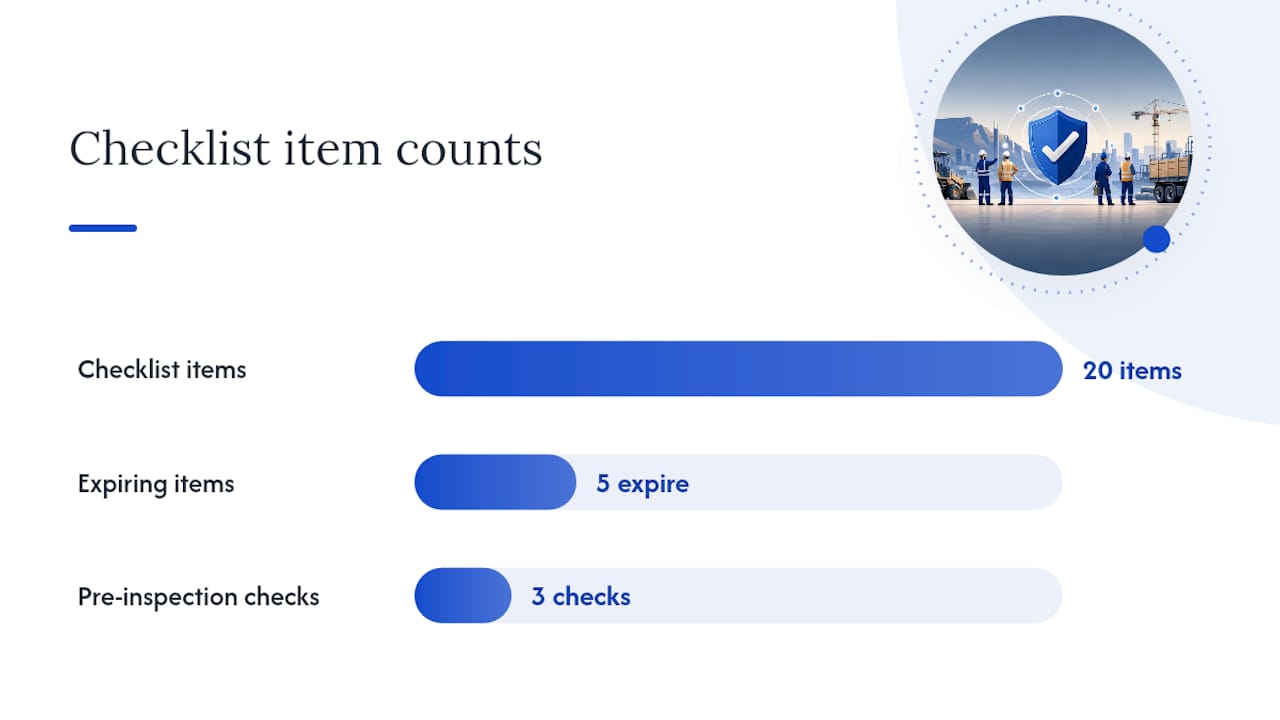
Before any inspection, run three checks: confirm every appointment letter has a matching CV, verify the five items that expire (medicals, insurance, training certificates, permits, and equipment certification), and spot-check one inspection register to confirm it's actually being filled in, not just filed.
What competitive tenders reveal about safety file quality
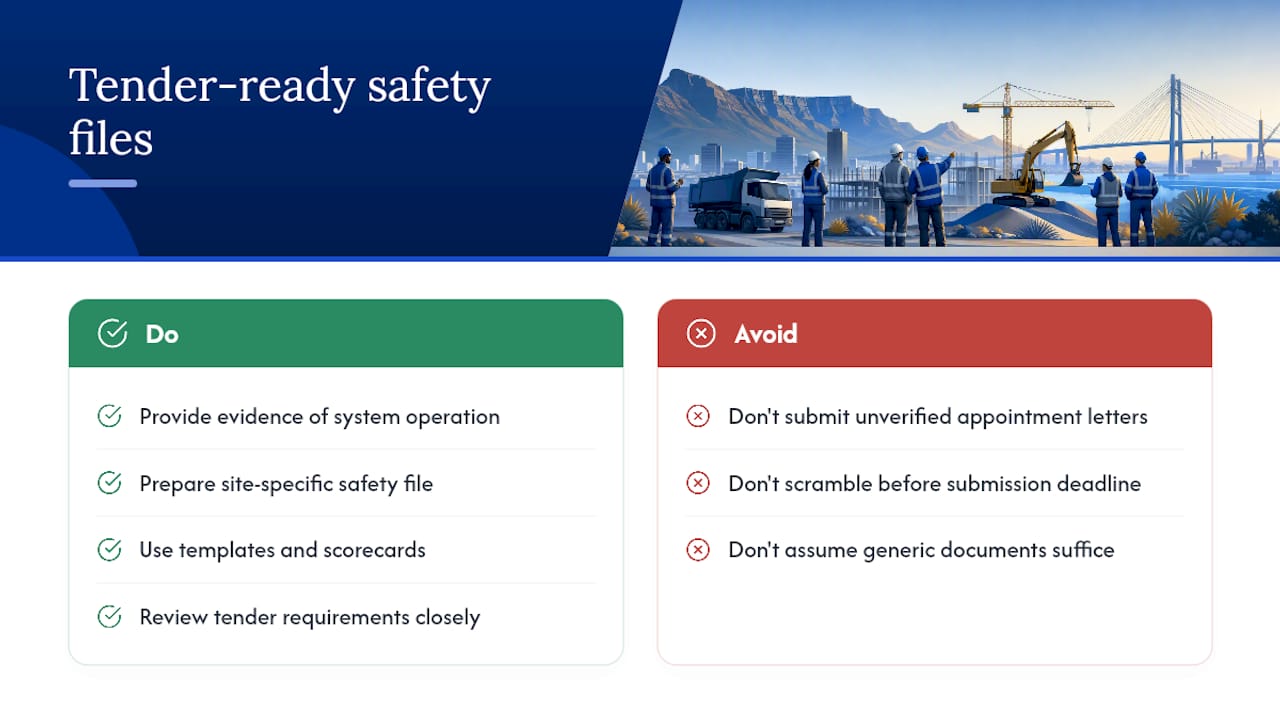
Clients and auditors look for one thing above all else in a safety file: evidence that a safety management system is actually running, not just documented. A signed appointment letter with no record of that person ever conducting an inspection tells a reviewer the appointment exists on paper only.
This matters well beyond the audit itself. Procurement teams score compliance documentation heavily in tender evaluations, and a contractor who can produce a clean, site-specific file faster than competitors has a real edge in the bidding process. That's where preparation tools, compliance scorecards and ready-made templates among them, save contractors from scrambling the week before a submission deadline. Reviewing a completed tender's requirements, such as a health and safety consultancy appointment on a public works project, shows how specific and non-negotiable these expectations get at the client level.
— Dolene April
Get compliance templates and live tender alerts in one place
A dedicated platform offers tender opportunities and safety compliance help together, providing access without a subscription lock-in for basic search. Building a fully compliant safety file from scratch takes real time, and finding the right tender to bid on takes just as much digging through scattered government portals.
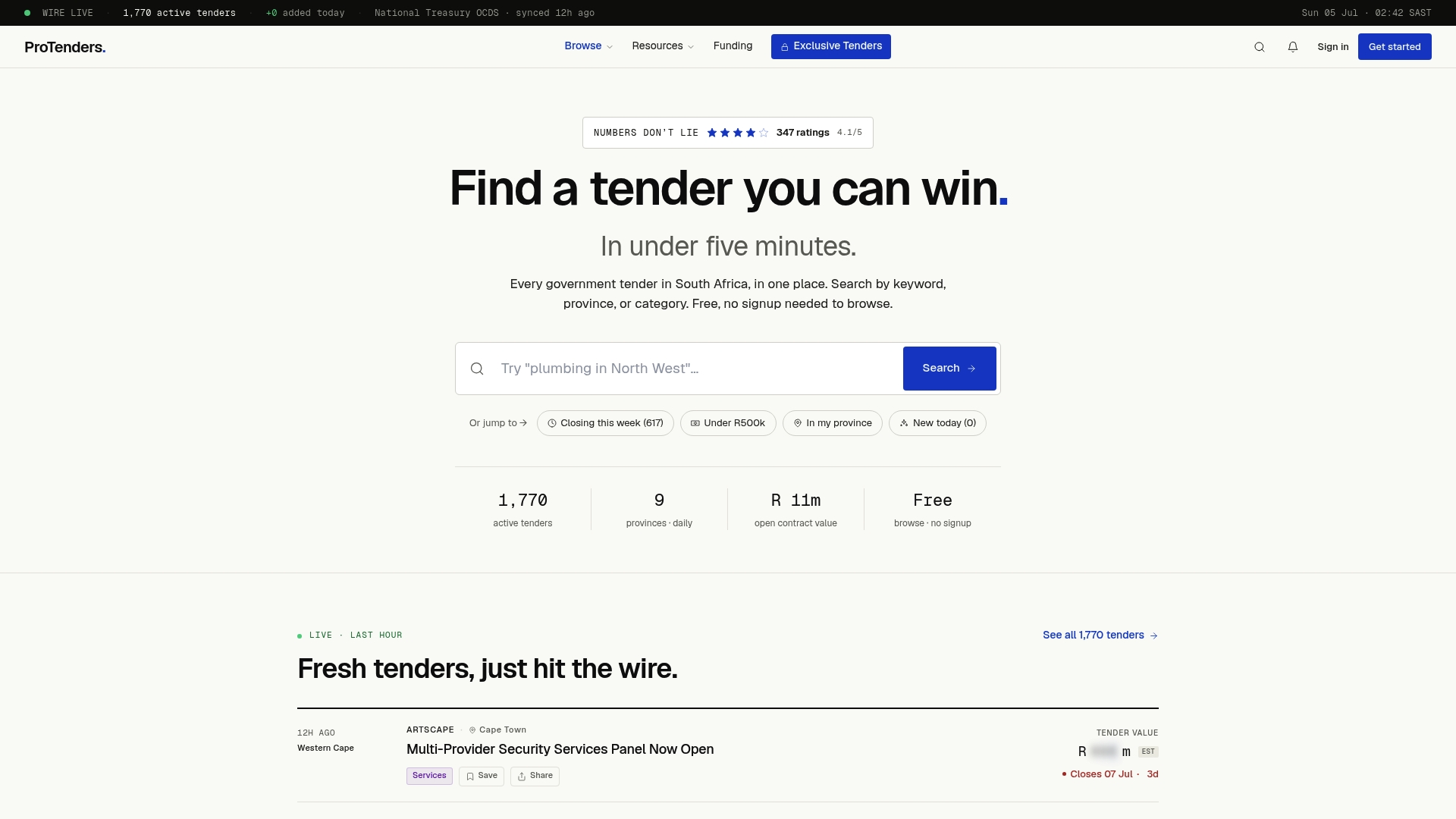
The platform aggregates live national, provincial, and municipal tenders in a searchable feed, and pairs that with compliance scorecards and document templates to assist users in assembling appointment letters, risk assessment structures, and registers for audit expectations. If you're preparing a bid that requires proof of an active safety management system, start by checking live government tenders in your category to see what clients are actually asking for right now, then work backward from their HSS requirements. You can also browse newly published tenders daily, or compare how Protenders stacks up against the official eTenders portal if you're deciding where to search first. Nothing stops you from compiling your file independently. The templates just remove the guesswork on structure.
This article is general information, not a substitute for advice from a qualified lawyer. Consult a qualified legal professional about your own circumstances before acting on anything here.
Sources
FAQ
How much does it cost to compile a safety file in South Africa?
Costs vary widely depending on project size and whether you use a consultant or compile it in-house, ranging from a few thousand rand for a small site to substantially more for complex projects with a dedicated safety officer; no fixed national rate exists because scope drives the price.
What are the 7 basic safety rules on a construction site?
Definitions vary across training providers, but common versions cover wearing correct PPE at all times, reporting hazards immediately, never bypassing machine guards, following lockout procedures, using fall protection at height, keeping walkways and exits clear, and never working under the influence of alcohol or drugs.
Can you give an example of what belongs in a safety file?
Yes. A typical file includes a project-specific health and safety plan, signed legal appointment letters with CVs, task risk assessments and SWMS, equipment inspection registers, a PPE issue log, and an incident register, all mapped to the client's Health and Safety Specification.
Can I work as a safety officer without SAMTRAC?
SAMTRAC is a widely recognized qualification but not the only route; competence can be demonstrated through other accredited safety management training and relevant experience, provided the appointment letter and supporting CV show genuine, verifiable competence for the role.
Who is responsible for keeping the safety file on site?
The principal contractor holds the primary duty to open, maintain, and keep the health and safety file on site under Construction Regulation 7, though individual contractors and subcontractors must supply their own compliant documentation into that file.