A tender capability statement is your one-page proof of delivery

A tender capability statement is a one-page document that proves your business can deliver a specific contract, using evidence instead of company history. It answers one question fast: can you do this job safely and well? Include:
- Company overview and core capabilities
- Proof of delivery (STAR-format project examples)
- Capacity and resources
- Compliance and accreditations
- Direct contact details
Key Takeaways
A tender capability statement wins bids when it proves delivery capacity with quantified evidence, not when it tells your company's history.
| Point | Details |
|---|---|
| Definition first | A capability statement is a one-page proof-of-delivery document, not a company profile. |
| Evidence over history | Use STAR-format project summaries with measurable outcomes for every case study. |
| Match evaluator priorities | Structure content around relevance, capacity, compliance, track record, and stability. |
| Build a reusable library | Keep CVs, certifications, and STAR summaries centralized for fast, consistent tailoring. |
| Find opportunities to apply it | Protenders aggregates live South African government tenders and offers compliance scorecards and templates to speed up submission. |
Table of Contents
- What is a tender capability statement, exactly?
- Why do buyers request a capability statement?
- What should a capability statement include?
- How do you lay out a one-page capability statement?
- What common mistakes hurt a capability statement?
- How do you build a reusable capability library?
- Copyable examples: project summary and contact block
- What procurement rewards, and what it doesn't
- Find and prepare for the right tenders faster
- Sources
- FAQ
What is a tender capability statement, exactly?
A capability statement isn't your company profile with the fluff trimmed. It's a procurement evaluation tool, built to answer one question: does this business reduce our risk of a failed delivery? Think of a normal company profile as your business's story. A capability statement is your business's resume, aimed at one job posting.
Every line has to answer a procurement question fast: What do you do? Have you done it before, at this scale? Can you prove it? Are you legally allowed to bid? Who do we call? A tender-ready company profile covers company overview, services, relevant experience, key projects, capacity, team, compliance, and contact information, structured for evaluation rather than marketing.
Why do buyers request a capability statement?
Evaluators are scoring risk, not reading a brochure. They run through a mental checklist for every submission: is this relevant to the scope, does this business have the capacity to deliver, is it compliant, does it have a track record, and is it commercially stable enough to finish the job?
Your document should answer each point directly and in order:
- Relevance: does your work match the tender's scope and industry?
- Capacity: do you have the staff, equipment, and bandwidth right now?
- Compliance: are your registrations, accreditations, and certifications current?
- Track record: can you show, not tell, past delivery?
- Stability: does anything suggest financial or operational risk?
Every sentence should reduce a buyer's doubt about future reliability, not recount your business's origin story.
What should a capability statement include?
Authoritative guidance from HHS lists the fields procurement expects to see: business name and branding, a company summary, core capabilities, certifications, major clients, industry codes, staff clearances, registration numbers, and contact information. Build your document around these sections:
- Company overview: two or three sentences, no history lesson.
- Core competencies/services: bulleted, not paragraphed.
- Key projects: two to three, in STAR format (see below).
- Operational capacity: equipment, staff numbers, current bandwidth.
- Team highlights: names, roles, relevant certifications.
- Compliance and accreditations: registration numbers, industry codes, safety certifications.
- Contact block: direct names, not a generic info@ address.
Keep each section to a few lines. Anything requiring more space, full CVs, safety files, financial statements, belongs as an attachment, not inline text. Pro Tip: Use the STAR method (Situation, Task, Action, Result) for every project example. State the client's problem, what you were asked to do, how you did it, and the measurable result, for example, "completed 15% under budget." STAR example: Situation: municipal client needed emergency water infrastructure repair within 10 days. Task: replace 200 meters of aging pipe. Action: deployed a four-person crew and existing equipment stock. Result: completed in 8 days, zero safety incidents, under the original quote.
How do you lay out a one-page capability statement?
Keep the layout tight and predictable, so an evaluator scanning dozens of these can find what they need in seconds.
- Top left: your logo and a one-line value proposition ("Structural steel fabrication for municipal infrastructure since [year]").
- Top right: contact name, phone, email, registration numbers.
- Body, left column: core capabilities as a bulleted list.
- Body, right column: two to three STAR project summaries, three lines each.
- Bottom strip: capacity indicators (staff count, equipment, current availability) and compliance badges or codes.
Sample wording you can adapt directly:
- Overview line: "[Business name] delivers [service] to [sector] clients across [region]."
- Capability bullet: "Design, fabrication, and installation of steel structures up to [capacity]."
- STAR summary: "Delivered [project type] for [client type], completed [X]% under budget, zero safety incidents."
Aim for 15 to 25 words per micro-section. Use bold labels, bullets over paragraphs, and export as a PDF so formatting survives every email client.
What common mistakes hurt a capability statement?
Do: quantify every outcome ("reduced turnaround by three days," not "fast turnaround"), use active delivery language, mirror the tender's own wording, and include relevant industry or registration codes. Don't: open with company history, use generic marketing lines like "committed to excellence," or write dense paragraphs an evaluator has to hunt through.Before you submit, run this quick tailoring check:
- Does the language mirror the tender's scope of work, word for word where possible?
- Are your two or three project examples relevant to this specific buyer or sector?
- Have you updated capacity numbers to reflect current, not historical, availability?
- Are compliance details current and matched to this tender's requirements?
- Have you dropped anything that doesn't answer a procurement question?
Pro Tip: Never reuse a STAR project example without checking it still matches the scope. A perfect case study for a construction tender reads as irrelevant padding on an IT services bid.
How do you build a reusable capability library?
Rewriting a capability statement from scratch for every tender wastes time and invites errors. Build a master library instead: a central folder of CVs, certifications, equipment lists, and STAR-format project summaries you can pull from on demand. Preparing this before you need it speeds up your response time and improves consistency across bids.
- Store every completed project as a STAR summary the moment it wraps up, while details are fresh.
- Keep certifications, registration numbers, and staff CVs in one shared folder, always current.
- Select the two to three most relevant items for each new tender.
- Tailor language to match the specific scope and evaluation criteria.
- Run a final quality check against the tender's own wording.
Timeline: roughly one hour to select relevant material, thirty minutes to tailor it, and fifteen minutes for a final quality check, a workflow that turns a same-day scramble into a repeatable process.
Copyable examples: project summary and contact block
STAR project summary: Situation: regional client needed HVAC retrofit across six buildings within a fixed budget. Task: project lead responsible for scoping and delivery. Action: phased installation minimizing downtime. Contact block: Business name, registration number, primary contact name and title, direct phone, direct email, relevant industry codes.- Attach full CVs, safety files, and financials as separate documents.
- Keep only summary lines and key figures inline on the one-pager.
What procurement rewards, and what it doesn't
Working through bid after bid, the pattern is consistent: evaluators reward clarity and evidence, not enthusiasm. A capability statement that lists three specific, quantified projects beats one that claims broad expertise across ten industries. The businesses that win aren't always the most experienced. They're the ones whose documents make it easiest for a tired evaluator to say yes.
One lesson worth repeating: an overstated capacity claim causes more damage than a modest, honest one. Test your statement after the first submission, then revise it.
Find and prepare for the right tenders faster
Writing a sharp capability statement only pays off if it reaches the right opportunities. Protenders aggregates every live South African government tender, national, provincial, and municipal, into one searchable feed, so you spend your time tailoring documents instead of hunting for where to submit them.
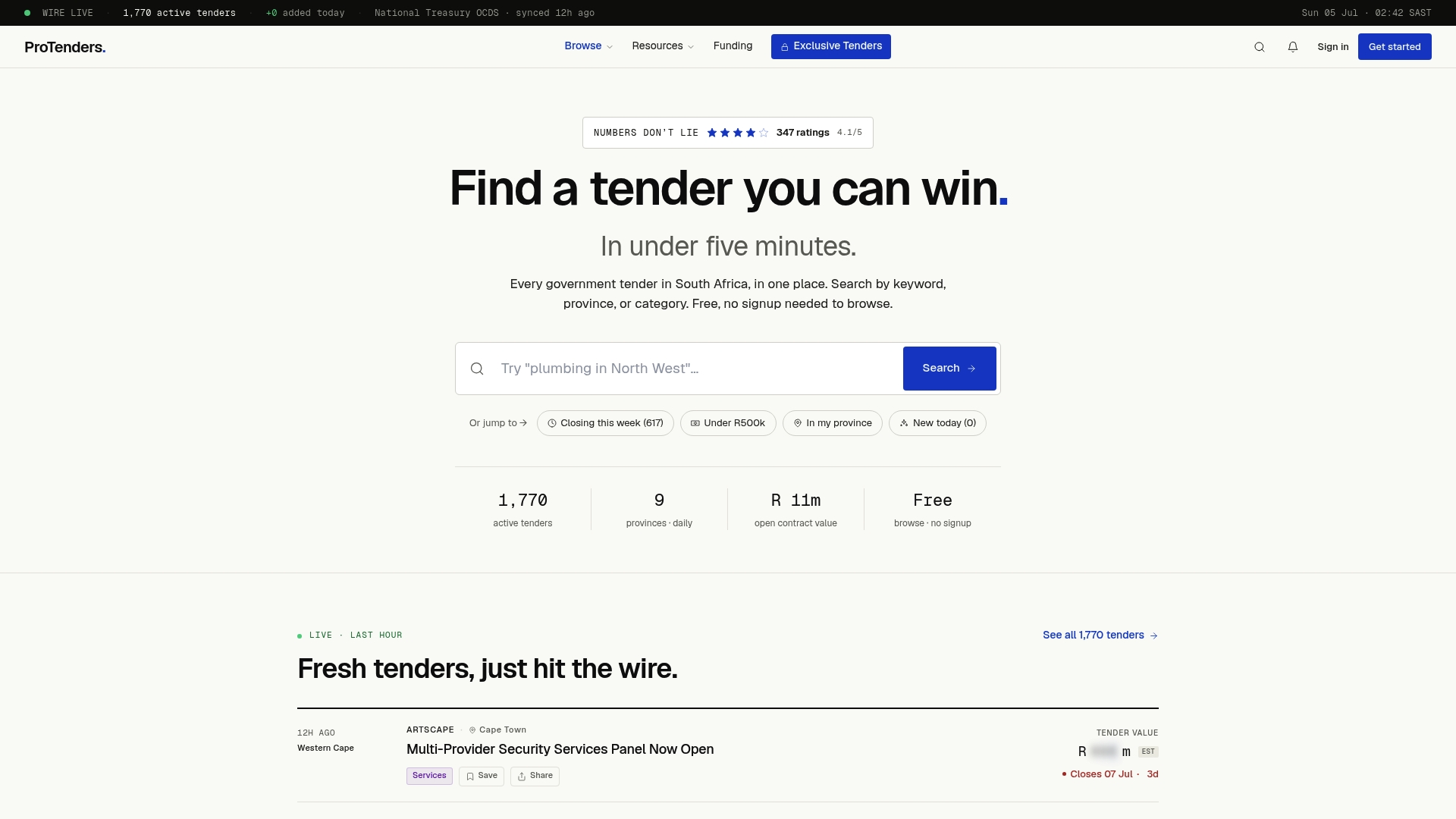
Beyond search, Protenders gives you compliance scorecards to check your readiness against a tender's actual requirements, a document template library to speed up your master capability file, and a bid workspace to keep everything organized under deadline. Browse the live tender feed today, match your new capability statement to a real opportunity, and see exactly what buyers in your sector are asking for right now.
Sources
- Tender-ready company profile: How to structure your business for procurement and new business - Circle Media
- Finding government tenders South Africa: Complete guide - Sourcefin
- How to write a good capability statement | HHS
FAQ
How do I make a capability statement?
Start with a one-page layout covering company overview, core capabilities, two to three STAR-format project examples, capacity indicators, compliance details, and contact information. Tailor the language and examples to match each specific tender's scope.
What is a capability statement?
It's a concise document, usually one page, that proves what your business can deliver for a specific opportunity, evaluated on evidence and capacity rather than company history.
What are some examples of tender documents?
Common tender documents include the capability statement, compliance certificates, reference lists, pricing schedules, and company registration proof. Building these into a master library ahead of time speeds up every submission.
Is there a free template for a capability statement?
Yes. Government sources like HHS publish free sample templates, and the one-page layout structure covered above (branding, contact block, capabilities, STAR projects, capacity) can be copied directly into any document editor.
Recommended
- How to Write a Winning Tender Proposal: Complete Guide 2026 | ProTenders
- Tender Documents South Africa: Checklist & Guide (2026) | ProTenders
- Tender Limits Explained: A Practical Guide for Small Businesses | ProTenders
- Tender Glossary South Africa | Procurement Terms, Acronyms & Definitions | ProTenders