Tender Document Preparation in South Africa: A Practical Guide

To prepare tender documents in South Africa, build a master file of your company records, read the bid invitation for what is mandatory, complete every SBD form in full, attach proof of tax compliance and your CSD report, and finish your submission at least a day before closing. Most disqualifications come from a missing or inconsistent document, not from a weak price. This guide gives you the checklist, the form-by-form detail, a working timeline and a final check.
TL;DR
- Keep a ready "master file" of registration, tax, B-BBEE, banking and ID documents, so each new bid only needs the bid-specific items.
- Every bid invitation has its own list of returnables. Treat any generic checklist as a starting point and the bid document as the final word.
- SBD forms must be completed in full, signed and consistent with your CSD report.
- Start days before closing and finish at least 24 hours early, then check the submission summary or bid box receipt.
- Sector rules (local content, CIDB for construction) apply only to some tenders, so check which ones apply to yours.
Table of Contents
- What tender document preparation actually involves
- Build your master file first
- The SBD forms, one by one
- Read the bid document for what is specific to this tender
- The proposal and cover letter
- A tender preparation timeline you can follow
- Final check before you submit
- Perspective: why preparation beats chasing more tenders
- Plan for the money after the award
- Get ready for the next tender with ProTenders
- FAQ
- Sources
What tender document preparation actually involves
A South African tender response has two layers. The first is your standing compliance: the documents that prove your business exists, pays its taxes, is registered as a supplier and can be paid. The second is the bid-specific layer: completed forms, a pricing schedule, a proposal that answers the specification, and any technical evidence the buyer asks for.

The government communications office describes the basic rule plainly: a submitted bid must come with a comprehensive proposal that addresses the bid document requirements, all the associated SBD forms and a valid SARS tax clearance certificate. The details differ by buyer, but that structure holds across national departments, provinces and municipalities.
If you are new to the whole process, our guide to applying for government tenders covers the steps before document preparation. This article picks up once you have found a tender worth bidding on.
Build your master file first
The fastest way to prepare any tender is to not start from zero. Collect the standing documents once, store them in one folder, and refresh them on a schedule. A typical master file holds:
- Company registration documents (CIPC registration, and your registration number)
- Your Central Supplier Database (CSD) report
- Proof of tax compliance from SARS, with the compliance PIN
- A valid B-BBEE certificate or sworn affidavit
- Proof of banking details (a bank-stamped letter or confirmation)
- Certified copies of the IDs of directors or owners
- Proof of business address
- A company profile and capability statement, with references
That list mirrors what ranking guides for South African bidders commonly set out, and it matches the examples of returnables in National Treasury bid documents, which list the CSD report, CIPC registration documents and copies of ID documents among the items bidders hand in. The same treasury document says its list is guidance and not exhaustive, so bidders must provide everything required by each clause.
The CSD report
The Central Supplier Database is the single source of supplier information for organs of state. The CSD registration process page explains that supplier details are verified with bodies such as SARS, CIPC and Home Affairs, and that you must keep your information complete and accurate. It also warns that the commodities and delivery locations you capture are used by buyers to find suppliers for quotations, so capture them carefully.
Why this matters for tender documents: buyers cross-check your forms against your CSD report. The Department of Water and Sanitation's directive to bidders says the interests you disclose on SBD 4 must line up with what is captured in the CSD report, and that SBD 6.1 must be aligned to it as well. Before any bid, download a fresh CSD report and read it against your forms.
Tax compliance proof
A valid SARS tax clearance certificate is listed by the GCIS as a required attachment to a bid, and the City of Cape Town says successful submission needs proof of SARS tax compliance. Many buyers ask for the compliance status PIN so they can verify you online. Check the invitation to see which one the buyer wants, and check the validity date before you print or upload.
B-BBEE certificate or affidavit
The DWS directive asks for a valid B-BBEE certificate or a sworn affidavit. If you are a small business using an affidavit, make sure it is current, signed and commissioned, and that the turnover and ownership details match the rest of your paperwork.
The SBD forms, one by one
Government bids come with standard bidding documents. The GCIS lists them: SBD 1 (invitation to bid), SBD 3.1 to 3.3 (pricing schedules), SBD 4 (declaration of interest), SBD 5 (national industrial participation, not always applicable), SBD 6.1 (preference points claim), SBD 6.2 (local production and content), SBD 7 (contract forms), SBD 8 (past supply chain practices) and SBD 9 (certificate of independent bid determination), plus the general conditions of contract.
| Form | What it does | Common mistake |
|---|---|---|
| SBD 1 | Invitation to bid and bidder particulars | Not completed in full, or dated outside the advert period |
| SBD 3.1 / 3.2 / 3.3 | Pricing schedule | Arithmetic errors, or VAT charged by a non-VAT vendor |
| SBD 4 | Declaration of interest | Interests in other companies not disclosed, or different from the CSD report |
| SBD 6.1 | Preference points claim | Claiming points your certificate does not support |
| SBD 6.2 | Local content declaration | Skipped when the tender is a designated sector |
| SBD 8 | Past supply chain practices | Left unsigned |
| SBD 9 | Independent bid determination | Left unsigned |
For a practical routine on forms, see our walkthrough on a master file and 24 to 48 hour recheck for SBD forms.
Read the bid document for what is specific to this tender
A generic checklist cannot tell you everything. The bid invitation decides what you must return, and a National Treasury example shows the range: a pricing schedule, SBD 1, proof of authority, SBD 4, SBD 6.1, authorisation declarations, the CSD report, CIPC documents, ID copies and, depending on the category, technical items such as ISO 9001 certificates, indemnity insurance, warranties and a CIDB certificate for construction-related work (see the treasury special conditions document).
When the document arrives, go through it in this order:
- Find the returnables table or checklist. Many bid documents include one. Copy every item into your own tracking sheet.
- Mark mandatory versus optional items. Failure to supply a mandatory item can make a bid non-responsive.
- Check the evaluation criteria. Note how price, preference points and functionality are weighted, and what minimum score the functionality stage requires.
- Note the validity period. Bid documents state how long your offer must stay open, for example 180 days in one 2026 treasury document.
- Read the submission method. Electronic upload, bid box or courier each have different risks.
- List the questions. Raise them with the named contact before the deadline, in writing.
Sector and buyer differences
Some requirements apply only to certain tenders. In designated sectors, SBD 6.2 and Annex C on local content become mandatory returnables where applicable. Skills-development requirements tied to compulsory training can also be mandatory in some construction-related documents, and the same source says failing them can make a tender non-responsive.
Construction bidders should also read the technical specification closely. One DBSA bid document, for instance, sets out local labour targets of 60% women, 55% youth and 2% persons with disabilities for temporary jobs, which is the sort of requirement that must be reflected in your method statement and costing. Treat it as an example of the detail you will find, not a rule for every tender.
The proposal and cover letter
Forms prove you are compliant. The proposal wins you the points for functionality. A good proposal answers the specification in the order the buyer set it, uses the buyer's headings, and attaches evidence for every claim: reference letters, certificates, CVs of key staff, equipment lists and a programme or work plan where relevant.
Two of our guides help here: the tender proposal format for South African contractors and the tender cover letter template and checklist. Keep the cover letter short, name the bid number and title exactly as in the invitation, and list the attachments.
If your team handles many supplier documents, tools for automating supplier document processing can help with sorting and extracting data from large piles of files, though the final review of a bid should always be done by a person who has read the invitation.
A tender preparation timeline you can follow
The eTenders guide for bidders is blunt: do not leave registration or bidding to the last minute, and complete your process at least one day (24 hours) before the closing date. A realistic plan works backwards from closing. Adjust the days to the size of the bid, since a quotation needs far less than a large construction tender.
| When | What to do |
|---|---|
| As soon as you see the tender | Download the full bid document, decide bid or no bid, and diarise the closing date and any briefing session |
| Within 2 days | Build your returnables tracker and identify missing or expiring documents |
| Days 3 to 5 | Update CSD, SARS proof, B-BBEE affidavit and certified copies if anything is out of date |
| Mid-period | Attend the compulsory briefing if there is one, and send written queries |
| Second half | Draft the proposal, price the bid, complete the SBD forms |
| 3 to 2 days before closing | Have a second person review forms, signatures, totals and attachments |
| 24 hours before closing | Submit, then confirm the submission is complete |
Final check before you submit
The City of Cape Town states that you cannot change your bid after the closing date, so the check must happen beforehand. Its guide also lists what the bid documents must show: the full name of the person submitting, the ID or company registration number, the bidder's tax reference and VAT numbers, and proof of tax compliance. The person named on the bid is the one the city will communicate with, so use an address and phone number you monitor.
Work through these questions:
- Is every mandatory item in the returnables list included?
- Is every form completed in full, with no blank fields, and signed and dated where required?
- Does the signatory have proof of authority (a resolution or authority letter)?
- Do the names, registration numbers and ownership details match across forms, affidavit and CSD report?
- Is the pricing arithmetic correct, and is VAT treated correctly for your registration status?
- Are tax compliance and B-BBEE documents valid on the closing date?
- Is the file the right version and legible?
Electronic submissions
For eTenders, the portal guide tells bidders to follow the on-screen Submission Checklist: every item must be fully uploaded and marked before submission, and only one file per item is allowed because a second upload replaces the first. In practice, combine multiple documents for one item into a single PDF and name it clearly. The eTenders how-to guide also says to review your bid document submission afterwards to confirm everything has gone through correctly.
Our electronic submission checklist and the step-by-step eTenders submission walkthrough go through the portal screens.
Hand-delivered submissions
For paper bids, the GCIS instructs bidders to deliver the completed forms, the original tax clearance certificate and the signed and dated proposal before the closing date and time, placing them in the bid box in an envelope that clearly states the bid name or number. Other buyers have their own addresses and rules, so confirm the delivery point and allow for traffic and security queues.
Perspective: why preparation beats chasing more tenders
We see the same pattern across SMMEs: businesses spend their energy hunting for more tenders and too little on being ready for the ones they find. A bid that is incomplete is rejected before anyone reads your price, and that is the most avoidable loss in public procurement.>
Our approach at ProTenders is to treat the tender as a lifecycle: discover, prepare, then deliver. That is why we pair a live feed of national, provincial and municipal tenders with compliance scorecards, document templates and a bid workspace. The goal is that your master file is already in good shape when the right tender appears, so you spend your time on the proposal and pricing.>
Preparation also shapes what happens after the award. Delivering a contract takes cash flow, invoicing discipline and sometimes funding, so we connect bidders to funding partners and give them RFQ and invoice tools. Get the documents right, and the rest of the lifecycle becomes much easier to manage.>
Dolene April
Plan for the money after the award
Preparation does not stop at submission. A municipal contract management policy describes the payment side of a civil contract: invoices and engineers' reports are matched to the bill of quantities, certificates and payment vouchers are completed, and payments must align with the adjudication minutes and supplier-status checks such as CSD. That means your CSD record has to stay current for the life of the contract, and your invoices have to be clean.
Costing a bid with delivery cash flow in mind also matters, because buyers pay after work or supply is certified. If you need working capital for an awarded tender, look at our business funding programs, such as the FNB Vumela Fund accelerate loan for early-stage businesses or the Astron Energy development fund for growing emerging businesses. Each programme has its own criteria, so read its page before applying.
Get ready for the next tender with ProTenders
Browsing every live national, provincial and municipal tender on ProTenders is free, and you do not need to sign up to search by keyword, region or category. Start at our government tenders page or the tender feed, then use the guides above to prepare.
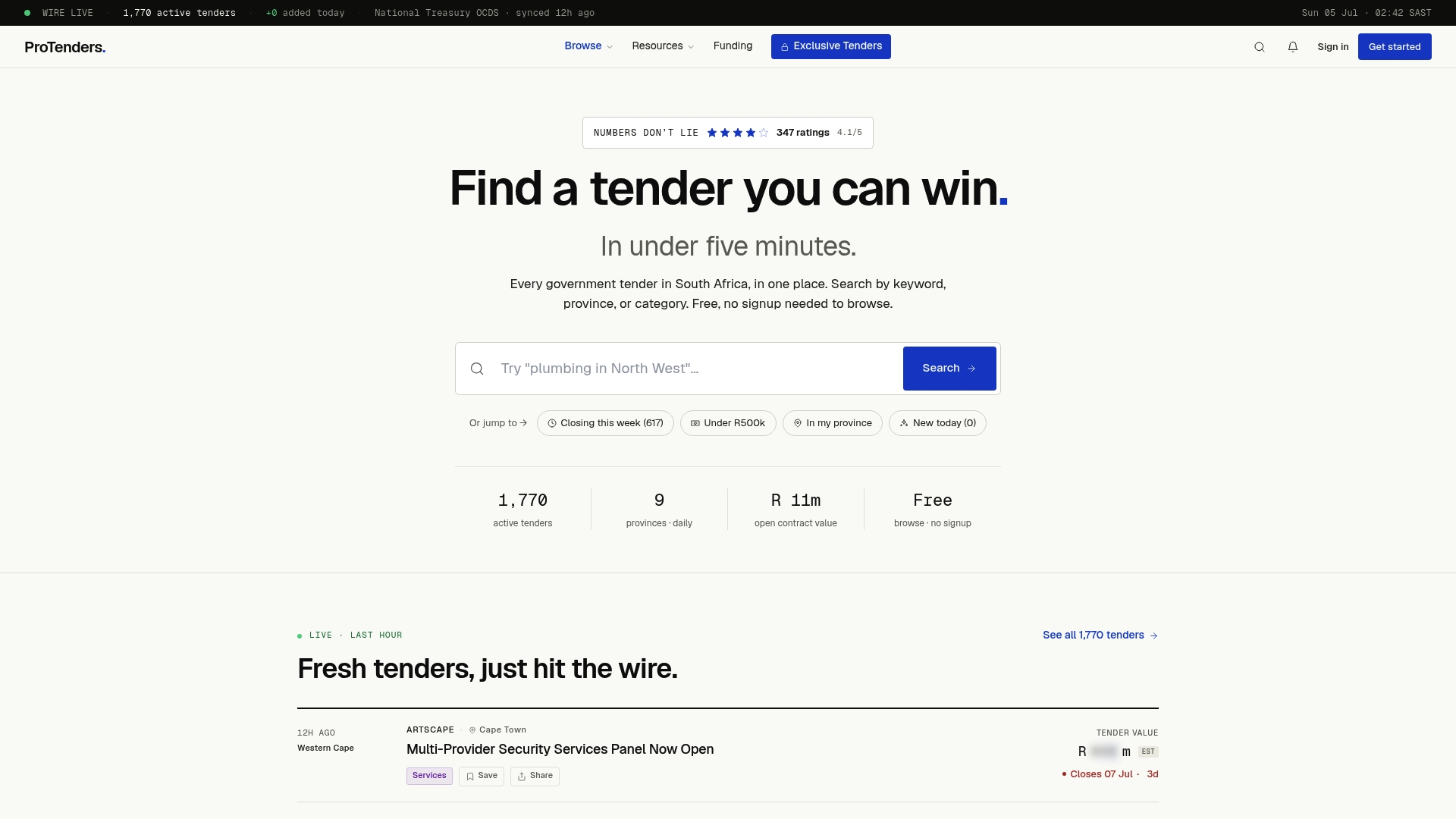
When you are bidding regularly, our paid plans add the tools that save preparation time: compliance scorecards, document templates, a bid workspace and automated alerts. Pro is R1,990 per year, Business is R3,990 per year, and Enterprise starts from R999 per month. See the full comparison on the pricing page, or set up free daily tender alerts so a suitable bid never catches you unprepared.
FAQ
What documents do I need for a South African government tender?
Most bids need your company registration documents, CSD report, SARS tax compliance proof, B-BBEE certificate or affidavit, banking proof, certified director IDs and the completed SBD forms. Many also ask for a proposal, pricing schedule and proof of authority for the signatory. The bid invitation lists the exact returnables, and it overrides any generic checklist.
How long before the closing date should I start preparing?
Start as soon as you download the bid document, and aim to submit at least 24 hours before closing. That margin is what the eTenders guide recommends. Allow extra days if you need certified copies, an updated affidavit or a CSD correction, since those depend on third parties.
Do I need to complete every SBD form?
You complete every form the bid document includes and requires, in full. Some, such as SBD 5 or the local content form SBD 6.2, apply only to certain tenders. If a form is in your bid pack and not marked as inapplicable, treat it as required and ask the buyer in writing if unsure.
Can I fix a mistake after the closing date?
Generally no. The City of Cape Town states that bids cannot be changed after closing, so do your review before submitting. If you spot an error early enough, correct it and resubmit before the deadline, following the buyer's rules on replacing a submission.
Sources
- Tender procedures, Government Communication and Information System
- National Treasury special conditions of contract, RT83-2026 (eTenders)
- Directive to bidders on packaging of bid documents, Department of Water and Sanitation
- Central Supplier Database registration process
- Submit a tender, City of Cape Town
- Guide on how to access and register on eTenders
- Guide: how to submit a response on the eTenders portal
- Section 2: Objective criteria (eTenders)
- Additional specifications for CIDB programme, DBSA
- Contracts management model policy 2025, Tsantsabane Municipality