Tender Mistakes to Avoid in South Africa: 12 Costly Errors

Most South African tenders are not lost on price. They are lost earlier, when a bid is late, unsigned, missing a mandatory form or sent the wrong way, and the evaluators never reach your numbers. The mistakes below come from real tender documents and official guidance, grouped by the stage at which they happen, so you can check for them before you commit, while you prepare and before you submit.
TL;DR
- Bids are screened in stages: on-time submission and responsiveness come first, then functionality, then price. A bid that fails an early stage is never priced against the others.
- The commonest fatal errors are administrative: late delivery, a missed compulsory briefing, unsigned or incomplete SBD forms, and missing tax or registration evidence.
- Generic answers, unsupported claims and ignored word limits weaken a bid that is otherwise compliant.
- Underpricing and cash-flow gaps can hurt you after you win, so test your capacity and working capital before you bid.
- A short pre-submission checklist, run at least a day before closing, catches most of this.
Table of Contents
- Why bids fail before anyone reads your price
- Mistakes before you bid
- Mistakes in reading the tender pack
- Mistakes in the response itself
- Mistakes at submission
- Mistakes after you win
- A pre-submission checklist by stage
- Put the checks into your routine
- FAQ
- Sources
Why bids fail before anyone reads your price
Public buyers in South Africa do not weigh everything at once. A 2025 Coega Development Corporation RFP shows a typical staged process: timeous submission, then responsiveness, then functionality, then price and specific goals, then a qualitative commercial-risk assessment. You must pass each threshold before price can help you.

That changes how you should think about mistakes. A cheap bid with a missing form is worth nothing. A strong technical response that arrives after the closing time is worth nothing either. Compliance is the entry ticket, and quality and price only matter once you hold it.
The same document lists what can get a tender rejected: late submission, the wrong manner of submission, incomplete returns, missing mandatory returnables, unsigned or un-initialled pages where required, alterations without initials, the use of correcting fluid, and failure to meet a functionality threshold or compulsory briefing requirement. Keep that list in mind as you read the rest.
Mistakes before you bid
1. Bidding on everything that looks close
A wide net feels productive, but each bid costs days of preparation. The cidb's contractor guidance says a bid/no-bid decision should weigh delivery capacity, contract risk and working capital, not only your chance of winning.
Before committing, confirm:
- You are eligible and the scope is clear to you.
- You have the people and equipment, and your current and foreseeable commitments leave sufficient capacity.
- You have enough time to prepare a proper response.
- You know the client's payment history and credit risk.
- You have read the contract and penalty terms, and understand insurance, bonds, retention, escalation and dispute procedures.
- You can finance the work until you are paid.
Three well-prepared bids beat ten rushed ones. If you are still learning the route to public work, our guide on how to get government tenders in South Africa walks through registration and where to look.
2. Ignoring cash flow and the cost of money
Winning a tender you cannot finance is a mistake that shows up months later. The cidb advises calculating the money a contract needs, pricing the cost of money and evaluating client payment delays, then forecasting project costs, income and office overheads to estimate working capital.
Its guidance also illustrates that a contractor can be out of pocket for months on a contract that is profitable in the end, and warns that a single late payment can sink a construction business. If your forecast shows a gap, deal with it before you price: build the financing cost into your rates, or line up funding. Our business funding programmes page lists partners that back SMMEs with awarded work.
3. Underpricing to win
Pricing at cost, or below, to beat rivals is tempting, especially for a first contract. Transport for NSW's bid guidance, written for Australian suppliers but sound anywhere, says to check that every cost is included and the pricing is detailed enough to justify the price. Walk through labour, materials, transport, insurance, bonds, overheads, escalation and the cost of waiting for payment. If the number only works when nothing goes wrong, it does not work.
Mistakes in reading the tender pack
4. Skipping the compulsory briefing
Where a briefing is compulsory, attending is not optional and signing the attendance register correctly matters. The Coega RFP makes compulsory briefing attendance and a correctly completed attendance register mandatory, and says failure to provide mandatory information prevents further evaluation.
Put the briefing in your diary the day you find the tender, and send someone who can answer technical questions. See our note on compulsory briefing sessions in SA tenders for what to bring and how to handle online and site sessions.
5. Not reading the pack twice
The most common advice in tender-writing guides is to follow instructions precisely, and it holds for South Africa. Read the full document once for understanding and once with a highlighter, listing every returnable, form, certificate, format rule and deadline. Build a simple compliance matrix: one row per requirement, one column for where your response answers it.
If something is unclear, ask in writing before the query deadline rather than guessing. Buyers usually share answers with all bidders, which also tells you what competitors are asking.
6. Incomplete or badly signed SBD forms
The standard bidding documents trip up more SMMEs than any technical question. GCIS lists forms that may accompany a bid, including SBD 1, SBD 3 pricing forms, the SBD 4 declaration, SBD 6.1 preference, SBD 6.2 local content where applicable, SBD 7 contract, SBD 8 past practice and SBD 9 independent bid determination. It also says documents must be signed, dated and submitted before the stated closing time.
A Department of Water and Sanitation RFQ directive goes further: supplied SBDs must be fully completed, signed and uploaded, with signature dates aligned to the current request. Re-using last month's signed form with an old date is a classic error.
Keep a master file of your company details, then recheck every field against the specific tender. Our guide to filling in SBD forms with a master file and a 24 to 48 hour recheck shows the routine.
7. Missing tax, registration or B-BBEE evidence
GCIS says a bid must include a comprehensive proposal that addresses the specification, all the associated SBD forms and valid SARS tax compliance evidence. The DWS directive adds CIPC registration and B-BBEE evidence, and says SBD 6.1 preference claims must align with your CSD and B-BBEE ownership information.
The practical mistakes are:
- A tax compliance status that has lapsed or is not in good standing at the time of closing.
- Claiming preference points your certificate or ownership details do not support.
- CSD details that differ from what you declare on the forms.
Check these a week out, not on closing day, because fixing a tax or CSD problem takes time you will not have.
Mistakes in the response itself
8. Generic, copy-paste answers
Evaluators can tell when a response was written for another buyer. The UK's Government Commercial Agency advises tailoring answers to the buyer, addressing all requirements, using recent relevant evidence and measurable outcomes, and avoiding generic or unsubstantiated claims. It also recommends observing word and format limits and arranging an independent review.
In practice, answer the question that was asked, in the order it was asked, and name the buyer's site, system or problem. Replace "we have extensive experience" with a project, a client type, a year and a result.
9. Claims with no proof
Every strength you state should come with evidence: reference letters, completed project lists, certificates, staff CVs and photos where relevant. Keep figures consistent across the technical response, pricing schedule and forms. If your CV says a site manager has ten years' experience and the form says eight, you have handed the evaluator a reason to doubt everything else.
Where a tender scores functionality, a clear method statement and project plan carry real points. Our article on a project quality plan for tenders explains how to structure one.
10. Padding and ignoring limits
Long answers do not score higher. Respect page and word limits, use the buyer's headings, and cut anything that does not answer a requirement. Bidders who spend three pages on company history and two lines on the method have the weighting backwards.
Mistakes at submission
11. Leaving delivery to the last hour
Late bids are not negotiable. The Coega RFP states that late bids are returned unopened, that prescribed forms must be used, and that incomplete mandatory information makes a submission null and void or non-responsive. For hard-copy bids it also requires sealed, securely packed and clearly marked submissions, and loose pages can eliminate a bid.
For hard copies, bind the pages, number them, and deliver to the right box or address with time to spare for traffic and security checks.
Electronic bids bring their own traps. A 2026 SABS RFP requires PDF files, caps the email submission at 14 MB, rejects submissions made through links or WeTransfer and puts responsibility for on-time submission on the bidder. A pack that is too large, in the wrong format or shared by link may never count. Our electronic submission checklist covers file size, naming and proof of receipt.

12. Never confirming receipt
Submitting is not the same as being received. Where email or portal submission is allowed, keep the sent confirmation, check that the attachment opens, and ask for an acknowledgement where the process permits one. If a dispute arises, your record is your evidence.
Mistakes after you win
The mistakes do not stop at award. The cidb recommends monitoring capacity, cash flow, subcontracts and contract risk once the work starts. Subcontractors in particular should know the risks it describes: price shopping by prime contractors, non-payment, and prime contractors using subcontractor money as an interest-free overdraft. Get payment terms and scope in writing before you start.
It is also worth knowing the warning signs of fake opportunities, so you never pay to "secure" a tender that does not exist. See our list of tender scam warning signs in South Africa.
A pre-submission checklist by stage
| Stage | Check | Why it matters |
|---|---|---|
| Before committing | Eligibility, capacity, working capital, payment history | Avoids winning work you cannot deliver |
| Preparing | Briefing diarised, queries sent, compliance matrix built | Stops mandatory items being missed |
| Documents | All SBDs completed, signed, dated for this tender | Unsigned or outdated forms can make a bid non-responsive |
| Evidence | SARS status, CSD, CIPC, B-BBEE, references | Preference claims must match your records |
| Quality review | Independent read, word limits, consistent figures | Catches generic answers and contradictions |
| Pricing | Every cost included, financing cost priced | Prevents underpricing and cash-flow gaps |
| Submission | Right format, size and address, early delivery, proof of receipt | Late or wrongly submitted bids are not evaluated |
## Our view: build the system, not just the bid>
We built ProTenders because we kept seeing the same pattern: capable SMMEs lose not on ability but on process. A missed briefing, an expired document, a form signed for the wrong tender. None of that is a talent problem. It is a workflow problem, and workflows can be fixed.>
That is why we treat tendering as three connected phases: finding the right opportunity, preparing a compliant and credible bid, and delivering the work with the funding to carry it. Our platform brings live national, provincial and municipal tenders together so you can search by keyword, region or category without signing up. Compliance scorecards, document templates and a bid workspace are there to make the repeatable parts of a bid repeatable.>
Our advice is to stop treating each tender as a fresh emergency. Keep your documents current, bid selectively, and decide on funding before you win, not after.>
Dolene April
Put the checks into your routine
Start free: you can browse all live government tenders by keyword, region or category without creating an account, and set up free daily tender alerts so you hear about relevant opportunities with enough lead time to attend briefings and prepare properly.
When you are ready for compliance tools, templates and a bid workspace, the Pro plan costs R1 990 per year and Business R3 990 per year, with Enterprise from R999 per month. If your concern is financing an awarded contract, our funding programmes connect you with partners.
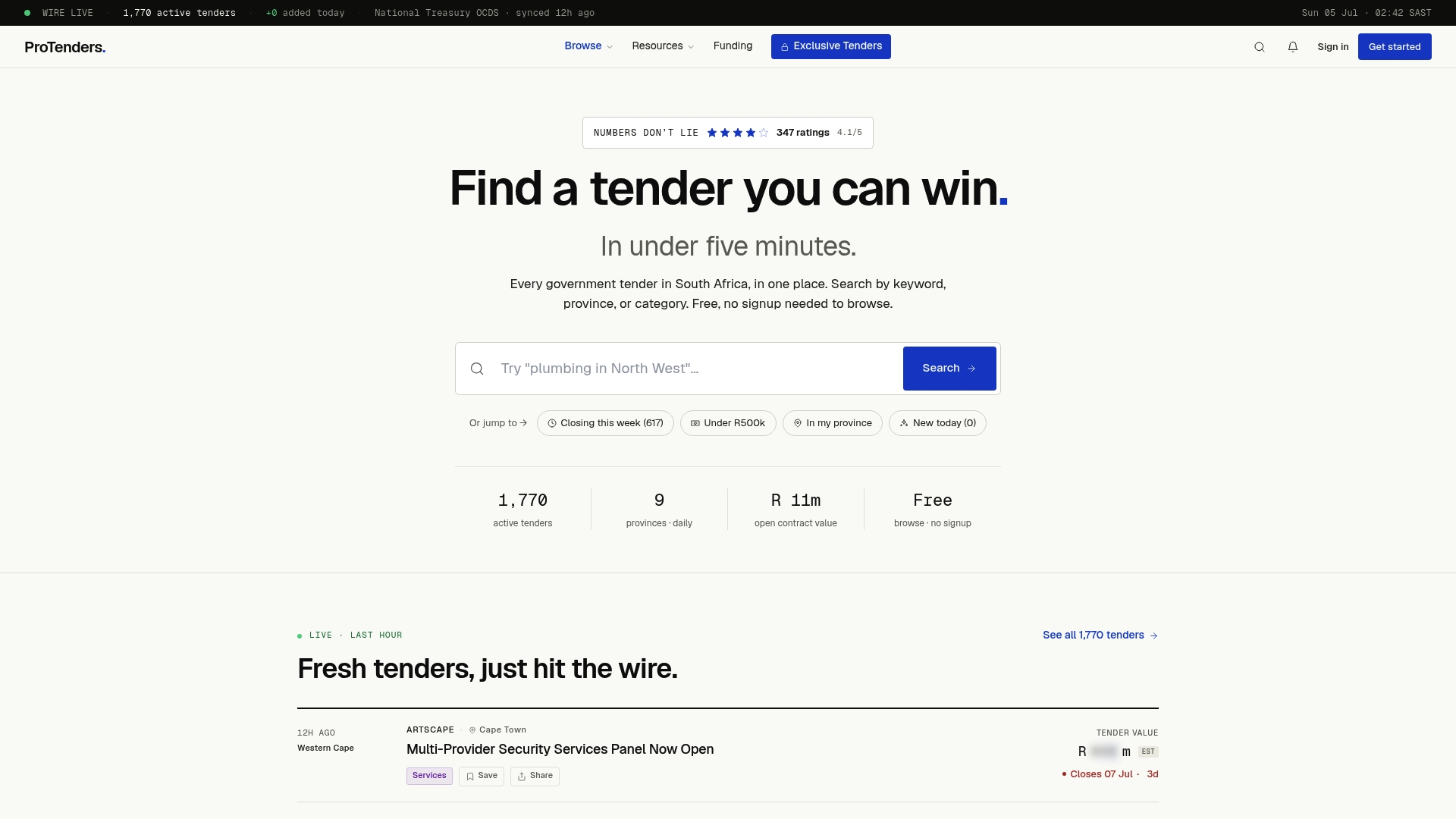
If you work in a particular sector, the focused pages for building tenders, government IT tenders and transport and fleet tenders make it easier to spot opportunities that fit your capacity. More practical notes are in our tender guides.
FAQ
What are the conditions for rejection of a tender in South Africa?
A tender can be rejected if it is late, submitted the wrong way, incomplete or missing mandatory returnables. Unsigned pages, alterations without initials, correcting fluid, and failing a compulsory briefing or functionality threshold are also grounds, as set out in a 2025 Coega RFP. Always check the specific tender document, because each buyer sets its own rules.
What are the stages of the tendering process?
You decide whether to bid, study the pack and ask questions, prepare the response and pricing, then submit before closing. The buyer then evaluates in stages, typically timeous submission, responsiveness, functionality and price, before award. After award comes delivery, where capacity and cash flow need active monitoring.
How can I be successful in tenders?
Bid selectively, keep your compliance documents current, and answer every requirement with specific evidence. Price realistically, including the cost of waiting for payment. Review your bid independently before submitting early, since late or non-compliant bids never reach evaluation.
Do I need to attend a compulsory briefing session?
Yes, where the tender says it is compulsory. In the Coega RFP, attendance and a correctly completed register are mandatory, and missing information prevents further evaluation. Check whether the session is on site or online, and sign in properly.
Sources
- Coega Development Corporation RFP CDC-279-25 (eTenders)
- GCIS tender procedures
- DWS RFQ directive 2026
- SABS RFP 201928 (eTenders)
- cidb Contractor Management Guidelines, Section 2
- cidb Subcontracting arrangements
- How to write an effective tender bid: a supplier guide (GCA)
- How To Write A Strong Response (Transport for NSW)